The direct answer
How to retake an exam: get the failed paper back, sort every lost mark into three piles — did not know it, knew it but ran out of time, careless mistake — rebuild the biggest pile first by testing yourself, and prove the rebuild with timed past papers in the last two weeks. That is the whole system.
You failed the exam, and now there is a second date on the calendar. That date changes how you should study. The first time, you were learning the subject from the start. This time, you already know most of it, and a small part of it beat you. Studying everything again, the same way, is the most natural thing to do — and the most wasteful. It spends your weeks on topics you already pass, and leaves the topics that failed you until last.
A retake is not a fresh start. It is a repair job, with a deadline.
This article is different from how to handle a bad exam result. That system is for the first seven days after a bad result: one day off, then sorting the errors and restarting. This system starts where that one ends — when you know you have to sit the exam again, and you have weeks, not days, to rebuild. It fits inside how to revise for exams without cramming, and it uses the same rule that runs through the whole site: test yourself, do not re-read.
The system in short
- Get the failed paper back and list every mark you lost, question by question.
- Sort the losses into three piles, and find which pile holds most of the marks.
- Rebuild the biggest pile first, by testing yourself on the weak topics, with gaps between tests.
- Make a retake plan from the weeks you actually have, with one if-then plan for starting each session.
- Prove it with timed past papers in the last two weeks, then re-test in the last week and stop learning new topics.
Step 1: Get the paper back and find out why you failed
Do not start studying for the retake until you know why you failed. A mark on its own tells you nothing. Two students can both get 48%, one because they did not know three topics, the other because they knew the topics and ran out of time. Those two students need opposite plans, and “study more” helps neither of them properly.
Get the paper back. If your teacher does not hand papers back automatically, ask for it, and ask for the mark scheme too. Go through the paper question by question and write down every mark you lost: the question, the marks lost, and what happened. “Q3, 4 marks: could not remember the definition.” “Q5, 6 marks: ran out of time, left it blank.” Be specific. “I did badly” is not a list. A list is something you can work from.
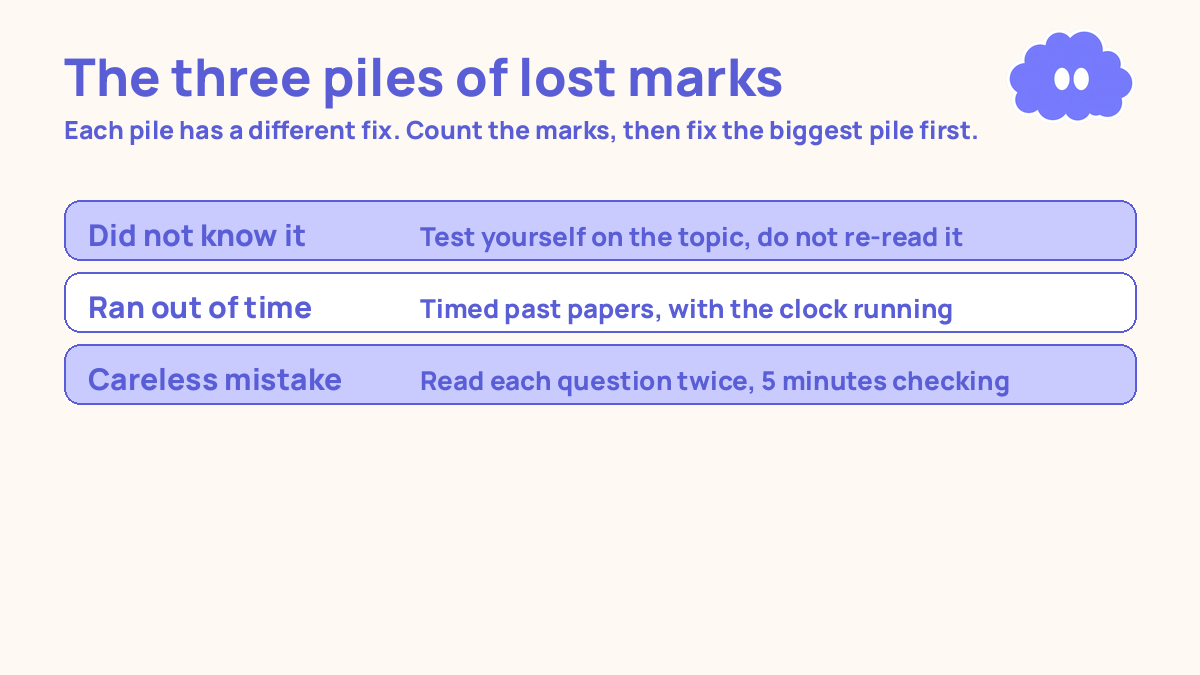
Then sort the list into three piles, because each pile has a different fix.
Pile 1: Did not know it. You had not covered the topic, or you covered it and could not remember it in the exam. The fix is testing yourself on that topic, not re-reading it.
Pile 2: Knew it but ran out of time. You knew the material and could not finish. This is a time pile, and more revision will not fix it. The fix is timed practice, with the clock running.
Pile 3: Careless mistake. You knew the answer and wrote the wrong number, misread the question, or skipped a page. The fix is a checking habit: five minutes at the end of every paper, and reading each question twice before answering.
Count the marks in each pile. Most students find one pile holds most of the marks. That pile is where the retake plan goes first.
Step 2: Rebuild the weak topics by testing yourself, not re-reading
Start with the biggest pile, and start with its single weakest topic. Not all the weak topics at once — one. A retake plan that tries to rebuild everything in week one rebuilds nothing.
For that one topic, the work is testing, not reading. In a 2013 review, Dunlosky and colleagues rated ten common study techniques, and only two received a high utility rating — practice testing and distributed practice. Re-reading was rated low. That is the difference between work that feels like learning and work that is learning.
Testing yourself means closing the notes and answering questions from memory, then checking. Ten questions, notes closed, then check, then note what you got wrong. The check matters. Across 61 studies, testing yourself beat restudying by a medium amount, and the advantage was larger when the test came with feedback than without it (Rowland, 2014). A test without checking is only half a test — you walk away not knowing which answers were wrong, and the wrong ones stay wrong.
It will feel worse than re-reading. That feeling is not evidence. In one study, students who recalled a passage remembered more a week later than students who restudied it, even though the restudiers felt more confident immediately after studying (Roediger & Karpicke, 2006). Feeling fluent right after re-reading is not the same as remembering a week later. On retake day, a week later is what counts.
So the rule for every weak topic is the same: read it once to remind yourself of it, then close the notes and test yourself. If you get a question wrong, do not re-read the whole topic. Read the one point you missed, then test it again tomorrow. That is the retrieval practice system for students in one sentence, and it is the engine of this whole retake.
Space the tests out. Test the topic today, again in three days, again in seven days. That 1-3-7 pattern is a practical starting schedule, not a research rule — the research says spacing beats massing, and the right gap grows with how long you need to remember the material (Cepeda et al., 2006). A gap is what turns the second test into a real test instead of a re-read. Sleep between tests, and let the gap do some of the work. Sleep is when the day’s learning is consolidated (Diekelmann & Born, 2010).
Mix the topics once you know them. Students who practised maths problems mixed together scored far higher a week later than students who practised them blocked by type, even though the blocked group did far better during practice itself (Rohrer & Taylor, 2007). Mixing feels worse and works better — but only once you know the procedures. Learn it first, test it, then mix it. The interleaving system for mixed subjects explains where that line is.
Step 3: Make a retake plan that fits the weeks you actually have
Count the weeks to the retake date, then count the topics. That is the whole plan, and most retake plans fail because they skip the counting.
Give the biggest topic the most sessions, not the most hours in one day. A topic rebuilt in four short sessions across a week beats the same topic crammed into one long Sunday, because each session after the first is a test after a gap. That is the spaced repetition system for students applied to a retake.
A four-week plan looks like this. It is a practical starting plan, not a research rule — change the numbers to fit your weeks, but keep the shape.
| Week | The work | How you know it worked |
|---|---|---|
| Week 1 | Diagnose: paper back, three piles counted, weakest topic tested three times | You can list the weak topics in order of marks lost |
| Week 2 | Rebuild: two weak topics, tested on day 1, day 3, day 7 | You get more questions right on the second test than the first |
| Week 3 | Rebuild the rest, mix the topics, one timed past paper | The timed paper shows fewer gaps than the first one |
| Week 4 | Prove it: timed papers, re-test the weak topics, no new topics | You finish a timed paper inside the time, with checking done |
If you have two weeks instead of four, do not squeeze the four-week plan into two. Cut the topic list. Rebuild only the biggest pile, and only the topics inside it that lost the most marks. A short retake plan that fixes the biggest pile beats a long plan that touches everything and fixes nothing.
Now write the plan as if-then plans, one per session. “If I sit down after breakfast, then I will test myself on ten questions from the weak topic.” An if-then plan names the cue and the action in advance, so starting does not need a fresh decision every morning. Across 94 studies, if-then plans raised goal attainment by a medium-to-large amount over holding the goal alone (Gollwitzer & Sheeran, 2006).
Do not rely on feeling motivated. A daily study habit takes weeks to feel automatic — in one study the median time was 66 days, with a range of 18 to 254 days — and one missed day does not reset it (Lally et al., 2010). Your retake is probably shorter than that, so use the plan and the if-then cue instead. If you miss a day, do the next session, do not do a double day to catch up. That rule is in how to get back on track after a bad study day.
Step 4: Practise under exam conditions
In the last two weeks, stop learning and start rehearsing. That is the hardest switch in a retake, because rehearsing shows you what is still weak, and learning feels safer. But the exam is not a test of what you have read. It is a test of what you can do, under time, with the clock running.
Do timed past papers, with the time blocks written on the paper before you start. Mark each paper the same day, and write the gaps down — topic by topic, marks lost by topic. Then fix only the gaps before the next paper. A paper never marked is a wasted afternoon. The past-paper system for exams is the full version of this: timed paper, mark the same day, write the gap list, fix only the gaps, repeat.
Do at least three timed papers if you can: one to find the gaps, one to check the fixes, one as a full rehearsal. If you have mock exams available, use them the same way — how to use mock exams to prepare covers how to treat a mock as a rehearsal, not a verdict. A bad mark on a practice paper is free information. It shows you exactly which topics to fix, days before the exam, instead of the exam itself showing you.
Watch the clock pile while you do this. If pile 2 was your biggest pile — you knew the material and ran out of time — timed papers are not just practice, they are the fix. Write the time blocks on the paper, and if a question eats its time, mark it, move on, and come back to it later.
Protect your sleep in these two weeks. Sleep is when the day’s learning is consolidated, and a retake built on short nights is a retake built on work that was never finished. Stop at a set time every night.
Step 5: The last week — re-test, do not learn new topics
The last week is for proving, not for learning. No new topics in the last week. If a topic is still new in the last week, it will not be learned in time, and trying will take time away from the topics you have already rebuilt.
Re-test the weak topics, one at a time, notes closed. Count how many questions you get right this time, compared with the first test. That number is the evidence the rebuild worked. If the number has not moved, the topic needs another round of testing, not another round of reading.
Do one final timed paper early in the last week, with the checking routine at the end: five minutes, every question answered, name and number on the paper, no missed page. Then stop doing full papers. The day before the exam, do a short re-test of the weak topics and then stop. How to revise the night before an exam and the exam week plan for students cover that last day in detail — the rule is the same in both: short, familiar, and finished early.
If you are behind at this point, do not try to catch up by doubling the work. How to revise when you are behind says the same thing: cut the list, test the biggest pile, and stop at a set time.
A worked example: biology, 48%, retake in five weeks
This is a worked example, with the article’s own numbers — not a real student, and not a promise of a grade.
You get your biology result: 48%. The pass mark is 50%. The retake is in five weeks. The paper comes back the next day.
Week 1 — diagnose: You list every mark lost. Q3, 4 marks: could not remember the definition of a cell. Q5, 6 marks: ran out of time, left blank. Q7, 2 marks: used the wrong formula. Q9, 5 marks: did not know photosynthesis. Q11, 3 marks: misread the question. Total lost: 20 marks. Sorted: pile 1, did not know it, 9 marks (Q3 and Q9). Pile 2, ran out of time, 6 marks (Q5). Pile 3, careless, 5 marks (Q7 and Q11). Pile 1 is biggest.
Week 2 — rebuild: Photosynthesis, ten questions, notes closed, on Monday, Thursday, and the following Monday. First test: 3 right out of 10. Second test: 6 right. Third test: 8 right. The cell definition gets the same treatment.
Week 3 — mix and time: You mix photosynthesis and cell questions together, then do one timed past paper on Saturday, 60 minutes, time blocks on the paper. The paper shows one new gap: respiration, 4 marks lost. That joins the weak list for week 4.
Week 4 — prove it: Two more timed papers, marked the same day. The gaps get smaller each time. Photosynthesis re-test: 9 right out of 10.
Week 5 — last week: No new topics. Re-test photosynthesis, cells, and respiration, notes closed. One final timed paper early in the week. The day before the retake, a short re-test and an early stop.
| Error | Marks lost | Pile | The one change |
|---|---|---|---|
| Q3: could not remember the cell definition | 4 | Did not know it | Test 10 questions, 3 times a week |
| Q9: did not know photosynthesis | 5 | Did not know it | Same as Q3 — weakest topic first |
| Q5: ran out of time, left blank | 6 | Ran out of time | One timed past paper a week |
| Q7: wrong formula | 2 | Careless mistake | Read each question twice, 5 min checking |
| Q11: misread the question | 3 | Careless mistake | Same as Q7 — checking routine |
When it goes wrong
You study everything again, the same way. This is the most common retake failure. It feels thorough, and it wastes the weeks on topics you already pass. Stop, get the paper back, and count the piles. The plan starts from the piles, not from chapter one.
You re-read the weak topics instead of testing yourself. Re-reading feels like work, and it is rated low utility. If you have read a topic twice and still cannot answer questions on it with the notes closed, reading it a third time is not the fix. Close the notes and test yourself.
You do timed papers too early. A timed paper before you have rebuilt the weak topics only shows you everything at once, and it wastes a paper. Rebuild first, test topic by topic, and come back to papers when there is something to rehearse.
You keep adding new topics in the last week. Stop. A new topic in the last week takes time from the topics you have rebuilt, and it will not be learned in time. Re-test what you have rebuilt, do the final timed paper, and stop learning.
You miss a week and try to catch up with double days. Do not do a double day. Do the next session, at the normal length, and cut the topic list to the biggest pile.
Weekly review checklist
Copy this list and use it each week:
- Which pile held the most marks this week, and did I work on that pile first?
- Did I test the weakest topic three times this week, notes closed, and did the score rise?
- What did the last timed paper show, and did I fix those gaps before the next paper?
- What one change will I make next week: a new weak topic, another timed paper, or a stricter checking routine?
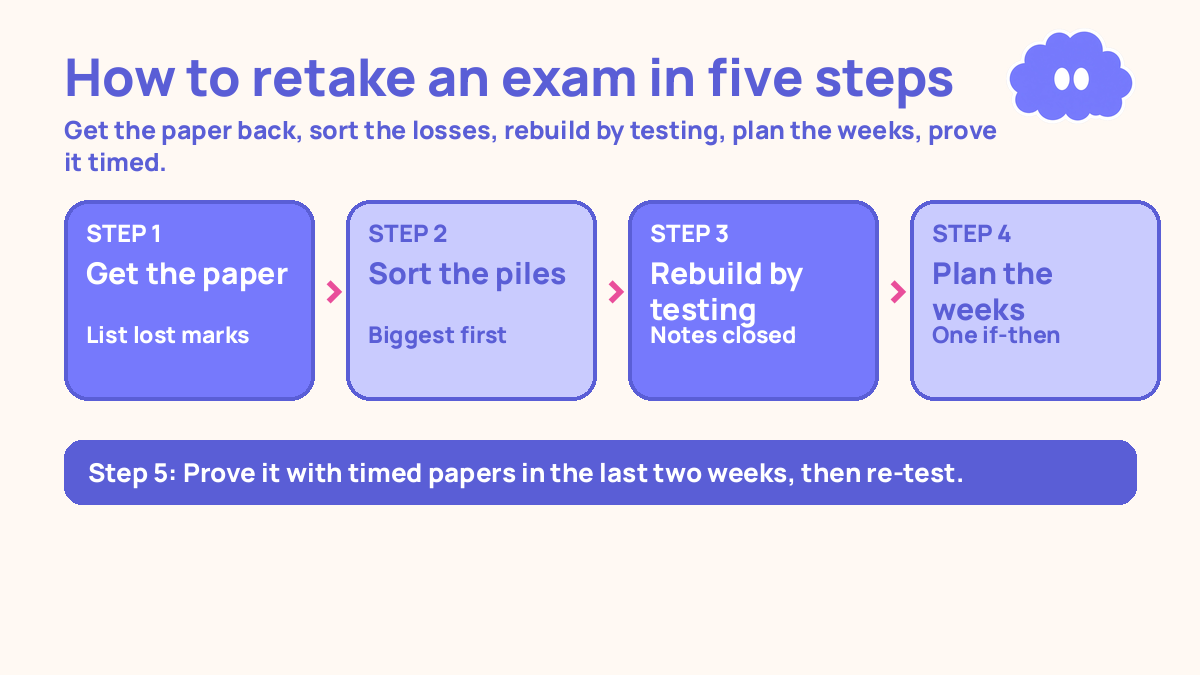
Downloadable infographic spec: one vertical image, title “How to retake an exam”, with the five steps — get the paper back, sort into three piles, rebuild by testing, plan from the weeks you have, prove it with timed papers — and the rule “test yourself, do not re-read” in Thynq cream, Cloud Purple, Dark Purple and pink, with the cloud mascot. Text taken word-for-word from this article.
What this system is not
It is not a promise of a better grade next time, and it is not a claim that a retake is easy if you follow five steps. A retake is hard, and the second attempt carries more pressure than the first. This system is a way to turn a failed paper into a list, a list into three piles, three piles into one rebuild at a time, and a rebuild into timed proof — and to measure whether the rebuild worked, instead of hoping it did.
Sources
- Dunlosky, J., et al. (2013). Psychological Science in the Public Interest, 14(1), 4-58. Only practice testing and distributed practice rated high utility; rereading rated low.
- Roediger, H. L., & Karpicke, J. D. (2006). Psychological Science, 17(3), 249-255. Retrieval practice beat restudying after a delay, despite restudiers feeling more confident immediately.
- Rowland, C. A. (2014). Psychological Bulletin, 140(6), 1432-1463. Across 61 studies, testing beat restudying, and the advantage was larger with feedback than without it.
- Cepeda, N. J., et al. (2006). Psychological Bulletin, 132(3), 354-380. Spaced practice beat massed practice, and the right gap grows with how long you need to remember the material.
- Gollwitzer, P. M. & Sheeran, P. (2006). Advances in Experimental Social Psychology, 38, 69-119. Across 94 studies, if-then plans raised goal attainment (d = 0.65).
- Lally, P., et al. (2010). European Journal of Social Psychology, 40(6), 998-1009. The median time for a behaviour to feel automatic was 66 days, with a range of 18 to 254 days.
- Diekelmann, S. & Born, J. (2010). Nature Reviews Neuroscience, 11(2), 114-126. Sleep improves the consolidation of what was learned.
- Rohrer, D. & Taylor, K. (2007). Instructional Science, 35(6), 481-498. Interleaved practice scored higher a week later than blocked practice, despite feeling worse during practice.
- Karpicke, J. D. & Blunt, J. R. (2011). Science, 331(6018), 772-775. Retrieval beat concept mapping a week later, on both verbatim and inference questions.
For the full revision plan this fits inside, read how to revise for exams without cramming, and for the first seven days after the bad result, read how to handle a bad exam result.
Questions
How long do I need to prepare for a retake?
Use the weeks you actually have, not the weeks you wish you had. With four or five weeks, one weak topic rebuilt per week plus a timed paper each week is a realistic plan. With two weeks, cut the topic list to the biggest pile of lost marks and test those topics only.
Should I re-read all my notes before the retake?
No. Re-reading was rated low utility in a 2013 review by Dunlosky and colleagues, while practice testing was rated high. Read a topic once to remind yourself of it, then close the notes and test yourself on it. The test is the study.
What if I cannot get my failed exam paper back?
Work from the mark scheme and your memory of the questions you left blank or guessed. Test yourself on the whole topic list, and let the test results be the list. The topics you score lowest on are the weak topics, whether or not you have the paper.
What if I fail the retake too?
Do the same diagnosis again, on the new paper, before you decide anything about the subject. A second failure usually means the fix was aimed at the wrong pile — often more re-reading when the problem was timing, or more topics when the problem was one weak topic. Talk to a teacher about your options, including extra support, before you sit it a third time.