The direct answer
Put one question on the front of a card and a short answer on the back. Shuffle, answer each card from memory before you flip it, and sort the cards into two piles: know it, and missed it. Review the missed pile tomorrow, and the known pile in a few days. That is the whole system.
Flashcards work when they force you to recall. They fail when they become re-reading on small pieces of paper — flipping through a deck and nodding is not studying. The rule is simple: answer before you flip, every card, every time.
Why flashcards work — and when they do not
A flashcard is retrieval practice in its smallest form. You see a question, you try to recall the answer with nothing to look at, then you check. That is exactly the technique that Dunlosky and colleagues rated highest in their 2013 review of ten common study techniques: practice testing. The card is just a convenient way to carry the test around.
But flashcards only work for the right kind of material: facts, definitions, steps, formulas, vocabulary, dates. They do not work for understanding a whole argument, or for skills like writing an essay or solving a new kind of problem. Use cards for the pieces you need to recall quickly, and use full questions and past papers for the rest. If a card needs a paragraph to answer, it is not a flashcard — it is a note. Split it.
The system in short
- For each topic, write 3 to 5 questions, one per card. Question on the front, short answer on the back.
- Shuffle the deck. Go through it one card at a time, answering from memory before you flip.
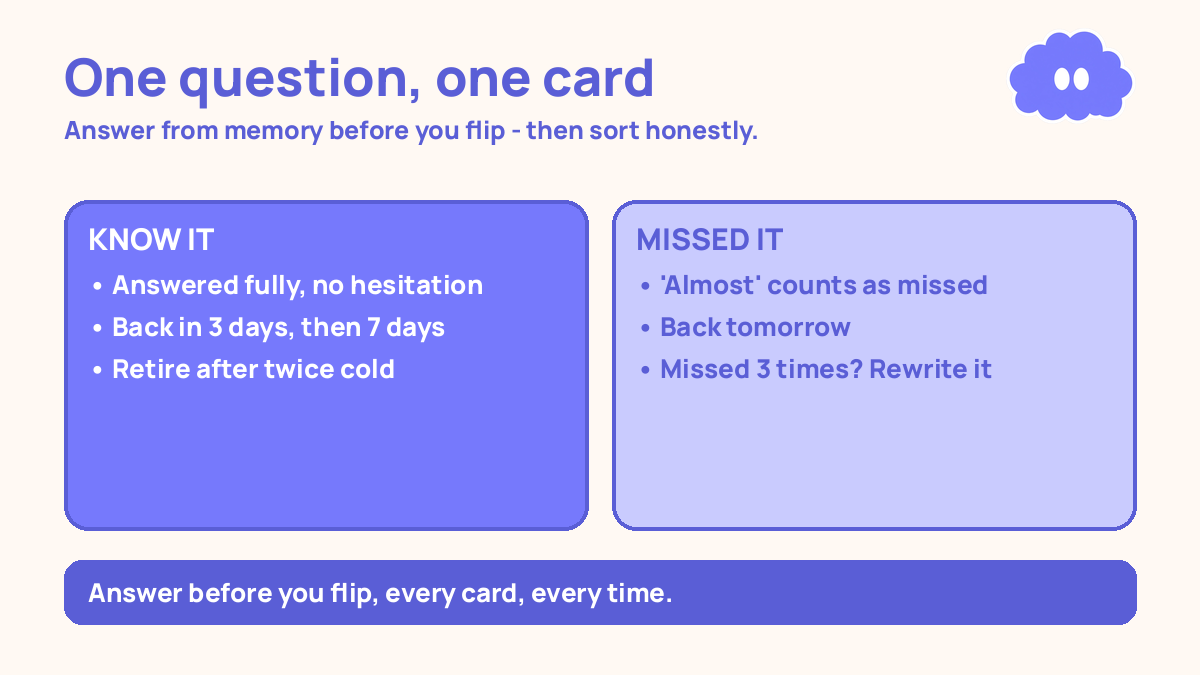
- Sort into two piles: know it, and missed it. Be honest — “almost” counts as missed.
- Review the missed pile tomorrow. Review the known pile in 3 days, then in 7 days.
- Rewrite any card you miss three times: smaller question, clearer wording, or split into two cards.
- Retire cards you know cold, twice in a row, after a gap. They are learned. Spend the time on what you still miss.
Step 1: Write good cards, not many cards
A good card has one question and one short answer. Examples that work:
- Front: “What are the two techniques Dunlosky et al. rated highest?” Back: “Practice testing and distributed practice.”
- Front: “First step of the light-dependent reactions?” Back: “Light hits chlorophyll in photosystem II.”
- Front: “Formula for moles?” Back: “moles = mass ÷ molar mass.”
A bad card has a vague question or a long answer: “Explain photosynthesis” is not a card. It is a topic. Split it into five cards, one per step, and each one becomes answerable in seconds.
Three to five cards per small topic, up to ten for a big one. A deck of 200 cards you never finish is worse than 40 cards you actually review every day. If the deck feels endless, you made too many cards — or the cards are too big.
Step 2: Answer before you flip, every time
This is the one rule that decides whether flashcards help or waste your time. Read the question, say or write the answer from memory, then flip and check. If you flip first and then think “yes, I knew that”, you have learned nothing — you have just recognised the answer, and recognition is not recall.
Say the answer out loud if you can. Speaking forces you to commit to an answer instead of nodding. If you study in a library, write the answer on scrap paper instead. The point is the same: commit before you check.
Step 3: Sort honestly, and let the missed pile decide tomorrow
Two piles, no middle pile. Know it means you answered fully, without hesitation, before flipping. Anything less — partial, hesitant, “almost” — goes in the missed pile. Being strict here is a kindness to yourself: the missed pile is your study plan for tomorrow, and a pile full of “almost” cards you marked as known is a plan built on a lie.
The missed pile comes back tomorrow. The known pile comes back in 3 days, then in 7 days — the same starting schedule as the spaced repetition system for students. Cards you know cold twice in a row, after a gap, get retired. They are learned. Your time belongs to the cards you still miss.
Step 4: Fix the card, not just the memory
If you miss the same card three times, the problem is usually the card. Rewrite it:
- Too big? Split it into two smaller cards.
- Too vague? Make the question specific: add “in order”, “give one example”, or “name the first step”.
- Too similar to another card? Reword one so you cannot answer it from the other card’s answer.
A card you keep missing after rewriting is a signal to go back to the material: re-learn the topic once, properly, then make fresh cards. Do not keep drilling a card for a topic you never understood in the first place.
If you would rather not sort piles by hand, the free flashcard maker runs this loop in your browser: answer before you flip, rate the card, and the missed ones come back tomorrow while the easy ones wait days or weeks. Paste a list to build a deck in one go, and print it when you want paper cards.
A worked example: one week, one subject
You have a chemistry test in three weeks, and 6 topics to cover.
Monday: Make cards for topics 1 and 2 — 8 cards total. Go through them once, answering before you flip. Missed pile: 3 cards. Tuesday: Review the 3 missed cards first. Make cards for topics 3 and 4 — 8 more cards. Go through all 16. Missed pile: 5 cards. Wednesday: Review the 5 missed cards. Make cards for topics 5 and 6. Full deck is now 24 cards. Missed pile: 4 cards. Thursday: Review the 4 missed cards, plus the known pile from Monday (3-day gap). Retire 2 cards you now know cold. Friday: Review the missed pile only — it should be small by now. Rewrite the one card you have missed three times, splitting it into two. Weekend: One quick pass through the whole deck, 15 minutes. Any card you miss goes back to Monday’s pile.
By the end of week one, you have 24 cards, a small missed pile, and you know exactly which topics are weak. That is a better position than a student who “revised chemistry all week” by re-reading the textbook twice.
For the testing habit behind the cards, read retrieval practice system for students. The cards are the format; retrieval is the method.
When it goes wrong
You flip through the deck without answering. Then you are re-reading on small paper. Stop, shuffle, and start again with the rule: answer before you flip, every card. If you catch yourself flipping early, put the deck down and come back in an hour. A deck reviewed properly in 15 minutes beats a deck skimmed in an hour.
The deck keeps growing and you never finish it. You are making too many cards, or cards that are too big. Cap the deck: no more than 10 cards per topic, and retire cards you know cold. A deck you finish every day is a system. A deck you never finish is a guilt pile.
You know the cards but fail the exam questions. Cards test recall of pieces. Exams test using those pieces: explaining, comparing, applying. Cards are one tool, not the whole revision. Add full questions and past papers in the last week, so you practise using what the cards taught you to recall.
You only review the cards you know. Easy cards feel good. Missed cards feel bad. But the missed cards are the whole point — they are the gaps. Start every session with the missed pile, not the known pile. If a card is comfortable, it is probably finished. Retire it and move on.
Weekly review checklist
Copy this list and use it each week:
- How many cards did I make this week, and how many did I retire?
- Which cards do I still miss after three tries, and do they need rewriting?
- Did I answer before flipping, every card, or did I start skimming?
- What one change will I make next week: fewer cards, smaller questions, or more time on the missed pile?
Downloadable infographic spec: one vertical image, title “One question, one card”, with the loop — answer from memory, flip and check, sort into know it / missed it, missed pile tomorrow, known pile in 3 then 7 days — in Thynq cream, Cloud Purple, Dark Purple and pink, with the cloud mascot. Text taken word-for-word from this article.
What this system is not
It is not a promise of a grade, and it is not a claim that flashcards alone will pass an exam. They are a tool for recalling the pieces — facts, steps, formulas — that bigger exam answers are built from. Use them for the pieces, use full questions and past papers for the whole answers, and do not mistake a deck you can flip through for knowledge you can use with the book closed.
Sources
- Dunlosky, J., et al. (2013). Improving students’ learning with effective learning techniques. Psychological Science in the Public Interest, 14(1), 4-58. Only practice testing and distributed practice received a high utility rating; rereading was rated low.
- Cepeda, N. J., et al. (2006). Distributed practice in verbal recall tasks: a review and quantitative synthesis. Psychological Bulletin, 132(3), 354-380. Spaced practice beat massed practice, and the optimal gap grows with the retention interval.
For the full revision plan this fits into, read how to revise for exams without cramming, and for the schedule behind the review gaps, read the spaced repetition system for students.
Questions
What makes a good flashcard?
One question, one answer, on one card. A question you can answer without looking, and an answer short enough to check in seconds. If a card needs a paragraph to answer, split it into two or three cards.
Should I use paper cards or an app?
Either works. Paper cards are free, fast to make, and easy to carry. An app can schedule reviews for you. Pick the one you will actually use every day — the system is the daily review, not the format.
How many flashcards should I make per topic?
Three to five for a small topic, up to ten for a big one. More cards is not better — a deck of 200 cards you never finish is worse than 40 cards you actually review every day.
What do I do with cards I keep getting wrong?
They go back to the front of the queue for tomorrow, and you rewrite the question smaller or clearer. A card you keep missing is usually a bad question, not a bad memory — split it, simplify it, or reword it.