The direct answer
To revise without cramming, start at least two weeks before the exam, split the syllabus into testable topics, test yourself on each topic instead of re-reading it, and review each topic again after a gap — next day, then a few days later — instead of studying it once and moving on. Use past papers in the last week to practise under exam conditions.
That is the whole plan. Cramming is not a moral failure. It is what happens when there is no plan, so the work piles up until the night before. This article gives you the plan.
Why re-reading feels like it works, and does not
Re-reading feels easy because the words look familiar. Familiarity is not memory. When you close the book and try to write the answer, that familiarity disappears, and that is the moment that matters in an exam.
In a 2013 review, Dunlosky and colleagues rated ten common study techniques. Only two received a high utility rating: practice testing — testing yourself — and distributed practice — spacing study out over time. Rereading and highlighting were rated low. That does not mean notes are useless. It means notes are for checking yourself after you have tried to recall, not for reading over and over as the main method.
A related finding is worth knowing, because it explains why cramming feels good. In a well-known study by Roediger and Karpicke (2006), students who restudied a passage felt more confident immediately afterwards than students who tested themselves. A week later, the result reversed: the tested students remembered more. If you judge your revision by how it feels on the day, you will pick the method that fails a week later.
The system in short
- List the topics. One line per topic, from the syllabus or past papers, not from your notes.
- For each topic, write questions you can answer without looking: definitions, steps, causes, examples.
- Study a topic once, then test yourself on it the same day, without notes.
- Review it again after a gap: next day, then a few days later. Longer gaps as the exam gets further away, shorter gaps when it is close.
- In the last week, do past papers under timed conditions, mark them, and fix only the gaps they show.
- The night before, review your question lists and your past-paper mistakes. Do not start a new topic.
Step 1: List the topics, not the chapters
Open the syllabus, or the last three past papers if you do not have one, and write one line per topic. Aim for 15 to 30 topics for a typical exam. If you have 50, group them. If you have 5, split them.
A topic is testable if you can turn it into a question. “Photosynthesis” is a chapter. “Explain the light-dependent reactions, in order, with one example each” is a topic. Write topics, not chapters.
Step 2: Turn each topic into questions
For each topic, write 3 to 5 questions. Use the exam’s own language where you can: explain, compare, calculate, describe the steps, give an example.
This step is the work. It is also the step most students skip, because it feels slower than reading. It is slower on day one, and much faster by day three, because you now have a test for every topic instead of a pile of notes to re-read.
Keep the questions on one page per topic, or on flashcards. The format does not matter. Having questions you can answer without looking matters.
Step 3: Learn, then test the same day
For each study session, pick one or two topics. Learn the topic — read, watch, or work through it once — then close everything and answer your questions from memory. Then check your answers and correct them in writing.
Do not test yourself without checking. A wrong answer you never correct is worse than no answer, because you will remember the wrong version. Check, correct, move on.
Step 4: Space the reviews
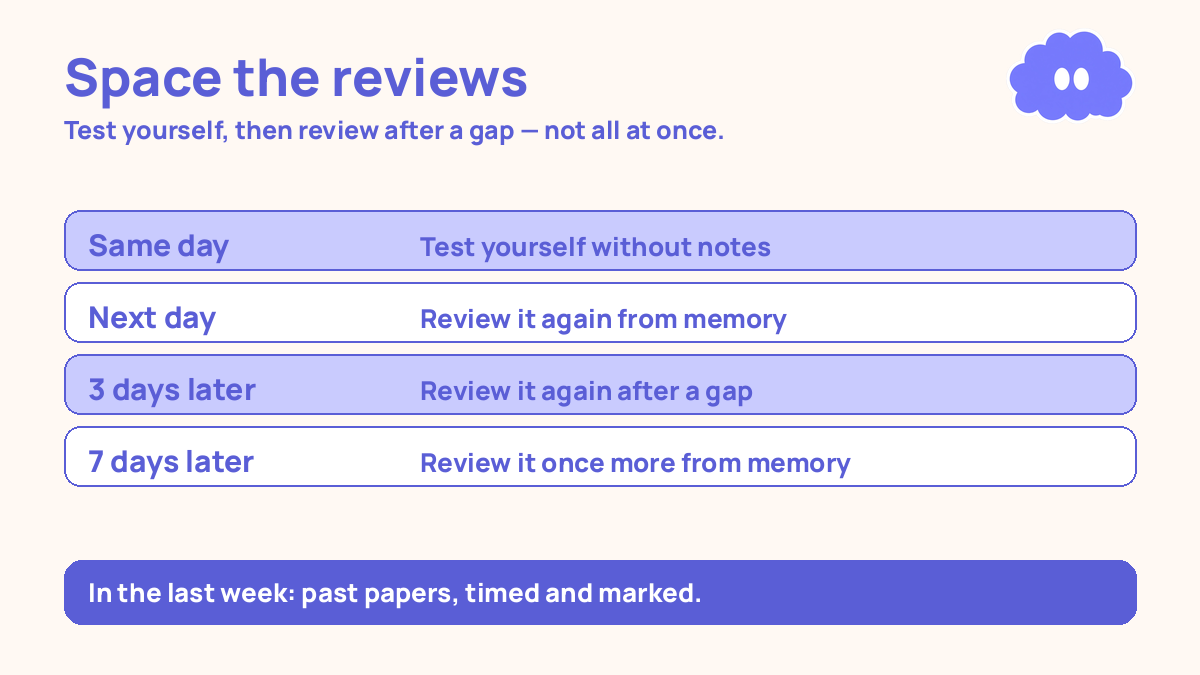
Review each topic again after a gap, not immediately. A practical starting schedule, to try for a week and adjust, is: same day, next day, then three days later, then seven days later. That schedule is a starting point for a student, not a rule from a research paper — the research finding is simpler and more useful: the gap should grow with how long you need to remember the material, so a test next week needs shorter gaps than a test in three months.
In practice, that means: if your exam is in two weeks, review each topic every two to three days. If it is in two months, review weekly. Do not try to keep a perfect spacing chart. A review done a day late is still a review. A review skipped because the chart felt too complicated is a loss.
A worked example: two weeks to an exam
Week 1, Monday to Friday, 2 hours a day:
- Each day: 2 new topics, learned and tested the same day.
- Each day: 30 minutes reviewing yesterday’s topics from memory.
- By Friday: 10 topics covered, each tested at least twice.
Week 2, Monday to Wednesday:
- Each day: 2 new topics, plus 30 minutes reviewing older topics.
- By Wednesday: all topics covered at least once, most twice or three times.
Week 2, Thursday and Friday:
- Past papers, timed, marked, gaps fixed. No new topics.
- Thursday evening: review question lists only.
- Friday, the night before: review past-paper mistakes and question lists. Stop early. Sleep matters more than one more topic.
If you only have one week, compress, do not skip: one week, 3 topics a day, reviews every day, past papers on days 6 and 7.
When it goes wrong
You are behind and the exam is close. Cut topics, do not cut testing. Cover the most likely topics properly, with questions and one review, instead of reading everything once. A half-covered syllabus, tested, beats a fully-read syllabus, forgotten.
You keep re-reading because testing feels hard. That hardness is the point. Testing feels hard because you are actually retrieving, and retrieval is what builds memory. Start with easier questions if you need to, then make them harder.
You forget a topic you already covered. That is normal, and it is why spacing exists. Forgetting between reviews is not failure. It is the signal to review again, and the second recall will usually be stronger than the first.
Past papers show big gaps. Good. That is what they are for. Fix the gaps with questions and one more review, do not re-read the whole chapter. One past paper, marked properly, teaches you more about the exam than a week of reading.
Weekly review checklist
Copy this list and use it each week until the exam:
- Which topics have I tested without notes?
- Which topics have I reviewed after a gap?
- What did the last past paper show I still get wrong?
- What one change will I make next week: fewer new topics, more reviews, or more past papers?
Downloadable infographic spec: one vertical image, title “Revise without cramming”, with the six steps from “The system in short” and the two-week example as a simple timeline, in Thynq cream, Cloud Purple, Dark Purple and pink, with the Cloud mascot. Text taken word-for-word from this article.
What this system is not
It is not a promise of a grade, and it is not a claim that spacing or testing works the same for every subject, every student, and every exam. It is a plan built on the two techniques learning researchers rated highest, with a timetable you can actually follow. If a subject needs a different method — a language needs speaking practice, a practical subject needs doing — add that practice to the plan, do not replace testing with reading.
Sources
- Dunlosky, J., et al. (2013). Improving students’ learning with effective learning techniques. Psychological Science in the Public Interest, 14(1), 4-58.
- Cepeda, N. J., et al. (2006). Distributed practice in verbal recall tasks: a review and quantitative synthesis. Psychological Bulletin, 132(3), 354-380. Spaced practice beat massed practice, and the optimal gap grows with the retention interval.
- Roediger, H. L., & Karpicke, J. D. (2006). Test-enhanced learning. Psychological Science, 17(3), 249-255. Retrieval practice beat restudying after a delay, despite restudiers feeling more confident immediately.
For the full system behind this plan, start with how to build a study system that fits your life, and if your phone breaks your sessions, fix that first with the phone focus system for distracted students.
Questions
How early should I start revising for an exam?
As early as you can, but the plan here works from two weeks out. What matters is spacing: several short reviews over days, not one long session the night before.
Is cramming ever better than nothing?
Yes, if the exam is tomorrow and you have not started. Cramming is a rescue plan, not a revision system. Use it to cover the most likely topics, then test yourself, do not just re-read.
Should I re-read my notes or test myself?
Test yourself first, then check your notes. Re-reading feels fluent and easy, which is exactly why it misleads you about what you actually remember.
What if I have several exams at once?
Give each subject a daily slot, even a short one, instead of finishing one subject completely before starting the next. Spacing works across subjects too.