The situation
You open your phone and lose an hour. The problem is not willpower. It is the setup around you. Change the setup first, then the focus follows.
This system has one rule that matters: the phone is out of reach during work blocks.
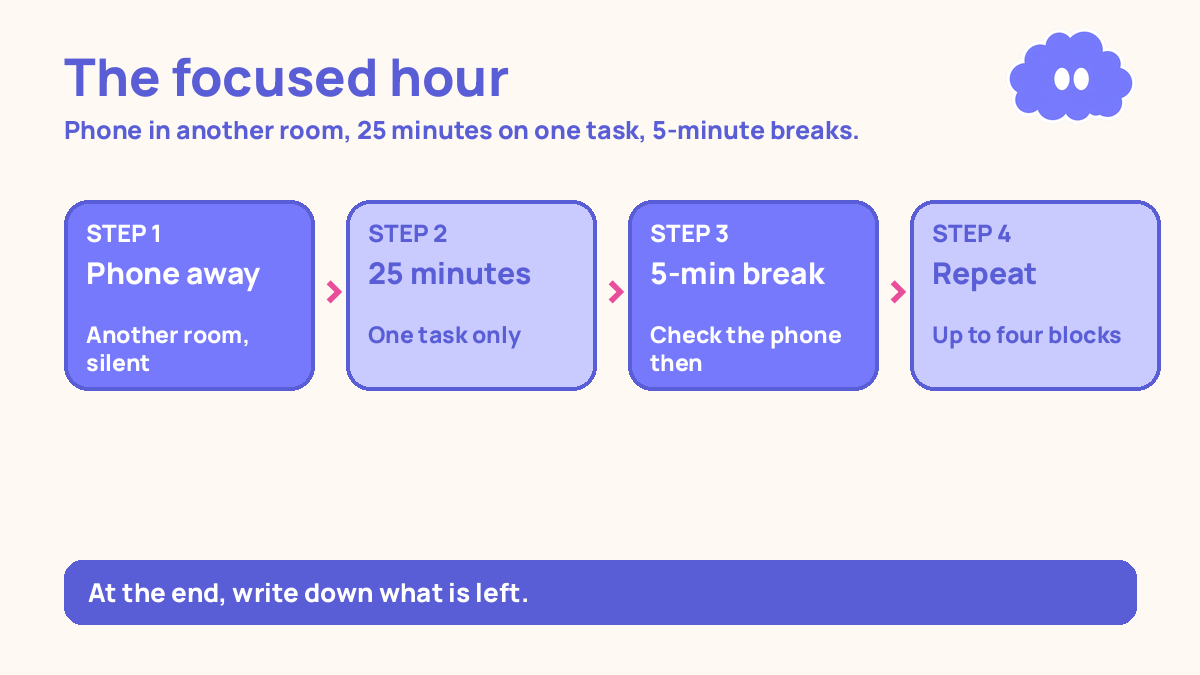
The system in short
- Before you start, get everything you need on paper or on your computer.
- Put the phone in another room, or in a bag by the door, on silent.
- Work for 25 minutes on one task.
- Take a 5-minute break. You may check the phone then, if you want to.
- Repeat for up to four blocks, then take a longer break.
- At the end, write down what is left.
Step 1: Change the setup, before you start
Willpower fails when the phone is next to you and buzzing. Setup does not need willpower once it is done.
Do these three things, every session:
- Turn notifications off, or put the phone on silent. Not vibrate. Silent.
- Move the phone out of arm’s reach. Another room is best. A bag by the door works if you live in one room.
- Put a timer where you can see it, so you are not checking the phone for the time.
If you study with friends online, tell them your work blocks in advance: “I am offline 7–8, back after.” Then you are not ignoring anyone. You are in a session.
Step 2: One task, 25 minutes
Pick one task before the timer starts. “Write the essay plan” is a task. “Work on the essay” is not, because it has no end.
Set a timer for 25 minutes. Work on that task only. If a thought comes up — a message to send, a video to watch — write it on a scrap of paper and deal with it in the break. Writing it down gets it out of your head without breaking the block.
Step 3: Breaks are for checking, work is not
When the timer rings, take a 5-minute break. This is when you can check the phone. That is the deal: no checking during work, free checking during breaks.
After four blocks, take a 20–30 minute break. Eat, walk, rest. Then start again only if you have another task planned.
This is not about never using your phone. It is about deciding when you use it, instead of letting it decide for you.
A worked example day
7:00, setup
- Notes on the desk, phone in the kitchen on silent, timer set.
- Task written down: “Turn chapter 5 notes into one page.”
7:00–7:25, block 1
- Work on the one page. A message thought comes up. Write it on scrap paper.
7:25–7:30, break
- Check the phone, reply if needed, get water.
7:30–7:55, block 2
- Finish the one page. Write down what is left: “Review the one page tomorrow.”
7:55, stop
- Two blocks done, one task finished, phone back in your pocket.
That is a focused hour. It does not feel long, because the breaks are built in.
When it goes wrong
You check the phone mid-block. Do not restart the day. Note it, put the phone back, and finish the block. One check is a slip, not a failure.
You need the phone for a definition or a file. Get it before the block starts. If you must look something up mid-block, write the question down and look it up in the break, unless the whole task depends on it.
You feel anxious without the phone. Start with shorter blocks: 15 minutes work, 5 minutes break. Build up to 25 minutes over a week. The system should feel doable, not punishing.
Friends keep messaging during blocks. Tell them once, plainly, when you are offline. Most people understand a set hour better than silence with no explanation.
Weekly review checklist
Once a week, answer these in writing:
- How many blocks actually happened, without a mid-block check?
- What pulled you away most often: messages, videos, or boredom?
- Which setup change helped most: distance, silent mode, or the timer?
- What one setup change will I try next week?
If distance helped, keep the phone further away. If boredom pulled you away, make tasks smaller. Change the setup, not your self-image.
What this system is not
It is not a promise of grades, and it is not a ban on phones. Phones are useful. This system just puts phone use where it belongs: in breaks, by choice, not in work blocks, by habit.
Questions
Do I need a focus app for this to work?
No. The system uses a timer and a place to put the phone. An app can help, but it is not required, and it should not become another thing to check.
What if I need my phone for study material?
Get the material first, then put the phone away. Download notes or screenshots before the session, so you do not need to open other apps mid-session.
What if I keep checking anyway?
Make checking harder, not forbidden. Put the phone in another room, or in a bag by the door. Distance works better than willpower.