The direct answer
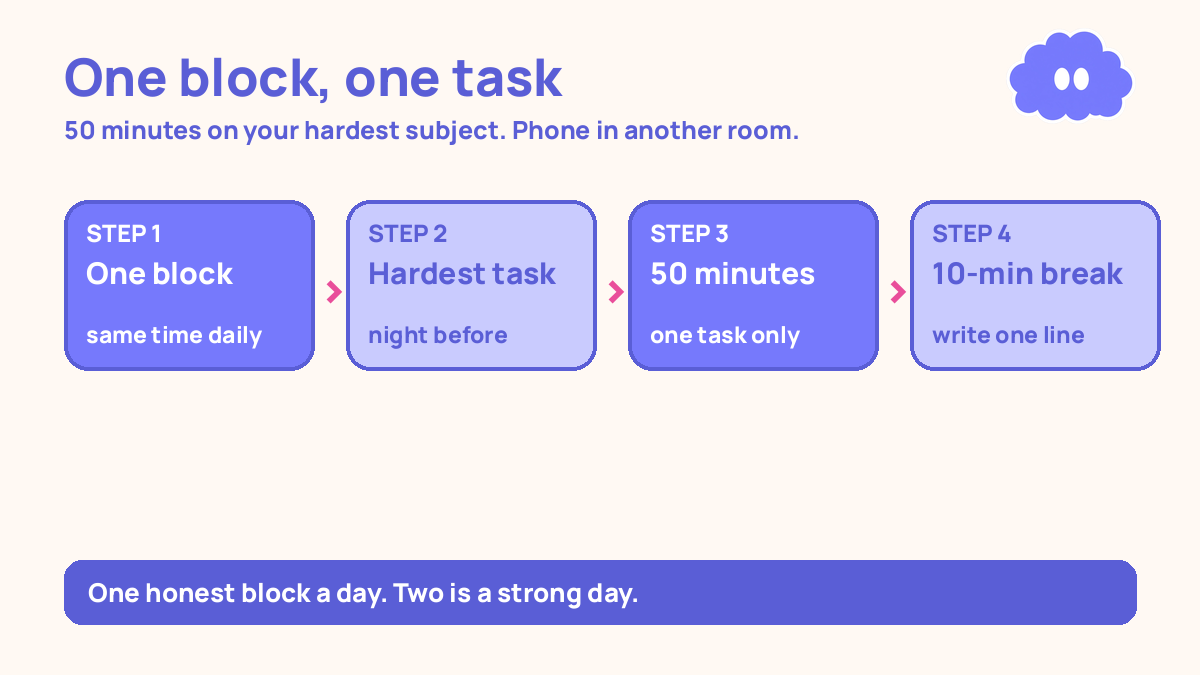
Deep work is one block a day, 50 minutes, on your hardest subject with no phone or messages, and no switching. You pick one task before you start, work on that task only until the timer ends, then take a real break. That is the whole system.
It works because hard work needs unbroken attention, and unbroken attention needs a closed door. Most students never get a full hour of it. They get an hour of half-attention, split between the work and the phone. One honest block beats three distracted hours.
Why one block matters more than a long day
A long study day sounds impressive, but most of it is not study. It is sitting at a desk, checking messages, re-reading the same page, and starting tasks you do not finish. The hours pass, but the hard work does not get done.
One deep work block changes that. It is a fixed time, every day, when the hardest thing gets done first. You do not have to feel motivated or finish the whole subject. You only have to sit down, close everything else, and work on one task for 50 minutes.
The block also teaches you how long hard work actually takes. Most students guess: an essay they think takes an hour takes three. After two weeks of daily blocks, your guesses get better, and your plans get honest. That is how a weekly study planner for students starts to work. The planner puts the block in the day. The block does the hard work.
If your phone breaks every session, fix that first with the phone focus system for distracted students: phone in another room, timer on, one task at a time.
The system in short
- Pick one deep work block a day, at the same time, in the same place.
- Choose the hardest task the night before, and write it in one line.
- Clear the desk, put the phone in another room, and close everything you do not need.
- Set a timer for 50 minutes and work on that one task only.
- When the timer ends, stop. Take a 10-minute break, away from the desk.
- Write down what you finished, in one line, and stop for the day if that was your block.
- Once a week, review your blocks and change one thing.
Step 1: Pick one block, same time, same place
Choose a time you can protect most days: for many students, the first hour after classes or the morning. The time matters less than the habit. Same time, same place, every day, so starting takes no decision.
Tell the people around you, if you can: “I study from 5 to 6, please do not disturb me.” If you share a room, pick a library corner, an empty classroom, or a quiet spot you can return to.
Start with one block a day, not three. One block you actually do is worth more than three blocks you plan and skip. After two weeks of daily blocks, you can add a second block on some days. Do not add it in week one.
Step 2: Choose the hardest task the night before
Never choose the task in the moment. That is when your brain will pick the easy task, or the task that feels like work but is not. Choose the night before, when you are calm, and write it on paper in one line.
The task should be hard, and finished in the block, or clearly started. “Write the first draft of one essay paragraph” is a task. “Work on the essay” is not. “Solve the five hardest problems from chapter 4” is a task. “Do maths” is not. If you cannot write the task in one line, it is too big. Split it until it fits.
Put the hardest subject first. Easy subjects can be done in tired hours. The hard subject needs your best hour. Give it the block, every day, until it stops being the hardest subject.
Step 3: Clear the desk and remove the phone
Before the timer starts, clear the desk. Only the things for this task stay: the book, the paper, the pen, the laptop if the task needs it. Everything else goes away. A clear desk means fewer things to look at instead of working.
Put the phone in another room. Not on silent, not face down, not in your pocket. In another room. If you need a timer, use a kitchen timer, a watch, or a laptop timer. A timer on the same device as your messages is a timer that loses.
Close every tab and app you do not need. If the task needs the internet, open only the page you need. If it does not need the internet, turn the Wi-Fi off. This step takes two minutes. It saves the block. Most deep work failures are not failures of willpower. They are failures of setup.
Step 4: Work on one task only for 50 minutes
Set a timer for 50 minutes and start. Work on the task you wrote down, and nothing else. If another task pops into your head, write it on a scrap of paper and keep going. Do not switch. Switching is how a 50-minute block becomes 50 minutes of three half-started things.
If you get stuck, stay with the task. Re-read the question. Write down what you know. Try one small step. Getting stuck is part of hard work, not a sign that the block has failed. The students who learn most are the ones who stay stuck for a while and work through it, instead of switching to something easy.
If the task finishes early, do not start a new task in the same block. Use the remaining minutes to check your work, or to test yourself on what you just did. In a 2013 review, Dunlosky and colleagues rated ten common study techniques, and only two received a high utility rating: practice testing and distributed practice. Re-reading was rated low. A block spent testing yourself is a block spent on the strongest method.
Step 5: Stop, break, and write down what you finished
When the timer ends, stop. Do not finish the whole task, and do not start the next one. Take a 10-minute break, away from the desk if you can. Stand up, get water, look out of a window, walk around. Do not open your phone. Ten minutes of scrolling is not a break. It is a new distraction that will follow you into the next block.
After the break, write down what you finished, in one line. “Drafted one essay paragraph, 280 words.” “Solved problems 1 to 4, problem 5 still stuck.” That line is your record. At the end of the week, those lines tell you what the blocks actually produced.
If you want a second block, take a longer break first — 20 to 30 minutes, with food or a walk — then repeat the system with a new task written down. Do not chain blocks together without a break. Tired deep work is not deep work.
A worked example: a day with one deep work block
Ali has classes until 3pm, and his hardest subject is maths. His deep work block is 4pm to 4:50pm, in the library each weekday. The night before, he writes the task on paper: “Solve the five hardest problems from chapter 4, questions 12 to 16.”
At 4pm, he sits down with only his maths book, a notebook, and a pen. His phone is in his bag, in a locker. He sets a watch timer for 50 minutes and starts. Question 12 takes 15 minutes, question 13 takes 10, question 14 stops him, and questions 15 and 16 take the rest.
At 4:50pm, the timer rings. He stops, takes a 10-minute break, and writes one line in his notebook: “Solved 12, 13, 15, 16. Question 14 still stuck — ask in class tomorrow.” Then he does his easy work: a 50-minute block of history reading, or a short review of yesterday’s notes. The hard work is done.
When it goes wrong
The block keeps getting interrupted. An interruption breaks the block, and a broken block was not a deep work block. Find a quieter place, tell people your block time, and put the phone in another room. If interruptions keep coming from one source, change the time or the place. Change the setup, not your toughness.
You sit down, but you cannot start. The task is too big, or too vague. Split it. “Write the essay” becomes “write the first paragraph”. “Revise chapter 4” becomes “answer the five questions at the end of chapter 4 from memory”. The first step should be so small that starting feels silly.
Fifty minutes feels too long, and your mind wanders after 20. Start with 25 minutes instead. Use the Pomodoro technique for students for two weeks, one block a day, and build up to 50. The 25-minute length was Francesco Cirillo’s practical choice, not a number from cognitive science, and 50 minutes is a practical alternative, not a rule.
You do the block, but you still just re-read notes. The block only controls time and attention. What you do inside it still matters. Use the block for testing yourself, writing, or solving problems — not for re-reading. Answer questions from memory, then check. Roediger and Karpicke found in 2006 that students who recalled a passage remembered more a week later than students who restudied it, even though the restudiers felt more confident right after studying.
Weekly review checklist
Copy this list and use it each week:
- How many deep work blocks did I actually do this week, and on which days?
- What did each block produce — one line per block, what was finished?
- Which subject got the block most often, and which hard subject never got one?
- What broke the blocks — phone, interruptions, tasks too big, or starting too late?
- What is the one change I will make next week — and only one?
The one-change rule matters. If you try to fix five things at once, you will fix none of them. Pick the single change that would help most: an earlier block time, a quieter place, smaller tasks, or the phone in another room. One change, tried for a full week, then judged honestly.
Downloadable infographic spec: one vertical image, title “One block, one task, no phone”, with the seven steps — pick one block a day, choose the hardest task the night before, clear the desk and remove the phone, work on one task for 50 minutes, stop and take a 10-minute break, write down what you finished, review and change one thing — and the checklist question “What did today’s block produce?” in Cloud Purple #7679FC, Dark Purple #5A5ED6, Cream Paper #FFF9F3 and Pink #E94E9A, with the Cloud mascot. Text taken word-for-word from this article.
What this system is not
It is not a promise of a grade, and it is not a claim that 50 minutes is the correct length for every brain and every task. It is a practical system: one protected block, one hard task, no distractions, and an honest record of what the block produced.
It is also not a system for doing everything. Easy work, admin, and light review do not need a deep work block. They can be done in short gaps or tired hours. The block is for the one hard thing that keeps getting pushed to tomorrow. Give that thing one hour a day, and it will stop being the thing you are afraid of.
Sources
- Dunlosky, J., et al. (2013). Improving students’ learning with effective learning techniques. Psychological Science in the Public Interest, 14(1), 4-58. Only practice testing and distributed practice received a high utility rating; rereading was rated low.
- Roediger, H. L., & Karpicke, J. D. (2006). Test-enhanced learning. Psychological Science, 17(3), 249-255. Students who recalled a passage remembered more a week later than students who restudied it, though restudiers felt more confident immediately.
- Cirillo, F. — Pomodoro Technique, late 1980s. Classic cycle: 25 minutes work, 5 minutes break, longer break after four. The 25-minute length was Cirillo’s practical choice, not a number derived from cognitive science.
For the weekly plan that holds the block, use the weekly study planner for students, and for the timer that builds up to 50 minutes, use the Pomodoro technique for students.
Questions
How long should a deep work block be?
Start with 50 minutes of work and a 10-minute break. If 50 feels too long at first, start with 25 minutes and build up over two weeks. The length matters less than keeping the block free of distractions.
What counts as deep work for a student?
One hard task that needs your full attention: writing, problem sets, reading a difficult chapter, or testing yourself on a topic. Easy admin, re-reading notes, and answering messages do not count.
What if I get interrupted during a block?
Note where you stopped, deal with the interruption, and start a fresh block. A broken block was not a deep work block, so do not count it as one. Protect the next block better.
How many deep work blocks should I do each day?
One honest block a day is a good start. Two is a strong day for most students. More than three, every day, is hard to keep up, and tired deep work is not deep work.