The direct answer
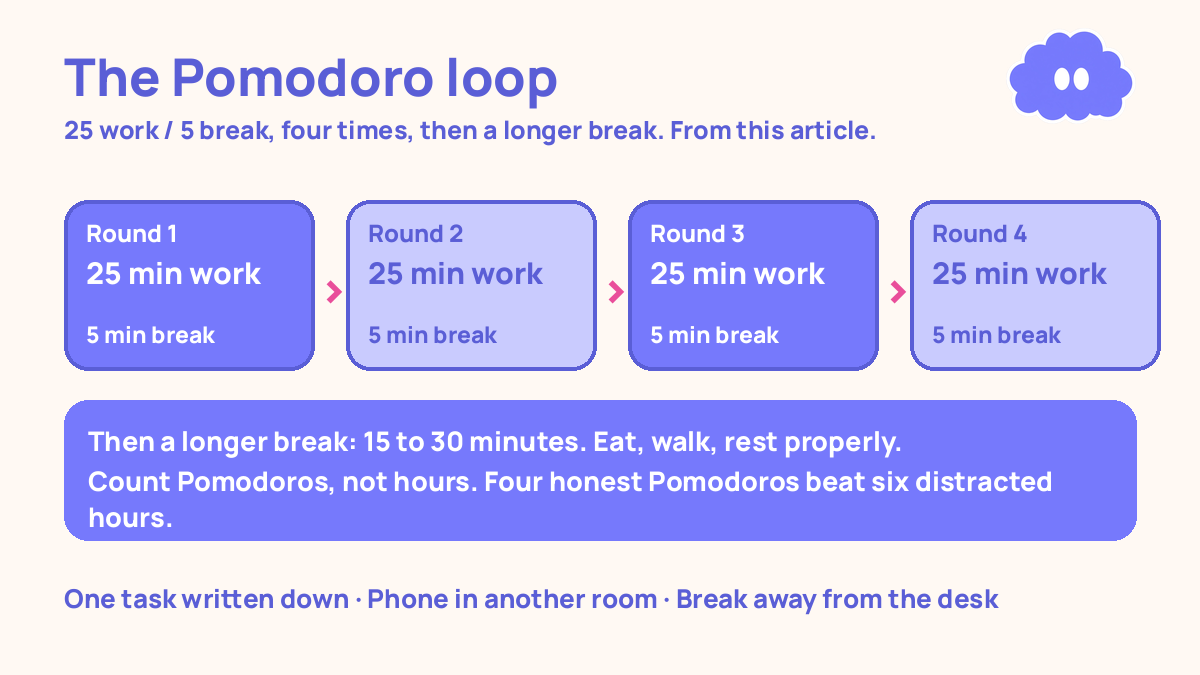
Set a timer for 25 minutes, work on one task only until it rings, then take a 5-minute break. After four rounds, take a longer break of 15 to 30 minutes. That is the whole technique. It works because the timer gives you a start you cannot negotiate with and a stop you can trust, so starting feels small and stopping feels allowed.
You do not need an app, a planner, or a new habit system. You need a timer and one task written down before you start.
Why starting is the hard part
Most study sessions fail before they begin. You sit down, open your notes, check your phone once, and twenty minutes later you have done nothing and feel worse than when you sat down. The problem is not laziness. The problem is that “study for three hours” has no clear first step, so your brain finds an easier one.
A 25-minute timer fixes the size of the first step. Anyone can do 25 minutes. And because the end is fixed, you do not have to decide when to stop — the timer decides for you. That removes the two decisions that usually break a session: when to start and when to stop.
The Pomodoro Technique comes from Francesco Cirillo, a university student in the late 1980s who used a tomato-shaped kitchen timer. The classic cycle is 25 minutes of work, 5 minutes of break, and a longer break after four rounds. One thing to know honestly: the 25-minute length was Cirillo’s practical choice, not a number derived from cognitive science. It works for many students and many tasks, but it is not a law. If a task needs a longer run, use 50-minute blocks instead. The timer is a tool, not a rule.
The system in short
- Pick one task and write it down in one line. Not “study biology” — “answer the 10 questions on cell division from memory.”
- Put your phone in another room, or on silent, face down, out of reach.
- Set a timer for 25 minutes and start. Work on that one task only.
- When the timer rings, stop. Take a 5-minute break, away from your desk if you can.
- Repeat. After four Pomodoros, take a longer break of 15 to 30 minutes.
- At the end of the day, count your Pomodoros, not your hours. Four honest Pomodoros beat six distracted hours.
Step 1: Write the task before you start the timer
Never start a timer with a vague task. “Revise chemistry” will fill 25 minutes with shuffling papers. “Work through the five mole-calculation problems on page 42” will fill it with actual work.
Write the task on paper, in one line, before you touch the timer. If you cannot write it in one line, the task is too big — split it. A Pomodoro holds one small, finished piece of work: one set of questions, one section of notes, one page of a draft.
If your phone keeps breaking your sessions, fix that first. The phone focus system for distracted students is the same idea, applied to the phone: phone in another room, timer on, one task at a time.
Step 2: One task, one timer, no switching
During a Pomodoro, you do one thing. If another task pops into your head, write it on a scrap of paper and keep going. Do not switch. Switching is how a 25-minute block becomes 25 minutes of three half-started things.
If someone interrupts you, the Pomodoro is broken — note where you stopped, deal with it, and start a fresh one. That sounds strict, and it is, but it is also honest: a broken Pomodoro was not 25 minutes of focus, and counting it as one lies to you about how much you actually did.
Step 3: Take the break properly
A 5-minute break is not a reward for finishing. It is part of the system. Stand up, get water, look out of a window, stretch. Do not open your phone — five minutes of scrolling is not a break, it is a new distraction that will follow you into the next round.
The longer break after four Pomodoros is when you eat, walk, or rest properly. If you skip it and push on, the fifth Pomodoro will be the one where your focus falls apart, and you will blame yourself instead of the missing break.
Step 4: Plan the day in Pomodoros, not hours
“Study for four hours” is a wish. “Eight Pomodoros” is a plan. Before you start, decide how many Pomodoros the day needs and what each one is for. A realistic day for a student with classes might be four to six. A full revision day might be eight to ten, with a proper lunch break in the middle.
If you finish a task early, do not start a new task in the same Pomodoro unless it is tiny. Use the remaining minutes to check your work, or stop early and start the next Pomodoro fresh. A timer that always runs to the end, even when the work is done, teaches you to stretch work to fill time.
If you would rather the timer came attached to a plan, the revision planner builds the daily sessions from your exam date and topics, then runs a 25/5 timer inside whichever session you start. Same 25 minutes, one task already decided.
If you would rather not track the count by hand, the free study timer is this article as a tool: write your task, run a 25/5 block, and it saves the minutes. It keeps today against your goal, a streak, and your week, all on your own device.
A worked example: an evening after classes
You get home at 5pm. You have three hours before dinner and an hour after.
5:00–5:25 — Pomodoro 1: Answer the 10 cell-division questions from memory, then check against your notes. 5:30–5:55 — Pomodoro 2: Work through the five mole-calculation problems. 6:00–6:25 — Pomodoro 3: Write the first draft of one essay paragraph. 6:30 — longer break: Dinner, walk, rest. No studying. 7:30–7:55 — Pomodoro 4: Review yesterday’s topics from memory — ten minutes per topic, two topics. 8:00–8:25 — Pomodoro 5: Start tomorrow’s reading, one section only, with questions written in the margin.
Five Pomodoros, five finished pieces of work, and you know exactly what you did. Compare that with three hours of “studying” where the phone was on the desk.
When it goes wrong
The timer rings and you are in the middle of something good. Finish the sentence or the step, then take the break. Do not finish the whole task — that is how breaks disappear. If this happens every Pomodoro, your tasks are too big. Split them, or try a 50-minute block for that kind of work.
You keep checking your phone during the 25 minutes. The phone is the problem, not your willpower. Put it in another room. If you need it for a timer, use a kitchen timer, a watch, or a laptop timer with the phone still in another room. A timer on the same device as your messages is a timer that loses.
Four Pomodoros feel like nothing, so you do twelve and burn out. Four honest Pomodoros are a good day. Twelve in a row without a real break is not discipline, it is a crash waiting to happen. Count Pomodoros, take the long breaks, and stop when the plan says stop. Tomorrow exists.
You use the timer but still just re-read notes. The timer only controls time. What you do inside it still matters. Use Pomodoros for testing yourself, not re-reading: answer questions from memory, work problems, write from recall. In a 2013 review, Dunlosky and colleagues rated ten common study techniques, and only two received a high utility rating: practice testing and distributed practice. Re-reading was rated low. A Pomodoro spent re-reading is a well-timed version of the weakest method.
Weekly review checklist
Copy this list and use it each week:
- How many Pomodoros did I actually complete this week, and on which days?
- Which tasks kept breaking my Pomodoros — interruptions, phone, or tasks too big?
- What one change will I make next week: phone in another room, smaller tasks, or a longer break after four?
- Did I use my Pomodoros for testing myself, or mostly for re-reading?
Downloadable infographic spec: one vertical image, title “The Pomodoro loop”, with the cycle 25 work / 5 break, repeated four times, then a 15–30 minute longer break, and the three rules — one task written down, phone in another room, break away from the desk — in Thynq cream, Cloud Purple, Dark Purple and pink, with the cloud mascot. Text taken word-for-word from this article.
What this system is not
It is not a promise of a grade, and it is not a claim that 25 minutes is the scientifically correct length for every brain and every task. It is a practical timer system from a student who needed a way to start. If 25 minutes does not fit your work, change the length and keep the structure: one task, a timer, a real break, and an honest count at the end of the day.
Sources
- Dunlosky, J., et al. (2013). Improving students’ learning with effective learning techniques. Psychological Science in the Public Interest, 14(1), 4-58. Only practice testing and distributed practice received a high utility rating; rereading was rated low.
- Cirillo, F. — Pomodoro Technique, late 1980s. Classic cycle: 25 minutes work, 5 minutes break, longer break after four. The 25-minute length was Cirillo’s practical choice, not a number derived from cognitive science.
For the full system behind this timer, start with how to build a study system that fits your life, and if your phone breaks your sessions, fix that first with the phone focus system for distracted students.
Questions
How long is one Pomodoro?
25 minutes of work, then a 5-minute break. After four Pomodoros, take a longer break of 15 to 30 minutes. The 25-minute length was Francesco Cirillo’s practical choice, not a number from cognitive science.
What if 25 minutes feels too short?
Try 50-minute blocks instead. Some tasks, like writing or problem sets, need a longer run to get going. The timer still does the same job: a clear start, a clear stop, and a break you actually take.
What do I do when the timer rings mid-task?
Stop and take the break. If the task is nearly done, finish the sentence or the step, then break. Do not let one unfinished task eat the break, or the next Pomodoro starts tired.
Can I use Pomodoro for revision?
Yes, and it pairs well with testing yourself. Use each 25-minute block to test a topic from memory, then check your answers in the break or the next block. Spacing still matters: review the same topic again after a gap.