The direct answer
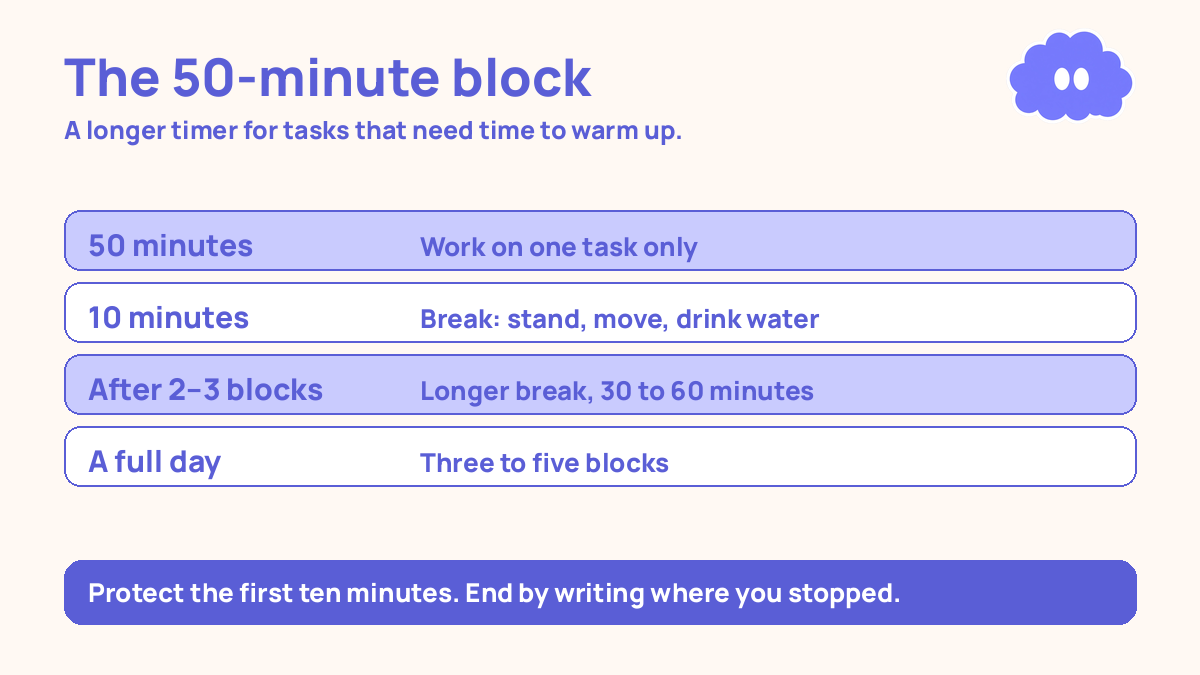
Work for 50 minutes on one task, then take a 10-minute break. Repeat three to five times a day, with a longer break after two or three blocks. That is the whole system. It is the same idea as the Pomodoro Technique, with a longer timer for tasks that need time to warm up — writing, problem sets, reading a hard chapter.
Use 50-minute blocks when 25 minutes ends just as you are getting going. Use 25-minute Pomodoros when a task is small, boring, or hard to start. The timer serves the task, not the other way round.
Why some tasks need a longer run
Some work has a warm-up cost. Writing an essay, working through a problem set, or reading a dense chapter takes ten or fifteen minutes before you are really inside it. If the timer rings at 25 minutes, you stop just as the work gets good — and starting again costs you another warm-up.
A 50-minute block gives you that warm-up plus thirty minutes of real work. The break after it is longer too — 10 minutes instead of 5 — because a longer block earns a longer rest. This is a practical timer, not a prescription from a research paper. The 25-minute Pomodoro length was Francesco Cirillo’s practical choice, and 50 minutes is the same kind of practical choice: long enough to get deep into a task, short enough that the end stays in sight.
If you have not tried the shorter version, start there: the Pomodoro technique for students is the easier habit to build, and it teaches the same discipline — one task, a timer, a real break.
When you want the block clocked for you, the free study timer runs 50/10 blocks with your task on the screen, then keeps the minutes in a weekly total by subject. No account, nothing to install.
The system in short
- Pick one task that needs a long run: one essay section, one problem set, one chapter.
- Put your phone in another room, or on silent, face down, out of reach.
- Set a timer for 50 minutes and start. Work on that one task only.
- When the timer rings, stop. Take a 10-minute break, away from your desk if you can.
- After two or three blocks, take a longer break of 30 to 60 minutes — a meal, a walk, real rest.
- Plan the day in blocks, not hours. Three to five blocks is a full day.
Step 1: Choose tasks that fit the block
A 50-minute block fits one substantial piece of work. Good fits: drafting one essay section, working through a problem set, reading one chapter and writing questions about it, revising one topic by testing yourself on it.
Bad fits: answering emails, tidying notes, “catching up” in general. Those are small tasks — they belong in a 25-minute Pomodoro, or in a short admin slot between blocks. Putting a small task in a 50-minute block just stretches it to fill the time.
Write the task down in one line before you start: “Draft the methods section, about 400 words” beats “work on my thesis.” If you cannot write it in one line, split it first.
Step 2: Protect the first ten minutes
The first ten minutes of a block are the most fragile. That is when the phone looks interesting, when you remember an email, when the desk suddenly needs tidying. Expect it. The rule is simple: nothing else until the timer has run ten minutes. By then you are usually inside the work, and the distractions have lost their pull.
If your phone keeps breaking your blocks, the phone is the problem, not your focus. The phone focus system for distracted students covers the setup: phone in another room, timer on, one task at a time.
Step 3: Use the middle of the block for the hard part
Plan the block so the hardest part lands in the middle, when you are warmed up. Start with something easy — re-read yesterday’s notes for five minutes, or re-state the problem in your own words — then do the hard thinking in minutes 15 to 40, then use the last ten minutes to write down where you stopped and what comes next.
That last step matters more than it looks. A block that ends with “where I stopped and what is next” makes the next block start in seconds instead of ten minutes of figuring out where you were.
Step 4: Take the break, and take the long break
A 10-minute break is a real break: stand, move, water, fresh air. Not your phone. After two or three blocks, take 30 to 60 minutes — eat properly, walk, rest. Students who skip the long break usually crash in the afternoon and then blame themselves for being lazy. They were not lazy. They were tired, because they skipped the rest the system promised them.
A worked example: a Saturday revision day
You have the whole day, and three subjects to cover.
9:00–9:50 — Block 1: Biology — test yourself on cell division from memory, then check and correct. (50 minutes) 10:00–10:50 — Block 2: Biology continued — past-paper questions on the same topic, timed, marked. 11:00 — longer break: 45 minutes. Walk, lunch, no studying. 11:45–12:35 — Block 3: Chemistry — work through the mole-calculation problem set, all five problems. 12:45–13:35 — Block 4: Chemistry continued — review yesterday’s topics from memory, ten minutes each. 13:45 — stop. Four blocks, three hours and twenty minutes of focused work, two subjects properly covered. The afternoon is free, and you actually know what you did today.
If you had sat at the desk “all day” instead, you would probably have done less real work and felt worse about it.
When it goes wrong
You lose focus at minute 30 every time. That is useful information, not failure. Either the task is too hard to hold for 50 minutes — split it, or do the hard part first — or that kind of task genuinely fits a shorter timer. Try a 25-minute Pomodoro for it and compare honestly after a week.
The block stretches: 50 minutes becomes 90. This usually means the break never happened. When the timer rings, stop. If the task is nearly done, finish the step, then break. A block without a break is not a longer block, it is the start of a tired afternoon.
You plan five blocks and do one. Plan fewer, not more. Three blocks done beats five planned and one done. Start with two blocks a day for a week, then add one. A plan you actually follow teaches you your real capacity. A plan you never follow teaches you to ignore your own plans.
You fill blocks with re-reading. The timer controls time, not method. Use blocks for testing yourself, writing, and solving — not re-reading notes. In a 2013 review, Dunlosky and colleagues rated ten common study techniques, and only two received a high utility rating: practice testing and distributed practice. Re-reading was rated low. A 50-minute block spent re-reading is a long, well-timed version of the weakest method.
Weekly review checklist
Copy this list and use it each week:
- How many 50-minute blocks did I complete this week, and on which days?
- Which tasks fit the 50-minute length, and which ones kept breaking at minute 30?
- Did I take the 10-minute breaks and the long break, or did I skip them?
- What one change will I make next week: fewer blocks, smaller tasks, or a shorter timer for one kind of task?
Downloadable infographic spec: one vertical image, title “The 50-minute block”, with the cycle 50 work / 10 break, a longer 30–60 minute break after two or three blocks, and the three rules — one task written down, protect the first ten minutes, end by writing where you stopped — in Thynq cream, Cloud Purple, Dark Purple and pink, with the cloud mascot. Text taken word-for-word from this article.
What this system is not
It is not a promise of a grade, and it is not a claim that 50 minutes is the scientifically correct length for studying. It is a practical timer for tasks that need a long run, from the same practical tradition as the 25-minute Pomodoro. If 50 minutes does not fit your work, change the length and keep the structure: one task, a timer, a real break, and an honest count at the end of the day.
Sources
- Dunlosky, J., et al. (2013). Improving students’ learning with effective learning techniques. Psychological Science in the Public Interest, 14(1), 4-58. Only practice testing and distributed practice received a high utility rating; rereading was rated low.
- Cirillo, F. — Pomodoro Technique, late 1980s. Classic cycle: 25 minutes work, 5 minutes break, longer break after four. The 25-minute length was Cirillo’s practical choice, not a number derived from cognitive science; 50-minute blocks are the same kind of practical choice for longer tasks.
For the full system behind this timer, start with how to build a study system that fits your life, and if 25 minutes fits a task better, use the Pomodoro technique for students.
Questions
When is a 50-minute block better than a 25-minute Pomodoro?
When the task needs warm-up time: writing, problem sets, coding, reading a hard chapter. If you keep hitting your stride just as the 25-minute timer rings, the block is too short for that task.
How long should the break be after 50 minutes?
10 minutes. Stand up, move, get water, look away from the screen. Do not open your phone — ten minutes of scrolling is not a break, it is a new distraction.
How many 50-minute blocks can I do in a day?
Three to five is a full day for most students. Four blocks is about three hours and twenty minutes of real focused work, which is more than most students actually do in a whole day of sitting at a desk.
What if I lose focus halfway through a block?
Note where you stopped, take a short pause, and restart the block. If it keeps happening with the same kind of task, that task may need a shorter timer — try a 25-minute Pomodoro for it instead.