The direct answer
Pick one small task before dinner, put your phone in another room, and work in two 25-minute rounds with a real break between them. Review what you already studied — do not start new, hard material. Then stop on time, write down what you finished, and go to bed at a normal hour. That is the whole routine. It works because it asks very little of a tired brain: one small task, a timer, and a stop you can trust.
Evening study is not about heroics. It is about keeping the day’s learning from slipping away overnight.
Why evenings are hard — and why they still matter
By evening, your brain has already worked all day. Classes, commuting, chores, messages, people — all of it costs attention, and by 7pm the tank is low. So you sit down to study and the page swims. You read the same paragraph three times. You check your phone, because the phone is easy and the page is hard.
That is normal. A tired brain is not a broken brain. It is a brain that has done a day’s work. The mistake is to fight it with a three-hour plan and a pot of coffee. The tired brain will lose that fight, and you will go to bed feeling like you failed.
If mornings work for you, do the hard work there. The morning study routine for students is built for that. This routine is for the other end of the day — the hour when you are tired but the day is not quite over.
The system in short
- Before dinner: pick one small task, write it in one line. Review, not new material.
- After dinner, give yourself 30 minutes to rest properly — eat, walk, do nothing useful.
- Phone in another room, on silent. Timer on — a kitchen timer, a watch, or a laptop timer.
- Round 1: 25 minutes, testing yourself from memory on today’s material.
- A 5-minute break, away from the desk, no phone. Then round 2: 25 minutes.
- Stop on time. Write down what you finished, and pick tomorrow’s morning task. Then rest.
Step 1: Pick one small task before dinner
Choose the task before dinner, not after it. After dinner you are full, warm, and even more tired — deciding what to study then is a decision you will lose. Pick it earlier, when you still have some energy left.
The task should be review. “Re-test the 10 cell-division questions from this morning.” “Work the 5 problems I got wrong in class.” “Write one paragraph explaining today’s topic from memory.” Small, finished, and about material you have already seen. Do not pick new, hard material for the evening. New material needs a fresh brain, and yours is not fresh. Save it for the morning.
Step 2: Rest properly after dinner
This step looks like doing nothing, and it is the most important one. After dinner, take 30 minutes to rest properly: eat slowly, walk, sit somewhere comfortable, talk to someone. Do not study during this half hour. Do not scroll your phone either — scrolling is not rest, it is a different kind of tired.
The rest is what makes the two rounds possible. A brain that has had half an hour off can do 25 minutes of focused review. A brain that went straight from dinner to the desk cannot. If you skip the rest, round 1 will be you staring at a page, and you will blame yourself for being lazy. You are not lazy. You are tired, and you did not rest.
Step 3: Phone in another room, timer on
Put the phone in another room, on silent, before you sit down. A tired brain reaches for the phone faster than a fresh one does, because the phone is the easiest thing in the room and effort is exactly what you do not have. Distance is the defence. The full setup is in the phone focus system for distracted students.
Use a timer that is not on your phone: a kitchen timer, a watch, or a timer on your laptop with messaging apps closed. The classic cycle, from Francesco Cirillo in the late 1980s, is 25 minutes of work, a 5-minute break, and a longer break after four rounds. The 25-minute length was Cirillo’s practical choice, not a number derived from cognitive science. If 25 minutes feels too long when you are tired, try 20 minutes — the length matters less than the start and the stop. The full timer system is in the Pomodoro technique for students.
Step 4: Two rounds of review, testing yourself
Round 1 is 25 minutes on the one task you picked before dinner. Round 2 is 25 minutes more — the same task finished, or the next small review step. Between them, a 5-minute break: stand up, water, window. No phone.
Test yourself inside the rounds. Do not re-read your notes — a tired brain will read the words and remember nothing. Answer questions from memory, work problems without looking, write a paragraph from recall and then check it. In a 2013 review, Dunlosky and colleagues rated ten common study techniques, and only two received a high utility rating: practice testing and distributed practice. Re-reading was rated low. In a 2006 study, Roediger and Karpicke found that students who recalled a passage remembered more a week later than students who restudied it, even though the restudiers felt more confident immediately after studying. Testing yourself feels harder than re-reading, and that is exactly why it works.
A practical starting schedule for spacing is to review a topic the next day, then in 3 days, then in 7 days. That schedule is a starting point to try, not a rule from the research. Your evening round is a natural place for the next-day review: test yesterday’s topic tonight, and it will be there tomorrow.
Step 5: Stop on time and protect your sleep
When the second round ends, stop. This is the rule that matters most in the evening, because the temptation is to push on. “Just one more hour.” One more hour becomes midnight, and midnight becomes a ruined tomorrow. The evening routine protects tomorrow as much as today.
Write down what you finished: “re-tested 10 questions, 8 right.” That line is the proof the evening happened. Then pick tomorrow’s task — the morning one — and write it in one line. Two minutes now, and tomorrow morning starts without a decision.
A worked example: a Tuesday evening
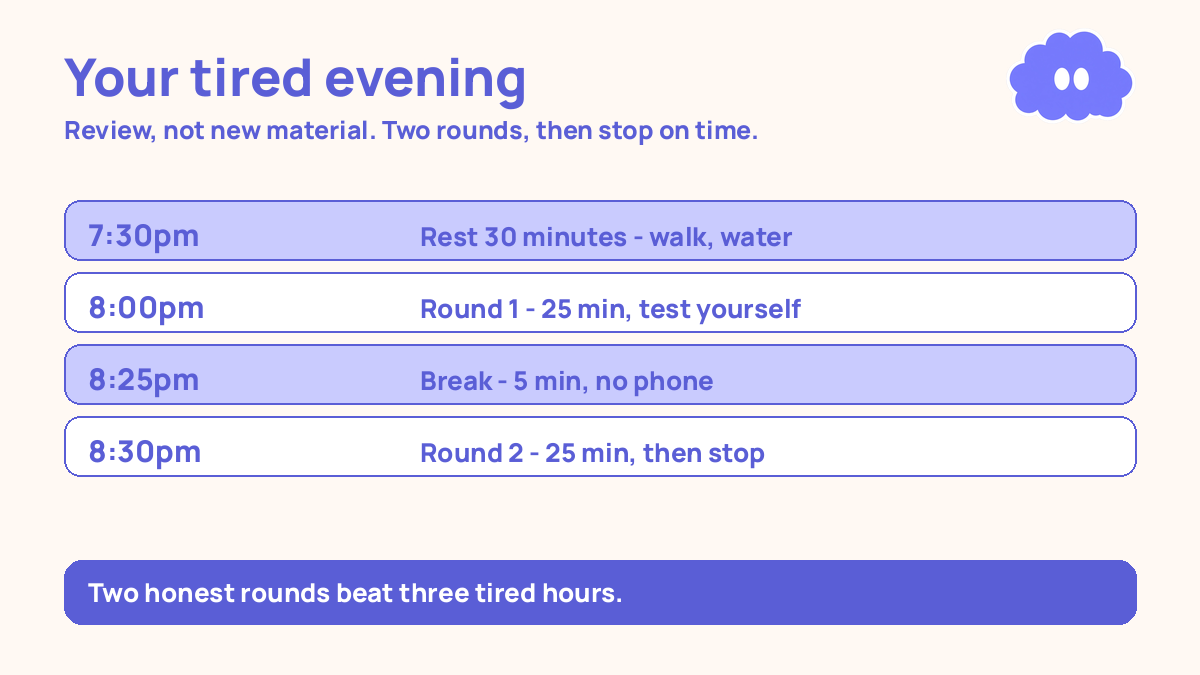
You had classes all day and got home at 5pm. Before dinner, you wrote one line: “Re-test the 10 cell-division questions from this morning.”
6:30pm — Dinner. You eat slowly. No studying, no phone scrolling. You sit and talk for a bit.
7:30pm — Rest. Thirty minutes of doing nothing useful. A short walk, some water, a stretch.
8:00pm — Round 1. Phone in the bedroom, on silent. Kitchen timer set for 25 minutes. You answer the 10 questions from memory, then check them. Seven right, three wrong. You write the corrections down.
8:25pm — Break. Five minutes. Stand up, water, window. No phone.
8:30pm — Round 2. You re-test the three you got wrong. Two right now, one still wrong. You write it down for tomorrow’s review. Then you write one paragraph explaining cell division from memory, and check it. Mostly right.
8:55pm — Stop. You write one line in the notebook: “10 questions re-tested, 8 right, 1 to review.” Then you write tomorrow’s task: “Answer the 5 mole questions from memory.” You put the notebook down. The evening is yours.
When it goes wrong
You fall asleep at the desk. You are not lazy — you are exhausted. Stop trying to study and go to bed. A 20-minute nap before the rounds can help on the worst days: set an alarm, sleep 20 minutes, then start. But if you fall asleep at the desk twice in one week, the problem is sleep, not the routine. Go to bed earlier for a week and the rounds will work again.
You sit down, but the phone comes with you and the evening disappears. A tired brain reaches for the phone fastest. The fix is distance, not willpower: phone in another room, on silent, before you sit down. If the phone is on the desk, the evening is already lost. The phone focus system for distracted students covers the full setup.
You keep pushing past the stop time and stay up too late. The stop time is the routine. Without it, the evening eats tomorrow. Set an alarm for the stop time, not just the start — when it rings, close the book, write the line, and rest. If you regularly need more than two rounds, do the extra work in the morning instead. The morning study routine for students is built for that.
You do the rounds but only re-read notes, and nothing sticks. Re-reading feels like work and teaches almost nothing, especially when you are tired. Test yourself instead: questions from memory, problems without looking, one paragraph from recall. If you cannot answer from memory, that is useful information — it tells you exactly what to review tomorrow.
Weekly review checklist
Copy this list and use it each week:
- How many evenings this week did I do two rounds, and how many did I skip?
- How many evenings did the phone break the routine, and where was it?
- Did I rest properly after dinner, or did I go straight to the desk?
- Did I stop on time, or did I push past the stop and lose sleep?
- What one change will I make next week: task picked earlier, a real rest after dinner, or a firmer stop time?
Downloadable infographic spec: one vertical image, title “Evening study routine for tired students”, with the six steps — pick one small review task before dinner, rest 30 minutes after dinner, phone in another room, two 25-minute rounds testing yourself from memory, stop on time, write down what you finished — and the line “two honest rounds beat three tired hours”, in Thynq cream, Cloud Purple, Dark Purple and pink, with the cloud mascot. Text taken word-for-word from this article.
What this system is not
It is not a way to study for three hours when you are exhausted, and it is not a promise of a grade. It is a practical way to keep one honest hour in the evening and protect your sleep. It will not work if you are sleeping too little — fix sleep first, then the routine works. And if you are so tired that even one round feels impossible, the honest answer is rest, not a better system. A night of proper sleep is worth more than an evening of staring at a page.
Sources
- Dunlosky, J., et al. (2013). Improving students’ learning with effective learning techniques. Psychological Science in the Public Interest, 14(1), 4-58. Only practice testing and distributed practice received a high utility rating; rereading was rated low.
- Cepeda, N. J., et al. (2006). Distributed practice in verbal recall tasks. Psychological Bulletin, 132(3), 354-380. Spaced practice beat massed practice; the best gap grows with how long you need to remember.
- Roediger, H. L., & Karpicke, J. D. (2006). Test-enhanced learning. Science, 311, 249-255. Students who recalled a passage remembered more a week later than students who restudied it, though restudiers felt more confident immediately.
- Cirillo, F. — Pomodoro Technique, late 1980s. Classic cycle: 25 minutes work, 5 minutes break, longer break after four. The 25-minute length was Cirillo’s practical choice, not a number derived from cognitive science.
For the morning version of this routine, read the morning study routine for students, and for the phone setup that protects the evening, the phone focus system for distracted students. If you work shifts and need a bigger system, the two-hour study system for working students shows how to fit two honest hours around work.
Questions
How can I study in the evening when I am already tired?
Make the session small and the start easy. Pick one task before dinner, put your phone in another room, and work in two 25-minute rounds with real breaks. Two honest rounds beat three hours of staring at a page while half asleep.
How long should an evening study session be?
About one hour of focused work: two 25-minute rounds with a 5-minute break between them, plus a longer break after. If you are exhausted, one round of 25 minutes still counts. Stop on time — studying late into the night steals tomorrow’s focus too.
What should I study in the evening?
Review, not new material. Test yourself on what you studied today or yesterday — answer questions from memory, work a few problems, re-check what you got wrong. New, hard material belongs in the morning, when your brain is fresh.
Is it better to study in the morning or the evening?
The morning is better for hard, new work, because your brain is freshest then. But the best time is the time you will actually do. If mornings do not work for you, a short, honest evening routine beats a morning routine you skip every day.