The direct answer
Pick one task the night before, start within 30 minutes of waking, put your phone in another room, and work in two 25-minute rounds with a 5-minute break between them. Then stop, write down what you finished, and set up tomorrow’s task. That is the whole routine. It works because the hour is protected and the task is already chosen — you never spend your freshest hour deciding what to do.
You do not need to wake up at 5am. You need one protected hour before your first class.
Why mornings work — and why they usually fail
Mornings are the best study time most students have, and the time most students waste. Your brain is fresh, your phone has not yet filled your head with other people’s news, and nobody is asking you for anything yet.
But mornings fail for a simple reason: you wake up and have to decide what to do. You open your phone to check the time, and twenty minutes later you are still in bed, scrolling. The work you do before 9am is often the best work of the day.
This routine removes the morning decision. The task is chosen the night before. The phone goes in another room before you sit down. The timer tells you when to start and when to stop. You do not need to feel motivated. You need to follow three steps you decided on last night, when you were awake enough to think clearly.
The system in short
- The night before: pick one task, write it in one line, and put your books and notebook where you will sit.
- Wake up, and start within 30 minutes. No phone in bed. Get up, wash your face, sit down.
- Phone in another room, on silent. Timer on — a kitchen timer, a watch, or a laptop timer.
- Round 1: 25 minutes on the one task. Then a 5-minute break, away from the desk, no phone.
- Round 2: 25 minutes. Test yourself from memory — do not just re-read.
- Stop. Write down what you finished, and pick tomorrow’s task. Then the morning is yours.
Step 1: Choose the task the night before
This is the step that makes the whole routine work, and it takes two minutes. Before bed, write one line: tomorrow’s task. Not “study biology” — “answer the 10 questions on cell division from memory.” If you cannot write it in one line, it is too big. Split it.
Put your books and notebook where you will sit in the morning. If your study spot is the kitchen table, put the book on the kitchen table. If it is your desk, put it on your desk. Morning-you is half awake and will take the easiest path. Make the work the easiest path, and the phone the hard one.
If starting is the wall — if you sit down and still cannot begin — read how to stop procrastinating study. It shrinks the first step until it is too small to put off.
Step 2: Start within 30 minutes of waking
The rule is simple: from waking to studying in 30 minutes. Get up, wash your face, drink water, sit down. Do not open your phone in bed. Do not check messages “just for a minute.” The minute is never a minute, and the morning is gone before the routine starts.
If you need an alarm, use a real alarm clock, or put your phone across the room so you have to get up to turn it off. Once you are up, stay up. Do not get back into bed. The bed is for sleeping, not for studying, and your brain knows the difference.
Breakfast can wait until after the two rounds, or you can eat something small before you start — a piece of fruit, some bread. Do not cook a full meal first. Cooking is a fine way to spend a morning, but it is not studying, and the hour will disappear into it.
Step 3: Phone in another room, timer on
Put the phone in another room, on silent, before you sit down. Not face down on the desk — in another room. A phone on the desk is a phone you will check the first time a question gets hard. The full setup is in the phone focus system for distracted students.
Use a timer that is not on your phone: a kitchen timer, a watch, or a timer on your laptop with messaging apps closed. The classic cycle, from Francesco Cirillo in the late 1980s, is 25 minutes of work, a 5-minute break, and a longer break after four rounds. The 25-minute length was Cirillo’s practical choice, not a number derived from cognitive science. If 25 minutes feels too short for the task, try 50-minute blocks instead. The full timer system is in the Pomodoro technique for students.
Step 4: Two rounds, testing yourself
Round 1 is 25 minutes on the one task you picked last night. Round 2 is 25 minutes more — either the same task, finished, or the next small step. Between them, a 5-minute break: stand up, water, window. No phone.
What you do inside the rounds matters as much as the timer. Do not spend them re-reading notes. In a 2013 review, Dunlosky and colleagues rated ten common study techniques, and only two received a high utility rating: practice testing and distributed practice. Re-reading was rated low. So test yourself: answer questions from memory, work problems without looking, write a paragraph from recall and then check it. In a 2006 study, Roediger and Karpicke found that students who recalled a passage remembered more a week later than students who restudied it, even though the restudiers felt more confident immediately after studying.
Spacing matters too. Cepeda and colleagues, in a 2006 synthesis, found that spaced practice beat massed practice, and that the best gap between sessions is not fixed — it grows with how long you need to remember the material. A practical starting schedule is to review a topic the next day, then in 3 days, then in 7 days. That schedule is a starting point to try, not a rule from the research.
Step 5: Stop, write it down, set up tomorrow
When the second round ends, stop. Do not add a third round “since you are on a roll.” The routine works because it ends on time and you go to class feeling like you have already done something real. If you keep going, the morning bleeds into the day, and tomorrow you will dread starting.
Write down what you finished: “answered 10 questions, 7 right, 3 to review tomorrow.” That line is the proof the morning happened, and it is also tomorrow’s task, half-written. Then pick tomorrow’s one task and write it down, in one line, before you leave the house. Two minutes now saves twenty minutes of deciding tomorrow morning.
A worked example: a Tuesday morning
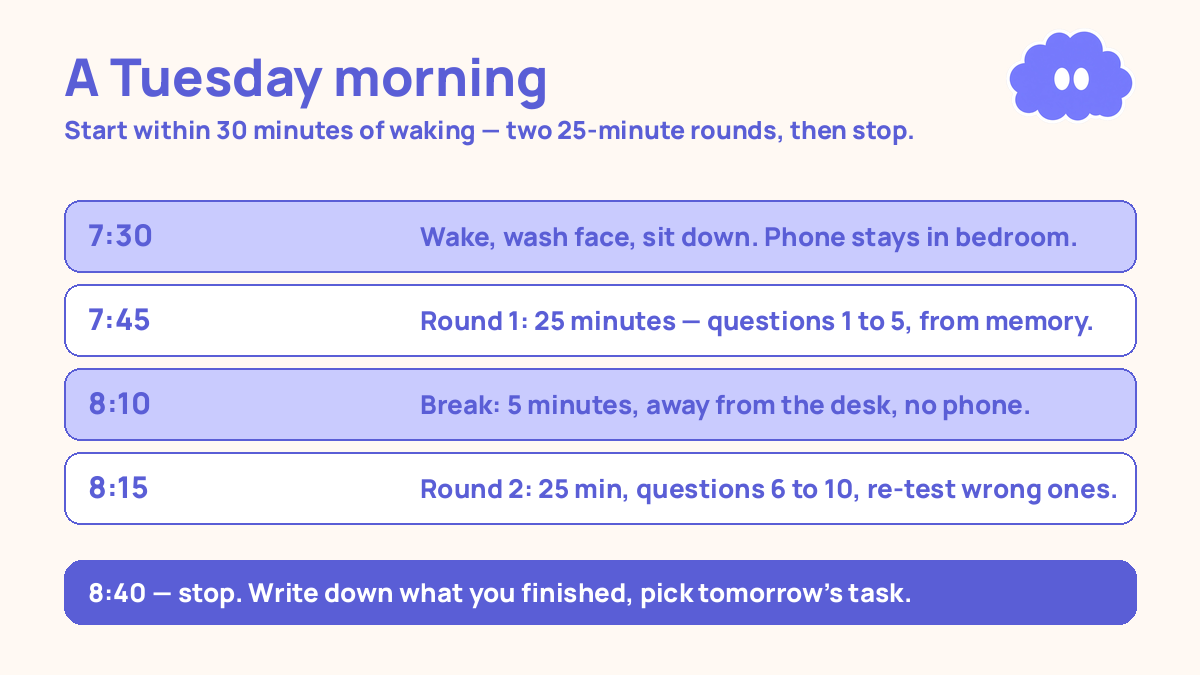
You have a 9am class. Last night, before bed, you wrote one line: “Answer the 10 questions on cell division from memory.” You put the biology book and your notebook on the kitchen table.
7:30am — Wake. Alarm across the room. You get up to turn it off. You wash your face, drink water, sit down at the kitchen table. The phone stays in the bedroom, on silent.
7:45am — Round 1. Kitchen timer set for 25 minutes. You answer questions 1 to 5 from memory, then check them. Three right, two wrong. You write the corrections down.
8:10am — Break. Five minutes. Stand up, stretch, look out of the window. No phone.
8:15am — Round 2. Questions 6 to 10 from memory. Then you re-test the two you got wrong in round 1. One right now, one still wrong. You write it down for tomorrow’s review.
8:40am — Stop. You write one line in the notebook: “10 questions, 8 right, 2 to review.” Then you write tomorrow’s task: “Work the 5 mole problems on page 42.” You eat breakfast, check your phone, and leave for class at 8:50am.
When it goes wrong
You wake up, open your phone in bed, and the hour is gone. The phone is the problem, not your willpower. Charge it outside the bedroom, or put it across the room so you have to stand up to turn the alarm off. If the phone is in your hand before your feet are on the floor, the morning is already lost. Fix the night before, not the morning.
You sit down but cannot start — the task feels too big. Shrink it. “Answer the 10 questions” becomes “answer question 1.” One question is too small to put off. If even that feels heavy, set the timer for 10 minutes and promise yourself you can stop when it rings.
You do the two rounds, then keep going and burn out before class. The routine ends after two rounds for a reason. If you keep going, you arrive at class tired, and tomorrow you will dread the morning. Stop on time.
You do it for three days, then skip a week. Three days followed by a skipped week is normal, not failure. Do not plan a heroic catch-up morning. Just do tomorrow’s routine: one task, picked tonight, two rounds, stop on time. The comeback is always one morning, never a whole week.
Weekly review checklist
Copy this list and use it each week:
- How many mornings this week did I start within 30 minutes of waking?
- How many mornings did the phone break the routine, and where was it?
- Did I pick the task the night before, or did I decide in the morning?
- Did I spend my rounds testing myself, or mostly re-reading?
- What one change will I make next week: task picked earlier, phone further away, or a shorter first round?
Downloadable infographic spec: one vertical image, title “Morning study routine”, with the six steps — pick one task the night before, start within 30 minutes of waking, phone in another room, two 25-minute rounds with a 5-minute break, test yourself from memory, stop and write down what you finished — and the line “the task is chosen the night before”, in Thynq cream, Cloud Purple, Dark Purple and pink, with the cloud mascot. Text taken word-for-word from this article.
What this system is not
It is not a 5am club, and it is not a promise of a grade. It is a practical way to protect one hour before class and spend it on the task that matters most. It will not work if you are sleeping too little — fix sleep first. And if mornings truly do not suit you, do not force them. The evening study routine for tired students is built for the other end of the day, and a routine you actually do beats a perfect one you skip.
Sources
- Dunlosky, J., et al. (2013). Improving students’ learning with effective learning techniques. Psychological Science in the Public Interest, 14(1), 4-58. Only practice testing and distributed practice received a high utility rating; rereading was rated low.
- Cepeda, N. J., et al. (2006). Distributed practice in verbal recall tasks. Psychological Bulletin, 132(3), 354-380. Spaced practice beat massed practice; the best gap grows with how long you need to remember.
- Roediger, H. L., & Karpicke, J. D. (2006). Test-enhanced learning. Science, 311, 249-255. Students who recalled a passage remembered more a week later than students who restudied it, though restudiers felt more confident immediately.
- Cirillo, F. — Pomodoro Technique, late 1980s. Classic cycle: 25 minutes work, 5 minutes break, longer break after four. The 25-minute length was Cirillo’s practical choice, not a number derived from cognitive science.
For the phone setup that protects the morning, read the phone focus system for distracted students, and for the timer, the Pomodoro technique for students.
Questions
What is a good morning study routine for students?
Pick one task the night before, start within 30 minutes of waking, put your phone in another room, and work in two 25-minute rounds with a 5-minute break between them. Then stop, write down what you finished, and set up tomorrow’s task.
How early do I need to wake up to study in the morning?
You do not need to wake up at 5am. You need one hour before your first class or commitment. If your first class is at 9am, wake at 7:30am, start studying by 8am, and stop at 9am. The routine works because the hour is protected, not because it is early.
What should I study first in the morning?
The hardest thing, or the thing you have been putting off. Your brain is freshest in the morning, and finishing the hard task first means the rest of the day feels lighter. Do not start with easy admin or re-reading notes — start with the task that matters most.
What if I am not a morning person?
Then do not force a 5am routine. Try a short morning version — one 25-minute round before class — and do your longer study in the evening instead. The evening study routine for tired students is built for that. A routine you actually do beats a perfect one you skip.