
The situation
You work part-time and you have 1–2 hours for study, often when you are already tired. You do not need more hours. You need a smaller, tighter plan for the hours you have.
This system uses two tasks: one hard, one easy. That is it.
The system in short
- At the start of the week, pick your two most reliable study hours.
- Each day, pick one hard task and one easy task.
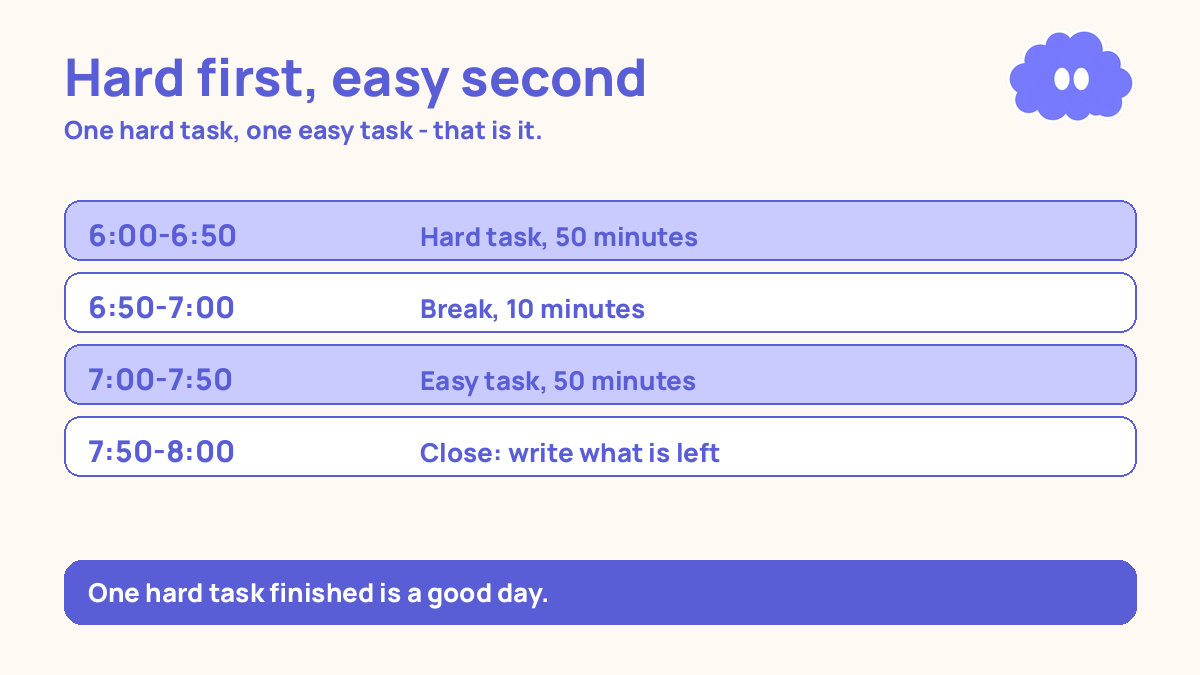
- Do the hard task first, for 50 minutes.
- Take a 10-minute break.
- Do the easy task for 50 minutes, then stop.
- Write down what is left, so tomorrow starts clean.
Step 1: Pick reliable hours, not ideal hours
Look at your rota, not your hopes. Which hours actually happen, week after week?
For many working students, that is an hour before a shift, or an hour after, but not both on the same day. Pick the hour you can keep on tired days, not the hour you keep on good days.
Write the hours down. “Study 6–8pm, Monday, Wednesday, Friday” is a plan. “Study in the evening” is not.
Step 2: One hard task, one easy task
A hard task is work that needs thinking: new material, past-paper questions, writing from memory.
An easy task is work that keeps things moving: organising notes, reviewing flashcards, reading a short section again.
Do not pick two hard tasks. You will finish neither, and you will feel like the day failed. One hard task finished is a good day.
Examples:
- Hard: Do 5 past-paper questions and mark them.
- Easy: Turn today’s marked answers into flashcards.
Step 3: 50 minutes, break, 50 minutes
Set a timer. Work on the hard task for 50 minutes, with your phone out of reach. Take a 10-minute break. Then work on the easy task for 50 minutes.
When the second timer ends, stop, even if the task is not perfect. Write down what is left in one line: “Past-paper Q6 left, flashcards for chapter 3 left.” Tomorrow, you start from that line, not from scratch.
A worked example day
You finish a shift at 5pm and you are tired. Your planned hours are 6–8pm.
6:00–6:50, hard task
- Do past-paper questions 1 to 5, closed book.
- Mark them. Note the two topics you got wrong.
6:50–7:00, break
- Eat, drink water, step away from the desk.
7:00–7:50, easy task
- Make flashcards for the two topics you got wrong.
- Review yesterday’s flashcards once.
7:50–8:00, close
- Write tomorrow’s line: “Review flashcards, then past-paper Q6–10.”
You studied for 2 hours, finished a hard task, and you know exactly what comes next. That is enough.
When it goes wrong
You come home too tired to start. Do the easy task only, for 30 minutes, and stop. A short session kept is better than a planned session skipped and felt guilty about.
Your shift runs late. Move the session, do not cancel the week. One moved session is normal. Three cancelled sessions in a row is a sign the hours need changing.
You spend the hour re-reading. Close the notes and test yourself. If you cannot answer a question without looking, that topic goes on tomorrow’s hard task list.
You have an exam week and more time. Keep the same system, just add a third hour, with a long break before it. Do not change the system on the week you need it most.
Weekly review checklist
Once a week, answer these in writing:
- How many planned hours actually happened?
- Which task type got finished most often, hard or easy?
- What time of day worked best, before or after shifts?
- What one change will I make to next week’s hours?
If planned hours kept failing, the hours are wrong, not you. Pick different hours and test them for a week.
What this system is not
It is not a promise of grades, and it is not a plan to study through exhaustion. If you are ill or badly sleep-deprived, rest comes first. A system that only works on perfect days is not a system for a working student.
Questions
What if I only have one hour, not two?
Use the same system, with one task only. Do the hard task first, while you have the most energy, and leave the easy task for another day.
Should I study before or after a shift?
Whichever hour is more reliable. If you come home too tired to start, try a short session before the shift instead, and test it for a week.
What if my shifts change every week?
Plan week by week, on the day your rota comes out. Pick the two most reliable hours, and do not plan study on days you know will be too long.