The direct answer
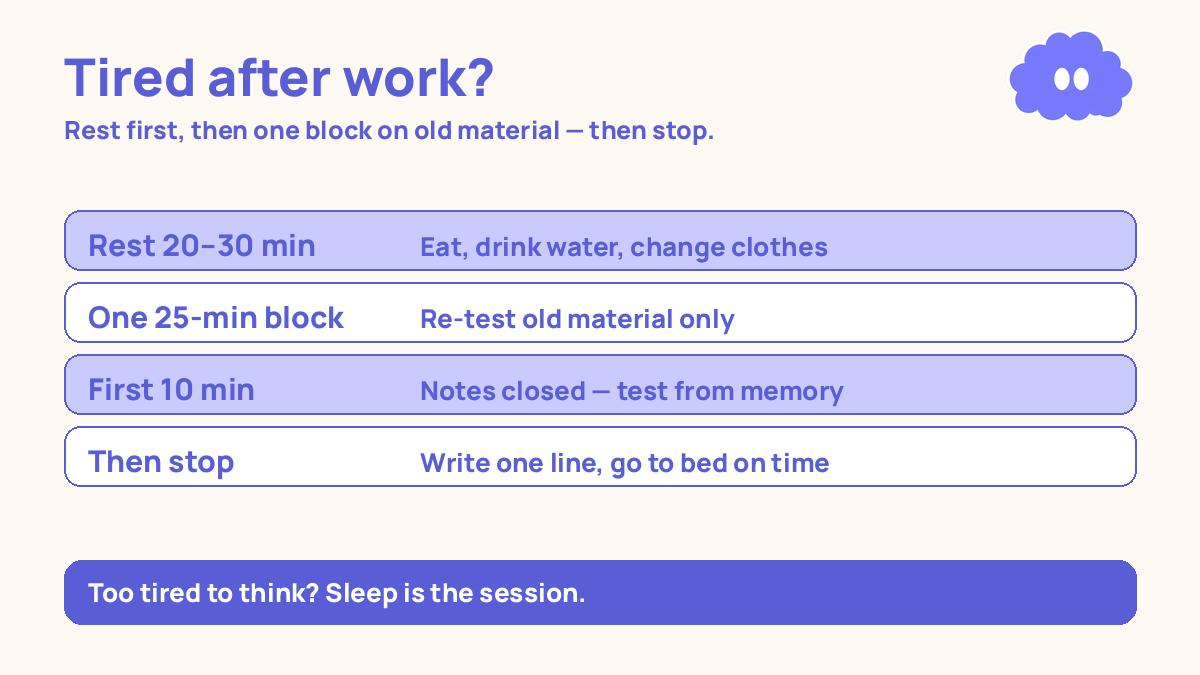
Rest for 20 to 30 minutes after your shift, then study for one 25-minute block, and stop — re-testing something you have already studied, from memory, not learning anything new. It works because a tired brain cannot do what a fresh brain does, and pretending it can is how tired evenings turn into hours of re-reading, guilt, and nothing learned.
Why tired studying fails
After a shift, your body and your attention are both tired. Attention is what study runs on: holding a question, recalling an answer, checking it, fixing the gap. That needs focus, and a tired brain has little left.
So what happens on a tired evening? You sit down, open your notes, and read. Reading feels like studying, because your eyes are moving and the words are going in. But the words are not staying. You reach the bottom of the page and cannot say what was on it. An hour passes, you feel worse, and you go to bed believing you cannot study and work at the same time.
You can. The problem is that you are studying the way a fresh person studies, with a tired brain. Change the session to fit the brain you actually have at 8pm after a shift. In a 2013 review, Dunlosky and colleagues rated ten common study techniques; only two received a high utility rating: practice testing and distributed practice. Re-reading and highlighting were rated low. Re-reading is the weakest method at the weakest time; testing yourself on old material is the strongest method at the right size — one short block.
Night shifts or rotating hours? The study system for shift work students covers that pattern.
The system in short
- Come home, eat, drink water, change out of your work clothes. Rest for 20 to 30 minutes. No studying yet.
- Pick one topic you have already met — a gap from an earlier session, never new material.
- Set a timer for 25 minutes. Phone in another room.
- Test yourself from memory for ten minutes, then check your notes and fix the gaps.
- Write one line: what you tested, what you got wrong.
- Stop. Go to bed at a normal time. The session is done.
Step 1: Rest first
Do not study the moment you walk in. The first 20 to 30 minutes after a shift belong to recovery, and recovery is not laziness. Eat something real, drink water, change out of your work clothes, and sit away from your desk for a few minutes, doing nothing that needs attention.
The rest does two things: it lets your body come down from the shift, and it separates work from study. Go straight from the till to your notes and your brain is still at work. The rest is the boundary.
Do not scroll on your phone during the rest — it is a new stream of things to pay attention to, and it will follow you into the study block. Boring rest restores attention. Fall asleep during the rest and tonight is a no-study night.
Step 2: Pick the right task — old material only
A tired brain should never meet new material: it needs the most attention you have, and at 8pm after a shift that attention is gone. It will be read, not learned. So do not start it.
Pick a gap instead: the starred items in your one-line notes from your last proper session, the questions you got wrong, the shaky topic. That is tonight’s task. Re-testing old material is the most useful thing a tired brain can do, and the easiest — you have seen it before, so recall is possible even tired, and checking gives a clear right-or-wrong answer.
With no starred gaps, pick the topic from two days ago and test yourself from memory. Cepeda and colleagues, in a 2006 synthesis, found that spaced practice beat massed practice, and that the best gap grows with how long you need to remember. Meeting a topic again after two days is spacing — the second meeting that makes the first one stick.
Tonight’s block slots into a bigger week as the re-test. The one-hour study system for working students is the fresh-brain version; the two-hour study system for working students is the fuller one for a free day. Same rule: recall first, notes second.
Step 3: One 25-minute block, phone in another room
Set a timer for 25 minutes. The round comes from Francesco Cirillo’s Pomodoro Technique, from the late 1980s, and the length was his practical choice, not a number from cognitive science. On a tired evening, 25 minutes is the right size: short enough to hold your attention, long enough for one real piece of work. If even 25 feels too long, do 15.
Put your phone in another room before you start. A tired brain reaches for the phone first — the easiest thing in the room — so remove it. If you need a timer, use a kitchen timer, a watch, or a laptop timer. The phone focus system for distracted students is built on this move.
Inside the block, test yourself first. Close your notes: ten minutes of recall — write what you remember, answer last session’s questions, work the problems. Then open your notes and check, starring what you still get wrong. Spend the rest of the block fixing one gap, not all of them: work the problem again, explain it in your own words, test yourself once more.
Why recall first? Re-reading feels fluent, and that fluency lies to you. In a 2006 study, Roediger and Karpicke found that students who recalled a passage remembered more a week later than students who restudied it, even though the restudiers felt more confident immediately after studying. Feeling fluent right after re-reading is not the same as remembering a week later. When you are tired, the temptation to re-read is strongest — which is why the rule matters most tonight: notes closed for the first ten minutes, no exceptions.
Step 4: Write one line, then stop — and the no-study night
When the timer rings, stop. Write one line: what you tested, what you got wrong. Then stop for the night — no second block, even if the first went well, because on a tired evening it is usually re-reading in disguise, and it eats into your sleep. Sleep is when the day’s work settles, so go to bed at a normal time.
Some nights, the block will not happen: too tired to think, asleep during the rest, or the shift ran long. Do not force it. Do one tiny thing instead: write down tomorrow’s topic and start time in one line. It takes a minute and means tomorrow starts without a decision. Then go to bed. A no-study night is not a failed night — you chose sleep over a useless hour of re-reading. What kills a system is not a missed night; it is the guilt after one, which turns one missed night into a missed week. Write the line, sleep, start again tomorrow.
If no-study nights happen more than twice a week, the problem is the plan, not you: move a session to a morning or a day off. The study system for students with a part-time job shows how to plan the week from your rota. For the bigger picture, start with how to build a study system that fits your life.
A worked example: a tired Tuesday after a retail shift
You work in a shop, 5pm to 9pm, and get home at 9:20pm, tired, with a maths test on Friday.
9:20–9:45pm — rest: Eat, drink water, change clothes, sit on the sofa for ten minutes doing nothing. No phone scrolling.
9:45–10:10pm — one block: Your last session was Sunday, and you starred one gap: factorising. Timer set, phone in the kitchen, notes closed: three factorising problems from memory. Two right, one wrong. You check the wrong one, see where you slipped, and work it again. One line: “Factorising — 2 of 3 right first try, third fixed. Still slow on negatives.”
10:10pm — stop: No second block, no next chapter. You go to bed at a normal time. Tomorrow morning that line tells you exactly what to re-test. Friday’s test is in three days, and you have met factorising twice now — once on Sunday, once tonight — with a gap between the meetings. That gap is doing more work than an extra hour of re-reading ever would.
The other version: you sit down at 9:20, re-read for an hour, fall asleep at the desk, and wake up guilty and no better at factorising. Same evening, same tiredness, different method.
When it goes wrong
You skip the rest and study straight off the shift. The block feels awful, you re-read for 25 minutes, and you conclude the method does not work. It does work — the rest is part of it. Try it for three evenings before you judge it.
You keep reaching for your phone during the block. The phone is not a willpower problem. It is a distance problem. Put it in another room, or give it to someone else for 25 minutes. Set a morning alarm before you put it away. A timer on the same device as your messages is a timer that loses, and a tired brain loses to it fastest.
You do the block but you still just re-read your notes. The rule is mechanical: notes closed for the first ten minutes, no exceptions. If you cannot write anything from memory, the topic needs another meeting, not more re-reading. Write down what you could not recall, star it, and re-test it first in your next proper session. The retrieval practice system for students has more ways to test yourself when recall feels hard.
You have three tired evenings in a row and nothing is sticking. The week has no fresh-brain session in it, and no system survives on tired evenings alone. Move one session to a morning or a day off, even if it is only 25 minutes, and make that the session where new material happens. Tired evenings are for re-testing; fresh sessions are for learning. You need both.
Weekly review checklist
Copy this list and use it each week:
- How many tired-evening blocks did I do, and on which nights?
- How many nights were no-study nights, and did I write tomorrow’s line?
- Did I rest 20 to 30 minutes before the block, or study straight off the shift?
- Did I start each block testing myself from memory, or slip into re-reading?
- What one change will I make next week?
Downloadable infographic spec: one vertical image, title “How to study when you are tired after work”, with the evening in order — rest 20 to 30 minutes, one 25-minute block, re-test old material only, notes closed for the first ten minutes, write one line then stop — in Cream Paper, Cloud Purple, Dark Purple and Pink, with the Cloud mascot. Text taken word-for-word from this article.
What this system is not
It is not a promise of a grade, and one tired block a night is not enough on its own — it is one piece of a week that also needs a fresh-brain session for new material. What it is: a way to make tired evenings useful instead of wasted, built on the two techniques learning researchers rated highest, at a size a tired brain can hold. Too tired? Sleep. Can you hold one block? Do one. The structure stays the same: rest first, old material only, recall first, one line, then stop.
Sources
- Dunlosky, J., et al. (2013). Improving students’ learning with effective learning techniques. Psychological Science in the Public Interest, 14(1), 4-58. Only practice testing and distributed practice rated high; rereading and highlighting rated low.
- Cepeda, N. J., et al. (2006). Distributed practice in verbal recall tasks. Psychological Bulletin, 132(3), 354-380. Spaced practice beat massed practice; the optimal gap grows with how long you need to remember.
- Roediger, H. L., & Karpicke, J. D. (2006). Test-enhanced learning. Science, 311, 249-255. Recallers remembered more a week later than restudiers, though restudiers felt more confident immediately.
- Cirillo, F. — Pomodoro Technique, late 1980s. 25 minutes work, 5 minutes break, longer break after four; the 25-minute length was Cirillo’s practical choice, not a number from cognitive science.
For the fresh-brain sessions this evening block supports, read the one-hour study system for working students and the two-hour study system for working students. Review the week with the weekly study review system.
Questions
Should I study straight after a shift, or rest first?
Rest first, for 20 to 30 minutes. Eat something, drink water, change your clothes, and sit down properly. Studying straight off a shift means studying with a tired brain, and tired brains re-read instead of thinking.
How long should I study when I am tired?
One 25-minute block, and stop there. A tired brain can hold one honest block of testing yourself from memory. Two blocks usually means the second one is re-reading, and re-reading teaches you little.
What should I study when I am tired?
Re-test something you have already met, not new material. New material needs a fresh brain. A tired evening is for meeting old gaps again: recall a topic from two days ago, check your notes, fix what you missed.
What if I am too tired to study at all?
Then do not study. Sleep is the session. Do one tiny thing instead: write down tomorrow’s topic and start time in one line, so tomorrow starts without a decision.