
The direct answer
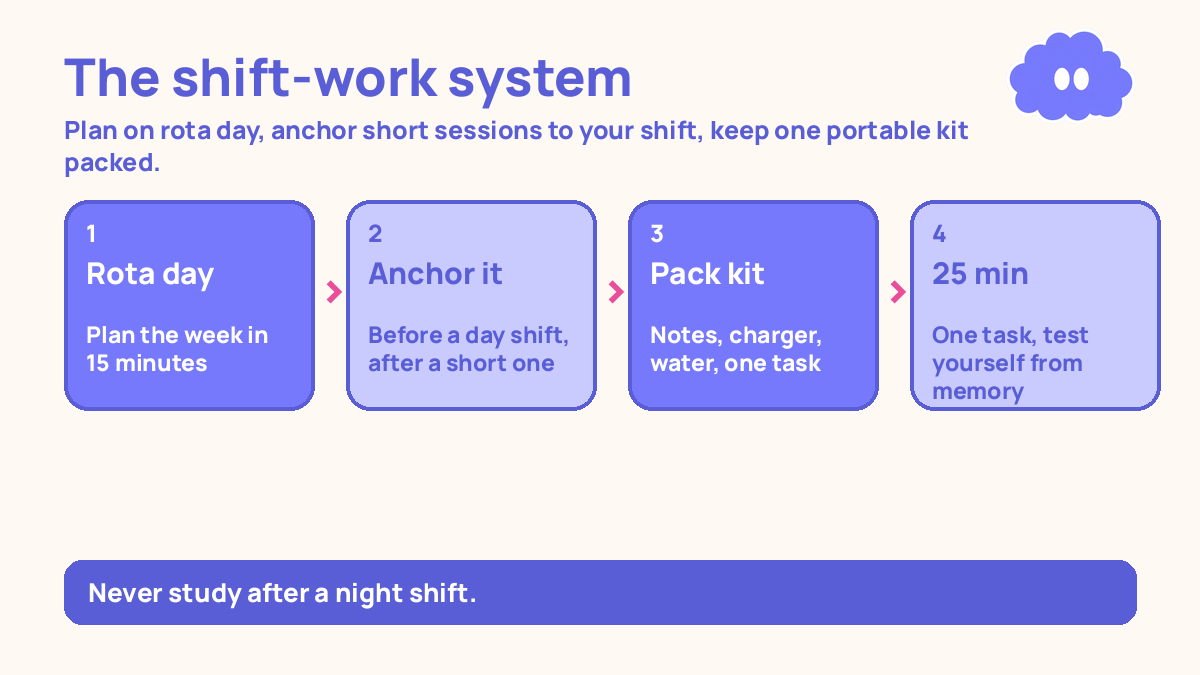
A study system for shift work is: plan on the day your rota comes out, pick the two or three most reliable hours that week, and anchor short sessions to your shift pattern — before a day shift, after a short shift, never after a night shift. Keep one portable kit packed, study in 25-minute blocks, and test yourself from memory instead of re-reading. When the rota changes, the plan changes with it. That is the system, not a failure of it.
Your rota is not the enemy of your study. A plan that pretends the rota does not exist is.
Why shift work breaks normal study systems
Most study systems assume a fixed day: same hour, same place, same routine. Shift work gives you none of those. Your hours change weekly, your energy changes daily, and a plan made on Monday is wrong by Wednesday. So you stop planning, study whenever you happen to have time, and by the end of the month you have studied in bursts and forgotten most of it.
The fix is not a fixed routine. It is a weekly routine: a plan you remake every week, on rota day, in fifteen minutes. Two or three reliable hours, anchored to the shifts you actually have, with a kit that moves with you. The system is the remaking, not the routine.
For the full system behind this one, start with the 2-hour study system for working students. This article is that system, fitted to a rotating rota.
The system in short
- On rota day, plan the week in fifteen minutes: which days have a reliable hour, and which do not.
- Anchor sessions to the shift: before a day shift, after a short shift, never after a night shift.
- Keep one portable kit packed — notes, charger, water, one task written down — so study can happen anywhere.
- Study in 25-minute blocks: one task in one line, phone in another room, test yourself from memory.
- Review each topic again after a gap: the next day, then a few days later. A practical starting schedule, not a research rule.
- Once a week, check: did the planned hours happen, and which anchor worked best?
Step 1: Plan on rota day, in fifteen minutes
The day your rota comes out is planning day. Fifteen minutes, pen and paper. Write down the week’s shifts, then pick the two or three most reliable hours — the days with a short shift, the mornings before a late start, the evenings after an early finish. Do not plan study on days you know will be too long. A plan that includes an impossible day is a plan that fails on purpose.
Pick one task per planned hour, in advance, and write it on the plan: “Tuesday 7pm — answer the 10 cell-division questions.” A planned hour with a planned task starts without decisions. A planned hour with no task becomes twenty minutes of deciding what to do, and then the phone.
If the rota changes mid-week — a swapped shift, an extra shift — replan in five minutes, the same way. Move the hour, do not cancel it. A moved hour is still an hour. A cancelled hour is a gap, and gaps grow.
Step 2: Anchor sessions to the shift
Before a day shift works for many students: one 25-minute block in the morning, before the shift starts, when the mind is fresh. It is short, it is done before the day gets in the way, and it counts. After a short shift works too: one hour in the evening, hard task first, test at the end — the same shape as the one-hour study system for working students.
After a night shift, do not study. You are exhausted, and exhausted study is not study — it is sitting at a desk, half-asleep, re-reading the same page. Sleep, eat, rest. The study hour moves to the next day, before the next shift. Rest is part of the system, not a break from it.
Try both anchors for a week each — before and after — and keep the one that actually happens. The best anchor is the one that survives your real week, not the one that sounds best.
Step 3: Keep a portable kit
When the study hour moves, the study place moves with it. A fixed desk is a luxury shift workers do not have. So keep one portable kit packed by the door: notes for tomorrow’s task, a charger, water, earphones, and one task written on a slip of paper.
The kit is what makes a spare hour usable. Without it, a free hour becomes twenty minutes of packing and deciding — and you will stay where you are, doing nothing, instead. With it, a free hour is a study hour, wherever you are: the library, a quiet corner at work before your shift, the kitchen table.
Pack the kit the night before, for tomorrow’s task. When the hour arrives, you grab the kit and go. Two minutes, no decisions.
Step 4: One task, one timer, test yourself
A shift-work session is short, so it must have shape. One task, written in one line, before you start: “Work through the five mole-calculation problems on page 42.” If you cannot write it in one line, the task is too big — split it.
Set a timer for 25 minutes and work on that one task only. The 25-minute block comes from the Pomodoro Technique, built by Francesco Cirillo as a university student in the late 1980s: 25 minutes of work, 5 minutes of break, a longer break after four rounds. The 25-minute length was his practical choice, not a number derived from cognitive science — but the structure is what helps on a short, tired day: a clear start, a clear stop, and a break you actually take.
Inside the block, test yourself. Answer questions from memory, work problems, write from recall, then check your answers. In a 2013 review, Dunlosky and colleagues rated ten common study techniques, and only two received a high utility rating: practice testing and distributed practice. Re-reading was rated low. A 25-minute block spent re-reading notes after a shift is a well-timed version of the weakest method. The same 25 minutes spent testing yourself is the strongest one.
Put your phone in your bag, on silent, during the block. A phone that buzzes with shift swaps and group messages will break every session it can reach.
Step 5: Space the review out
Testing yourself once is not enough. Review each topic again after a gap — the next day, then a few days later. That is a practical starting schedule to try for a week, not a rule from research. The research direction is clear: in a 2006 synthesis, Cepeda and colleagues found that spaced practice beat massed practice across materials, ages and retention intervals, and that the best gap grows with how long you need to remember the material.
For a shift worker, spacing has a second advantage: it survives a missed week. If a brutal rota eats three days, the topics are still on the list, with their next review dates, waiting for the next planned hour. The list is the memory of the system. Without it, a missed week becomes a lost month.
A worked example: a week on a rotating rota
Your rota comes out on Sunday. This week: Monday day shift, Tuesday late shift, Wednesday off, Thursday night shift, Friday day shift.
Sunday, planning (15 minutes): Reliable hours: Monday 6:30am before the shift, Wednesday 10am, Friday 6:30am. Thursday is a night shift — no study. Tuesday is a late shift — one block in the morning if it happens, no promise. Monday, 6:30–6:55am: One block before the shift. Answer the 10 cell-division questions from memory, then check. Three wrong — on Wednesday’s list. Wednesday, 10:00–11:00am: Day off, one full hour. Hard task first: work through the five mole problems. Then test cell division again — all right this time. Friday, 6:30–6:55am: One block before the shift. Test mole calculations from memory. One wrong — it stays on the list for next week.
Three sessions, two topics tested twice each, one night shift respected, no guilt about Thursday. That is a good week on a rotating rota.
When it goes wrong
The rota changes mid-week and the plan falls apart. Replan in five minutes, the same way: which hours are still reliable, which task moves where. Move the hour, do not cancel it. A system that changes with the rota is still a system. A system that breaks the first time the rota changes was never a system.
You study after a night shift and retain nothing. Stop. Night shifts are for sleep, not study. The hour moves to the next day, before the next shift. Pushing through exhaustion every time is not discipline, it is a crash waiting to happen — and a crashed student studies nothing for a week.
You miss a whole week and try to catch up in one weekend. Do not. A weekend of cramming will not replace a week of spaced testing, and it will leave you exhausted for the next rota. Restart with one 25-minute block a day, one task at a time, and rebuild over the week. A missed week is a gap, not a failure.
Every session is all-or-nothing. Either a perfect three-hour session or nothing at all. The system is built to kill that: one 25-minute block is a real session. Four honest blocks beat six distracted hours, and one block on a hard day beats zero. Small and finished beats big and imagined.
Weekly review checklist
Copy this list and use it each week, on rota day:
- Which planned hours actually happened, and which anchor worked best — before, after, or day off?
- Which topics did I test, and which ones are still wrong after two tests?
- What broke the system this week — a rota change, a night shift, the phone, or tasks too big?
- What one change will I make next week: a different anchor, a better kit, smaller tasks, or fewer planned hours that actually happen?
Downloadable infographic spec: one vertical image, title “The shift-work system”, with the weekly loop — rota day plan, anchor the session, pack the kit, one task, test yourself — and the rule “never study after a night shift”, in Thynq cream, Cloud Purple, Dark Purple and pink, with the cloud mascot. Text taken word-for-word from this article.
What this system is not
It is not a promise of a grade, and it is not a claim that a rotating rota can be tamed by a timetable. Some weeks the rota will win, some nights will be too long, and some topics will need a teacher’s help, not a timer. This is a practical system for a changing week: plan on rota day, anchor short sessions to the shift, keep a kit packed, and test yourself instead of re-reading. If the rota changes, change the plan — one step at a time, and check on rota day whether the change helped.
Sources
- Dunlosky, J., et al. (2013). Improving students’ learning with effective learning techniques. Psychological Science in the Public Interest, 14(1), 4-58. Only practice testing and distributed practice received a high utility rating; rereading was rated low.
- Cepeda, N., et al. (2006). Distributed practice in verbal recall tasks. Psychological Bulletin, 132(3), 354-380. Spaced practice beat massed practice; the best gap grows with how long you need to remember the material.
- Cirillo, F. — Pomodoro Technique, late 1980s. Classic cycle: 25 minutes work, 5 minutes break, longer break after four. The 25-minute length was Cirillo’s practical choice, not a number derived from cognitive science.
For the full system behind this one, use the 2-hour study system for working students on the weeks when two hours exist, and the one-hour study system for working students for single-hour days. For the weekly check that keeps the rota plan honest, use the weekly study review system.
Questions
How do I study when my shifts change every week?
Plan week by week, on the day your rota comes out. Pick the two or three most reliable hours that week, and do not plan study on days you know will be too long. A system that changes with the rota is still a system.
Should I study before or after a shift?
Try both for a week each and keep the one that actually happens. Before a shift suits early starts; after a shift suits short days. Night shifts are different — study before the shift, never after a night shift when you are exhausted.
What if I miss a whole week of study because of shifts?
Do not try to catch up in one weekend. Restart with one 25-minute block a day, one task at a time, and rebuild over the week. A missed week is a gap, not a failure — the system restarts the same way it started.
How do I keep notes and materials organised across changing shifts?
Keep one portable kit — notes, charger, water, one task written down — packed by the door. When the study hour moves, the kit moves with it. Study happens where the kit is, not where the desk is.