The direct answer
A one-hour study system for working students is: one protected hour, the hard task first for 40 minutes, then an easier task or a test for 20 minutes, then stop. One task written in one line, phone in another room, timer on. Test yourself from memory instead of re-reading. That is a full day of study, in one hour, and it survives tired evenings because it is small enough to start.
You do not need more hours. You need one hour that belongs to study, every day, doing the kind of work that sticks.
Why one hour feels like nothing — and why it is not
After a shift, an hour feels too small to matter. So you skip it, and wait for a day with three free hours — a day that never comes. By the end of the week you have studied nothing, and the guilt makes next week worse.
That is the trap. One hour a day, most days, is not nothing. It is five hours a week of steady work, spaced out, testing yourself — and spacing beats massing. In a 2006 synthesis, Cepeda and colleagues found that spaced practice beat massed practice across materials, ages and retention intervals. Five short sessions will beat one long weekend session almost every time. The hour is enough. The problem was never the size of the hour. It was that the hour had no shape.
For the full system behind this one, start with the 2-hour study system for working students. This article is the same system, shrunk to one hour, for the days and weeks when two hours do not exist.
The system in short
- Pick one hour, at the same time every day, and protect it. Same time, same place, same hour.
- Before the hour starts, write one hard task in one line, and one easy task in one line.
- First 40 minutes: the hard task, with a timer, phone in another room.
- Last 20 minutes: test yourself on an older topic from memory, then check your answers.
- Stop when the hour ends. One honest hour beats three half-working hours.
- Once a week, check: did the hour happen, and did the hard task come first?
Step 1: Protect one hour, at the same time every day
“Study when I have time” is not a plan. “7 to 8pm, every weekday” is a plan. Pick the hour that survives most days. For most working students that is early evening, after food and a short rest — not the minute you walk in the door, and not 10pm when you are already asleep on your feet.
Tell the people you live with, if you can. Not as a big announcement, just: “I study 7 to 8, then I am free.” An hour other people know about is an hour that gets protected. An hour nobody knows about gets interrupted.
If a day genuinely has no hour — a double shift, a family event — do one 25-minute block instead of none. One block keeps the habit alive. Zero for three days kills it, and restarting is the hardest part.
Should the hour be before or after work? Whichever hour is more reliable. If you come home too tired to start, try a short session before work instead, and test it for a week. The best hour is the one that actually happens, not the one that sounds best.
Step 2: Hard task first, while you have the most energy
Tired brains can still do hard work — for 40 minutes, on one task. What they cannot do is a vague session with no shape. So the hard task goes first, while you have the most energy, and it is written in one line before you start: “Answer the 10 questions on cell division from memory.” Not “study biology”.
If you cannot write it in one line, the task is too big — split it. A 40-minute block holds one small, finished piece of work: one set of questions, one section of notes, one page of a draft. Starting with the easy task is tempting, because it feels like progress, but it leaves the hard task for the end of the hour, when you have the least energy left. Hard first, easy second. Always.
Set a timer for the 40 minutes and work on that one task only. The timer gives you a start you cannot negotiate with and an end you can trust. Put your phone in another room, on silent. A phone on the desk after a long shift is a phone you will check, and one check becomes an hour.
Step 3: Test yourself, do not re-read
The last 20 minutes are for testing, not re-reading. Pick an older topic — one you studied days ago — close the book, and answer its questions from memory. Then check your answers.
In a 2013 review, Dunlosky and colleagues rated ten common study techniques, and only two received a high utility rating: practice testing and distributed practice. Re-reading, highlighting and summarising were all rated low. So twenty minutes spent re-reading notes after work feels like studying and mostly is not. Twenty minutes spent testing yourself feels harder and mostly is studying.
Keep a list of questions per topic, so the test starts without decisions. When the 20 minutes begin, pick a topic from the list and answer its questions. No staring at a pile of notes wondering where to begin. And review each topic again after a gap — the next day, then a few days later. That is a practical starting schedule to try for a week, not a rule from research.
Step 4: Stop when the hour ends
When the hour ends, stop. Pack up, write tomorrow’s two tasks on a slip of paper, and walk away. One honest hour beats three half-working hours, and the hour only stays honest if it ends.
Do not stretch the hour because you feel guilty about a short day. Guilt is not a study method. If the hour was real — hard task first, test at the end, phone away — then it was enough. Tomorrow exists, and the system runs again.
If you have energy left and want more, do one more 25-minute block — but only after the hour is properly finished, with a real break in between. Do not blur the hour into an endless evening. The end is part of the system.
A worked example: a weekday after a shift
You finish work at 5:30pm. You get home, eat, rest for half an hour. Your study hour is 7 to 8pm.
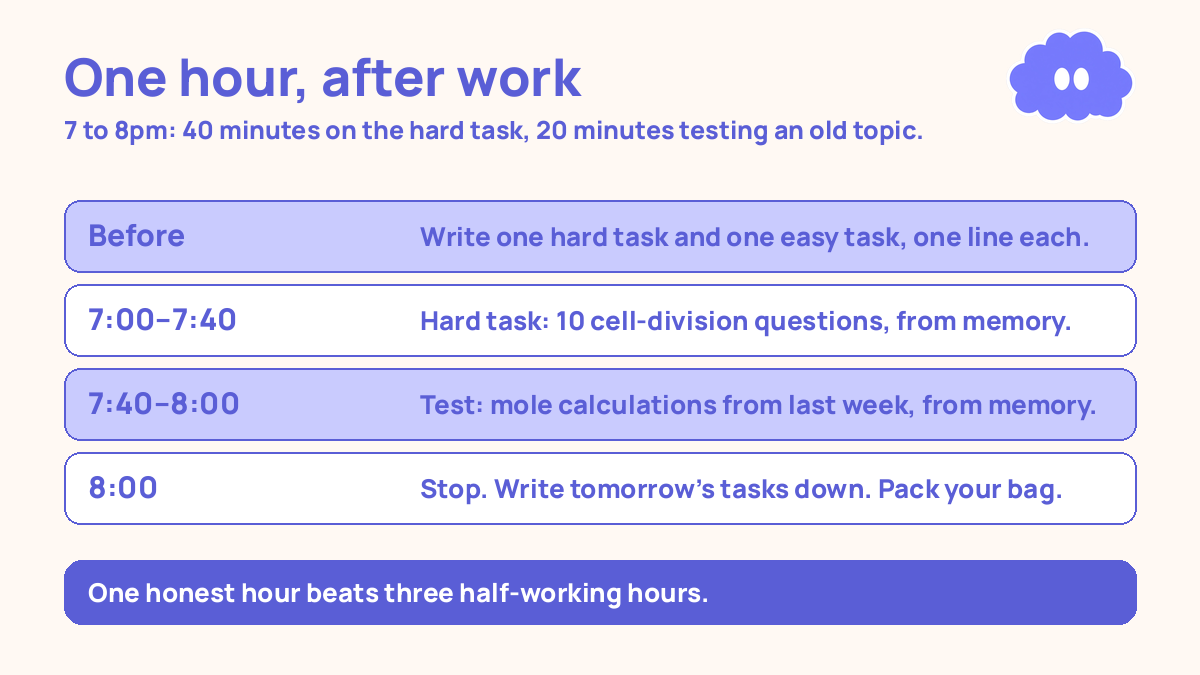
7:00–7:40 — Hard task: Answer the 10 cell-division questions from memory, then check against your notes. Phone in another room, timer on. Three wrong — they go on tomorrow’s list. 7:40–8:00 — Test: Review mole calculations from last week, from memory. Five questions, then check. One wrong — it stays on the list. 8:00 — Stop: Write tomorrow’s tasks on a slip of paper. Hard task: work through the five mole problems. Test: cell division, quickly. Pack your bag.
One hour, one hard task finished, one old topic tested, tomorrow already decided. Five of those in a week is five hours of real study — spaced, tested, and finished. That is a good week for a working student.
When it goes wrong
You come home too tired to start. The hour is too late, or the first step is too big. Try two fixes, one at a time: move the hour earlier, or shrink the first step to two minutes — open the book, read one question, write one line. Two minutes is too small to argue with, and once you have started, the next step is easier than the first.
The easy task eats the hour and the hard task never happens. That is the order failing, not you. Hard task first, always, written in one line before the hour starts. If the easy task is admin — emails, organising notes — do it after the hour, or not at all. Admin is not study.
You study for three hours on Sunday and nothing all week. Three hours on Sunday feels like a lot, and it is — but spacing beats massing. One hour a day, five days a week, will beat one big Sunday almost every time. Shrink Sunday to planning and one block, and move the work to weekdays.
Your shifts change and the hour keeps breaking. Plan week by week, on the day your rota comes out. Pick the most reliable hour each day, and do not plan study on days you know will be too long. A system that changes with the rota is still a system — a system that pretends the rota does not exist is a wish.
Weekly review checklist
Copy this list and use it each week:
- How many days this week did the hour actually happen, and how many days did I do one 25-minute block instead?
- Did the hard task come first, or did the easy task eat the hour?
- Which topics did I test, and which ones are still wrong after two tests?
- What one change will I make next week: a different hour, smaller tasks, phone further away, or a before-work session instead of after-work?
Downloadable infographic spec: one vertical image, title “The one-hour system”, with the hour split — 40 minutes hard task first, 20 minutes test yourself — and the three rules: one hour protected, one task written down, phone in another room, in Thynq cream, Cloud Purple, Dark Purple and pink, with the cloud mascot. Text taken word-for-word from this article.
What this system is not
It is not a promise of a grade, and it is not a claim that one hour a day will fix every subject. Some weeks work will take the whole evening, some exams really are in two days, and some topics need a teacher’s help, not a timer. This is a practical system for a working student: one protected hour, hard task first, test at the end, and an honest stop. If the week changes, change the system — one step at a time, and check after a week whether the change helped.
Sources
- Dunlosky, J., et al. (2013). Improving students’ learning with effective learning techniques. Psychological Science in the Public Interest, 14(1), 4-58. Only practice testing and distributed practice received a high utility rating; rereading, highlighting and summarising were rated low.
- Cepeda, N., et al. (2006). Distributed practice in verbal recall tasks. Psychological Bulletin, 132(3), 354-380. Spaced practice beat massed practice; the best gap grows with how long you need to remember the material.
For the full system behind this one, use the 2-hour study system for working students on the weeks when two hours exist. For the daily timer that holds the hour together, use the Pomodoro technique for students. And for the weekly check that keeps the hour honest, use the weekly study review system.
Questions
Is one hour a day actually enough?
For steady progress, yes — one honest hour, most days, beats a heroic four-hour session once a week. Spacing works better than cramming. One hour is enough for one hard task and one test, and that is a real day of study.
Should I study before or after work?
Whichever hour is more reliable. If you come home too tired to start, try a short session before work instead, and test it for a week. The best hour is the one that actually happens, not the one that sounds best.
What if I only have 30 minutes, not an hour?
Use the same system, smaller: one task, one 25-minute block, test yourself, stop. A 25-minute block keeps the habit alive on a short day. Zero minutes for three days kills it, and restarting is the hardest part.
How do I study when I am tired after work?
Do the hard task first, while you have the most energy, and keep it small — one task in one line. Tired brains can still test themselves for 25 minutes. What they cannot do is a vague three-hour session with no shape.