
The direct answer
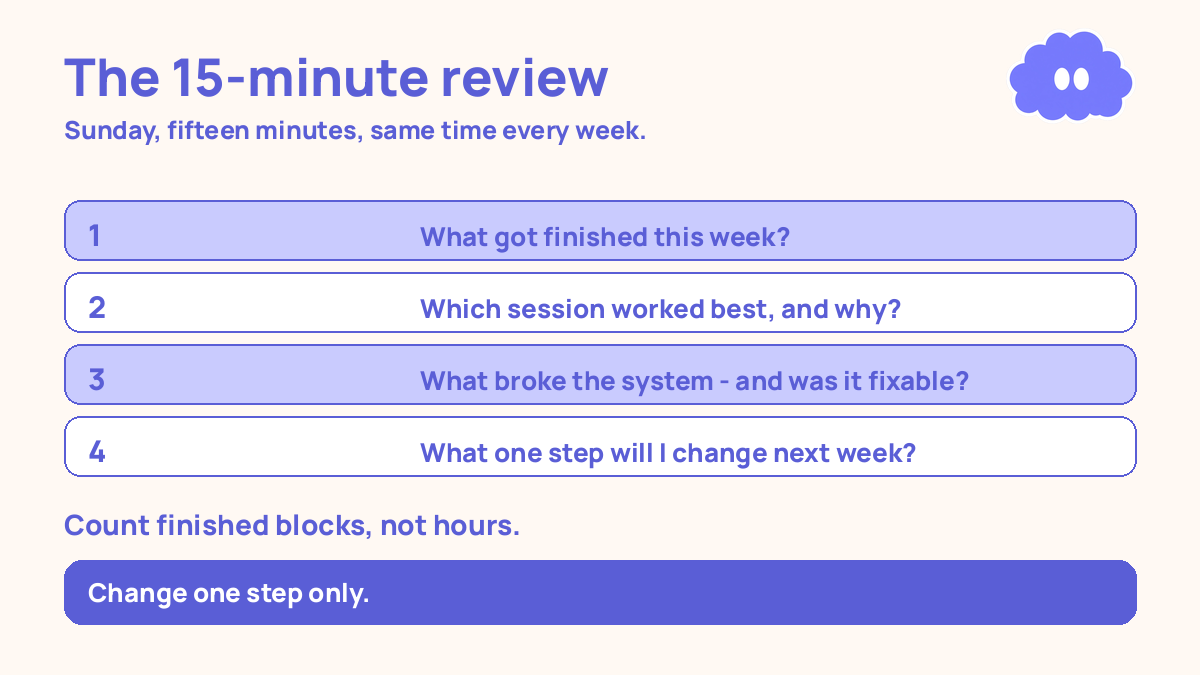
A weekly study review is fifteen minutes, once a week, on the same day: answer four questions in writing — what got finished, which session worked best and why, what broke the system and was it fixable, and what one step will I change next week? Change one step only. That is the whole system. It is what turns a study plan into a study system, because the system learns from the week instead of restarting every Monday.
Without a review, you are not running a system. You are making a fresh plan every week and hoping it works this time.
Why weeks blur together
Most students plan on Monday and never look back. By Sunday, the week is a blur: some days you studied, some days you did not, and you cannot say why. So Monday’s plan is a guess, built on a feeling, and it fails in the same places the last plan failed — the same hour that never happens, the same phone that always wins, the same task that is always too big.
A written review breaks that loop. Fifteen minutes of honest writing shows you the pattern: the hour that worked was always the morning one, the phone always won after 8pm, the tasks that finished were always the ones written in one line. Once you can see the pattern, one small change fixes it. Without the review, you keep changing everything and learning nothing.
For the full system behind this one, start with how to build a study system that fits your life. This article is the weekly review inside that system, as a standalone habit.
The system in short
- Pick one day and one time for the review — Sunday, fifteen minutes, same time every week.
- Answer four questions in writing: what got finished, which session worked best and why, what broke the system and was it fixable, what one step will I change next week?
- Change one step only. If the time failed, change the time. If tasks were too big, make them smaller. If the phone broke sessions, fix the phone setup first.
- Keep the reviews in one notebook or one file, dated, so you can look back in a month and see the pattern.
- Next week, run the system with the one change — and review again.
Step 1: Fix the review to one day and one time
Sunday works for most students, because the week is over and the next one has not started. Fifteen minutes, at the same time — after lunch, before dinner, whenever it survives. Set a timer. When it rings, stop. A review that takes an hour is not a review, it is a planning session wearing a review’s name, and you will stop doing it.
Keep the review in one place: a notebook, or one plain file, with the date at the top of each entry. “Oct 25 — …” The value is not in the tool. It is in the record. In a month, you can look back and see what kept breaking — and that pattern is worth more than any single week’s plan.
Do not skip the review in a bad week. A bad week reviewed honestly is worth more than a good week nobody looked at. The bad week is where the pattern lives.
Step 2: Question one — what got finished?
Write down what actually got finished this week, not what you planned to finish. Finished means done: questions answered, problems worked, a paragraph written, a topic tested. Not “studied biology” — “answered the 10 cell-division questions, worked 5 mole problems, wrote one essay paragraph”.
Be specific, and be honest. If the list is short, write the short list. A short list you can see is useful. A long list you invented is not. The point is not to feel good or bad — it is to know what happened, so next week’s plan is built on facts.
Count finished blocks, not hours. Four honest 25-minute blocks beat six distracted hours, and the count tells you the truth about the week in a way hours never do.
Step 3: Question two — which session worked best, and why?
Look at the finished list and find the best session of the week. Not the longest — the best. The one where the work was real and the time passed without a fight. Then write down why it worked. Was it the hour? The place? The phone in another room? The task written in one line? The topic you actually liked?
This question is the most useful one in the review, because it tells you what to do more of. Most students only ask what went wrong. Asking what went right shows you the conditions that work for you — and those conditions are different for everyone. Your best session might be 7am in the library. Someone else’s might be 9pm at the kitchen table. The review finds yours.
If no session worked, write that down too, and why: no hour protected, phone always in reach, tasks always too big. That is still an answer. It tells you the system never got a fair test.
Step 4: Question three — what broke the system, and was it fixable?
Write down what broke, in plain words. Not “I was lazy” — that explains nothing and fixes nothing. Name the break: “The 7pm hour got eaten by dinner every day.” “The phone was on the desk, so every block broke.” “The tasks were too big to finish in one block, so I never finished anything.”
Then ask: was it fixable? Most breaks are. A broken hour can move. A phone can go in another room. A big task can split. The breaks that are not fixable — an exam week, an illness, a family emergency — get a different answer: the system shrinks for a week, it does not die. One 25-minute block a day through a hard week keeps the habit alive. Zero for a month kills it.
If the same thing broke three weeks in a row, it is not a bad week. It is the system. Change the step that keeps breaking, not your attitude toward it.
Step 5: Question four — what one step will I change next week?
Pick one change. Only one. If the time failed, change the time. If tasks were too big, make them smaller. If the phone broke sessions, fix the phone setup first. Write the change down, in one line, at the bottom of the review.
One change, tried for a week, then reviewed again. That is how a system improves instead of restarting. If you change everything at once, you will never know what actually helped — and next Sunday you will be guessing again.
The change should be small enough to keep. “Study at 7am instead of 7pm” is a change. “Study perfectly every day” is not a change, it is a wish. Small, specific, keepable — that is the test.
A worked example: a Sunday review
It is Sunday, 4pm. Fifteen minutes, timer on, notebook open.
What got finished? Answered the cell-division questions, worked 5 mole problems, wrote one essay paragraph. Tested cell division twice, mole problems once. Three days kept the study hour, two days did not. Which session worked best, and why? Tuesday, 7pm, in the library. Phone in the bag, one task written down, two blocks finished without a break in focus. The library worked because the room was quiet and the phone was far away. What broke, and was it fixable? Thursday and Friday, the 7pm hour got eaten by dinner running late. Fixable: move the hour to 6pm on those days, or accept two blocks at 8pm instead. The phone broke one block on Wednesday — fixable, it was on the desk. One change for next week: Study hour moves to 6pm on Thursday and Friday. Phone goes in the bag, not on the desk, for every block.
Timer rings. Fifteen minutes, four answers, one change. Next week runs with the change, and next Sunday reviews it.
When it goes wrong
The review becomes a planning session. You sit down to review and spend an hour planning next week in detail. Stop. The review is fifteen minutes and four questions. Planning is a different job, and it comes after the review, not instead of it. If the timer rings and you are still planning, close the notebook.
You skip the review when the week was bad. That is the week it matters most. A bad week reviewed honestly shows you the break. A bad week skipped shows you nothing, and next week repeats it. Sit down, write the short list, find the one break, pick the one change. Fifteen minutes, even on a bad week.
You change everything every week. New hour, new place, new tasks, new timer — and nothing ever gets a fair test. One change, one week. If the change helped, keep it. If it did not, change it back or try the next one. A system that changes weekly is not a system, it is a series of first days.
You review in your head instead of writing it down. A review in your head is a feeling, and feelings fade by Monday. A review in writing is a record, and a record shows you the pattern in a month. Write it down. Four questions, in writing, every week. That is the system.
Weekly review checklist
Copy this list and use it each Sunday:
- What got finished this week — finished, not planned?
- Which session worked best, and why — the hour, the place, the phone, the task?
- What broke the system this week, and was it fixable?
- What one change will I make next week — and is it small enough to keep?
Downloadable infographic spec: one vertical image, title “The 15-minute weekly review”, with the four questions — what got finished, which session worked best, what broke, what one change — and the rule “change one step only”, in Thynq cream, Cloud Purple, Dark Purple and pink, with the cloud mascot. Text taken word-for-word from this article.
What this system is not
It is not a promise that reviewing will fix your studying, and it is not a claim that fifteen minutes a week is enough on its own. The review only works if there is a system to review — an hour, a task, a timer. On a week with no system at all, the review will show you that, honestly, and that is still useful. This is a practical habit for keeping a system honest: four questions, in writing, one change, every week. If the review stops helping, change the review — one step at a time, and check after a month whether the pattern is clearer.
Sources
- Dunlosky, J., et al. (2013). Improving students’ learning with effective learning techniques. Psychological Science in the Public Interest, 14(1), 4-58. Only practice testing and distributed practice received a high utility rating; rereading was rated low.
- Cepeda, N., et al. (2006). Distributed practice in verbal recall tasks. Psychological Bulletin, 132(3), 354-380. Spaced practice beat massed practice; the best gap grows with how long you need to remember the material.
For the full system behind this one, start with how to build a study system that fits your life. The review pairs directly with the notes system you can actually review — the notes give you something to test, and the review tells you whether the testing is working. For the daily timer that holds the system together, use the Pomodoro technique for students.
Questions
How long should a weekly review take?
Fifteen minutes, once a week, on the same day. Longer than that and it turns into planning, which is a different job. Set a timer, answer the four questions in writing, pick one change, and stop.
What if the week was bad and I did almost nothing?
That is the week the review matters most. Write down what actually happened, without dressing it up, and find the one thing that broke first. A bad week reviewed honestly is worth more than a good week nobody looked at.
Should I change my whole system if the week went badly?
No. Change one step only. If you change everything at once, you will never know what actually helped. One change, tried for a week, then reviewed again. That is how a system improves instead of restarting.
Do I need a special notebook or app for the review?
No. One notebook, or one plain file, with a date at the top of each review. The value is in the written record — being able to look back in a month and see what kept breaking — not in the tool.