The direct answer
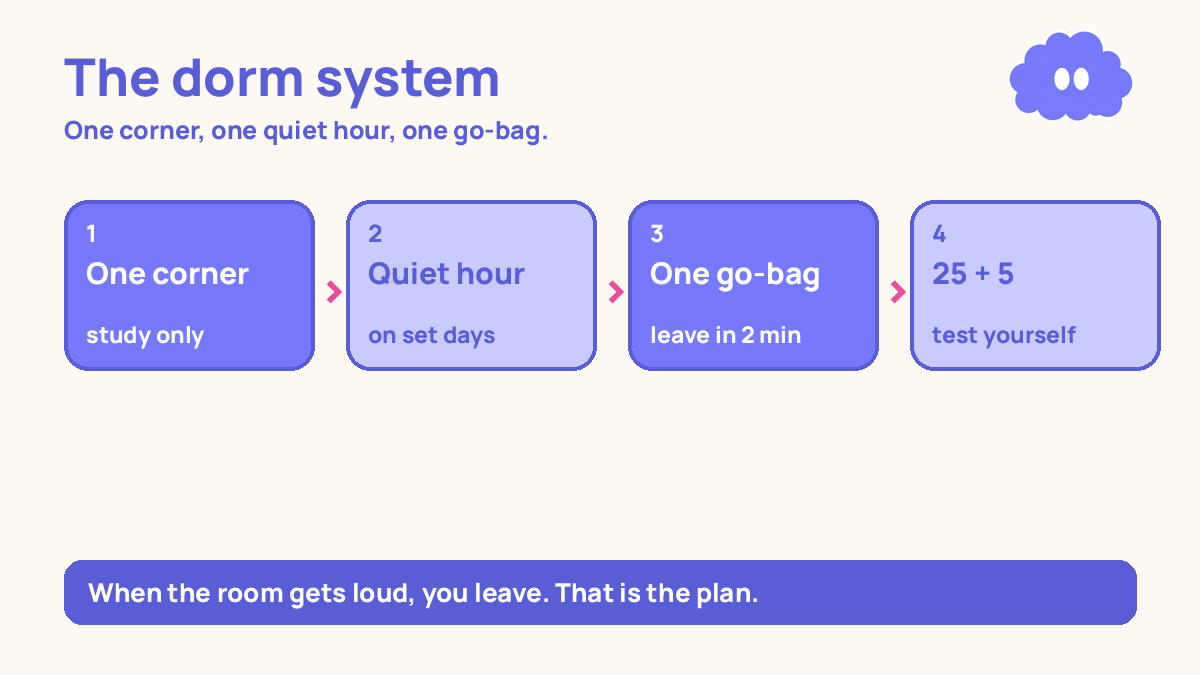
A dorm study system has three parts: one corner that is only for study, one agreed quiet hour with your roommate, and a go-bag packed for the library. Pick a daily time you can keep, do one task at a time, and test yourself instead of re-reading. When the room gets loud, you leave — that is part of the plan, not a sign it failed.
You do not need a perfect room. You need a system that works in a shared room, on a normal day, with other people living in it.
Why dorms break study systems
Most study advice assumes a quiet room and a desk. A dorm gives you neither. You share a room, the noise never fully stops, someone is always coming or going, and the bed is two steps away. So the usual plan — sit at your desk for three hours — falls apart on day one, and you blame yourself for a problem the room created.
The fix is not more willpower. It is a smaller system, built for the room you actually have. One corner, one hour, one task. And a second place to go when the first place stops working.
For the full system behind this one, start with how to build a study system that fits your life. This article is that system, fitted to a dorm room.
The system in short
- Pick one corner of the room and use it only for study. Not the bed, not the floor — one chair, one surface.
- Agree one quiet hour with your roommate, on set days. One hour, kept, beats three hours argued about.
- Pack a go-bag for the library: notes, charger, water, one task written down. Leaving should take two minutes.
- Study in short blocks with a timer — 25 minutes of work, 5 minutes of break — and test yourself from memory instead of re-reading.
- Review each topic again after a gap: the next day, then a few days later. That spacing is a practical starting schedule, not a research rule.
- Once a week, check what worked and change one thing.
Step 1: Claim one corner
You do not need a whole desk. You need one spot your brain learns to associate with work. A corner of the shared table, a chair by the window, the small desk if you have one. When you sit there, you study. When you are done, you leave it.
Keep the corner boring on purpose. Notes for today’s task, a pen, a timer. Nothing else. If the corner fills up with clothes, chargers and snack wrappers, it stops being a study corner and becomes a shelf. Clear it every night — thirty seconds, before bed.
If your room genuinely has no workable corner, skip to step 3 and make the library your corner. Do not study in bed. Your bed is where you sleep, and studying there teaches your brain that the bed is a place to be half-awake and half-working. You will fall asleep, or you will lie awake later. Either way, you lose.
Step 2: Agree one quiet hour
Do not ask your roommate for silence all evening. Ask for one hour, on set days, at a set time. “Can we keep 7 to 8pm quiet on weekdays? I will keep it too.” A small agreement people keep beats a big rule people ignore.
Make it easy to keep. Agree what quiet means: headphones on, no video calls, no music out loud. Put it on a note on the wall if that helps — not as a rule, as a reminder you both chose. And offer the same hour back. If your roommate needs 9 to 10pm for their own work, say yes. A system that only works one way will not last a week.
If your roommate will not agree, do not fight about it. Use the hour anyway, with headphones, and move your deep work to the library. The quiet hour is the cheapest version of the system, not the only one. A study system for shared-house students works on the same rule: agree the hours, plan one task at a time, review once a week.
Step 3: Pack a go-bag for the library
The library is your second study place, and the go-bag is what makes it usable. Without it, going to the library takes twenty minutes of packing, finding a charger, and deciding what to work on — and you will stay in the noisy room instead.
Pack it the night before. Notes for tomorrow’s task, a charger, water, earphones, and one task written on a slip of paper: “Answer the 10 questions on cell division from memory.” When the room gets loud, you grab the bag and go. Two minutes, no decisions.
Use the library for the work that needs real quiet: writing, problem sets, testing yourself. Use the dorm corner for short, planned sessions: one 25-minute block, one small task, then stop. Both places have a job. Neither place has to do everything.
Step 4: One task, one timer, test yourself
Dorm study fails when a session has no shape. “Study biology” in a noisy room becomes an hour of shuffling papers. Write the task in one line before you start: “Work through the five mole-calculation problems on page 42.” If you cannot write it in one line, the task is too big — split it.
Set a timer for 25 minutes and work on that one task only. When it rings, take a 5-minute break. The 25-minute length was Francesco Cirillo’s practical choice when he built the Pomodoro Technique as a student, not a number derived from cognitive science — but the structure is what matters: a clear start, a clear stop, and a break you actually take.
Inside the block, test yourself. Answer questions from memory, work problems, write from recall, then check your answers. In a 2013 review, Dunlosky and colleagues rated ten common study techniques, and only two received a high utility rating: practice testing and distributed practice. Re-reading was rated low. A 25-minute block spent re-reading notes in a dorm is a well-timed version of the weakest method. The same 25 minutes spent testing yourself is the strongest one.
Put your phone in your bag, on silent, during the block. A phone on the desk in a dorm is a phone that buzzes every time someone in the building messages. If you need the phone for a timer, use a laptop timer or a watch instead.
Step 5: Space the review out
Testing yourself once is not enough. Review each topic again after a gap — the next day, then a few days later. That is a practical starting schedule to try for a week, not a rule from research. The research direction is clear, though: in a 2006 synthesis, Cepeda and colleagues found that spaced practice beat massed practice across materials, ages and retention intervals, and that the best gap grows with how long you need to remember the material. So a topic for next month’s exam gets longer gaps than a topic for Friday’s test.
Keep the review short. Ten minutes per topic, from memory, then check. If you got it wrong, it goes back into tomorrow’s list. If you got it right twice, the gap gets longer.
A worked example: a weekday evening in the dorm
You have classes until 4pm. Your roommate is in the room, music on, a friend visiting.
4:30–4:55 — Dorm corner, block 1: Answer the 10 cell-division questions from memory, then check against your notes. Phone in your bag. 5:00–5:25 — Dorm corner, block 2: Work through the five mole-calculation problems. Roommate’s friend leaves; the room quiets down. 5:30 — Break and dinner: Eat, walk, rest. No studying. 7:00–8:00 — Agreed quiet hour: Your roommate has headphones on. You write the first draft of one essay paragraph, then review yesterday’s topics from memory — ten minutes each. 8:00 — Stop: Pack the go-bag for tomorrow, clear the corner, write tomorrow’s one task on a slip of paper.
Four blocks, four finished pieces of work, and you know exactly what you did. If the room had stayed loud at 7pm, the plan was the same — you would have taken the go-bag to the library instead.
When it goes wrong
Your roommate will not keep the quiet hour. Do not renegotiate every day. Use headphones for the hour, move deep work to the library, and try once more with a smaller ask — half an hour, three days a week. If it still does not hold, the system still works: the library is your quiet hour now.
You keep studying in bed because the corner is taken. The bed will win every time — it is warm and it is there. Stand up, take the go-bag, and go to the library, the common room, or a corridor table. Any chair that is not a bed is better than a bed.
The library is full or closed. Have a third place ready before you need it: a quiet corner of the dining hall after meals, an empty classroom, a stairwell landing with a table. The system needs two places, not one, and the third place is insurance.
You re-read your notes for an hour and call it studying. The timer only controls time. What you do inside it still matters. If you catch yourself re-reading, stop, close the notes, and write down everything you remember. That is the test. Then check. Feeling fluent right after re-reading is not the same as remembering a week later — students who recalled a passage remembered more a week later than students who restudied it, even though the restudiers felt more confident right after studying.
Weekly review checklist
Copy this list and use it each week:
- Which days did the quiet hour actually happen, and which days did I go to the library instead?
- How many 25-minute blocks did I complete, and how many were spent testing myself rather than re-reading?
- What broke the system this week — noise, the bed, the phone, or tasks too big?
- What one change will I make next week: a different quiet hour, a better go-bag, smaller tasks, or phone in the bag?
Downloadable infographic spec: one vertical image, title “The dorm system”, with the three parts — one corner, one quiet hour, one go-bag — and the cycle: one task written down, 25 minutes, test yourself, review after a gap, in Thynq cream, Cloud Purple, Dark Purple and pink, with the cloud mascot. Text taken word-for-word from this article.
What this system is not
It is not a promise of a grade, and it is not a claim that one corner and one quiet hour will fix every dorm. Some dorms are loud, some roommates are difficult, and some weeks the library is the only place that works. This is a practical system for a shared room: a corner, an hour, a bag, and an honest count of what you actually did. If the room changes, change the system — one step at a time, and check after a week whether the change helped.
Sources
- Dunlosky, J., et al. (2013). Improving students’ learning with effective learning techniques. Psychological Science in the Public Interest, 14(1), 4-58. Only practice testing and distributed practice received a high utility rating; rereading was rated low.
- Cepeda, N., et al. (2006). Distributed practice in verbal recall tasks. Psychological Bulletin, 132(3), 354-380. Spaced practice beat massed practice; the best gap grows with how long you need to remember the material.
- Roediger, H., & Karpicke, J. (2006). Test-enhanced learning. Science. Students who recalled a passage remembered more a week later than students who restudied it.
- Cirillo, F. — Pomodoro Technique, late 1980s. Classic cycle: 25 minutes work, 5 minutes break, longer break after four. The 25-minute length was Cirillo’s practical choice, not a number derived from cognitive science.
For the full system behind this one, start with how to build a study system that fits your life, and if you share a house rather than a dorm room, the study system for shared-house students works on the same rule. For exam revision in this system, use how to revise for exams without cramming.
Questions
What if I do not have a desk in my dorm room?
Pick one corner and one chair, and use it only for study. If the room has no workable corner at all, make the library your desk and keep a packed go-bag by the door so leaving takes two minutes, not twenty.
How do I get quiet hours from a roommate?
Ask for one hour on set days, not the whole evening, and keep your side of it. A small agreement people keep beats a big rule people ignore. Offer the same hour back when they need it.
Should I study in bed if there is nowhere else?
No. Your bed is where you sleep, and your brain knows it. Study at the desk, the table, or the library, even if it is less comfortable. Comfort that puts you to sleep is not helping.
What do I do when the dorm is too loud to focus?
Leave. That is the system, not a failure of it. Noise-cancelling headphones help with background noise, but a loud room is a signal to move to the library or a quiet corner, not to sit there getting angry.