
The direct answer
When you cannot start studying, shrink the first step until it is too small to argue with: two minutes of real work. Open the book, read one question, write one line. Set a timer for 25 minutes, put your phone in another room, and do only that one tiny step. Motivation usually follows starting — it almost never comes first.
You do not have a motivation problem. You have a first-step problem. Make the first step tiny, and the rest of the session can follow.
Why starting is the hardest part
Sitting down to study feels hard because the task in your head is enormous: “study biology” means hours of work, a pile of notes, and an exam somewhere in the future. Your brain looks at that, finds something easier — the phone, a snack, a video — and takes it. That is not laziness. That is a brain choosing a small, clear task over a huge, vague one.
So the fix is not a pep talk. It is a smaller first step. Two minutes of real work is a small, clear task, and your brain can say yes to it. Once you have started, the second step is easier than the first, because starting is the part that costs the most energy. Everything after starting is cheaper.
For the full system behind this one, start with how to build a study system that fits your life. This article is the first five minutes of that system, for the days when even five minutes feels too much.
The system in short
- Shrink the first step to two minutes of real work — not preparing to study, studying.
- Write one task in one line, on paper, before you start. If you cannot write it in one line, the task is too big.
- Put your phone in another room, on silent. Not face down on the desk — another room.
- Set a timer for 25 minutes and start. Work on that one task only.
- When the timer rings, decide honestly: one more block, or stop for today. Either answer is allowed.
- If you stopped early, write down what stopped you — phone, tiredness, a task too big — and fix that one thing tomorrow.
Step 1: Shrink the first step to two minutes
Do not plan to study for three hours. Plan to study for two minutes. Open the book to the right page. Read one question. Write one line of an answer. That is the whole plan.
Two minutes is too small to argue with. Your brain cannot reasonably say “two minutes is too much” — and that is the point. The step is designed to be undeniable. Once the two minutes are done, you are already studying. The timer is already running. The book is already open. The hardest part is already behind you.
If two minutes still feels too big, make it one minute. Open the book and read the first question. That is it. The step must be so small that refusing it feels sillier than doing it.
This is not a trick. It is how starting actually works: motion first, motivation second. Nobody feels motivated to start a hard task. People who start hard tasks start them while unmotivated, and the motivation arrives somewhere in the middle — or it does not, and they finish anyway, because the timer is running and the task is written down.
Step 2: Write one task in one line
A vague task is a session that never starts. “Study biology” can mean anything, so your brain picks the easiest thing in the room. Write the task in one line, on paper, before you touch the timer: “Answer the 10 questions on cell division from memory.” You either did it or you did not.
If you cannot write it in one line, the task is too big — split it. “Write the essay” becomes “write the first paragraph”. “Revise chemistry” becomes “work through the five mole-calculation problems on page 42”. A block holds one small, finished piece of work. A task that fits in one line is a task you can start.
Keep the line visible while you work. When your attention drifts, the line pulls it back: this is the task, this is the only task, the timer will ring.
Step 3: Remove the phone from the room
Starting is hard enough without a phone in reach. A phone on the desk is a phone you will check before the two minutes are up — and once you check it, the session is over before it began. Put it in another room, on silent. Not face down on the desk — another room.
If you need a timer, use a kitchen timer, a watch, or a laptop timer — with the phone still in another room. A timer on the same device as your messages is a timer that loses.
This step feels extreme the first time. It is not. It is the cheapest version of focus there is: distance, not willpower. Willpower fails, especially at the start of a session. Distance works while you are still deciding whether to begin.
Step 4: Let the timer do the starting
Set a timer for 25 minutes and start. The timer does the job motivation was supposed to do: it gives you a start you cannot negotiate with, and an end you can trust. You only have to hold focus until it rings. Then you get a break, and you get to decide again.
The 25-minute block comes from the Pomodoro Technique, built by Francesco Cirillo as a university student in the late 1980s: 25 minutes of work, 5 minutes of break, a longer break after four rounds. The 25-minute length was his practical choice, not a number derived from cognitive science — but the structure is what helps on a day you cannot start: a clear start, a clear stop, and a break you actually take.
If 25 minutes feels too long on a bad day, set the timer for 15. A 15-minute block you finish is worth more than a 25-minute block you never start. The timer still does the same job at any length.
Step 5: Decide honestly when the timer rings
When the timer rings, stop and ask one question: one more block, or stop for today? Either answer is allowed — but it must be an honest answer, not a drift. If you did one real block, that is a start, and it counts. If you have energy for one more, do one more. If you are genuinely exhausted, stop, rest, and start again tomorrow with the same tiny first step.
What you must not do is sit at the desk for three hours, half-working, and call it a day. That is the worst of both worlds: no rest, and no work. One honest block and a real break beats three hours of pretending.
And if you stopped after five minutes, write down what stopped you before you walk away. Phone, tiredness, a task too big, a worry you could not shake. That note is the most useful thing in the session — it tells you what to fix tomorrow. A five-minute start that teaches you the blocker is worth more than a day of waiting to feel ready.
A worked example: a day when nothing will start
It is 5pm. You have been meaning to study since lunch. You have opened your notes three times and closed them three times. The exam is next week.
5:00 — Two minutes: You write one line on paper: “Answer the 10 cell-division questions from memory.” Phone goes in the kitchen. Timer set for 25 minutes. You open the book. 5:00–5:25 — Block 1: You answer six questions before the timer rings. You check them: four right, two wrong. The two wrong ones go on tomorrow’s list. 5:25–5:30 — Break: Water, stretch, stand up. You feel better than you did at 5pm — not because the work was easy, but because it started. 5:30–5:55 — Block 2: You finish the last four questions, then review yesterday’s topic from memory for ten minutes. 5:55 — Stop: Two blocks, one topic tested, tomorrow already decided. You did not feel motivated at 5pm. You started anyway, and starting did the work motivation was supposed to do.
When it goes wrong
You wait all day to feel ready, and the day disappears. Waiting is the failure mode. The fix is the two-minute step, done now, badly, rather than perfectly later. A bad start today beats a perfect start tomorrow that never comes.
You start, then check your phone “for a second” and lose an hour. The phone was too close. Another room is the rule. If you work somewhere you cannot leave it in another room, put it in your bag, zipped, on silent, at the bottom. Two seconds to check becomes twenty seconds of unzipping — and that is usually enough.
The task is so big you cannot write it in one line. Then it is not one task, it is a project. Split it until one piece fits in one line. “Write the essay” is a project. “Write the first paragraph” is a task. Start with the task.
You start every day and stop after one block, every day. One block a day is still a system — it is better than zero. But if you always stop after one, ask why: is the block too long, is the task too hard, or are you tired at that hour? Change one thing — a shorter block, a smaller task, a different hour — and check after a week. Do not change everything at once, or you will never know what actually helped.
Weekly review checklist
Copy this list and use it each week:
- How many days this week did I start, and how many days did I wait and never start?
- What was the first step on the days I started — was it small enough?
- What stopped me on the days I stopped early — phone, tiredness, a task too big, or a worry?
- What one change will I make next week: a smaller first step, phone further away, a different hour, or smaller tasks?
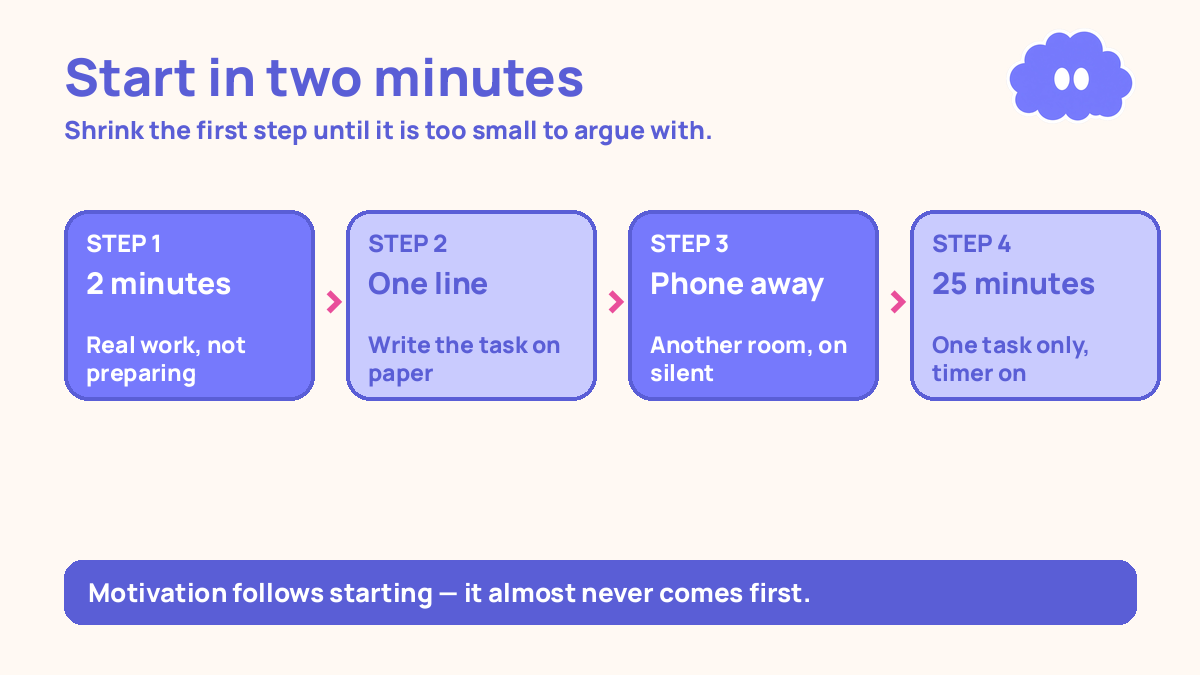
Downloadable infographic spec: one vertical image, title “Start in two minutes”, with the four steps — shrink it to two minutes, write one task in one line, phone in another room, timer on — and the rule “motivation follows starting”, in Thynq cream, Cloud Purple, Dark Purple and pink, with the cloud mascot. Text taken word-for-word from this article.
What this system is not
It is not a promise that starting will always feel good, and it is not a claim that two minutes will fix a week of avoidance. Some days you will start and stop after one block. Some days the exhaustion is real and rest is the right answer. This is a practical system for the hardest five minutes of studying: a tiny first step, one written task, a phone in another room, and a timer. If the first step does not work, make it smaller — not bigger, not louder, smaller — and check after a week whether it helped.
Sources
- Cirillo, F. — Pomodoro Technique, late 1980s. Classic cycle: 25 minutes work, 5 minutes break, longer break after four. The 25-minute length was Cirillo’s practical choice, not a number derived from cognitive science.
- Roediger, H., & Karpicke, J. (2006). Test-enhanced learning. Science. Students who recalled a passage remembered more a week later than students who restudied it, even though the restudiers felt more confident immediately after studying.
For the full system behind this one, start with how to build a study system that fits your life. If your phone is the thing that stops you starting, the phone focus system for distracted students goes deeper on it. And for the timer itself, step by step, use the Pomodoro technique for students.
Questions
Should I wait until I feel motivated to study?
No. Motivation usually follows starting, not the other way round. A two-minute first step is small enough to do without motivation, and once you have started, the next step is easier than the first. Waiting for the feeling is how a day disappears.
What is the smallest first step that actually works?
Two minutes of real work: open the book, read one question, write one line. Not preparing to study — studying, at the smallest size. If two minutes feels too big, make it one minute. The step must be too small to argue with.
What if I start and then stop after five minutes?
Then you started, and that counts. Write down what stopped you — phone, tiredness, a task too big — and fix that one thing tomorrow. A five-minute start that teaches you the blocker is worth more than a day of waiting.
Does this work on days when I am genuinely exhausted?
On a truly exhausted day, do one 25-minute block and stop. Rest is also part of the system. The rule is: one small start, then an honest decision. Pushing through exhaustion every day is not discipline, it is a crash waiting to happen.