
The direct answer
A notes system you can actually review is: one page per topic, written as questions with the answers on the other side, tested from memory the next day and again a few days later. No copying slides word for word, no highlighting everything, no five-page notes that never get opened. If you cannot test yourself from your notes, they are not notes — they are a filing cabinet.
Your notes should be a tool you use every day, not a pile you avoid.
Why notes pile up unread
Most students take notes the same way: copy what the teacher said, or what the slide said, as fast as possible, in full sentences. The notes get longer, neater, and more complete — and they never get read again. Because reading them feels like work, and re-reading them feels like nothing is happening. Both feelings are correct. Re-reading is the weakest way to use notes.
The problem is the shape of the notes. Notes written as statements can only be re-read. Notes written as questions can be tested. And testing is the work that makes the material stick. In a 2013 review, Dunlosky and colleagues rated ten common study techniques, and only two received a high utility rating: practice testing and distributed practice. Re-reading, highlighting and summarising were all rated low. So a pile of beautiful notes you only re-read is a pile of the weakest method, neatly filed.
For the full system behind this one, start with how to build a study system that fits your life. This article is the notes inside that system, built to be tested.
The system in short
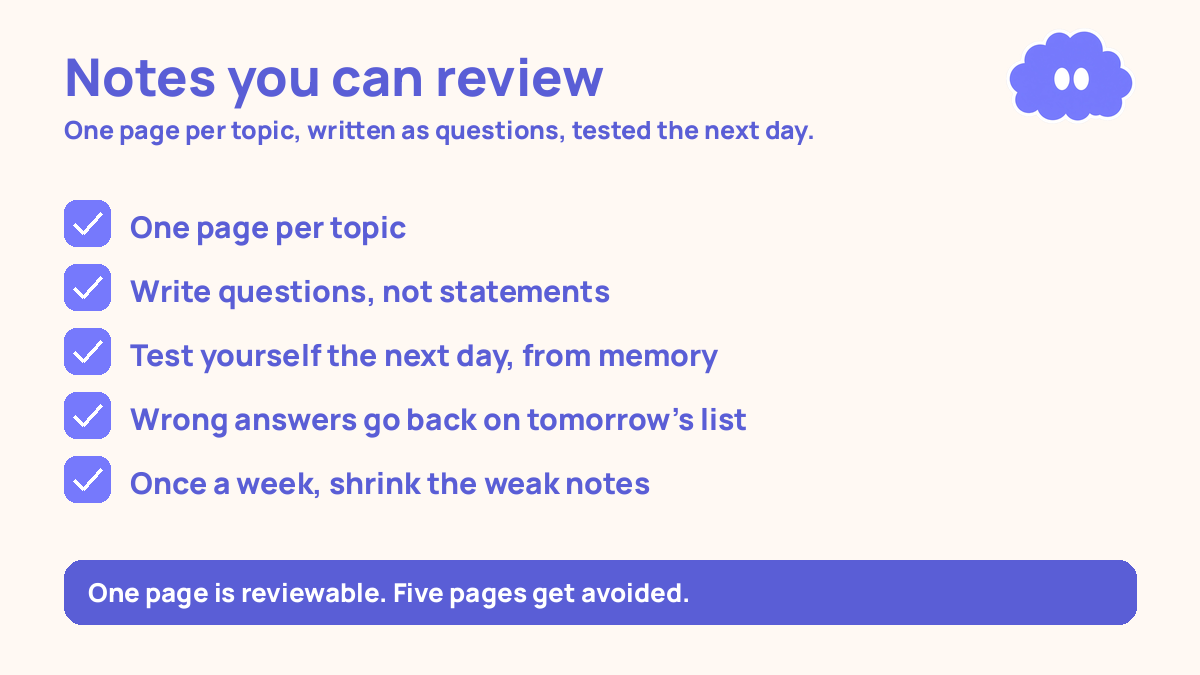
- One page per topic. If a topic needs five pages, you have not understood it yet — shrink it.
- Write notes as questions, with the answers on the other side of the page or on a separate sheet.
- In class, capture the question and the answer in your own words. Do not copy slides word for word.
- The next day, test yourself from the questions, without looking. Then again a few days later.
- Anything you get wrong goes back on tomorrow’s list. Anything you get right twice gets a longer gap.
- Once a week, in the weekly review, check which topics are still weak and which notes need shrinking.
Step 1: One page per topic
One page is a rule, not a suggestion. A topic that fits on one page is a topic you can review in ten minutes. A topic spread over five pages is a topic you will avoid, because opening it feels like starting a chore.
Shrinking a topic to one page forces you to decide what matters. What are the five questions this topic has to answer? What are the answers, in your own words, in two lines each? Everything else is detail you can look up when you need it — it does not belong on the review page.
If a topic genuinely will not fit, split it. “Cell division” becomes two pages: “Mitosis” and “Meiosis”, each with its own questions. Two small pages beat one huge one, because each one is a finished job you can test.
Keep the page simple: the topic at the top, questions down the left, answers on the back or a separate sheet. No colour-coding system, no symbols, no perfect handwriting. The page is a tool, not a display.
Step 2: Write questions, not statements
In class, do not copy what the teacher said. Listen for the question the material answers, and write that down. “Why does the cell divide?” — not a paragraph about division. “How do you calculate moles?” — not the formula copied from the board.
Write the answer in your own words, in two lines, on the other side of the page. Your own words matter because they prove you understood it. A copied sentence proves you can copy. When you test yourself later, the question is on one side and the answer is hidden — and the test is real.
If the teacher gives you a handout or slides, do not copy them into your notes. Staple the handout to the page, or write the slide number on it. Your notes are the questions. The handout is the reference. Mixing them together gives you five pages of reference and no questions at all.
Step 3: Test yourself the next day
The first review happens the next day, from memory, without looking. Read the question, answer it out loud or on paper, then check. That first test is where you find out what you did not actually learn — and finding out a day later is cheap. Finding out the night before the exam is not.
Feeling fluent right after re-reading is not the same as remembering a week later. In a 2006 study, Roediger and Karpicke found that students who recalled a passage remembered more a week later than students who restudied it, even though the restudiers felt more confident immediately after studying. The test feels harder than re-reading, and that difficulty is the point.
Keep the test short: ten minutes per topic, five questions, then check. If you got a question wrong, it goes back on tomorrow’s list. If you got it right, it comes back in a few days. If you got it right twice, the gap gets longer. That is a practical starting schedule — next day, then a few days later — not a rule from research. The research direction is clear, though: in a 2006 synthesis, Cepeda and colleagues found that spaced practice beat massed practice across materials, ages and retention intervals, and that the best gap grows with how long you need to remember the material.
Step 4: Use the weekly review to shrink weak notes
Once a week, look at your question lists and ask the four weekly review questions: what got finished, which session worked best and why, what broke and was it fixable, what one change will I make next week? For notes, the useful version is: which topics are still weak after two tests, and do their notes need shrinking?
A topic that stays weak usually has notes that are too long, too copied, or too vague. Shrink them: fewer questions, shorter answers, your own words. A topic with five questions you can answer is stronger than a topic with twenty questions you avoid. The weekly study review system is the habit that catches this — fifteen minutes on Sunday, four questions, one change.
Do not keep adding to notes that are not working. Adding more pages to a pile you avoid makes a bigger pile you avoid. Shrink, test, repeat.
A worked example: a week of notes for two topics
You have two topics this week: cell division and mole calculations.
Monday, in class: Cell division — one page, five questions, answers in your own words on the back. Mole calculations — one page, five questions, worked examples in your own words. Tuesday, 25 minutes: Test cell division from memory. Four right, one wrong — the wrong one goes on Wednesday’s list. Test mole calculations: three right, two wrong — both go on Wednesday’s list. Wednesday, 25 minutes: Retest the three wrong questions. All three right this time. Review cell division once more, quickly. Friday, 10 minutes: Test both topics again, quickly. Cell division: all five right. Moles: four right, one wrong — it stays on the list. Sunday, weekly review: Cell division is done — its gap gets longer. Moles has one stubborn question — shrink its notes to two lines and test it again on Monday.
Two topics, two pages, four short tests, and you know exactly which question is still weak. Compare that with five pages of copied notes nobody opened.
When it goes wrong
Your notes are five pages per topic and you avoid them. Shrink them. One page, five questions, answers in your own words. The pile is not the problem — the size of each page is. A one-page topic gets tested. A five-page topic gets avoided.
You highlight everything and call it reviewing. Highlighting feels like work and mostly is not. If everything is highlighted, nothing is. Stop highlighting, write five questions instead, and test yourself on them. The test is the review.
You rewrite your notes neatly and feel like you studied. Rewriting is copying, and copying is the weakest method wearing a neat outfit. Spend that time testing instead. Neat notes you never test are still notes you never use — they are just prettier.
You test yourself once and never again. One test is not enough. The second test, after a gap, is where the learning happens. Put the wrong answers on tomorrow’s list, and the right answers on a list for a few days later. Without the gap, you are testing short-term memory, not learning.
Weekly review checklist
Copy this list and use it each week:
- Which topics did I test this week, and which questions are still wrong after two tests?
- Which notes are too long, too copied, or too vague — and can I shrink them to one page?
- Did I test from memory, or did I mostly re-read and highlight?
- What one change will I make next week: fewer questions per topic, shorter answers, testing the next day without fail, or shrinking one stubborn topic?
Downloadable infographic spec: one vertical image, title “Notes you can actually review”, with the three rules — one page per topic, questions not statements, test the next day and again after a gap — and the cycle: write, test, check, repeat, in Thynq cream, Cloud Purple, Dark Purple and pink, with the cloud mascot. Text taken word-for-word from this article.
What this system is not
It is not a promise of a grade, and it is not a claim that one page per topic will work for every subject. Some subjects need diagrams, some need long worked examples, and some need a teacher’s help before the notes make sense. This is a practical system for notes that get used: one page, questions, a test the next day, and a weekly check of what is still weak. If a subject needs more, give it more — one page at a time, and check after a week whether the notes are being tested or just being kept.
Sources
- Dunlosky, J., et al. (2013). Improving students’ learning with effective learning techniques. Psychological Science in the Public Interest, 14(1), 4-58. Only practice testing and distributed practice received a high utility rating; rereading, highlighting and summarising were rated low.
- Cepeda, N., et al. (2006). Distributed practice in verbal recall tasks. Psychological Bulletin, 132(3), 354-380. Spaced practice beat massed practice; the best gap grows with how long you need to remember the material.
- Roediger, H., & Karpicke, J. (2006). Test-enhanced learning. Science. Students who recalled a passage remembered more a week later than students who restudied it.
For the full system behind this one, start with how to build a study system that fits your life. The notes pair directly with the weekly study review system — the notes give you something to test, and the review tells you which notes need shrinking. For the testing itself, use the spaced repetition system for students.
Questions
Should I rewrite my notes neatly after class?
No, not as a habit. Rewriting feels like studying and mostly is not — it is copying. Spend that time turning the notes into questions and testing yourself on them instead. Neat notes you never test are still notes you never use.
How many pages of notes should one topic have?
One page, if you can. A topic that needs five pages is a topic you have not understood yet — shrink it to the questions that matter and the answers in your own words. One page is reviewable. Five pages get avoided.
When should I first review new notes?
The next day, from memory, without looking. Then again a few days later. That is a practical starting schedule, not a research rule. The first review is the one that matters most — it is where you find out what you did not actually learn.
What do I do with notes for a subject I hate?
Make the notes smaller and the tests shorter. One page, five questions, one 25-minute block. A hated subject with a small, finished task beats a hated subject with a pile of notes you avoid. The system is the same — the size is what changes.