
The direct answer
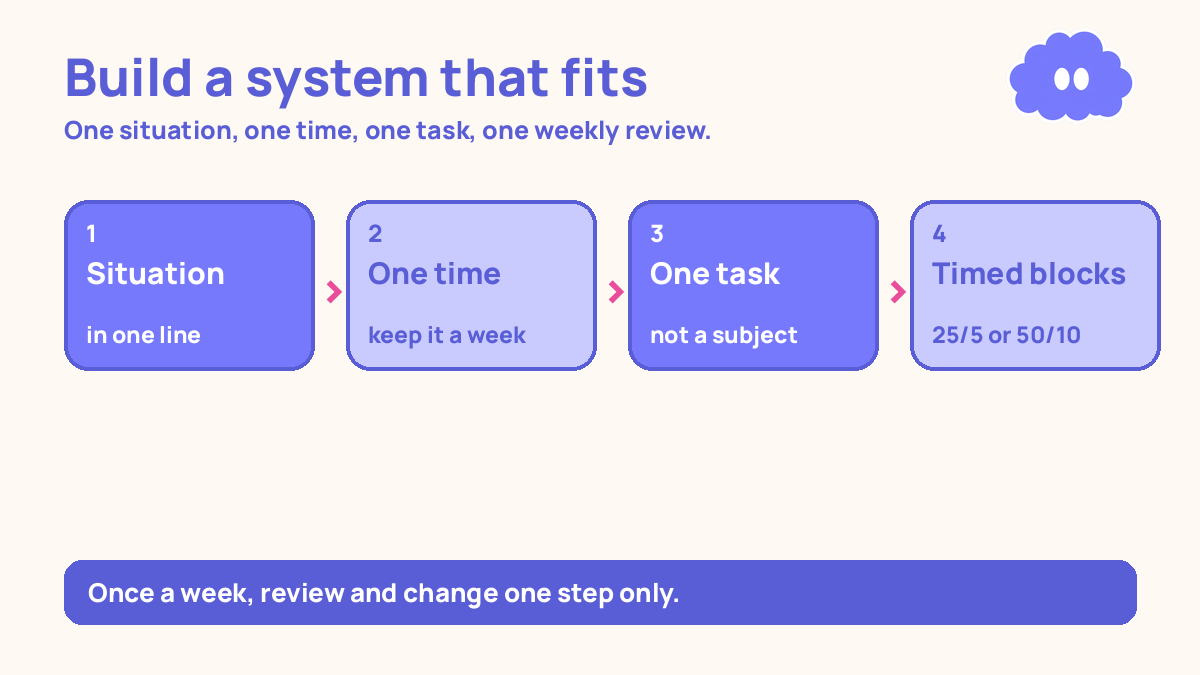
A study system that fits your life has four parts: one situation you are actually in, one daily time you can keep, one task at a time, and a weekly review where you change one thing. Pick those four, try them for one week, and do not buy an app or a new planner first.
Most study advice fails for the same reason. It describes a perfect student with a quiet room, eight free hours, and no job. You are not that student, or you would not be reading this. A system built for someone else’s life will break in yours on day two, and then you will blame yourself instead of the system.
So start from your life, not from a template.
The system in short
- Name your situation in one line: shared house, dorm, working student, online learner, or something else.
- Pick one daily study time you can keep for a week, even on a bad day.
- Before each session, write down one task, not a subject.
- Work in timed blocks, with a real break between them.
- At the end of the session, write down what is left.
- Once a week, review and change one step only.
That is the whole system. Everything else in this article is how to make those six steps fit your week.
Step 1: Name your situation honestly
Write one sentence about how you actually study now. Not how you wish you studied.
- “I live in a shared house and it is noisy after 6pm.”
- “I work shifts and I am tired in the evenings.”
- “I study online and no one checks whether I did the work.”
- “I have two hours a day, and I waste the first hour deciding what to do.”
That sentence picks your system for you. A noisy house needs agreed hours and a place to go, which is why there is a whole study system for shared-house students. Shift work needs short, tight plans, which is why the two-hour study system for working students exists. If your phone is the problem, start with the phone focus system for distracted students before you worry about anything else.
Do not try to fix every problem at once. Pick the one problem that breaks most of your sessions, and build the system around that.
Step 2: Pick one time you can keep
Do not pick your best time. Pick your most reliable time.
A good test: could you keep this hour on a tired day, a busy day, and a day when something went wrong? If the answer is no, the time is too ambitious. Pick a smaller, safer time.
One hour a day, kept for a week, beats four hours planned and two hours done. You can grow the time later, once the habit is real. You cannot grow a habit you never started.
Write the time down where you will see it. A note on your phone’s lock screen, a paper note on your desk, or a message to yourself. “Study 7-8am” is a plan. “Study sometime today” is a wish.
Step 3: One task, not a subject
“Study biology” is not a task. It is too big, and you will spend half the session deciding where to start.
A task has a verb and a finish line:
- Read chapter 4 and write 10 questions from memory.
- Do past-paper questions 1 to 5, then mark them.
- Turn yesterday’s lecture notes into one page of notes.
Write the task before the session starts, not during it. The five minutes you spend choosing a task during study time are five minutes you will not get back, and they are usually the minutes where the phone comes out.
Step 4: Work in timed blocks
Set a timer. Work on the one task only until it rings. Take a real break: stand up, get water, look away from the page. Then start the next block, or stop for the day.
Two common block sizes work for most students: 25 minutes with a 5-minute break, or 50 minutes with a 10-minute break. The 25-minute version comes from Francesco Cirillo’s Pomodoro Technique, developed in the late 1980s when he was a university student using a tomato-shaped kitchen timer. That 25-minute length was his practical choice, not a number from a brain study, so do not treat it as a rule. If 25 minutes feels too short for writing or problem sets, try 50.
The timer does two jobs. It gives you a start, which is the hardest part, and it gives you a stop, which stops a session from dragging into tired, useless work.
Step 5: End with what is left
When the session ends, write down two things: what you finished, and what is left. One line each.
- Finished: chapter 4, sections 1 and 2, questions written.
- Left: sections 3 and 4, and marking the questions.
That note is tomorrow’s starting point. Without it, tomorrow starts with the same lost ten minutes, deciding where you were.
A worked example week
Your situation: shared house, noisy evenings, one free hour in the morning.
- Monday to Friday, 7:00-8:00am: one task per day, two 25-minute blocks with a break between them.
- Monday: read chapter 4, write 10 questions from memory.
- Tuesday: answer those 10 questions, check them against the chapter.
- Wednesday: do past-paper questions 1 to 5, mark them.
- Thursday: turn the marked answers into one page of notes.
- Friday: recall the whole page without looking, then check what you missed.
- Sunday, 15 minutes: weekly review, below.
That is five hours in a week, five tasks finished, and a clear record of what worked. No all-nighters, no new app, no perfect room required.
When it goes wrong
You miss a day. Do not try to make it up by doubling the next day. Doubling a missed day usually breaks the next day too. Just do the next session as planned.
The time keeps failing. Change the time, not the whole system. Morning failing three days in a row is information: try evenings for a week and compare.
You keep choosing tasks that are too big. Make them smaller. “Read chapter 4” becomes “read sections 1 and 2”. A finished small task teaches you more about your pace than an unfinished big one.
You study, but you cannot tell if you understood it. That is a checking problem, not a time problem. Close the book and write what you remember, or answer questions without notes. Re-reading feels productive. Recall shows you what you actually know. This is the finding behind the two techniques learning researchers rated highest in a 2013 review by Dunlosky and colleagues: practice testing (testing yourself) and distributed practice (spacing study out over time).
Weekly review checklist
Once a week, answer these in writing. Copy this list and use it as your own:
- What got finished this week?
- Which session worked best, and why?
- What broke the system, and was it fixable?
- What one step will I change next week?
Change one step only. If the time failed, change the time. If tasks were too big, make them smaller. If the phone broke sessions, fix the phone setup first.
Downloadable infographic spec: one vertical image, title “My study system”, with the six steps from “The system in short” and the four weekly review questions, in Thynq cream, Cloud Purple, Dark Purple and pink, with the Cloud mascot. Text taken word-for-word from this article.
What this system is not
It is not a promise of grades. No system can guarantee a result, and anyone selling you one is selling you a feeling, not a method. It is a way to do steady work in a real life, and to know, at the end of the week, whether the work actually happened.
Sources
- Dunlosky, J., Rawson, K. A., Marsh, E. J., Nathan, M. J., & Willingham, D. T. (2013). Improving students’ learning with effective learning techniques. Psychological Science in the Public Interest, 14(1), 4-58. The review that rated practice testing and distributed practice as the only two high-utility techniques out of ten.
- Cirillo, F. The Pomodoro Technique, developed in the late 1980s. Classic cycle: 25 minutes work, 5 minutes break, longer break after four cycles.
Questions
How long should I try a study system before changing it?
One full week, and change only one step at a time after that. If you change everything at once, you will never know what actually helped.
What if I do not have a quiet room to study in?
The system is not the room. Pick a corner, a time, and one task, and keep those three the same for a week. A shared-house system and a dorm system both work on that same rule.
Is a study system just a timetable?
No. A timetable says when you study. A system also says what one task you will do, how you will check whether you understood it, and what you will change next week.
What is the first step if I have never had a system?
Pick one hour a day, at the same time, for one week, and write down one task before each hour. That is the whole system to start with.