
The situation
You live with other people. There is noise, no spare room, and no guarantee of quiet. You do not need a perfect study room. You need a system that works around other people, on a normal day.
This system has three parts: agree the hours, plan one task at a time, and review once a week.
The system in short
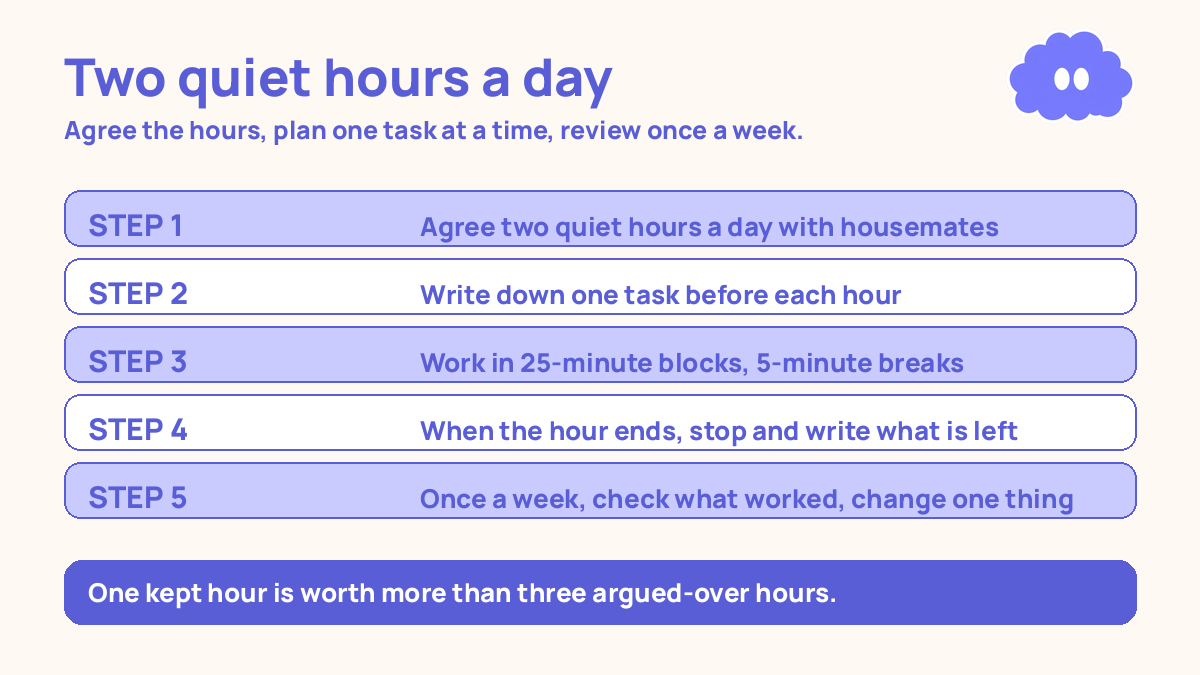
- Agree two quiet hours a day with your housemates, at set times.
- Before each hour, write down one task, not a subject.
- Work in 25-minute blocks, with a 5-minute break between them.
- When the hour ends, stop. Write down what is left, and move on.
- Once a week, check what worked and change one thing.
Step 1: Agree the hours, do not hope for them
Pick two hours that fit the house, not just you. Early morning often works, because fewer people are up. Late evening works if the house is calmer then.
Ask plainly: “Can we keep it quiet from 7 to 8 in the morning on weekdays? I will do the same for you when you need it.”
Write the hours on a note on the fridge or in the house group chat. An agreement people can see is easier to keep than a private hope.
If you cannot get two hours, start with one. One kept hour is worth more than three argued-over hours.
Step 2: One task, not a subject
“Study biology” is not a task. It is too big, and you will spend half the hour deciding where to start.
Before the hour, write one task like this:
- Read chapter 4 and write 10 questions from memory.
- Do past-paper questions 1 to 5, then mark them.
- Turn yesterday’s lecture notes into one page of notes.
Put your phone in another room, or in a bag by the door, for the hour. If you need your phone for a timer, use a kitchen timer or a watch instead.
Step 3: Work in blocks
Set a timer for 25 minutes. Work on the one task only. When the timer rings, take a 5-minute break. Stand up, get water, look away from the page.
Two blocks make one hour, with a break in the middle. If noise breaks in, note where you stopped, deal with it briefly, and start the next block. Do not try to make up lost minutes by skipping breaks. Tired work after a broken session is usually worse work.
A worked example day
7:00 – 8:00, quiet hour one
- 7:00–7:25: Read chapter 4, sections 1 and 2.
- 7:25–7:30: Break.
- 7:30–7:55: Write 10 questions from memory, without looking back.
- 7:55–8:00: Write down what is left: sections 3 and 4.
Evening, second hour
- Same pattern, one new task: answer the 10 questions, then check them against the chapter.
That is the whole day. Two hours, two tasks finished, and a clear note of what is next. You do not need to study all day to make progress.
When it goes wrong
The house is noisy anyway. Move to the library, a café, or a quiet corner for that hour, and keep the same task. The system is the task and the timer, not the room.
A housemate needs you during the hour. Help if it is urgent, note where you stopped, and finish the block later. Do not abandon the day because one hour broke.
You sit down and cannot start. Start smaller. Read one page. Write one question. Starting is the hard part, and a small start counts.
You keep re-reading instead of recalling. Close the book and write what you remember. Re-reading feels productive. Recall shows you what you actually know.
Weekly review checklist
Once a week, answer these four questions in writing:
- What got finished this week?
- Which hour worked best, and why?
- What broke the system, and was it fixable?
- What one step will I change next week?
Change one step only. If morning hours kept failing, try evenings. If tasks were too big, make them smaller. Small changes beat new systems.
What this system is not
It is not a promise of grades. No system can guarantee a result. It is a way to do steady work in a house that is not built for quiet, and to know, at the end of the week, whether the work actually happened.
Questions
What if my housemates will not agree to quiet hours?
Do not ask for the whole evening. Ask for one agreed hour, on set days, and keep your side of it. A small agreement people keep beats a big rule people ignore.
Is it better to study in the library instead?
If you can get there easily, yes, for deep work. Use the house system for short, planned sessions, and save the library for the work that needs real quiet.
How long should I try this system before changing it?
One full week. Change one step at a time after that, not the whole system, so you can tell what actually helped.