The direct answer
Close the book, try to recall the topic from memory, then check your notes and correct what you got wrong. Do that for every topic, every time you study it, instead of re-reading. That is retrieval practice. It feels harder than re-reading, and that hardness is the point: the effort of recalling is what builds the memory.
You do not need anything new to start. You need questions you can answer without looking, and the habit of closing the book before you answer them.
Why testing yourself works, and re-reading does not
Re-reading feels easy because the words look familiar. Familiarity is not memory. When you close the book and try to write the answer, that familiarity disappears — and that is the moment that matters in an exam, because the exam gives you no book to look at.
In a 2013 review, Dunlosky and colleagues rated ten common study techniques. Only two received a high utility rating: practice testing — testing yourself — and distributed practice — spacing study out over time. Rereading and highlighting were rated low. That does not mean notes are useless. It means notes are for checking yourself after you have tried to recall, not for reading over and over as the main method.
The reason testing feels worse in the moment is worth knowing. In a well-known study by Roediger and Karpicke (2006), students who restudied a passage felt more confident immediately afterwards than students who tested themselves. A week later, the result reversed: the tested students remembered more. If you judge your revision by how it feels on the day, you will pick the method that fails a week later. Judge it by what you can recall with the book closed.
The system in short
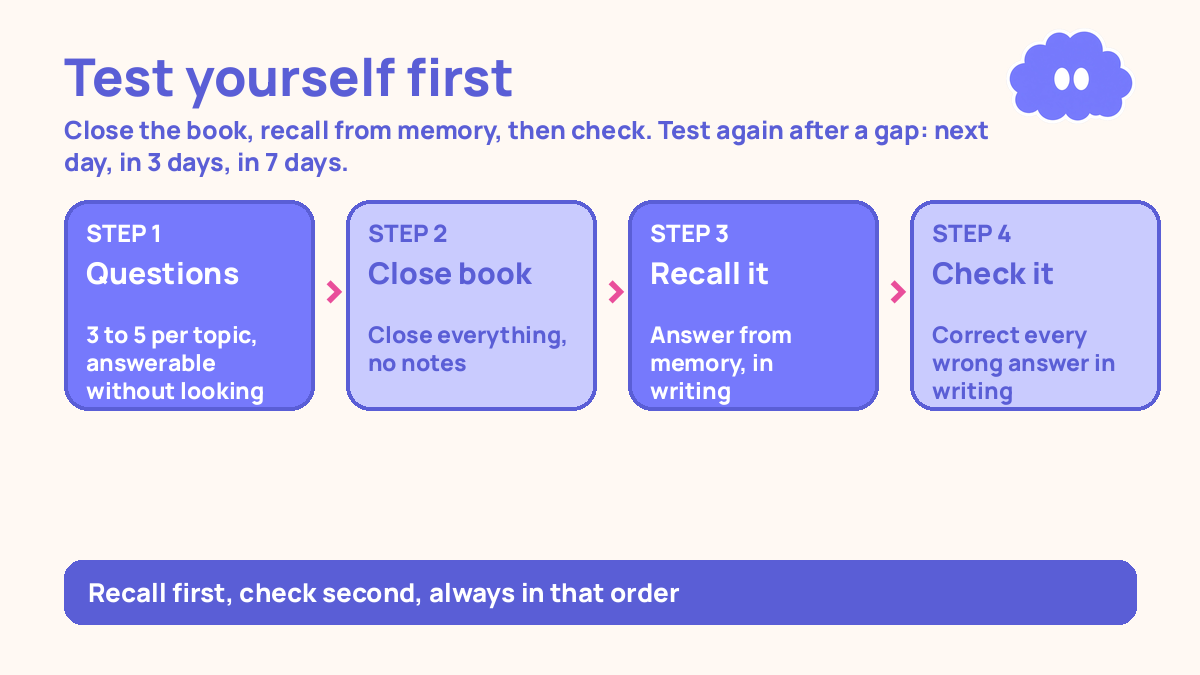
- For each topic, write 3 to 5 questions you can answer without looking: definitions, steps, causes, examples.
- Learn the topic once — read, watch, or work through it.
- Close everything. Answer the questions from memory, in writing.
- Open your notes and check. Correct every wrong or missing answer, in writing.
- Put the questions on your review list. Test the same topic again after a gap: next day, in 3 days, in 7 days.
- Make the questions harder as you improve. Easy questions first, exam-style questions last.
Step 1: Turn topics into questions
A topic is ready when you can turn it into a question. Use the exam’s own language: explain, compare, calculate, describe the steps, give an example. “Explain the light-dependent reactions, in order, with one example each” is a question. “Photosynthesis” is not.
Write 3 to 5 questions per topic, on one page per topic, or on flashcards. The format does not matter. Having questions you can answer without looking matters. This step is the work, and it is the step most students skip, because it feels slower than reading. It is slower on day one, and much faster by day three, because you now have a test for every topic instead of a pile of notes to re-read.
If you are revising for an exam, this is the same first step as the full plan in how to revise for exams without cramming. Retrieval practice is the engine inside that plan.
Step 2: Recall first, check second — always in that order
The order is the system. Recall first, with the book closed. Check second, with the book open. A review that starts with the book open is not retrieval practice. It is re-reading, and you already know what the research says about that.
Write your answers down, even if they are short. Writing forces you to commit to an answer instead of nodding along and thinking “yes, I knew that.” The nod is the trap. If you cannot write it, you do not know it yet — and now you know exactly what to fix.
Step 3: Correct in writing, not in your head
When you check and find a mistake, write the correct answer out. Do not just read it and move on. A wrong answer you never correct is worse than no answer, because you will remember the wrong version. Correct it, in writing, and that correction becomes part of the next test.
Keep a running list of the questions you get wrong. Those are your highest-value questions — they show you exactly where the gaps are, instead of making you re-read everything equally.
Step 4: Make the questions harder over time
Start with easy questions: definitions, single facts, one step. Once you can answer those without notes, move to harder ones: explain a process in order, compare two ideas, work a problem without looking at the worked example, explain the topic as if teaching it to someone else.
The last step before an exam is exam-style questions: timed, without notes, in exam language. That is where past papers come in — they are retrieval practice in the exam’s own format, and they belong in the last week of revision.
Step 5: Space the tests
Testing once is not enough. Test the same topic again after a gap — next day, in 3 days, in 7 days — and the memory lasts longer each time. The full schedule, with the list that keeps track of it, is in the spaced repetition system for students. The two systems are one habit: test yourself, then test again later.
When the questions are written, you can test yourself on them properly with the free quiz maker: multiple choice, true or false and short answers, shuffled every time, with your best score saved. For terms and definitions, the flashcard maker brings the ones you miss back on a schedule.
A worked example: one evening, one subject
You have two hours in the evening and a biology test in two weeks.
First 30 minutes — new topic: Learn cell division: read the chapter once, watch one short video if you need it. Write 5 questions as you go. Next 25 minutes — test: Close everything. Answer the 5 questions from memory, in writing. Check against your notes. Correct the two you got wrong, in writing. Next 25 minutes — second topic: Same pattern. Learn osmosis, write 4 questions, close the book, answer, check, correct. Last 20 minutes — reviews: Test two topics from yesterday from memory. One you recall easily — stretch its next gap. One you forgot — review it again tomorrow.
Two topics learned and tested, two old topics reviewed, and you know exactly which questions you still get wrong. That list is tomorrow’s starting point.
When it goes wrong
You cannot recall anything, so you give up and re-read. Start smaller. Recall one step instead of the whole process. Recall one definition instead of five. Use the easiest question first, check, then try the next one. A failed recall followed by checking still teaches you more than re-reading the same page again. The failure is information, not a verdict.
You test yourself but never check. Then you are practising wrong answers. Checking is not optional — it is half the system. Build it into the same session: recall, then check, then correct, before you move on to the next topic.
Your questions are too easy, so testing feels pointless. Good — that means you have learned that topic. Make the questions harder: explain instead of define, compare instead of list, work a new problem instead of repeating an old one. Easy questions that you always get right are finished. Move them to a longer gap and spend the time on what you still get wrong.
You test once and never again. One test builds a memory that fades. The second test, after a gap, is what makes it last. Put every question set on your review list with a date, and test again. If you do not have a list yet, the spaced repetition system shows you how to keep one on a single page.
Weekly review checklist
Copy this list and use it each week:
- Which topics did I test from memory this week, without notes?
- Which questions do I still get wrong, and what exactly is wrong in my answer?
- Are my questions getting harder, or am I still testing myself on definitions I already know?
- What one change will I make next week: smaller questions, harder questions, or more reviews of the ones I keep missing?
Downloadable infographic spec: one vertical image, title “Test yourself first”, with the four steps — write questions, close the book, answer from memory, check and correct — and the rule “recall first, check second, always in that order” — in Thynq cream, Cloud Purple, Dark Purple and pink, with the cloud mascot. Text taken word-for-word from this article.
What this system is not
It is not a promise of a grade, and it is not a claim that testing replaces learning. You still have to learn the material first — testing is how you find out whether the learning stuck, and how you make it stick longer. It is a plan built on the technique learning researchers rated highest, with a question format you can use for any subject. If a subject needs doing, not recalling — a language needs speaking, a practical subject needs practice — add that practice to the plan, do not replace testing with reading.
Sources
- Dunlosky, J., et al. (2013). Improving students’ learning with effective learning techniques. Psychological Science in the Public Interest, 14(1), 4-58. Only practice testing and distributed practice received a high utility rating; rereading and highlighting were rated low.
- Roediger, H. L., & Karpicke, J. D. (2006). Test-enhanced learning. Psychological Science, 17(3), 249-255. Retrieval practice beat restudying after a delay, despite restudiers feeling more confident immediately.
- Cepeda, N. J., et al. (2006). Distributed practice in verbal recall tasks: a review and quantitative synthesis. Psychological Bulletin, 132(3), 354-380. Spaced practice beat massed practice, and the optimal gap grows with the retention interval.
For the full revision plan this fits into, read how to revise for exams without cramming, and for the schedule that spaces your tests out, read the spaced repetition system for students.
Questions
What exactly is retrieval practice?
Trying to recall something from memory, without looking, before you check whether you were right. Answering questions, writing what you remember, explaining a topic out loud — all of it counts, as long as the book is closed first.
Isn’t testing just for exams, not for learning?
No. Testing is one of the two techniques learning researchers rated highest in the Dunlosky 2013 review, alongside spacing study out. A test you take while learning builds memory — it is not only a way to measure it.
What if I can’t remember anything when I test myself?
Start smaller. Use easier questions, or recall one step instead of the whole topic, then check and try again. A failed recall followed by checking still teaches you more than re-reading the same page again.
How is retrieval practice different from past papers?
Past papers are one form of it — timed, exam-style testing. Retrieval practice is the daily version: short questions you write yourself, answered from memory, for every topic. Use both: daily questions, then past papers in the last week.