The direct answer
To revise a subject you hate, shrink it until starting feels possible: find the exact point where you got lost, pick the easiest piece you can already do, and work on it for one 25-minute block a day, testing yourself from memory. No two-hour sessions, no opening the whole textbook, no waiting until you feel motivated. You build short wins day by day, and the subject stops feeling like a wall and starts feeling like small jobs. Most hated subjects are not hated. They are subjects where you fell behind and never found your way back in.
The problem is rarely the subject. It is the size of it in your head: a whole textbook, a whole term, a whole exam. Nobody can start that. Anyone can start one small piece for 25 minutes.
The system in short
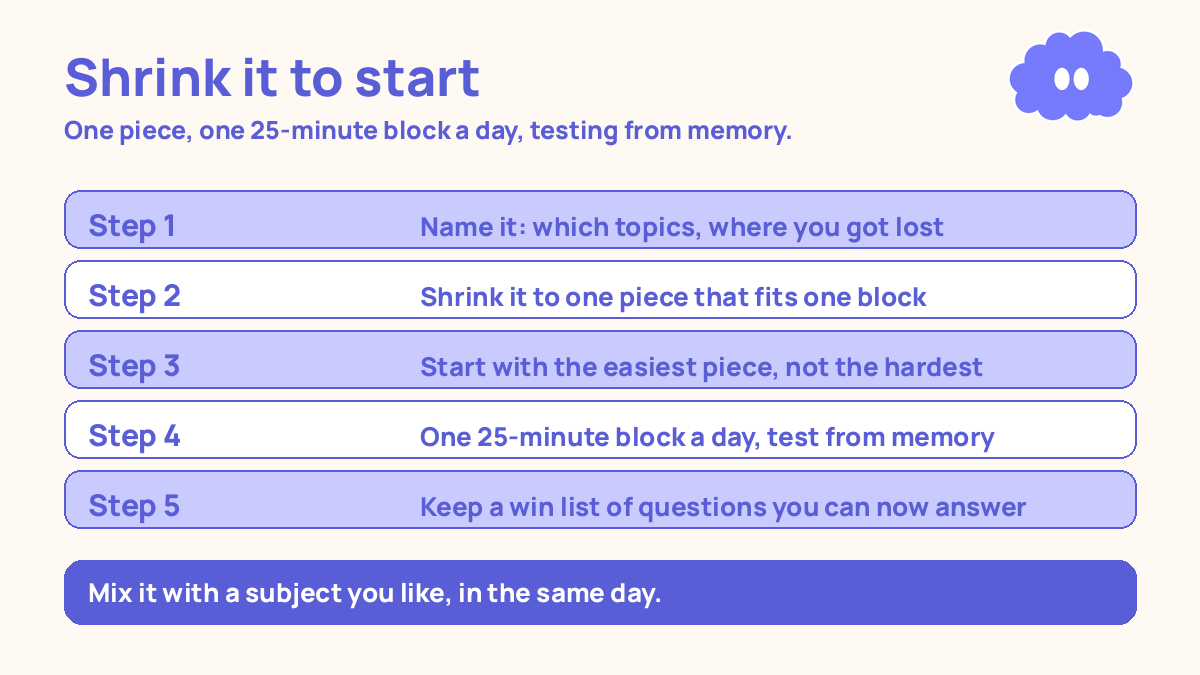
- Name the hate precisely: which topics, which kinds of questions, and where you got lost.
- Shrink the subject to the smallest piece you can do: one topic, one question type, one page.
- Start with the easiest piece, not the hardest. A win first, then the next piece.
- Work in one 25-minute block a day, testing yourself from memory, then checking.
- Keep a win list: every question you can now answer.
- Mix the hated subject with one you like, in the same day, so it is never the whole day.
Step 1: Name the hate precisely
“I hate chemistry” is too big to fix. Sit down with a piece of paper and the exam list, and get specific. Which topics do you avoid? Which kinds of questions make you close the book? When did it start going wrong — a chapter you missed, a test you failed?
Write it down: “I can do balancing equations, but I freeze on mole calculations. I missed the week on moles.” That is a problem you can solve.
For most students the cause is one of three things: you missed the foundations and everything after it stopped making sense; you failed at it once and now expect to fail; or you find it boring. Each one has a different fix.
If it is missing foundations, go back to the point where you got lost, not forward. If it is one bad failure, get a few small wins to prove the story wrong. If it is boredom, make the work active — testing yourself, not rereading — because passive reading of a boring subject teaches you nothing anyway.
If starting anything feels impossible right now, not just this subject, read how to start studying when you cannot start first. It covers the starting problem on its own.
Step 2: Shrink the subject to one small piece
Take the topic you named in step 1 and split it until one piece fits in a single 25-minute block. “Mole calculations” is too big. “Converting grams to moles for three elements” fits.
Write the piece on a card in one line: “Today: convert grams to moles for carbon, oxygen, and sodium.” That is your whole job for the day. Not the chapter. Not the topic. One line.
Put the rest of the textbook away, with only the pages for today’s piece open. Seeing the whole book while you work on one piece makes a small job feel impossible.
If you cannot split a topic into small pieces, you do not understand it well enough to see its parts yet. Ask a teacher or a classmate to split it for you, or split it by past paper question type.
Step 3: Start with the easiest piece, not the hardest
Most students start with the hardest part, fail, and conclude the subject hates them back. Start with the easiest piece you can already half-do. If you can balance equations but not mole calculations, start with balancing equations.
This is not avoiding the hard work. It is building the proof that you can do this subject at all. A student who has just got ten questions right will sit down tomorrow. A student who has just failed for an hour will not.
After two or three days of easy pieces, move one step harder. Not five steps. One. If you fail, go back half a step. That is how you find the level where learning happens.
Keep the pieces in order on a list, easiest first. Crossing pieces off it is the visible proof that you are moving. A subject you hate needs visible proof, because your feelings will tell you nothing is changing long after it has.
Step 4: One 25-minute block a day, testing yourself
One block a day beats three hours once a week. The daily block keeps the subject warm and the habit small enough that you actually do it. Set a timer for 25 minutes, work on today’s piece only, then stop. The 25-minute length was Francesco Cirillo’s practical choice in the late 1980s, not a number from cognitive science: the Pomodoro technique for students explains the cycle, and a 50-minute block suits longer pieces.
Inside the block, test yourself. Close the notes, answer from memory, then check. Do not reread the chapter and call it revision. In a 2013 review, Dunlosky and colleagues rated ten common study techniques, and rereading was rated low. Only practice testing and distributed practice rated high.
Put your phone in another room before the block starts. A hated subject plus a phone on the desk is a lost block before it begins.
Do the block at the same time every day if you can. Same time, same place, same piece of paper. A routine removes the daily decision of when to start.
Step 5: Keep a win list
On the back of your piece list, keep a win list: every question type you can now answer that you could not answer last week.
Read the win list every Sunday. Hated subjects lie to you: they tell you that you are making no progress, because the feeling does not change as fast as the knowledge does.
Review each win after a gap, not on the same day. Test a piece, review it the next day, then again in three days, then in seven days. That next day, in 3 days, in 7 days rhythm is a practical starting schedule, not a research rule. A 2006 review by Cepeda and colleagues found that spaced practice beat massed practice, and the best gap grows with how long you need to remember.
When a win fades — you test it after a gap and get it wrong — do not panic. It found a weak spot before the exam did. Put the piece back on the list, do one more block on it, and move on.
Step 6: Mix it with a subject you like
Never let the hated subject be your whole study day. Pair each block of it with a block of a subject you like. Do the hated subject first, then the liked subject as the reward.
It stops the hated subject from colouring the whole day, which is how students end up avoiding studying altogether.
If you have an exam week coming, the exam week plan for students shows how to give every subject at least one block a day.
A worked example: a day with a hated subject
Sara hates chemistry. She can do balancing equations, but she freezes on mole calculations, because she missed the week on moles. Her exam is in four weeks.
Sunday evening: She writes the hate down precisely: “Moles. I missed that week. I can balance equations. I cannot convert grams to moles.” She splits moles into pieces, easiest first: grams to moles for elements, then for compounds, then one simple mole question, then mole ratios.
Monday 5:00–5:25 — Block 1. She starts with the easiest piece: converting grams to moles for carbon, oxygen, and sodium. She closes her notes, does ten conversions from memory, and checks. Eight right. She writes the two she missed on a fix card, tests them again, gets them right. One win on the list.
Monday 5:30–5:55 — Block 2, biology. A subject she likes, as the reward. The day was not all chemistry.
Tuesday 5:00–5:25 — Block 1. She reviews yesterday’s piece first: five conversions, all right. Then the next piece: grams to moles for compounds. Six right out of ten.
Wednesday 5:00–5:25 — Block 1. Review of both pieces, then one simple mole question. She gets it wrong, reads the worked example, covers it, and does it again. Right the second time.
Thursday: She is tired and does not want to do it. She does the block anyway, because it is 5pm and 5pm is the block. Ten conversions, all right. A small day is still a day.
Friday 5:00–5:25 — Block 1. Mole ratios. She gets half right. Her teacher shows her she was using the wrong ratio step. One missing idea, found.
Sunday: She reads the win list. Two weeks ago she could not convert grams to moles at all. Now she can, for elements and compounds, and she can do simple mole questions. She still does not love chemistry, but she does not dread the block any more.
When it goes wrong
You sit down for the block and cannot start, because the piece still feels too big. Shrink it again. Half the piece. One question instead of ten. If one question still feels too big, read the worked example first, cover it, and copy it from memory.
You do the easy pieces for two weeks and never move to the hard ones. Easy pieces are the start, not the plan. After three days on one level, move one step harder.
You test yourself, get everything wrong, and conclude you are hopeless at the subject. Getting everything wrong on a first test is normal. It is information, not a verdict. In a 2006 study, Roediger and Karpicke found that students who recalled a passage remembered more a week later than students who restudied it, though the restudiers felt more confident immediately. Check the answers, write the fixes in one line each, and test again tomorrow.
You skip three days because you are busy, and now starting again feels worse than before. Do not try to catch up with a long session. Do one 25-minute block on the easiest piece you have already won. Three missed days cost you three blocks, not the whole system.
Weekly review checklist
Copy this list and use it each Sunday:
- Which pieces did I finish this week, and which ones are still open?
- How many questions can I now answer that I could not answer last week?
- Did I test myself from memory, or did I mostly reread?
- Did I do the block every day, and at the same time?
- What one change will I make next week: smaller pieces, one step harder, or the phone in another room?
Downloadable infographic spec: one vertical image, title “Taming a subject you hate”, with the six steps from name the hate precisely to mix it with a subject you like, the three rules — shrink it to one piece, start with the easiest, one block a day — and the win list, in Thynq cream, Cloud Purple, Dark Purple and pink, with the cloud mascot. Text taken word-for-word from this article.
What this system is not
It is not a promise that you will love the subject, and it is not a claim that every subject can be fixed in a few weeks. Some subjects stay hard, and some gaps are too big for one exam season. It is a practical way to make a hated subject small enough to start, and to build the wins that prove you can do it.
Sources
- Dunlosky, J., et al. (2013). Psychological Science in the Public Interest, 14(1), 4-58. Only practice testing and distributed practice rated high; rereading rated low.
- Cepeda, N. J., et al. (2006). Psychological Bulletin, 132(3), 354-380. Spaced practice beat massed practice; the best gap grows with how long you need to remember.
- Roediger, H. L., & Karpicke, J. D. (2006). Science. Recall beat restudy a week later, though restudiers felt more confident immediately.
- Cirillo, F. — Pomodoro Technique, late 1980s. 25 minutes work, 5 minutes break, longer break after four. The 25-minute length was Cirillo’s practical choice, not science-derived.
The idea behind this system is the same as the idea behind all revision: test yourself, space it out, and start small. That is how to revise for exams without cramming.
Questions
Why do I hate this subject so much?
Usually because you fell behind in it, not because you cannot do it. A subject you cannot start feels like a subject you hate. Finding the exact point where you got lost is the first fix.
How long should I study a subject I hate each day?
Start with one 25-minute block a day. A short daily block you actually do beats a two-hour session you avoid for a week. Add a second block only after a week of daily ones.
Should I start with the hardest part of a hated subject?
No. Start with the easiest part you can already do, and build from there. Confidence comes from finished work, and the hard parts get easier once you have a few wins behind you.
What if I still hate it after two weeks of trying?
Check whether you are testing yourself or just rereading, and whether the pieces are small enough. If both are right and it still feels impossible, ask a teacher or a classmate where you went wrong — a gap is often one missing idea.