The direct answer
An exam week plan is seven days of testing yourself from memory, reviewing each topic after a gap, and stopping at a fixed time each evening. No new topics after day three, no all-night sessions, and no long rereading. You plan each day the night before in ten minutes, work in focused blocks, and finish each day knowing which topics are solid and which still need work.
This plan is built on the two methods learning researchers rated highest. In a 2013 review, Dunlosky and colleagues looked at ten common study techniques and gave a high utility rating to only two: practice testing and distributed practice. Rereading was rated low. So this week is not reading your notes again. It is closing the notes, testing yourself, and spacing the reviews out.
The system in short
- On the evening before exam week, list every exam, its date, and its topics. Rank each topic: solid, shaky, or weak.
- Give each day a theme: the exam that is nearest gets the most blocks. The exam furthest away gets one review block a day.
- Work in blocks of 25 or 50 minutes. Each block has one job: test yourself on one topic from memory, then check your answers.
- Review every topic three times across the week: first test, a next-day review, and a final review two or three days later. That next day, in 3 days, in 7 days rhythm is a practical starting schedule, not a research rule.
- Stop at a fixed time each evening. Sleep is part of the plan, not a reward for finishing.
- Each night, write tomorrow’s plan in ten minutes: which topics, which blocks, and what “done” looks like.
Step 1: Map the week before it starts
Do this on the evening before exam week, with a piece of paper and your exam timetable. It takes about half an hour, and it saves you from deciding what to study every morning.
Write down every exam, the date, the time, and the topics it covers. Then rank each topic honestly: solid means you could answer questions on it now without notes; shaky means you know parts of it; weak means you barely remember it.
If you only have four or five days, the plan still works. Shorten it: each topic gets two rounds of testing instead of three, and cut the lightest topics first. What you never cut is the testing itself.
If you are already inside a week of the exam, the revision planner switches itself to triage: it stops new topics after the second study day and puts your weakest subjects and past-paper mistakes first. It will not pretend a week can cover a term.
Step 2: Give each day a theme
A day with no theme becomes a day of drifting between subjects. Each day gets one main exam — the one nearest in time — and that exam gets most of the blocks. The other exams get one review block each, so nothing goes cold for a whole week.
A typical seven-day shape looks like this:
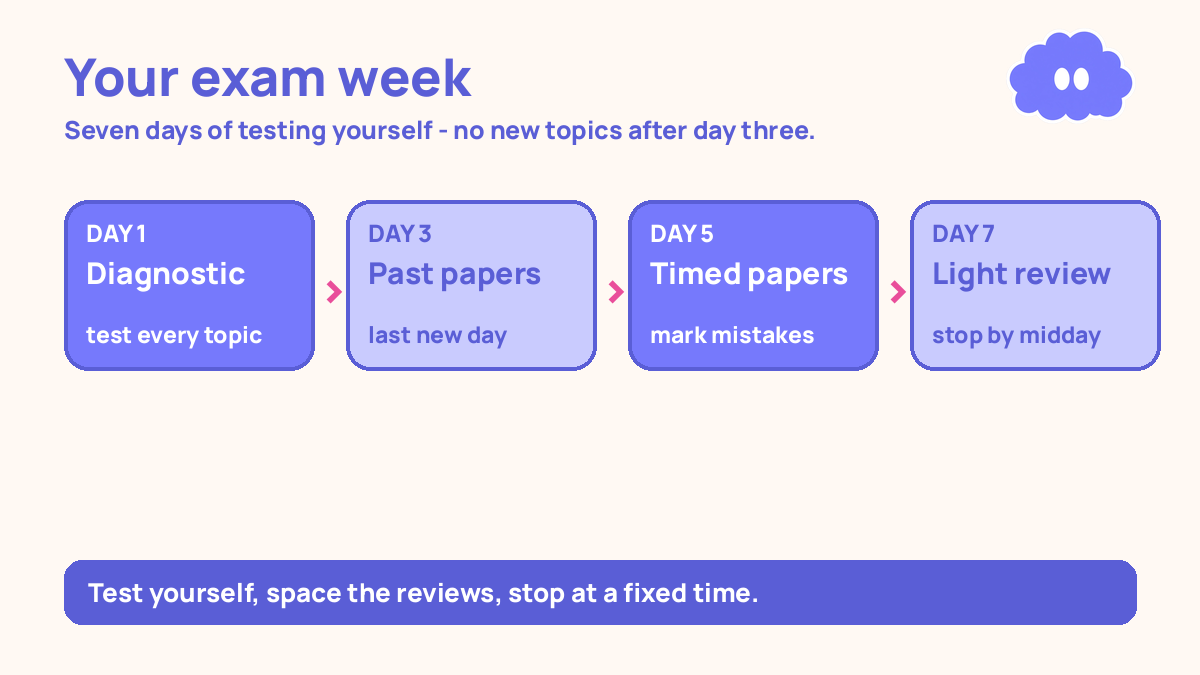
- Day 1: Test every topic once, quickly, and find the gaps. A diagnostic day.
- Day 2: Deep work on the weakest topics from day 1, plus one review block for the next exam.
- Day 3: Past papers for the nearest exam. Your last day for anything new.
- Day 4: Second round of testing on everything, with the gaps getting the most time.
- Day 5: Past papers under timed conditions, then review of the mistakes.
- Day 6: Light review only. Test each topic once, briefly. Stop early.
- Day 7: Morning review of your one-page summary, then stop by midday.
This is where how to revise for exams without cramming fits: it is the pillar this plan hangs on. The week plan is that idea with dates on it.
Step 3: Work in blocks that test you
Every block has the same shape: close the notes, test yourself, then check. The testing can be answering questions from memory, writing out a topic on a blank page, working problems without looking at the worked examples, or doing questions from a past paper system for exams.
A 25-minute block suits short testing: ten questions, one topic, one page from memory. A 50-minute block suits a past paper section or a longer problem set. The 25-minute length was Francesco Cirillo’s practical choice in the late 1980s, not a number from cognitive science, so use whichever length fits the job. The Pomodoro technique for students explains the 25-minute cycle, and how to study in 50-minute blocks covers the longer version.
Between blocks, take a real break: five minutes after a 25-minute block, ten after a 50-minute one. Stand up, get water, look out of a window. Do not check your phone: a five-minute scroll becomes twenty minutes.
Four to six focused hours a day is a full exam-week day. Count finished blocks, not hours: a block where you tested yourself and checked your answers counts.
Step 4: Space the reviews
Testing a topic once is not enough. Spacing means meeting the same topic again after a gap, when you have started to forget it, and pulling it back strengthens it. A 2006 review by Cepeda and colleagues found that spaced practice beat massed practice across materials, ages, and retention intervals, and that the best gap is not fixed: it grows with how long you need to remember the material. There is no magic interval to copy.
A practical starting schedule is: test a topic, review it the next day, then review it again in three days, then again in seven days. That is a starting point to try for a week, not a rule from the research. In exam week, squash it to fit: first test on day 1, review on day 2 or 3, final review on day 5 or 6.
Keep a simple tracking sheet. One line per topic, with three boxes: tested, reviewed, final review. Tick the box when you actually test yourself, not when you read the notes.
The spaced repetition system for students explains this spacing idea in full, and the retrieval practice system for students explains the testing side. This week plan uses both: testing inside the block, spacing across the week.
If you are not sure which reviews fall on which day this week, the spaced repetition scheduler lists only today’s re-tests and never puts one on the exam day. The exam countdown shows how many focus sessions you really have left before each paper.
Step 5: Stop at a fixed time every evening
Pick a stop time before exam week starts — say 8pm — and keep it every day. When the stop time comes, you stop, even if a topic feels unfinished. Write down what is unfinished, put it first tomorrow, and walk away.
This rule protects sleep: a tired brain tomorrow costs more than an extra hour tonight. It also protects honesty: a plan with no stop time grows until it fills the whole evening, and then you are studying at midnight, rereading, and calling it revision.
The evening routine takes ten minutes. Three questions, written on paper: what did I test today, and how did it go? Which topics are still weak? What are tomorrow’s blocks? That is tomorrow’s plan, already written.
Step 6: Use past papers as the rehearsal
Past papers are the closest thing to the real exam, and they belong in the middle of the week, not the end. Do the first one on day 3, untimed: work through it slowly and note every question you could not answer. Those questions become your study list for days 4 and 5.
Do the second one on day 5, timed, under exam conditions: no notes, no phone, the same time limit as the real exam. Then spend a full block marking it and writing down every mistake in one line each. A mistake you write down is a mistake you can fix.
If you run out of past papers, write your own questions. Take a topic, close the notes, and write five questions a teacher might ask about it. Then answer them.
A worked example: seven days before three exams
Sara has three exams: biology on Monday, chemistry on Wednesday, and maths on Friday. She has seven days.
Sunday evening: Sara lists her topics. Biology: three solid, two shaky, one weak. Chemistry: two solid, two shaky, one weak. Maths: two solid, one shaky, one weak. Stop time: 8pm every day.
Day 1: Diagnostic day. She tests every biology topic for 25 minutes each, writing answers from memory. The weak topic is worse than she thought. Chemistry and maths get one review block each.
Day 2: Deep work on the weak biology topic, three 50-minute blocks in smaller pieces. Two blocks on the shaky topics. One block each for chemistry and maths.
Day 3: Biology past paper in the morning, untimed, then a block marking it and listing the gaps. Afternoon: the weak chemistry topic twice. Maths gets one block.
Day 4: Second round of testing on all biology topics, plus the gaps from the past paper. Then three blocks on chemistry. Maths gets one block.
Day 5: Timed biology past paper in the morning, then a block marking it. Afternoon: chemistry past paper, untimed, with marking. Maths: two blocks on the weak topic.
Day 6: Light review. One 25-minute block per biology topic. Chemistry topics get one block each. Maths gets two blocks. She stops at 5pm.
Day 7: The day before the biology exam. Morning: she reads the one-page summary she made during the week, tests herself on the three topics she kept getting wrong, and stops by midday. Afternoon: a walk, an early dinner, her bag packed, bed by 10pm.
By Monday morning she has tested every biology topic three times, done two past papers, and knows which questions she can answer. She did not study all night once.
When it goes wrong
Day 1 shows you are further behind than you thought, and you panic. Day 1 is supposed to find the gaps. Do not add hours. Cut the lightest topics — the solid ones get one block instead of two — and move those blocks to the weak topics.
You spend the whole week rereading because testing feels horrible. Testing yourself feels worse than rereading, because it shows you what you do not know. That discomfort is the point. In a 2006 study, Roediger and Karpicke found that students who recalled a passage remembered more a week later than students who restudied it, though the restudiers felt more confident immediately. Feeling fluent after rereading is not the same as remembering a week later. Test in smaller pieces: five questions instead of twenty.
One subject eats the whole week and the others go cold. The nearest exam feels scariest, so it takes every block. The fix is the daily review block: every exam gets at least one block a day. Twenty-five minutes on a far-off subject keeps it warm.
You keep moving the stop time later, and by day 4 you are studying at midnight. The stop time only works if it is fixed. When you feel the pull to carry on, write the unfinished topic at the top of tomorrow’s plan and stop.
Weekly review checklist
Copy this list and use it each evening:
- Which topics did I test today, and how many answers could I give without notes?
- Which topics are still weak, and how many blocks tomorrow?
- Did every exam get at least one block today, or did one subject eat the day?
- Did I stop at my fixed time, and did I write tomorrow’s plan before stopping?
- What one change will I make tomorrow: smaller tests, more past paper time, or an earlier stop?
Downloadable infographic spec: one vertical image, title “Your exam week, in seven days”, with the seven-day shape from day 1 diagnostic testing to day 7 stop by midday, the three rules — test yourself, space the reviews, stop at a fixed time — and the tracking sheet of one line per topic with three boxes, in Thynq cream, Cloud Purple, Dark Purple and pink, with the cloud mascot. Text taken word-for-word from this article.
What this system is not
It is not a promise of a grade, and it is not a claim that seven days is enough for every subject or every student. If you are starting from nothing, seven days of testing will still help, but it will not replace a term of steady work. It is a practical way to use the week you have.
Sources
- Dunlosky, J., et al. (2013). Psychological Science in the Public Interest, 14(1), 4-58. Only practice testing and distributed practice rated high; rereading rated low.
- Cepeda, N. J., et al. (2006). Psychological Bulletin, 132(3), 354-380. Spaced practice beat massed practice; the best gap grows with how long you need to remember.
- Roediger, H. L., & Karpicke, J. D. (2006). Science. Recall beat restudy a week later, though restudiers felt more confident immediately.
- Cirillo, F. — Pomodoro Technique, late 1980s. 25 minutes work, 5 minutes break, longer break after four. The 25-minute length was Cirillo’s practical choice, not science-derived.
For the evening before the exam, read how to revise the night before an exam. For the exam itself, the past paper system for exams is the rehearsal. The idea behind all of it is how to revise for exams without cramming.
Questions
When should I start my exam week plan?
Seven days before your first exam, or as many days as you have. With fewer days, shorten the rounds and cut the lightest topics first, never the testing.
How many hours should I study each day in exam week?
Four to six focused hours is a full day. Count finished blocks of testing yourself, not hours sitting at a desk.
Should I study new topics in exam week?
No new topics after day three. Exam week is for testing what you covered, fixing gaps, and practising exam-style questions.
What if I have two exams on the same day?
Split each block between the two subjects and alternate them. Swap the order the next day, so neither subject always gets your tired hours.