The direct answer
The night before an exam, revise for two to three hours at most, in short blocks, testing yourself on the topics that matter most — then stop, pack your bag, and go to bed at your normal time. No new topics, no all-nighter, and no rereading your notes until midnight. The exam is won by the week before it, not by the night before it. Tonight’s job is to warm up what you know, find the one or two gaps you can still fix, and arrive tomorrow rested.
A tired brain recalls less, reads questions worse, and panics faster. The night before is a warm-up and a wind-down, not a second exam week squeezed into one evening.
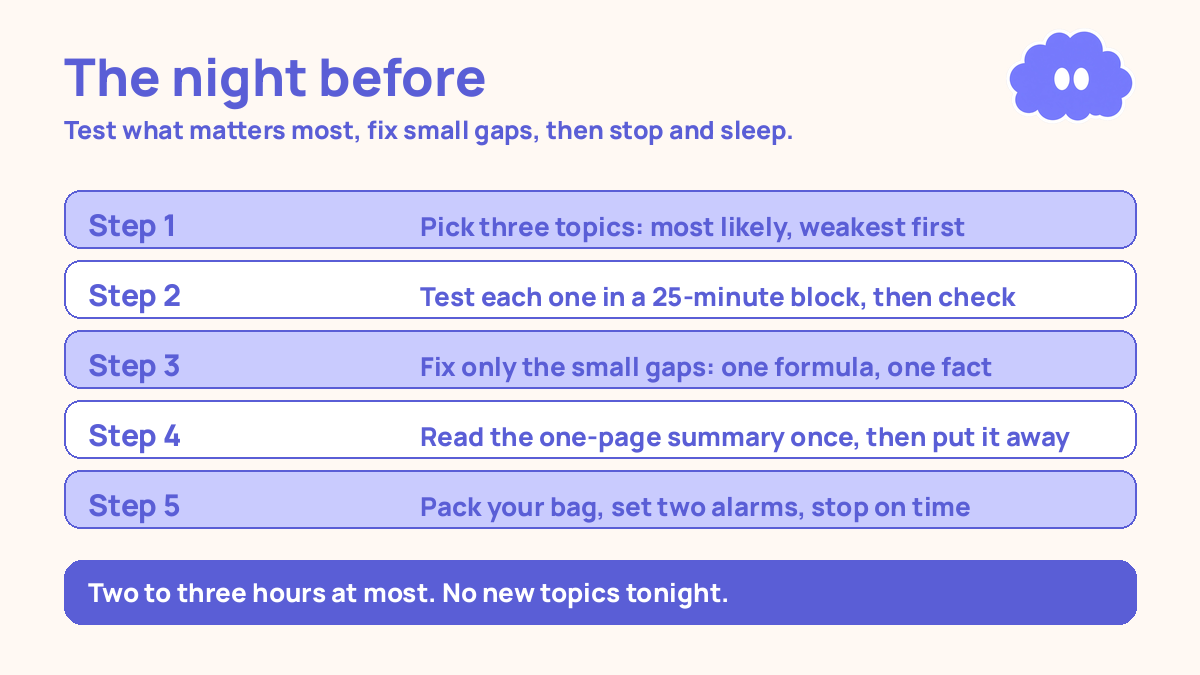
The system in short
- Before dinner, pick three topics: the ones most likely to come up, and the ones you keep getting wrong.
- Test yourself on each one from memory, in a 25-minute block, then check your answers. No rereading first.
- Fix only the small gaps you find: one formula, one definition, one worked example each.
- Read your one-page summary once, out loud if you can, then put it away.
- Pack your bag, lay out what you need for the morning, and set two alarms.
- Stop at least an hour before bed. No screens in that last hour if you can help it. Sleep at your normal time.
Step 1: Pick three topics, not everything
The biggest mistake the night before is trying to cover everything. You cannot, and trying will leave you sure that you know nothing. Pick three topics before you start: the two most likely to appear, and the one you keep getting wrong.
How do you know what is most likely to appear? Look at the past papers: the topics that appear every year are the ones to test tonight. If you have not done past papers, look at the topics your teacher spent the most time on. That is enough.
Write the three topics on a piece of paper, in order. The weakest one goes first, while your focus is fresh. The strongest one goes last, so the evening ends with something you can do well.
If you followed an exam week plan for students, tonight is day 7 of that plan: a morning review and a stop by midday. If you did not, tonight’s plan still works on its own. It is a short version of the same idea: test, fix the small gaps, stop.
Step 2: Test yourself, then check
Each topic gets one 25-minute block. Close the notes. Write down everything you remember about the topic on a blank page, or answer five questions on it from memory. Then open the notes and check.
Checking is where the learning happens tonight. For each gap, write the correct answer in one line on a separate piece of paper. That paper is your fix list: five to ten lines, not a page. If the list is longer, keep only the lines most likely to be asked.
Do not reread the whole chapter to check one answer. Open the notes, find the answer, write it down, close the notes. Rereading feels safe, but in a 2013 review Dunlosky and colleagues rated it low, while practice testing and distributed practice were the only two rated high. Tonight you are doing the first of those: test, check, fix.
If 25 minutes feels too short, use a 50-minute block instead. The 25-minute length was Francesco Cirillo’s practical choice in the late 1980s, not a number from cognitive science. The Pomodoro technique for students explains the short cycle, and how to study in 50-minute blocks covers the longer one.
Step 3: Fix only the small gaps
After testing all three topics, you have a fix list of five to ten lines. Spend one block fixing them, and only them. A gap is fixable tonight if it is small: one formula you keep mixing up, one definition you keep paraphrasing wrong, one type of question you keep starting wrong.
A gap is not fixable tonight if it is a whole topic you never studied. Do not try: an hour on a new topic will not make it usable tomorrow, and it will cost you the sleep and calm the topics you do know need. Cross it off. If it comes up tomorrow, you lose those marks — a better trade than losing marks on everything because you arrived exhausted.
For each fix, test yourself again after ten minutes. Cover the line, say the answer, check. If you get it right twice, it is fixed for tonight. If you get it wrong twice, write it on a small card and read it once in the morning.
This is also the time to check the practical things: how many marks each section is worth, how long each section should take, and what you do if you get stuck. Spend five minutes on that, not on more content.
Step 4: Read your summary once, then put it away
If you made a one-page summary during the week, read it once now, out loud if you can. If you did not make one, write one in ten minutes: the three topics, the fix list, and the two or three facts you most want to remember tomorrow. One page, no more.
Then put it away. Do not carry it around the house rereading it. The summary did its job: it collected the important things in one place. Carrying it after that is not revision, it is worry with paper.
Tonight is not the night for another paper: one paper done well during the week beats a rushed paper tonight. If you never did one, do not start now. Look at one past paper’s questions for five minutes, just to remind yourself what they look like, and stop there.
Step 5: Pack, plan the morning, and stop
Pack your bag now, not in the morning. Pens, pencils, ruler, calculator with working batteries, water, your exam slip or ID if you need one. Put it by the door. Lay out the clothes you will wear. Set two alarms: one for waking, one as a backup five minutes later.
Write tomorrow’s morning plan in three lines: what time you leave, how you get there, and what you do first when you sit down. Read the whole paper before writing anything, then start with the question you are surest about. Decide that tonight.
Then stop. At least an hour before bed, put the books away. Do something that is not studying: a shower, a short walk, music, talking to family. No revision videos, no last-minute notes on your phone. One “quick check” becomes an hour of scrolling and a later bedtime.
Be in bed at your normal time. An early night you cannot fall asleep in is worse than a normal night, because you lie there worrying. If you cannot sleep, do not get up and revise. Lie still, breathe slowly, and let your body rest even if your mind is busy.
A worked example: the night before a biology exam
Sara’s biology exam is tomorrow at 9am. She gets home at 5pm.
5:00–5:10 — Pick the topics. Past papers show cell division and genetics appear every year, and she keeps getting genetics wrong. Her three topics: genetics first, cell division second, ecology third — her strongest.
5:10–5:35 — Block 1, genetics. She closes her notes and writes everything she remembers about inheritance. She checks: she mixed up two terms and forgot one ratio. Three lines on the fix list.
5:40–6:05 — Block 2, cell division. She answers five questions from memory. She gets four right. The one she misses is a stage order. One line on the fix list.
6:10–6:35 — Block 3, ecology. She writes out the food web topic from memory. She gets it all right. No fix lines. She ends the testing on a win.
6:35–7:00 — Fix block. Four lines to fix. She tests herself on each one twice. All four stick. Dinner.
7:15–7:30 — Summary. She reads her one-page summary aloud once, then puts it away.
7:30–8:00 — Pack and plan. Bag by the door, clothes laid out, two alarms set. Morning plan written: leave at 8:15, walk, read the whole paper first, start with the ecology question.
8:00 — Stop. She showers, talks to her family, and is in bed by 10:30, her normal time. Two hours and twenty minutes of revision, three topics tested, four gaps fixed.
When it goes wrong
You sit down and feel like you know nothing, so you panic and open every book. That feeling is normal the night before, and it is usually wrong. It comes from tiredness and from looking at the whole subject at once. Do one test on one small topic, check it, and count the answers you got right. One honest test, passed, is worth more than an evening of rereading.
A friend messages you that they studied a topic you skipped, and now you want to learn it. Do not. A topic you have never studied cannot be learned well in one evening, and chasing it will eat the time your real topics need. Reply to your friend, put the phone in another room, and go back to your three topics.
It is 11pm and you are still revising because stopping feels like giving up. Stopping is not giving up. It is the plan. The extra hour will be rereading, and rereading was rated low in the 2013 review. Pack the bag, set the alarms, and go to bed.
You cannot sleep because your mind keeps running through the topics. Do not get up and revise. Lie still and breathe slowly. Run through one topic in your head if it helps: what are the three things you know about it? Resting still helps, even if sleep is slow to come.
Weekly review checklist
Copy this list and use it after every exam, while the night is still fresh:
- Did I pick three topics, or did I try to cover everything?
- Did I test myself from memory, or did I mostly reread?
- How many gaps did I actually fix, and were they small ones?
- Did I stop at least an hour before bed, and sleep at my normal time?
- What one change will I make next time: fewer topics, an earlier stop, or the phone in another room?
Downloadable infographic spec: one vertical image, title “The night before, in six steps”, with the six steps from pick three topics to stop an hour before bed, the three rules — test yourself, fix only small gaps, sleep at your normal time — and the morning plan of leave time, travel, and first question, in Thynq cream, Cloud Purple, Dark Purple and pink, with the cloud mascot. Text taken word-for-word from this article.
What this system is not
It is not a promise of a grade, and it is not a claim that one good evening fixes a term of missed work. If you have not studied all term, tonight will not save the exam. It is a practical way to use the evening you have: warm up what you know, fix the small gaps, and arrive tomorrow rested.
Sources
- Dunlosky, J., et al. (2013). Psychological Science in the Public Interest, 14(1), 4-58. Only practice testing and distributed practice rated high; rereading rated low.
- Roediger, H. L., & Karpicke, J. D. (2006). Science. Recall beat restudy a week later, though restudiers felt more confident immediately.
- Cirillo, F. — Pomodoro Technique, late 1980s. 25 minutes work, 5 minutes break, longer break after four. The 25-minute length was Cirillo’s practical choice, not science-derived.
The idea behind tonight is the same as the idea behind the whole week: test yourself, space it out, and stop on time. That is how to revise for exams without cramming, and the past paper system for exams is how you find the topics worth testing tonight.
Questions
How long should I revise the night before an exam?
Two to three hours at most, in short blocks, and stop at least an hour before bed. The night before is for testing what you already know, not for learning new material.
Should I study new topics the night before an exam?
No. A new topic the night before costs you sleep and confidence, and you will not learn it well enough to use it. Test the topics you already covered instead.
What time should I stop revising the night before an exam?
Stop at least an hour before bed, and be in bed at your normal time. A full night of sleep helps you more than an extra hour of tired rereading.
What if I feel like I know nothing the night before?
Test yourself on one small topic and check the answers. Most students know more than the panic tells them. One honest test, passed, is worth more than an evening of rereading.