The direct answer
In the last week before the exam, do a past paper under timed exam conditions, mark it honestly, write down every gap it shows, and fix only those gaps before the next paper. Repeat. That is the whole system. A past paper is not a test of whether you are ready. It is a tool that shows you what to fix while there is still time.
Do not start with past papers. Start with the topics, test yourself on them, space your reviews — then let past papers show you what is left. This is the last step of the full plan in how to revise for exams without cramming, not the first step.
Why past papers work
A past paper is retrieval practice in the exam’s own format. You answer from memory, under time pressure, in the exam’s language — and then you mark it, so you find out exactly what you got wrong. That is the same method that Dunlosky and colleagues rated highest in their 2013 review: practice testing. A paper just does it at full size, with the clock running.
It also does something no other method does: it shows you the exam itself. How questions are worded. How marks are split. Which topics come up again and again. How much time each question really takes. Students who have never seen a past paper walk into the exam and spend the first twenty minutes learning the format. Students who have done three papers already know it.
One honest warning: a past paper only helps if you mark it. A paper done and never marked is just a stressful afternoon. The marking is where the learning happens.
The system in short
- Get the last three past papers for your exam, plus the mark scheme if you can find it.
- In the last week, do paper one: timed, exam conditions, no notes, no phone.
- Mark it the same day, honestly, using the mark scheme. Write down every gap: topic, question, what went wrong.
- Fix only the gaps: make questions for each one, test yourself, review after a gap.
- Do paper two: timed. Compare the marks by topic, not just the total. Did the fixed gaps improve?
- Do paper three as a full rehearsal, two or three days before the exam: timed, same start time as the real exam if you can. Then stop. The night before is for question lists and rest.
Step 1: Get the papers and the mark schemes
Use the last three years if you can get them. Older papers are still useful for practice, but the format and syllabus may have changed — check against the current syllabus, and skip questions on topics that are no longer in it.
The mark scheme matters as much as the paper. It shows you how marks are given: one mark per point, or marks for the method even if the answer is wrong, or marks for explaining in your own words. Without it, you will mark yourself too kindly on vague answers and too harshly on good ones. If you cannot find an official mark scheme, mark with a teacher, a tutor, or a classmate — a second pair of eyes on your answers is worth more than doing another paper alone.
Step 2: Do the paper like the exam
Same time limit. Same conditions: no notes, no phone, no music, a clear desk, water only. Start at the same time of day as the real exam if you can. This is a rehearsal, not a study session — the point is to feel the pressure now, while it costs nothing.
If you get stuck on a question, do what you would do in the exam: mark it, move on, come back if time allows. Do not stop the clock to look something up. Looking it up during a practice paper teaches you nothing except that you can look things up — and you cannot, in the exam.
Write your answers fully, not in note form. An answer you “would have written” does not earn marks. The paper shows you what you can actually produce under pressure, not what you know in theory.
Step 3: Mark it the same day, and write the gaps down
Mark it the same day, while the paper is still fresh in your head. Use the mark scheme. Be honest: a half-answer is half marks, not full marks. Add up the total, but the total is the least important number on the page.
What matters is the gap list. For every question you lost marks on, write one line: the topic, the question, and what went wrong. Was it knowledge — you did not know it? Was it method — you knew it but set it out wrong? Was it time — you ran out? Was it the question itself — you misread it? Different causes need different fixes, and the gap list is what tells you which is which.
Step 4: Fix only the gaps
This is the step most students skip, and it is the step that makes the whole system work. Do not re-read the whole chapter. Do not redo the whole syllabus. Fix the gaps the paper showed:
- Knowledge gap: make questions for that topic, test yourself from memory, check, and put it on your review list. The retrieval practice system for students shows you how.
- Method gap: redo that type of question, slowly, with the mark scheme open, until you can set it out the way the marks want it.
- Time gap: practise that question type timed, in short bursts, until the pace feels normal.
- Misread question: slow down. Read the question twice, underline the command word — explain, compare, calculate — and answer what it actually asks.
One paper, marked properly, teaches you more about the exam than a week of reading. Three papers, each followed by fixing the gaps, is a complete final week.
A worked example: the last week before an exam
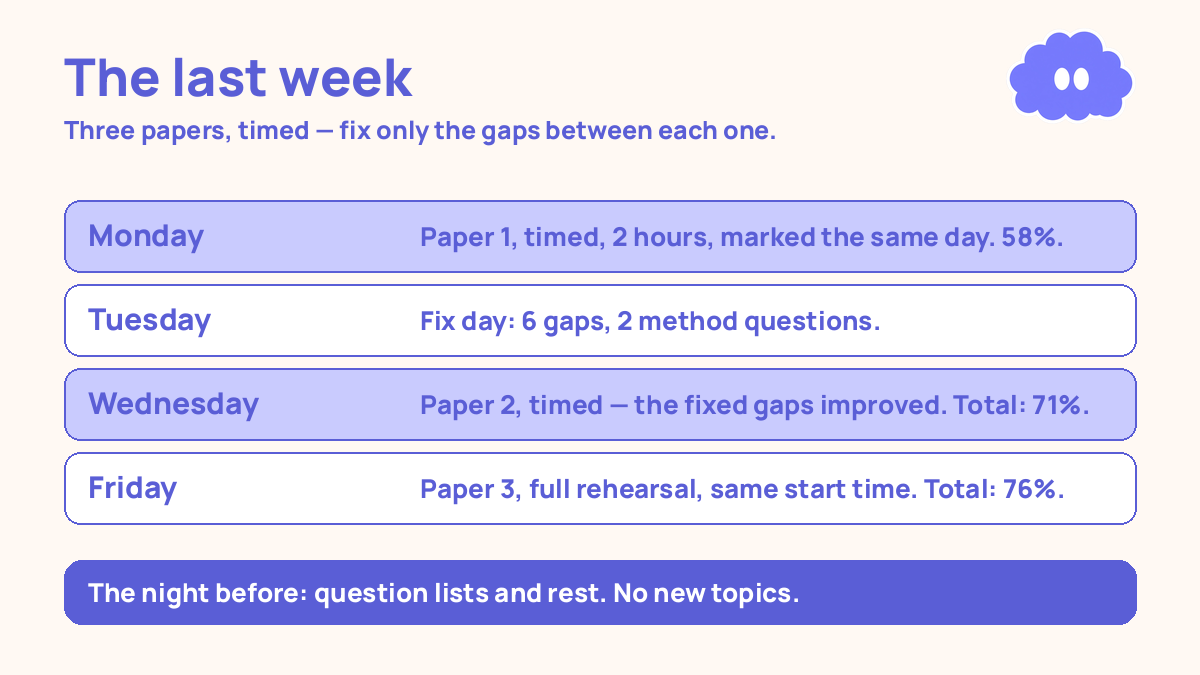
Monday — Paper 1, timed. 2 hours, exam conditions. Mark it in the evening. Total: 58%. Gap list: 6 knowledge gaps, 2 method gaps, 1 question misread. Tuesday — Fix day. No new paper. Make questions for the 6 knowledge gaps, test yourself on them, and redo the 2 method questions with the mark scheme open. Re-read the misread question and write out what it actually asked. Wednesday — Paper 2, timed. Total: 71%. The fixed gaps improved. New gap list: 3 knowledge gaps, 1 time gap on the long questions. Thursday — Fix day. Questions for the 3 gaps, timed practice on the long questions — 10 minutes each, mark scheme open. Friday — Paper 3, full rehearsal. Same start time as the real exam. Total: 76%. One gap left: a topic you keep getting half-right. One last test on it, then stop. Saturday, the night before: Question lists and past-paper mistakes only. No new topics. Stop early. Sleep matters more than one more topic.
Notice what did not happen: no re-reading whole chapters, no fourth paper at midnight, no panic. The papers did their job — they showed the gaps, and the gaps got fixed.
When it goes wrong
Your first paper’s mark is low and you panic. A low mark on a practice paper is free information, not a verdict. It arrived days before the exam, when you can still fix it. That is the best possible time to find out. Fix the gaps, do the next paper, and compare by topic. The total will move. If it does not move after fixing, the gaps were not the real problem — go back to the gap list and check whether you fixed the right things.
You do the paper but never mark it. Then you have practised answering, but you have no idea what was wrong. Marking is half the system. If marking feels hard, mark one section at a time, or mark it with someone else. A paper marked a day late is still useful. A paper never marked is a wasted afternoon.
You keep doing papers instead of fixing gaps. Five papers, none marked properly, teaches you less than two papers with the gaps fixed between them. If you catch yourself starting paper four with the same gaps paper one showed, stop. Fix the gaps first. The paper is a diagnostic, not a treadmill.
You run out of past papers. Use the papers you have twice — once to find gaps, once later to check them — and make your own exam-style questions from the syllabus for the rest. Old papers from a few years back, questions from textbooks, and questions a teacher sets are all useful. The format matters more than the year: timed, from memory, marked honestly.
Weekly review checklist
Copy this list and use it in the last week:
- Which papers did I do, timed, and what were the marks by topic?
- What gaps did each paper show, and did I fix them before the next paper?
- Are the same gaps appearing in every paper, or are new ones showing up?
- What one change will I make before the next paper: fix a topic, practise a method, or slow down and read the question twice?
Downloadable infographic spec: one vertical image, title “Paper, mark, fix, repeat”, with the cycle — timed paper, mark the same day, write the gap list, fix only the gaps — and the rule “a paper never marked is a wasted afternoon” — in Thynq cream, Cloud Purple, Dark Purple and pink, with the cloud mascot. Text taken word-for-word from this article.
What this system is not
It is not a promise of a grade, and it is not a claim that three papers will pass any exam. It is a rehearsal system for the last week: timed papers, honest marking, and fixing only what the papers show is broken. If you have not learned the topics yet, papers will only show you everything at once — go back to the full revision plan first, test yourself topic by topic, and come back to papers when there is something to rehearse.
Sources
- Dunlosky, J., et al. (2013). Improving students’ learning with effective learning techniques. Psychological Science in the Public Interest, 14(1), 4-58. Only practice testing and distributed practice received a high utility rating; rereading was rated low.
- Roediger, H. L., & Karpicke, J. D. (2006). Test-enhanced learning. Psychological Science, 17(3), 249-255. Retrieval practice beat restudying after a delay, despite restudiers feeling more confident immediately.
For the full revision plan this finishes, read how to revise for exams without cramming, and for the daily testing habit behind it, read the retrieval practice system for students.
Questions
When should I start doing past papers?
In the last week before the exam, once you have covered the topics and tested yourself on them. Doing papers too early wastes them — you need the topics learned first, so the paper shows your gaps instead of everything at once.
Should I do past papers timed?
Yes, at least the last two or three. Timed practice teaches you the pace the exam needs, and it shows you which questions eat your time. Untimed papers are fine for learning, but they do not prepare you for the clock.
How many past papers should I do?
Three is a good minimum for most exams: one to find your gaps, one to check the fixes, one timed as a full rehearsal. More helps if you have the time, but a paper done and marked properly beats five papers skimmed.
What do I do with a bad mark on a past paper?
Use it. A bad mark on a practice paper is free information — it shows you exactly which topics to fix, days before the exam, instead of the exam itself showing you. Fix the gaps it showed, then do another paper.