
The direct answer
Pick your study days from your work rota, study one hour at a time, and spend every hour testing yourself from memory before you open your notes. Three to five honest hours a week, spread across the week, is the system. A part-time job leaves you short of predictable hours, not hours — and the fix is planning from the rota, not from hope.
The real problem is not time, it is unpredictability
Students without jobs study at the same time every day. Your shifts move, the rota comes out late, and a manager asks you to cover a Saturday — so a plan built on fixed times breaks in the first week, and you conclude you cannot plan at all. You can: plan from the rota, the one document that tells the truth about your week.
The second problem is energy: a shift takes the part of you that concentrates. Studying after a long shift is hard, and pretending otherwise is how plans die. So this system puts the hard work before the shift or on days off, and gives work days only a short block — or none at all, on the worst days.
The third problem is what you do inside the hours you have: when hours are scarce, the method matters more. In a 2013 review, Dunlosky and colleagues rated ten common study techniques; only two received a high utility rating: practice testing and distributed practice. Re-reading and highlighting were rated low. With three to five hours a week, you cannot afford the low-rated methods. If your shifts rotate, the study system for shift work students covers that shape of week.
The system in short
- On Sunday, when the rota comes out, write down your shifts and your classes for the week.
- Pick three to five study sessions from the free gaps: longer ones on days off, one short one on work days.
- Each session is one hour: two 25-minute rounds with a break, or one 50-minute block. Test yourself first, check your notes second.
- Put each session in your calendar with a start time and one topic, like a shift.
- After each session, write one line: what you tested, what you got wrong.
- At the end of the week, review the lines, keep what worked, and change one thing.
Step 1: Plan from the rota, on Sunday
Sit down on Sunday for fifteen minutes with your rota and class timetable, and write the week out on paper, day by day: work, classes, free. If the rota comes out on Monday, plan on Monday.
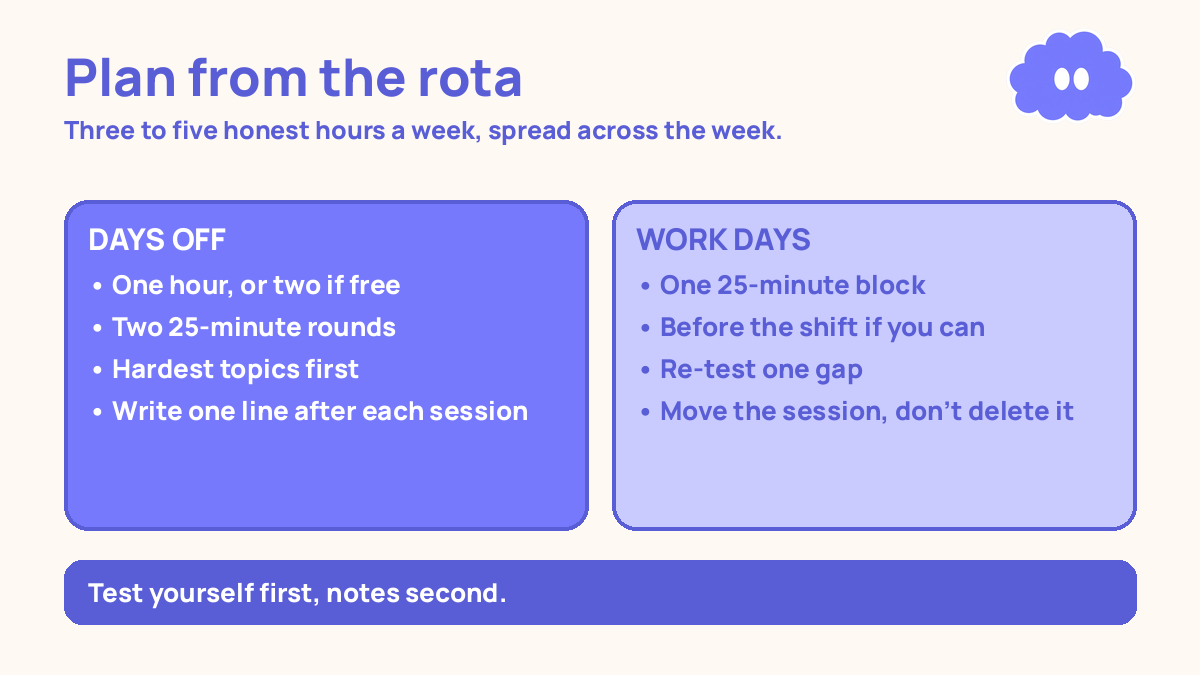
Now pick your sessions. Days off get the longer ones — one hour, or two if the day is free. Work days get one 25-minute session, only if the shift is short or starts late. A day with a long shift and classes gets none. Writing a session into a day that cannot hold it is the most common planning mistake: a missed session feels like a failure, and a failure feels like a reason to quit.
Aim for three to five sessions, totalling three to five hours. Start with three; add a fourth only when three hold for two weeks. A system that holds at three hours beats one that promises eight and delivers none. Write each session down with a start time and one topic — “Tuesday 10am, quadratic equations” is a session; “study maths this week” is a wish. The start time and the topic remove two decisions, and the session starts itself.
Step 2: The one-hour session
A session is one hour: two 25-minute rounds with a 5-minute break between them. The 25-minute round comes from Francesco Cirillo’s Pomodoro Technique, from the late 1980s, and the length was his practical choice, not a number from cognitive science. If a task needs a longer run, use one 50-minute block instead — the guide to 50-minute blocks explains how.
Round one is recall: close your notes, test yourself from memory — questions, problems, what you can remember. Ten to fifteen minutes of this is the core of the session. Then open your notes, check, and star the gaps. Round two fixes those gaps: re-test them, work the problems again, explain in your own words. Time left? Start the next topic the same way.
Why recall first? Re-reading feels fluent, and that fluency lies to you. In a 2006 study, Roediger and Karpicke found that students who recalled a passage remembered more a week later than students who restudied it, even though the restudiers felt more confident immediately after studying. Feeling fluent right after re-reading is not the same as remembering a week later. The retrieval practice system for students goes deeper into testing yourself well. End by writing one line: what you tested, what you got wrong, what to re-test next.
Step 3: Work days and days off
On a work day, the session is one 25-minute round, before the shift if you can — you are fresh before it, tired after it. Its one job is to re-test a gap from your last longer session, from memory. Ten minutes of recall, ten minutes of checking and fixing, five minutes of writing the line. It is the block that holds the system together, because it is the spacing. Cepeda and colleagues, in a 2006 synthesis, found that spaced practice beat massed practice, and that the best gap is not fixed — it grows with how long you need to remember. Meeting the same topic again two days later, for 25 minutes, is spacing in action.
If the block did not happen, do not do it tired at 11pm. Skip it, write one line saying why, and move on.
Days off hold the real work: the full hour, or two hours if the day is free — two one-hour sessions with a proper break of at least 30 minutes between them, away from the desk. Use days off for the hardest topics and new material, making the first meeting recall-based: read once, close the book, write what you remember, then check. The weekend study plan for working students runs the same system across Saturday and Sunday. If your days off are weekdays, run the same shape there — test, gap, re-test.
Step 4: When the rota changes mid-week
It will: a manager asks you to cover a shift, a class moves, a shift runs long. The rule is to move the session, not delete it — a moved session is still a session, and a 25-minute version beats a cancelled one. If no free gap is left that week, move it to the weekend review block. Every session should be accounted for, so you know what you missed and can catch it next week instead of discovering it at exam time.
Keep the plan on paper, where you can see it and cross things out. A plan in your head is invisible, and invisible plans get forgotten, not moved.
A worked example: a week with a part-time retail job
You work in a shop, 16 hours a week: Tuesday and Thursday 5–9pm, Saturday 9am–5pm. Classes run weekday mornings.
Sunday evening, planning: Monday, Wednesday, Friday: classes, free afternoons. Tuesday and Thursday: classes, shift 5–9pm. Saturday: shift 9–5pm. Sunday: free. You pick four sessions — Monday, Wednesday, Friday 2–3pm, Sunday 11am–12pm — plus a 25-minute re-test block at 4pm on Tuesday and Thursday.
Monday 2–3pm — session one: Topic: cell division. Round one: test yourself from memory, then check your notes — most of it right, but two stages mixed up. Round two: re-test the two stages, then start genetics. One line: “Cell division OK, stages 2 and 4 mixed up. Genetics started.”
Tuesday 4:00–4:25 — work-day block: Re-test the two cell division stages — right this time — then ten minutes on genetics gaps. One line written.
Wednesday 2–3pm — session two: Topic: genetics. Recall, check, fix the gaps, then briefly re-test Monday’s cell division. One line written.
Thursday 4:00–4:25 — work-day block: Re-test genetics gaps. Still shaky on one idea, so you star it for Sunday.
Friday 2–3pm: Quadratics, same shape. One line written.
Saturday: No study — you work all day, and the plan says so.
Sunday 11am–12pm — session four, the review: Re-test the starred genetics idea and Friday’s quadratics. The genetics idea clicks. You plan next week the same way. Four hours, two short blocks, nothing crammed.
When it goes wrong
The rota comes out late and the week starts unplanned. Plan on Monday morning instead, in ten minutes. If the rota changes on Wednesday, re-plan on Wednesday — a Wednesday plan beats no plan.
You keep studying after shifts and falling asleep over your notes. Stop studying after shifts; move those sessions to before the shift or to a day off. Studying exhausted wastes the hour and makes you dread the next session. If every day has a shift, study only on days off.
You do the hours but you are still just re-reading. The hours look right on paper, but the method is wrong. The fix is mechanical: notes closed for the first ten minutes of every session, no exceptions. If you cannot write anything from memory, the topic needs more meetings, not more re-reading — add a work-day block and meet it again in two days. The how to revise for exams without cramming guide uses the same rule: recall first, notes second.
You miss a whole week and feel like starting again is pointless. It is normal. A missed week is one week. Start again with two sessions, not five. The worst response is a heroic eight-hour week that collapses by Wednesday; the best is two honest sessions.
Weekly review checklist
Copy this list and use it each Sunday, with the new rota in front of you:
- How many planned sessions happened, and which were moved or missed?
- Which starred gaps are fixed, and which are still open?
- Did I start sessions by testing myself, or did I slip into re-reading?
- What did work do to the week — late rota, extra shifts, long days?
- What one change will I make next week?
Downloadable infographic spec: one vertical image, title “Study system for students with a part-time job”, with the week built from the rota — plan Sunday, one hour on days off, 25 minutes before a shift, review Sunday — and the rule “test yourself first, notes second”, in Cream Paper, Cloud Purple, Dark Purple and Pink, with the Cloud mascot. Text taken word-for-word from this article.
What this system is not
It is not a promise of a grade, and three to five hours a week is not enough for every course — some weeks need more. It is a way to keep up week by week with a job, built on the two techniques learning researchers rated highest, so exam season is a review, not a rescue. If you need more hours, add them on days off first. The structure stays the same: plan from the rota, test first, re-test the gaps, write down what happened.
Sources
- Dunlosky, J., et al. (2013). Improving students’ learning with effective learning techniques. Psychological Science in the Public Interest, 14(1), 4-58. Only practice testing and distributed practice rated high; rereading and highlighting rated low.
- Cepeda, N. J., et al. (2006). Distributed practice in verbal recall tasks. Psychological Bulletin, 132(3), 354-380. Spaced practice beat massed practice; the optimal gap grows with how long you need to remember.
- Roediger, H. L., & Karpicke, J. D. (2006). Test-enhanced learning. Science, 311, 249-255. Recallers remembered more a week later than restudiers, though restudiers felt more confident immediately.
- Cirillo, F. — Pomodoro Technique, late 1980s. 25 minutes work, 5 minutes break, longer break after four; the 25-minute length was Cirillo’s practical choice, not a number from cognitive science.
For the full two-hour version of this system, read the two-hour study system for working students, and for a shorter weekday version, the one-hour study system for working students. Review the week with the weekly study review system.
Questions
How many hours a week can a student with a part-time job actually study?
Most working students can hold three to five honest hours a week: two or three weekday hours plus a weekend block. That is enough if the hours are spent testing yourself and spacing reviews, not re-reading. Start with three.
Should I study on work days or only on days off?
Both, but differently. Days off hold your longer blocks, up to an hour or two. Work days hold one short block of 25 minutes, done before the shift if you can, because after a shift your energy is gone.
What do I do when my shifts change every week?
Plan the week on Sunday, when the rota comes out. Pick your study days from the rota, not from hope. Put each session in your calendar like a shift, with a start time and a topic, so a changed shift moves the session instead of deleting it.
Is one hour of study a day enough?
One honest hour a day, spent testing yourself from memory and reviewing gaps, is a real study system. It is not enough for every course at exam time, but it is enough to keep up week by week, and keeping up stops exam season becoming a crisis.