
The direct answer
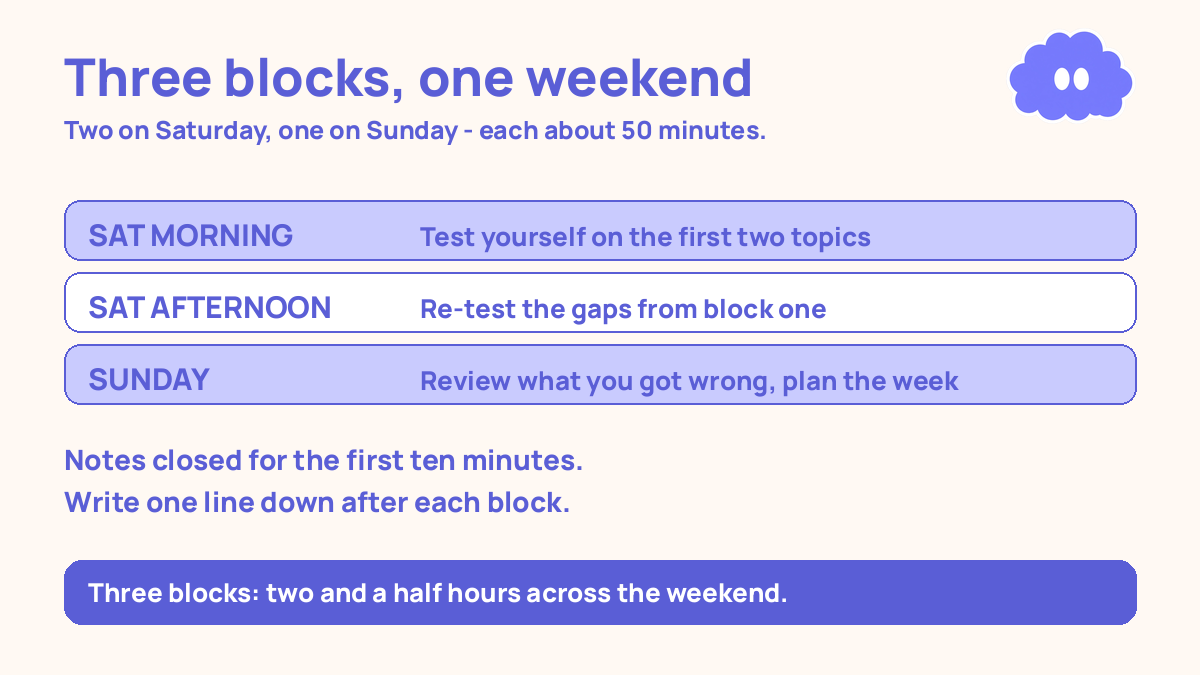
Study in three blocks across the weekend: two on Saturday and one on Sunday, each about 50 minutes long. Start every block by testing yourself from memory, then check your notes, fix the gaps, and plan the next block. That is the whole plan. It works because three short blocks with gaps between them beat one long session that ends in a headache and nothing remembered.
Why weekends go wrong for working students
The week eats everything. You work, you go to class, you come home tired, and by Friday you have a pile of notes you have not looked at since Monday. Then Saturday arrives and you want to rest and feel guilty for resting at the same time. So you either study for six hours straight and burn out, or you study nothing and spend Sunday evening panicking. Both treat the weekend as a rescue mission instead of a normal part of the week — and a rescue mission has to be huge, so it fails.
This plan treats the weekend as three ordinary blocks: small enough to actually happen, big enough to cover a week of material — if what you do inside them is testing yourself, not re-reading. In a 2013 review, Dunlosky and colleagues rated ten common study techniques; only two received a high utility rating: practice testing and distributed practice. Re-reading and highlighting were rated low. Re-reading feels productive and leaves almost nothing behind; testing yourself feels harder and leaves something you can use on Monday.
The system in short
- On Friday evening, or Saturday morning, write down what the week covered: three to five topics, one line each.
- Saturday morning, block one: test yourself on the first two topics from memory, then check your notes and mark the gaps.
- Saturday afternoon or evening, block two: test yourself on the remaining topics, then re-test the gaps from block one.
- Sunday, block three: a short review of everything you got wrong, plus a plan for the coming week.
- After each block, write down what you actually did in one line. No line, no block.
- If a block fails, shrink it to 25 minutes and do that.
Step 1: Make the Friday list
The plan starts before Saturday. On Friday evening, or first thing on Saturday morning, sit down for ten minutes and write the week’s topics on paper. Work from your notes, your slides, or your class timetable — not from what you think the week covered. Three to five topics is normal; group extras — “Cell division and genetics” is one topic, not two.
Next to each topic, write one question you should be able to answer about it. Not a summary, a question. “Why does the cell divide this way?” beats “cell division notes, pages 4 to 9.” Questions are what you will test yourself with tomorrow. If you missed a class, write that down too: “Missed Thursday’s lecture — borrow notes” is a task, not a failure. Skip it and Saturday morning becomes twenty minutes of shuffling papers.
Step 2: Saturday morning — the first block
Start Saturday morning if you can: finishing one block before lunch leaves the rest of the day yours, guilt-free. A block is 50 minutes: two 25-minute rounds with a 5-minute break, or one straight 50-minute block. The 25-minute length comes from Francesco Cirillo’s Pomodoro Technique, from the late 1980s — it was his practical choice, not a number from cognitive science. Fifty-minute blocks are a fine alternative; the guide to 50-minute blocks explains them.
Inside the block, test yourself first. Take the first two topics from your Friday list. Close your notes. Write down everything you can remember about each one, or answer the questions you wrote on Friday. Ten minutes per topic, then open your notes and check. Star the gaps — they tell you what Sunday is for. Do not start by re-reading: it feels smooth because the words are in front of you, and that smoothness is not learning. In a 2006 study, Roediger and Karpicke found that students who recalled a passage remembered more a week later than students who restudied it, even though the restudiers felt more confident right after studying. Feeling fluent right after re-reading is not the same as remembering a week later. End the block by writing one line: what you tested and what you got wrong. Then stop.
Step 3: Saturday afternoon — the second block
The second block covers the remaining topics the same way, then re-tests the gaps from the morning block. Ten minutes on those gaps is the most valuable ten minutes of the weekend, because you are meeting the same material a second time after a gap. That is distributed practice, the second of the two techniques Dunlosky and colleagues rated highly. Cepeda and colleagues, in a 2006 synthesis, found that spaced practice beat massed practice across materials and ages, and that the best gap is not fixed — it grows with how long you need to remember the material. A few hours between the two Saturday blocks is a real gap.
If the second block is short, do the re-test of the morning gaps first — it protects what you already did — then the new topics. A practical starting schedule — not a research rule — is to review the next day, then in 3 days, then in 7 days. The spaced repetition system for students shows how to run that rhythm across a term.
Step 4: Sunday — the review block
Sunday’s block is shorter and different: no new material, just three jobs — re-test what you got wrong on Saturday, catch up on what you missed, and plan the coming week. Start with the gaps: test your starred items from Saturday again from memory, before the notes. What you now get right is done; what is still wrong goes on next weekend’s list.
Then handle one loose end — the missed lecture, or the question you could not answer — picking the one that blocks next week’s classes. Then plan the week: write down, one line each, the sessions you can actually do between Monday and Friday. Be honest about your shifts. If you work until 8pm on Tuesday, Tuesday has no study session. Two weekday sessions of 25 minutes, plus the weekend, is a real week. Five imaginary sessions is not.
This Sunday planning step is the bridge to the weekday systems. If your weekday time is only an hour, the one-hour study system for working students shows how to use it. If you have two hours, the two-hour study system for working students is the bigger version of the same idea. The weekly study review system uses the same look-back habit at the end of the week.
Step 5: Protect the rest of the weekend
A study plan that eats the whole weekend will not survive a month. You work all week. The weekend is also for rest, friends, family, and doing nothing. If the plan takes all of that, you will quit the plan, not the rest. Three blocks is two and a half hours across a whole weekend; the rest is free, so guard it. When a block ends, it ends — guilt is not a study technique, and extra re-reading does not make up for a block spent testing yourself properly.
If something comes up, move a block, do not delete it — and if you skip one, write down why in one line.
A worked example: a weekend with a Saturday shift
You work in a shop, with a Saturday shift from 2pm to 8pm and Sunday free.
Friday evening, 9:00pm — ten minutes: You write the week’s topics from your notes: cell division, genetics, quadratic equations, essay structure. Four topics, four questions written next to them. You also note you missed Thursday’s maths class.
Saturday, 9:00–9:50 — block one, before the shift: Test yourself on cell division and genetics from memory, ten minutes each, then check your notes. Cell division is mostly right; genetics is half wrong. You star the genetics gaps and write one line: “Cell division OK, genetics gaps: dominant and recessive, Punnett squares.”
Saturday, 8:30–8:55 — block two, after the shift, shortened to 25 minutes: Re-test the genetics gaps first, then test yourself on quadratic equations from memory and check. One line written down.
Sunday, 11:00–11:50 — block three, the review: Re-test genetics and the essay-structure questions. You get genetics right this time, and borrow a classmate’s Thursday maths notes for the one example you missed. Then you plan the week: Monday 25 minutes on essay structure, Wednesday 25 minutes on genetics. The rest of Sunday is yours, and Monday starts with a plan instead of a pile.
When it goes wrong
Saturday morning disappears and you have done nothing by lunch. Do not try to rescue the day with a four-hour session. Do one 25-minute block after lunch: test yourself on one topic, check your notes, write one line. Then do the second block in the evening if you can, and move the review to Sunday.
You spend the whole block re-reading and call it studying. This is the most common failure, and it feels the most productive while it is happening. The fix is mechanical: notes closed for the first ten minutes of every block, no exceptions. If you cannot write anything from memory, that is useful information — it tells you the topic needs more work, not more re-reading. Write down what you could not recall and re-test it first next time.
Sunday evening arrives and you have not done the review block. Do a ten-minute version. Re-test the starred gaps only, from memory, and write next week’s plan in three lines. Ten minutes protects Saturday’s work; if Sunday evening keeps failing, move the review to the morning.
The plan works for two weeks, then the weekend fills up and it dies. This is not a motivation problem. It is a size problem. Drop to two blocks: one on Saturday, one on Sunday, 25 minutes each. Two short blocks every weekend for a month beat three long blocks for two weekends and then nothing.
Weekly review checklist
Copy this list and use it each Sunday evening:
- How many of the three weekend blocks did I actually complete, and which ones?
- Which topics did I test myself on, and which gaps are still starred?
- Did I start each block by testing myself from memory, or did I slip into re-reading?
- What got in the way this weekend — work, tiredness, or no plan on Friday?
- What one change will I make next weekend: earlier start, shorter blocks, or the Friday list the night before?
Downloadable infographic spec: one vertical image, title “Weekend study plan for working students”, with the three blocks — Saturday morning test yourself, Saturday afternoon re-test the gaps, Sunday review and plan the week — and the rules “notes closed for the first ten minutes” and “one line written down after each block”, in Cream Paper, Cloud Purple, Dark Purple and Pink, with the Cloud mascot. Text taken word-for-word from this article.
What this system is not
It is not a promise of a grade, and it is not a claim that three blocks a weekend is enough for every course and every exam. It is a practical way to use the only real hours a working student has, built on the two techniques learning researchers rated highest: testing yourself and spacing study out. The structure stays the same: test yourself first, meet the gaps again after a gap, and write down what actually happened.
Sources
- Dunlosky, J., et al. (2013). Improving students’ learning with effective learning techniques. Psychological Science in the Public Interest, 14(1), 4-58. Only practice testing and distributed practice received a high utility rating; rereading and highlighting were rated low.
- Cepeda, N. J., et al. (2006). Distributed practice in verbal recall tasks. Psychological Bulletin, 132(3), 354-380. Spaced practice beat massed practice; the optimal gap grows with how long you need to remember.
- Roediger, H. L., & Karpicke, J. D. (2006). Test-enhanced learning. Science, 311, 249-255. Students who recalled a passage remembered more a week later than students who restudied it, though restudiers felt more confident immediately.
- Cirillo, F. — Pomodoro Technique, late 1980s. Classic cycle: 25 minutes work, 5 minutes break, longer break after four. The 25-minute length was Cirillo’s practical choice, not a number derived from cognitive science.
For the weekday version of this plan, start with the two-hour study system for working students, and review the week with the weekly study review system.
Questions
How much should I study on a weekend if I work during the week?
Aim for three honest blocks: two on Saturday and one on Sunday, each 50 minutes or two 25-minute rounds. That is enough to test yourself, review what you missed, and set up Monday.
Should I study on both Saturday and Sunday?
Yes, if you can. Splitting the work across both days uses spacing: you meet the same material again after a gap, which helps you remember it. One long Sunday session is cramming.
What if I work a weekend shift?
Shrink the plan, do not cancel it. One 25-minute block of testing yourself beats a cancelled weekend. Study before a late shift, or after an early one, and keep the Sunday review short.
What should I do first in a weekend study block?
Test yourself from memory before you open your notes. Write down what you can recall, then check against your notes and mark the gaps. Re-reading first feels smooth and teaches you little.