
The direct answer
A weekly study planner is one page that shows your week before it starts: when you will study, what you will study, and what counts as done. You make it once a week, in 30 minutes, then follow it day by day instead of deciding what to do every morning. That is the whole system.
It works because the decisions are made once, when you are calm, instead of many times, when you are tired or distracted. You need a sheet of paper, your class timetable, and a pen.
Why a week works better than a day
Planning one day at a time feels flexible, but it has a hidden cost. Every morning you must decide what to study, when to start, and how long to go on for. Each decision is a chance to put it off, and by the time you have decided, half an hour is gone. A weekly plan removes that daily negotiation. You look at the page, find today, and start the first block.
A week is also the right size for real life. One day is too short, and a month is too long to see clearly. A week holds your classes, work shifts, deadlines, and rest days in one view. You can see the heavy days coming and move work to a quieter day, then check what happened and change one thing for next week. If you have never planned a week before, start with the phone focus system for distracted students as well.
The system in short
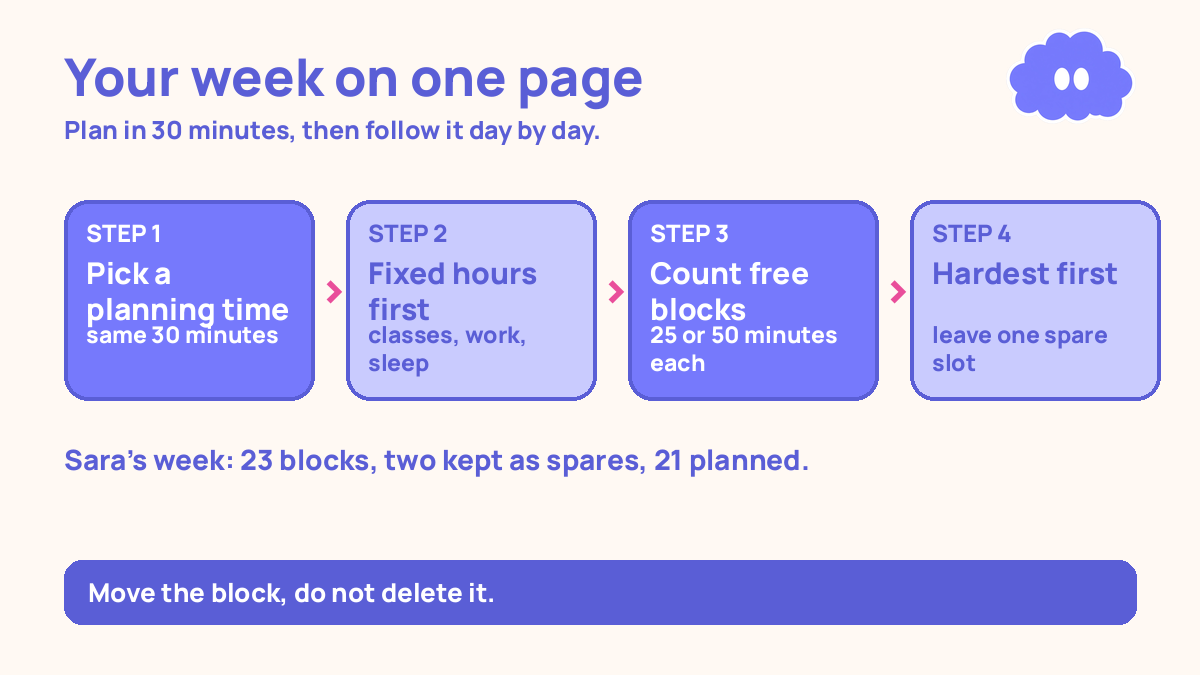
- Pick a planning time: the same 30 minutes every week, before the week starts.
- Write down your fixed hours first: classes, work, travel, meals, sleep, and anything else you cannot move.
- Count the free slots that are left. Those are your study hours. Do not plan more than that.
- List the work for the week: deadlines, tests, reading, and review. Give each piece a size in blocks.
- Put the work into the free slots, hardest first, and leave one empty slot as a spare.
- Each day, work the blocks in order. Cross each one off when it is done. At the end of the week, review what happened and change one thing.
Step 1: Pick a planning time and keep it
Choose one time each week to plan the next week. Sunday evening works for many students; if you work weekends, pick another evening. The day matters less than the habit: same time, same place, same 30 minutes. Put the planning time in the planner itself. Sit down with your class timetable, your deadlines, and last week’s planner, and put your phone in another room. The first few times, planning will take longer. After three or four weeks, 30 minutes is enough. If you miss a session, plan the next morning, even if the plan is rough.
Step 2: Write the fixed hours first
Before you plan any studying, write down everything you cannot move: classes, work shifts, travel time, meals, sleep, and family time. Most failed plans fail here. Students plan study hours on top of a full day, as if classes and work did not exist. Then the day fills up, the study blocks disappear, and they feel like they failed. They did not fail. The plan was wrong. It counted hours they did not have. Be honest about travel and meals: 40 minutes to campus is 40 minutes you cannot study in. What is left after the fixed hours are your real study hours.
Step 3: Count your free slots in blocks
Do not count your free time in hours. Count it in blocks: one focused session of 25 minutes or 50 minutes, with a break after it. Read the Pomodoro technique for students first, or try 50-minute blocks for longer tasks. A free hour is two 25-minute blocks, or one 50-minute block. A free evening of three hours is four or five blocks, once you take out breaks, food, and settling down. Write the number of blocks next to each day. Monday might have four, Tuesday two, Saturday six. Put heavy work on the days with many blocks and light review on the days with few. Leave at least one spare block in the week.
Step 4: List the week’s work and give it a size
List everything you need to do this week. Deadlines first, then tests, then reading, then review. Write each piece on its own line, with a size in blocks. “Revise biology” is not a piece of work. It has no size and no end. “Answer the 12 questions on cell division from memory, two blocks” is a piece of work. Give every item a size by guessing, then correcting the guess next week. Most students guess too small at first. Sort the list by what matters most: a test on Friday matters more than a reading due next month. If the list is bigger than your blocks, you have a problem you can see. Drop something, ask for an extension, or move something to next week. What you cannot do is pretend the list fits.
Step 5: Put the work into the slots, hardest first
Take your list and put each item into a free slot, starting with the hardest work and the earliest deadlines. Hard work goes into your best hours — for many students, the morning, or the first hour after getting home. Easy review goes into the tired hours at the end of the day. Do not put the same subject in every block of a day. Two blocks of maths, then a break, then one block of English, works better than four blocks of maths in a row. Write the plan so a stranger could follow it. Not “study”, but “two blocks: answer cell division questions from memory”. Put the plan where you will see it: on the wall above your desk, or on the first page of your notebook. A plan hidden in a drawer is not a plan.
Step 6: Work the plan day by day
During the week, your job is simple: look at today, do the first block, cross it off, do the next one. Do not re-plan the whole week every morning. If a block goes wrong — you get interrupted, you feel ill, a class runs long — cross it out and write what happened next to it in one line. “Missed: family visit.” “Half done: questions 1 to 6.” That note is gold at review time. If you finish a block early, use the leftover minutes to check your work, or stop early and rest. At the end of each day, take two minutes to look at tomorrow, and get anything you need ready tonight. For the system this planner sits inside, read how to build a study system that fits your life.
When the week you are planning is an exam countdown rather than a normal week, the revision planner does the same job from the other end: give it the exam date, your topics and the minutes you have a day, and it writes the blocks and the review dates for you.
When the week is mostly coursework — essays, problem sets, lab reports — the assignment and deadline tracker starts one step earlier. Put every deadline in one list and it sorts them by due date, keeps the week ahead at the top with overdue work in red, and tick each one off as it is finished. Plan the week from that list instead of from memory.
A worked example: a week with classes and a Friday test
Sara has classes every morning, works two evenings, and has a biology test on Friday. She plans on Sunday evening. Her fixed hours leave her four blocks on Monday, three on Tuesday, two on Wednesday, five on Thursday, three on Friday after the test, and six on Saturday. Sunday is planning and rest: 23 blocks, two kept as spares, so she plans 21.
Her list: biology revision (six blocks), maths problem set due Thursday (four blocks), English essay draft (four blocks), history reading (three blocks), review of last week’s topics (four blocks). That is 21 blocks. It fits, only just. She puts biology into the best slots: two blocks Monday morning, two on Thursday, one on Tuesday, one on Friday morning before the test. Maths goes into Tuesday and Wednesday evenings, the essay into Saturday morning, history into the tired evening slots, and review into the last block of each day. On Wednesday, a class runs long and she loses a block, so she moves the history reading to the spare block on Saturday afternoon. By Saturday evening, 19 of her 21 blocks are crossed off.
When it goes wrong
The plan is perfect on Sunday and dead by Tuesday. The plan counted hours you did not have. Go back to Step 2, write the fixed hours honestly, including travel and meals, and count blocks, not hours. A plan built on real hours survives the week.
You keep moving work to tomorrow, and tomorrow never comes. Moving a block once is planning. Moving it three times is avoiding it. When a block has moved twice, ask why. Is the task too big? Split it. Is it unclear? Write down the exact first step — open the book to page 42, answer question one — and start there. If it still will not move, drop it on purpose and write that down.
You plan the week, then never look at the plan again. A plan you cannot see is a plan you will forget. Put it on the wall, or on the first page of your notebook, and check it each morning for 30 seconds. If you keep forgetting to look, the plan is in the wrong place. Move it to where your eyes already go.
Urgent work eats the week and important work never happens. Put the important work into the best slots first. Urgent small jobs go into the gaps, not into your best hours. If every week is full of urgent work, something in your routine is creating emergencies. The weekly review is where you spot that pattern and change one thing.
Weekly review checklist
Copy this list and use it each week:
- How many of this week’s blocks actually happened, and how many were missed or moved?
- Which blocks were missed, and why — fixed hours I forgot, tasks too big, phone, tiredness, or something else?
- Which subject got less time than it needed, and which got more than it needed?
- What did I guess wrong about size — which tasks took more blocks than I planned, and which took fewer?
- What is the one change I will make next week — and only one?
The one-change rule matters. If you try to fix five things at once, you will fix none of them. Pick the single change that would help most: phone in another room, smaller tasks, or a spare block on Thursday. One change, tried for a full week, then judged honestly. This is also where the planner connects to the weekly study review system. The planner shows what you intended. The review system shows what you actually learned.
Downloadable infographic spec: one vertical image, title “Your week on one page”, with the seven steps — pick a planning time, write fixed hours first, count free blocks, list the work in blocks, put hard work in best slots, work the plan day by day, review and change one thing — and the checklist question “How many blocks actually happened this week?” in Cloud Purple #7679FC, Dark Purple #5A5ED6, Cream Paper #FFF9F3 and Pink #E94E9A, with the Cloud mascot. Text taken word-for-word from this article.
What this system is not
It is not a promise of a grade, and it is not a claim that planning harder makes you learn more. Planning only organises the work. The learning still happens inside the blocks. In a 2013 review, Dunlosky and colleagues rated ten common study techniques, and only two received a high utility rating: practice testing and distributed practice. Re-reading was rated low. A beautiful weekly plan filled with re-reading is still a weak week. It is also not a system that punishes you for a missed block. A missed block is information, not a failure. If the planner becomes a source of guilt, loosen it: fewer blocks, more spare time, smaller tasks.
Sources
- Dunlosky, J., et al. (2013). Improving students’ learning with effective learning techniques. Psychological Science in the Public Interest, 14(1), 4-58. Only practice testing and distributed practice received a high utility rating; rereading was rated low.
- Cirillo, F. — Pomodoro Technique, late 1980s. Classic cycle: 25 minutes work, 5 minutes break, longer break after four. The 25-minute length was Cirillo’s practical choice, not a number derived from cognitive science.
For the daily focus that makes the planned blocks work, use the phone focus system for distracted students, and for the review at the end of the week, use the weekly study review system.
Questions
How long does it take to plan a week?
About 30 minutes, once a week, at the same time. That half hour saves you from deciding what to study every single day, which is where most study time leaks away.
What if my timetable changes during the week?
Move the block, do not delete it. A plan that cannot move will break on the first busy day. Shift the work to another free slot the same week, and note the change.
How many hours should I plan to study each week?
Start with the hours you actually have, not the hours you wish you had. Count your free slots after classes, work and rest, then plan inside that number. Add hours only after a week where the plan held.
What do I do when I fall behind on the plan?
Do not try to catch up by doubling the next day. Pick the one missed piece that matters most, put it in the next free slot, and let the rest go. A plan you can repair is a plan you will keep.