The direct answer
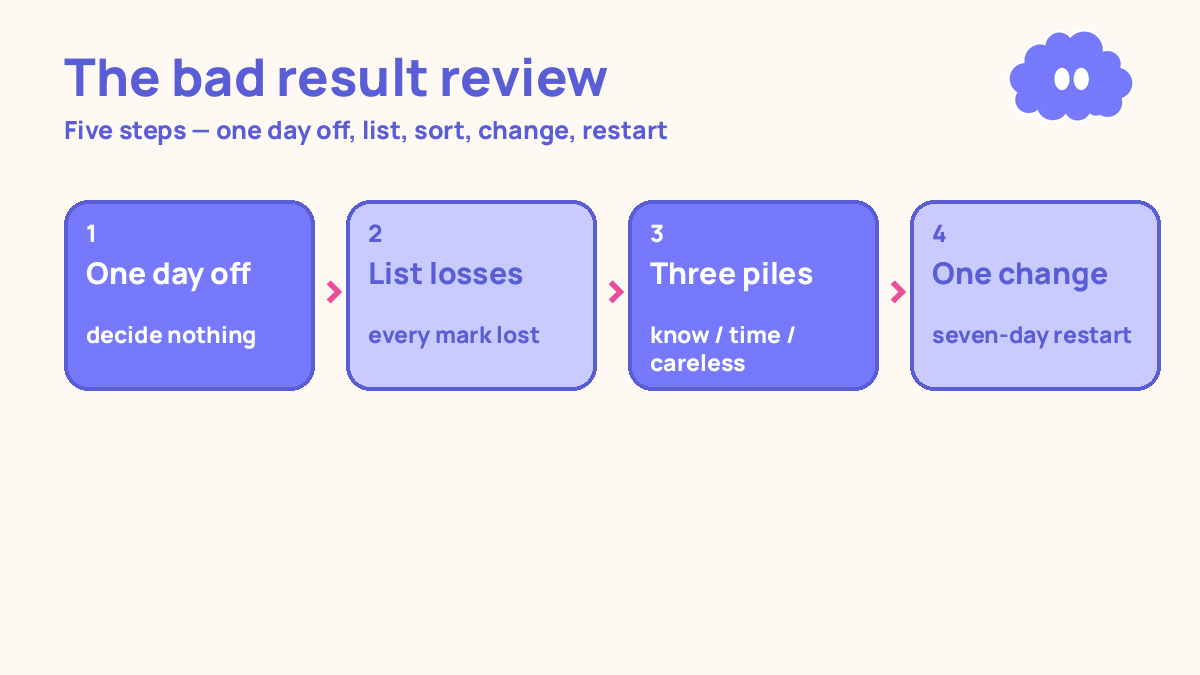
How to handle a bad exam result: take one day off, then get the paper back, sort every error into three piles — did not know it, knew it but ran out of time, careless mistake — and make one change per pile. Then restart your study with a seven-day plan. That is the whole system.
You open the result and your stomach drops. The mark is lower than you expected, lower than you told people it would be, and now you have to live with it. The first thought is usually about what the mark means about you. It means nothing about you. It means something about what you did and did not do in the weeks before the exam, and that is fixable.
The worst thing you can do with a bad result is decide what it means on the same day you get it. The second worst thing is to do nothing about it — to put the paper in a drawer and carry on studying the same way, hoping the next exam goes better. It will not, unless something changes. The system below is the middle path: one day off, then facts, then one change per cause, then a restart.
It sits inside how to revise for exams without cramming, and the weekly rhythm it restarts into is the weekly study review system.
The system in short
- Take one full day off. Decide nothing about the result on the day you get it.
- Get the paper back and list every mark you lost, question by question.
- Sort every error into three piles: did not know it, knew it but ran out of time, careless mistake.
- Make one change per pile — one new habit, not five.
- Restart with a seven-day plan that tests the weak topics first.
Step 1: Take one full day off, decide nothing
Do not decide anything about the result on the day you get it. Not whether to drop the subject, not whether to ask for a remark, not whether you are “bad at” the subject. On result day, your judgement is at its worst. You are reading the mark through disappointment, and disappointment makes everything look permanent.
Take one full day off. Not a week — a day. Go for a walk, watch something, talk to a friend, do anything that is not studying. The day off has a job: it separates the feeling from the facts. Tomorrow you will still have the same mark, but you will be able to look at it without the sting deciding for you.
Put a date on the restart — “I look at the paper on Thursday” — and write it down.
Step 2: Get the paper back and list what you lost
On the restart day, get the paper back. If your teacher does not hand papers back automatically, ask for it. You cannot fix what you cannot see, and a mark on its own tells you nothing about what went wrong.
Go through the paper question by question and write down every mark you lost: the question, the marks lost, and what happened. “Q3, 4 marks: could not remember the definition.” “Q5, 6 marks: ran out of time, left it blank.” “Q7, 2 marks: used the wrong formula.” Be specific. “I did badly” is not a list. A list is something you can work from.
Step 3: Sort every error into three piles
Now sort the list into three piles. This is the step that matters most, because each pile has a different fix, and most students try to fix all three with the same action — “study more” — which fixes none of them properly.
Pile 1: Did not know it. You had not covered the topic, or you covered it and could not remember it in the exam. The fix is testing yourself on that topic, not re-reading it. In a 2013 review, Dunlosky and colleagues rated practice testing and distributed practice as the only two high-utility techniques; re-reading was rated low.
Pile 2: Knew it but ran out of time. You knew the material and could not finish. This is a time problem, and more revision will not fix it. The fix is timed practice: past papers under exam conditions, with the clock running.
Pile 3: Careless mistake. You knew the answer and wrote the wrong number, misread the question, or skipped a page. The fix is a checking habit: five minutes at the end of every paper, and a rule to read each question twice before answering.
Count the marks in each pile. Most students find one pile holds most of the marks. That pile is where the change goes.
Step 4: Make one change per pile, not five
For each pile, pick one change. One, not five. A student who tries to change everything at once changes nothing, because five new habits is a new life, not a study plan.
For pile 1, the change is a testing habit: for the weakest topic, ten questions from memory, three times a week, notes closed. For pile 2, the change is one timed past paper a week, with the time blocks written on the paper before you start. For pile 3, the change is a checking routine: read each question twice, and keep five minutes at the end for checking.
Write each change as an if-then plan: “If I sit down after breakfast, then I test myself on ten questions from the weak topic.” An if-then plan names the cue and the action in advance, so starting does not need a fresh decision. Across 94 studies, if-then plans raised goal attainment by a medium-to-large amount (d = 0.65) over holding the goal alone (Gollwitzer & Sheeran, 2006).
Step 5: Restart with a seven-day plan
The restart is seven days, not a new term. Seven days is short enough to finish, and long enough to prove the changes work.
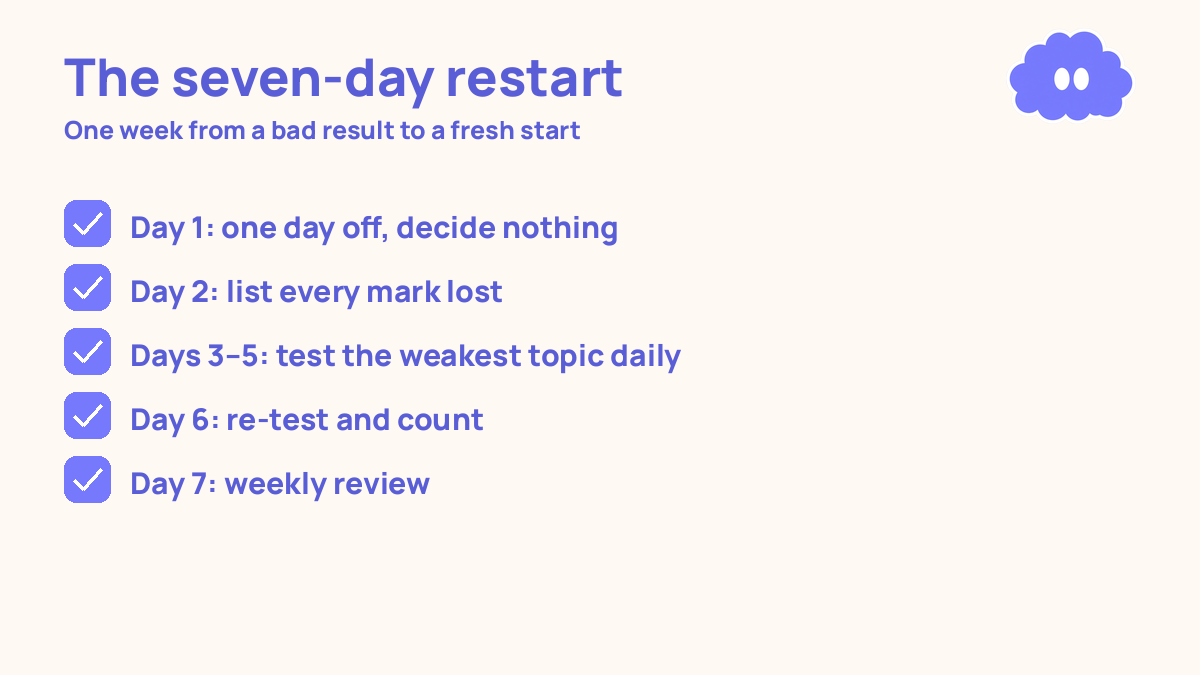
Days 1 to 3: test the weakest topic from pile 1, ten questions a day, notes closed, then check. Days 4 to 5: one timed past paper, with time blocks on the paper, and the checking routine at the end. Day 6: re-test the pile-1 topic and count how many questions you get right this time. Day 7: weekly review — what changed, what is still weak, what happens next week. If the restart stalls on day one, how to get back on track after a bad study day covers the day after a missed day, and what to do first.
A worked example: how to handle a bad exam result — chemistry 52%
You get your chemistry result on Monday: 52%. You expected 70%. The paper comes back on Thursday.
Monday — day off: You do not decide anything. You go for a walk, watch something, and tell your parents the mark and that you will look at the paper on Thursday. You write down the restart date: Thursday 4pm.
Thursday 4:00–4:45 — list the losses: You go through the paper. Q3, 4 marks: could not remember the definition of a mole. Q5, 6 marks: ran out of time, left blank. Q7, 2 marks: used the wrong formula for concentration. Q9, 5 marks: did not know the topic at all — electrolysis. Total lost: 17 marks.
Thursday 4:45–5:00 — sort the piles: Pile 1 (did not know it): Q3 and Q9, 9 marks. Pile 2 (ran out of time): Q5, 6 marks. Pile 3 (careless): Q7, 2 marks. Pile 1 holds most of the marks. Electrolysis and the mole definition are the weak topics. The changes: ten questions on electrolysis from memory three times a week, one timed past paper a week, and the checking routine.
Friday to Wednesday — the seven-day plan: Friday, Saturday, Monday: ten electrolysis questions, notes closed, then check. Tuesday: timed past paper, 60 minutes, time blocks on the paper, five minutes checking. Wednesday: re-test electrolysis, ten questions. You get 8 right, up from 3 on Friday. That number is the evidence.
| Error | Marks lost | Pile | The one change |
|---|---|---|---|
| Q3: could not remember the mole definition | 4 | Did not know it | Test 10 questions, 3 times a week |
| Q9: did not know electrolysis | 5 | Did not know it | Same as Q3 — weakest topic first |
| Q5: ran out of time, left blank | 6 | Ran out of time | One timed past paper a week |
| Q7: wrong formula for concentration | 2 | Careless mistake | Read each question twice, 5 min checking |
When it goes wrong
You decide on result day to drop the subject. Wait. A decision made on the worst day is the worst decision. Do the review first. If pile 1 holds most of the marks, the subject is fixable. If you still want to drop it after the seven-day plan, that is a decision made with facts, not feelings.
You cannot get the paper back. Work from memory and the mark scheme. Write down the topics you remember struggling with and the questions you left blank. A rough list beats no list. If even that is impossible, test yourself on the whole topic list and let the test results be the list.
Pile 1 is everything and it feels hopeless. It is not. Pile 1 is the easiest pile to fix, because testing yourself works and you can measure it. Start with the single weakest topic, ten questions a day, and watch the number rise. One topic fixed is proof the system works.
You do the review and then change nothing. This is the most common failure. The review feels like the work, so you stop after it. It is not the work. The work is the one change per pile, done three times a week. If you only do one thing from this article, do the testing habit for the weakest topic.
Weekly review checklist
Copy this list and use it each week:
- What were the three piles, and which one held the most marks?
- Did I do the one change for the biggest pile three times this week?
- How many questions did I get right on the re-test, compared with the first test?
- What one change will I make next week: a new weak topic, a timed paper, or a stricter checking routine?
Downloadable infographic spec: one vertical image, title “How to handle a bad exam result”, with the five steps — one day off, list the losses, sort into three piles, one change per pile, seven-day restart — and the rule “one change per pile, not five” in Thynq cream, Cloud Purple, Dark Purple and pink, with the cloud mascot. Text taken word-for-word from this article.
What this system is not
It is not a promise of a better grade next time, and it is not a claim that believing in yourself fixes a bad result. The link between mindset and grades is very weak. This system is a way to turn a bad mark into a list, a list into three piles, and three piles into one change each — and to measure whether the change worked, instead of hoping it did.
Sources
- Dunlosky, J., et al. (2013). Psychological Science in the Public Interest, 14(1), 4-58. Only practice testing and distributed practice rated high utility; rereading rated low.
- Gollwitzer, P. M. & Sheeran, P. (2006). Advances in Experimental Social Psychology, 38, 69-119. Across 94 studies, if-then plans raised goal attainment (d = 0.65).
- Sisk, V. F., et al. (2018). Psychological Science, 29(4), 549-571. Across 273 studies, the link between a growth mindset and achievement was very weak (r = 0.10).
Questions
Should I ask for a remark or a resit?
Check the rules first: how many marks you are short, what a remark costs, and the deadline. Then ask a teacher whether your paper looks like a marking error or a knowledge gap. A remark fixes the first. Only study fixes the second.
How do I tell my parents about a bad result?
Tell them the facts and the plan in the same conversation: the mark, what went wrong, and the one change you are making. Parents worry most when they hear a bad mark with no plan attached to it.
What if I failed the whole exam?
Use the same system at a bigger scale: get the paper back, sort every error into the three piles, and talk to a teacher about your options — resit, remark, or extra support. A failed exam is a bigger version of the same problem, not a different one.
How long should I wait before studying again?
Take one full day off. Then start the review in step 2. A week off turns a bad result into a habit of not studying. A day off is rest. A week off is avoidance.