
The direct answer
How to get back on track after bad day: do one small session today, at the normal time, with one task you can finish in 15 to 25 minutes. Do not make up the missed work. Do not study twice as long to punish yourself. Just do the next session, tick it off, and the habit is running again. That is the whole system.
Yesterday was a bad study day. You planned four blocks and did none of them. Or you sat down, got distracted, and finished nothing. Or life got in the way — a late shift, a family emergency, a headache. This morning you wake up feeling behind, guilty, and sure that the week is ruined.
It is not ruined. A bad day is one day. In one study, Lally and colleagues (2010) followed 96 people building a new daily behaviour for 12 weeks, and missing a single day did not measurably hurt the process. What breaks a habit is not one bad day. It is the second and third bad days — the ones that happen because the first one made you feel too guilty to start again.
So the system for the day after a bad day is simple: one small session, at the normal time, with no make-up work and no guilt. Do it, tick it off, and you are back on track. Not because you caught up. Because you started again.
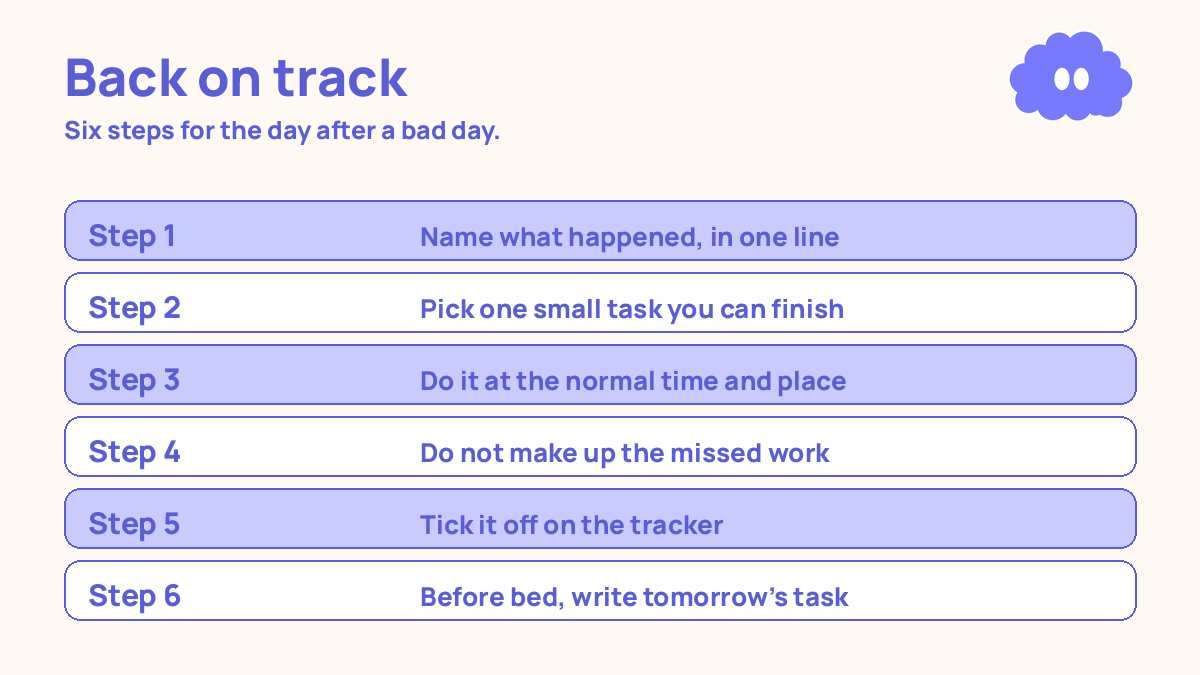
How to get back on track after bad day: the system in short
- Name what happened, in one line. No blame, no story. Just the fact.
- Pick one small task you can finish in 15 to 25 minutes.
- Do it at the normal time, in the normal place. Same time, same place, same session.
- Do not make up the missed work. Do not double the session.
- Tick it off on the tracker. One tick, one day back.
- Before bed, write tomorrow’s task. The habit is running again.
Step 1: Name what happened, in one line
Before you do anything else, write one line about yesterday. No blame, no story, just the fact. “Missed the session — late shift.” “Sat down, got distracted, finished nothing.” “Headache all afternoon.” That is all.
This matters because a bad day without a name becomes a feeling: “I am behind”, “I have ruined the week”. Feelings do not have a fix. Facts do. A late shift is a fact. “I am not disciplined enough” is a feeling, and it has no fix at all.
One line, on paper, then move on. Do not write a paragraph about it. The line is there so the bad day has a name and a size, and the size is one day, not the whole habit.
Step 2: Pick one small task you can finish
The task for today has to be small enough to finish in 15 to 25 minutes, and easy enough to start while you still feel bad. “Answer the 8 photosynthesis questions from memory.” “Work 4 mole problems.” Not the task you missed yesterday. A fresh task, small, finishable.
Do not pick the hardest task to prove something. Do not pick the missed work to catch up. The job of today’s session is not to catch up. The job is to restart. A small finished task restarts the habit.
If even a small task feels too much, make it smaller. One question. One problem. One page. The size does not matter. The finish matters. If the problem is not one bad day but a whole low week, how to study when you have no motivation is the system for that.
The phone focus system for distracted students is the companion piece here: phone in another room, timer on, one task at a time. If yesterday’s bad day was a phone day, fix the phone first, before you pick the task.
Step 3: Do it at the normal time, in the normal place
Do the session at the normal time, in the normal place. Same time, same place, same session. Do not move it earlier to “get it over with” or later because you are not ready. The normal time is the habit’s cue, and the cue is what makes the session start without a decision.
If the normal time has already passed, do the session at the next normal time. Do not squeeze it into a gap that does not exist. A session squeezed into a gap is a session that will not happen, and then the bad day becomes two bad days.
Set a timer for 15 to 25 minutes. The 25-minute length was Francesco Cirillo’s practical choice in the late 1980s, not a number derived from cognitive science. Work the one task until the timer rings. Then stop.
Step 4: Do not make up the missed work
This is the hardest step, and the most important one. Do not make up the missed work. Do not study twice as long. Do not do yesterday’s tasks on top of today’s. The missed work is gone. The next session is what matters.
Making up the work feels responsible, and it is the fastest way to a second bad day. A double session is twice as tiring, twice as likely to be abandoned halfway, and it teaches you that a bad day costs you double. The habit is not a debt. You do not owe yesterday’s hours. You owe today’s session.
If the missed work matters — an exam topic you have not covered, a deadline — put it on the list for the coming week, in its normal place, one task at a time. It will get done in the normal flow.
For the days when starting itself is the problem, how to stop procrastinating study covers the wider system: making the first step tiny and working in short blocks.
Step 5: Tick it off, and write tomorrow’s task
When the session is done, tick it off on the tracker. One tick, one day back. The tick is the proof: yesterday was bad, today happened, the habit is running again. Tick the box.
Then, before bed, write tomorrow’s task in one line, with a clear finish. “Answer the 10 cell-division questions from memory, then check.” That takes one minute, and it is what makes tomorrow’s session start the moment you sit down.
If you keep a study streak tracker, a bad day shows as one pale square in sixteen weeks of them. Tick today’s small task and the chain starts again from one.
A worked example: the day after a bad day
Yesterday was bad. You planned four blocks and did none of them — a late shift, then a headache, then the sofa. This is today, Thursday.
Thursday 7:00am — name it. One line on paper: “Wednesday: missed everything — late shift, then headache.” No blame, no story. Just the fact.
Thursday 7:00pm — the session. Normal time, kitchen table. The task: “Answer the 8 photosynthesis questions from memory.” Phone in the kitchen, on silent. Timer set for 25 minutes.
7:00–7:25 — the session. You answer the 8 questions. 6 right, 2 wrong. You write the 2 wrong ones on the list for tomorrow. Done. Tick the box. One tick, one day back.
7:25 — stop. No make-up work. No second session. The missed work goes on the list for next week, one task at a time.
Thursday night — tomorrow’s task. Before bed, one line: “Answer the 10 cell-division questions from memory, then check.” Friday starts the moment you sit down.
Friday 7:00pm — the next session. 10 questions, 8 right, 2 wrong. Tick the box. Two ticks in a row. The bad day is two days behind you, and the habit is running again.
Saturday — the check. Two good days, one bad day, two good days. That is a normal week.
| Day | What happened | Sessions | Ticks |
|---|---|---|---|
| Wednesday | Late shift, headache | 0 of 4 planned | None |
| Thursday | One small session, 7pm | 1 of 1 | 1 |
| Friday | One session, 7pm | 1 of 1 | 1 |
| Saturday | Normal day | 2 sessions | 2 |
When it goes wrong
You try to make up the missed work and burn out by midday. The double session is twice as tiring and twice as likely to be abandoned. The fix is the rule: one normal session, no make-up work. The missed work goes on the list for next week.
You treat one bad day as proof the habit is dead. It is not dead. Missing a single day did not measurably hurt the process in the Lally study. The habit dies on the second and third bad days, not the first. Do the next session, tick the box, and the habit is running again.
You pick a task that is too big, and it fails, and the bad day becomes two. The task for the day after a bad day has to be small and finishable. One question, one problem, one page, if that is what it takes. The size does not matter. The finish matters.
You have had three bad days in a row and the plan is clearly wrong. Then something about the plan is wrong, not you. Shrink the session to fifteen minutes, move it to a time that actually works, and make the first task tiny. Three bad days is a plan problem, and plans can be fixed.
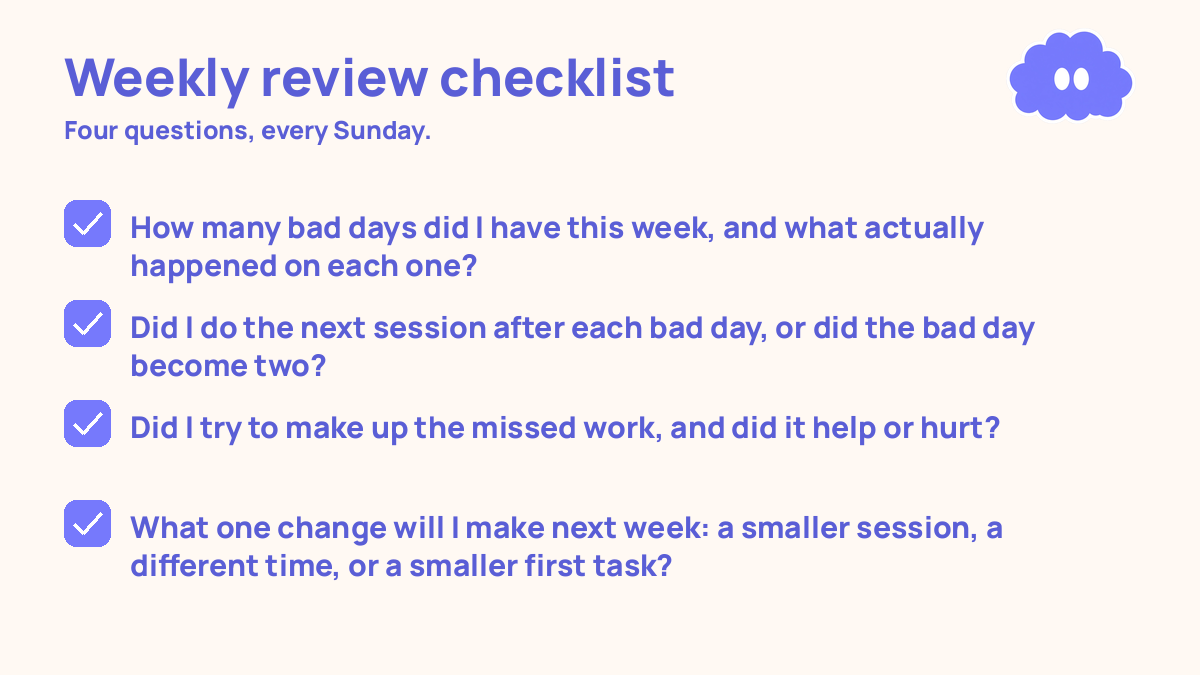
Weekly review checklist
Copy this list and use it each week:
- How many bad days did I have this week, and what actually happened on each one?
- Did I do the next session after each bad day, or did the bad day become two?
- Did I try to make up the missed work, and did it help or hurt?
- What one change will I make next week: a smaller session, a different time, or a smaller first task?
Downloadable infographic spec: one vertical image, title “Back on track”, with the six steps — name what happened, pick one small task, do it at the normal time, do not make up the missed work, tick it off, write tomorrow’s task — in Thynq cream, Cloud Purple, Dark Purple and pink, with the cloud mascot. Text taken word-for-word from this article.
What this system is not
It is not a claim that bad days do not matter, and it is not a promise of a grade. Bad days matter: they cost you a day of work. What this system claims is narrower: one bad day does not end a habit, and the fix is one small session, not a heroic catch-up. The research it leans on is specific: Lally and colleagues (2010) found that missing a single day did not measurably hurt the process of building a habit, in a study of 96 people over 12 weeks. If the habit has genuinely stopped — no session for two weeks — start smaller, at fifteen minutes, and rebuild one day at a time.
Sources
- Lally, P., van Jaarsveld, C. H. M., Potts, H. W. W. & Wardle, J. (2010). “How are habits formed: modelling habit formation in the real world”, European Journal of Social Psychology 40(6), 998–1009. 96 people tracked one new daily behaviour for 12 weeks. Missing a single day did not measurably hurt the process.
- Cirillo, F. — Pomodoro Technique, late 1980s. Classic cycle: 25 minutes work, 5 minutes break, longer break after four. The 25-minute length was Cirillo’s practical choice, not a science-derived number.
- Dunlosky, J., et al. (2013). Psychological Science in the Public Interest 14(1), 4–58. Only practice testing and distributed practice received a high utility rating; rereading was rated low. A restart session spent testing yourself beats one spent re-reading.
Questions
Does one bad day ruin my study habit?
No. In one study, Lally and colleagues (2010) found that missing a single day did not measurably hurt the process of building a habit. A bad day is one day. The habit is built by the days you do, not broken by the days you miss.
Should I make up the missed work the next day?
No. Doubling the work punishes you for a bad day and makes the next day harder. Do one normal session, at the normal time, and move on. The missed work is gone. The next session is what matters.
What if I have had three bad days in a row?
Then something about the plan is wrong, not you. Shrink the session to fifteen minutes, move it to a time that actually works, and make the first task tiny. Three bad days is a plan problem, and plans can be fixed.
How do I stop feeling guilty about a bad day?
Do one small session. Guilt fades when the next session happens, not when you think about the bad day harder. A 15-minute session with one finished task is the fastest way to feel back on track, because you are back on track.