The direct answer
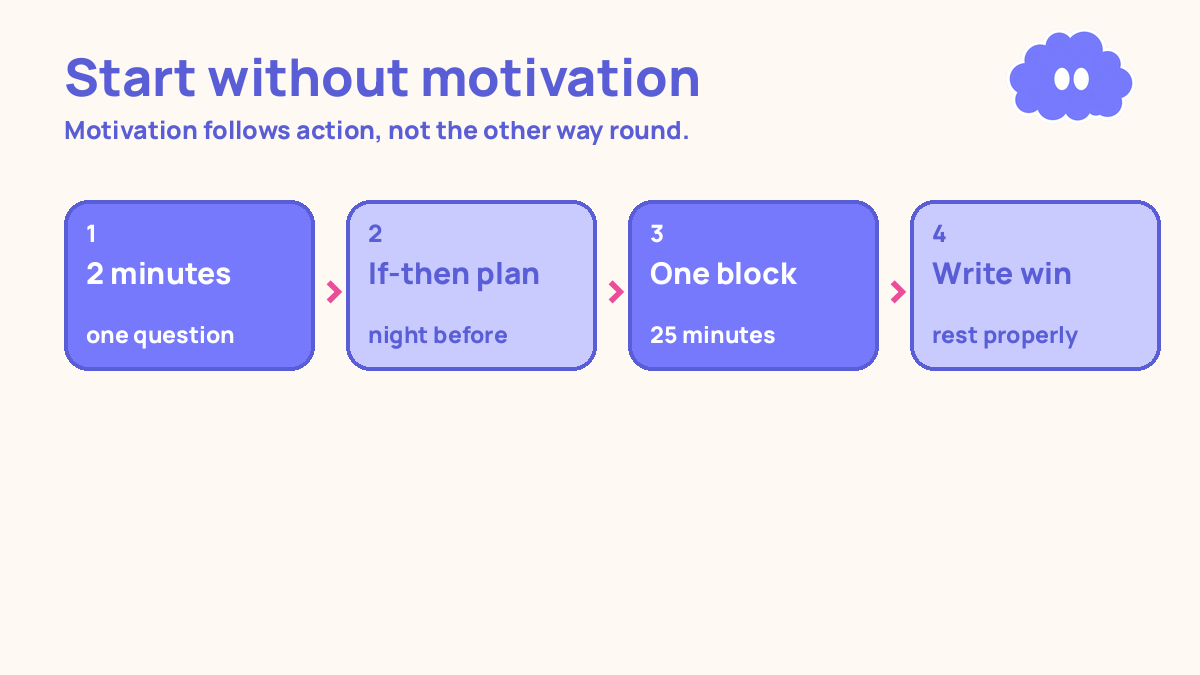
Here is how to study when you have no motivation: do not wait for it. Shrink the task to 2 minutes, start it with an if-then plan, and do one 25-minute block. That is the whole system. Motivation follows action, not the other way round. You will not feel like starting. You start anyway, for 2 minutes, and the feeling usually arrives after you have begun.
The day you do nothing
You wake up with no motivation. Not tired, exactly — just flat. The books are on the desk, the exam is next week, and you cannot make yourself care. You tell yourself you will start after lunch. After lunch you tell yourself you will start tomorrow.
The problem is not that you are lazy. The problem is that “study” feels like a mountain, and a mountain is not something you start climbing when you feel flat. The system below shrinks the mountain to a single step: 2 minutes, one question, one sentence. A step that small does not need motivation.
There is a second problem, and it is the advice you have probably heard: “just believe in yourself”. Believing in yourself is a small piece, not the answer. Across 273 studies, Sisk and colleagues (2018) found the link between a growth mindset and achievement was very weak (r = 0.10), and Yeager and colleagues (2019) found a small benefit for lower-achieving students only. So this article does not ask you to believe harder. It gives you a smaller task and a shorter block.
The system in short
- Shrink the task to 2 minutes: one question, one problem, one sentence.
- Write it as an if-then plan the night before: “If I sit down at 9am, then I will…”
- Sit down and start the 2 minutes. No phone, no deciding, no negotiating.
- When the 2 minutes are up, keep going for one 25-minute block — or stop. Either way, you started.
- After the block, write down the one thing you did. That is the day’s win.
- Rest properly. A no-motivation day is often a tired day, and rest is part of the system.
Step 1: Shrink the task to 2 minutes
Never sit down with a big task on a no-motivation day. “Revise biology” is a mountain. “Answer the first cell-division question” is a step. Write the step on paper, in one line, before you sit down. One question, one problem, one sentence — the smallest piece of the work that still counts as work.
Two minutes is the deal you make with yourself: “I will do this for 2 minutes, and then I can stop.” Two minutes is small enough that starting does not feel hard. And once you have started, stopping feels harder than continuing. The 2 minutes is a door, not a limit.
If 2 minutes still feels like too much, shrink it further: open the book to the right page. Put the pen on the desk. The smallest possible start is still a start.
Step 2: Write the if-then plan the night before
Motivation is lowest in the morning, so do the deciding the night before. After dinner, sit at your desk for 10 minutes and write tomorrow’s first task as an if-then plan: “If I sit down at 9am, then I will answer the first cell-division question.” Name the cue — sitting down at 9am — and the action — the first question.
In a meta-analysis of 94 studies, Gollwitzer and Sheeran (2006) found that deciding the cue and the action in advance raised goal attainment by a medium-to-large amount (d = 0.65) over holding the goal alone. Writing it the night before is the rehearsal.
Write the plan on paper and leave it on the desk, on top of the book. In the morning, you do not decide. You read the plan and do the first small piece.
Step 3: One 25-minute block, then decide
Set a timer for 25 minutes and work on the one small task. The 25-minute Pomodoro is a practical choice from Cirillo, not a number from cognitive science — what matters is that the block is short enough to finish on a bad day.
When the timer rings, decide: continue for another block, or stop. Both are allowed. One 25-minute block is a full win on a no-motivation day. It is 25 minutes of real work, a finished piece, and a routine kept alive. Zero minutes and a day of guilt is the alternative, and the guilt makes tomorrow worse.
If you continue, take a 5-minute break first: stand up, water, window, no phone. If you stop, write down the one thing you did, close the book, and rest.
If starting is the part that always fails, the how to start studying when you cannot start goes deeper on the first five minutes.
Step 4: Rest properly, and write down the win
A no-motivation day is often a tired day in disguise. You stayed up late, you slept badly, you studied for six hours yesterday and never recovered. If that is the case, rest is not giving up. It is the repair that makes tomorrow possible.
Rest properly: a walk outside, a real lunch, an early night. And write down the win before you rest: the one thing you did today, on paper.
One missed day does not reset anything. In a study of 96 people building one new daily behaviour, Lally and colleagues (2010) found the median time for it to feel automatic was 66 days, with a range of 18 to 254 days, and missing a single day did not measurably hurt. A bad day is a bad day, not a broken system. And when the bad day has already happened, how to get back on track after a bad study day is the restart — one small finished task, at the normal time, in the normal place.
A worked example: a Thursday with no motivation
You wake up flat. The exam is next week. You have the whole day free and no desire to use it.
Wednesday night — Plan (10 minutes): Write tomorrow’s first task on paper: “If I sit down at 9am, then I will answer the first cell-division question.” Lay out the biology book open to the questions page. Phone on charge in the kitchen. 9:00am — Start: Sit down. Read the plan. Answer the first question. Two minutes. 9:00–9:25am — Block 1: Keep going. Answer all 10 questions from memory, then check. Two wrong. Write the two correct answers out by hand. 9:25–9:30am — Break: Stand up, water, window. Decide: continue or stop. 9:30–9:55am — Block 2: Continue. Work through three mole problems. Two right, one wrong. Redo the wrong one slowly. 9:55am — Stop: Two blocks done. Write down the win: “10 questions, 3 problems.” Close the book. Walk, eat a real lunch, rest.
| Waiting for motivation | Starting without it | |
|---|---|---|
| 9:00am | Still in bed, phone | First question answered |
| 10:00am | Guilt, still nothing | Two blocks done |
| 12:00pm | “I’ll start tomorrow” | Win written down, resting |
| Tomorrow | Same flat feeling | Starts from a win |
| Week | Nothing done | Routine kept alive |
How to study when you have no motivation: what the day is telling you
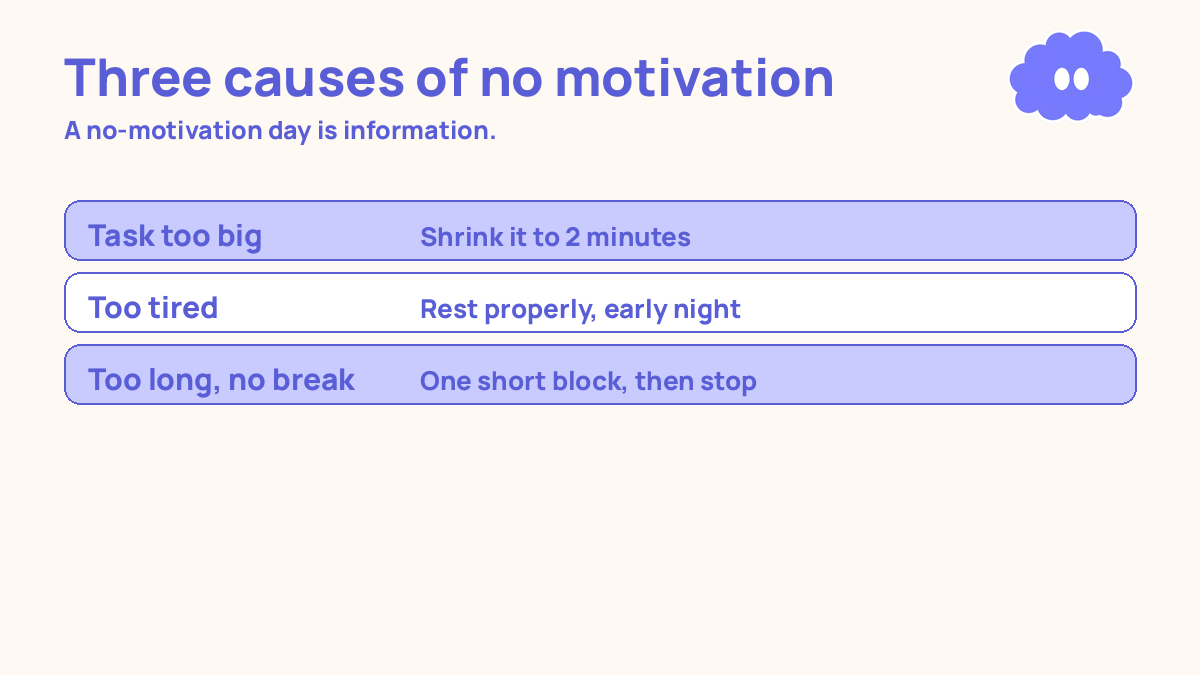
A no-motivation day is information, not a verdict. It usually means one of three things: the task is too big, you are too tired, or you have been going too long without a break. The system answers all three: shrink the task, do one short block, and rest properly.
If the flat feeling lasts for weeks, not days, that is different. A system cannot fix exhaustion, illness, or a course that is wrong for you. If every day feels like this for two weeks or more, talk to someone — a tutor, a doctor, a friend.
And remember what the research says about difficulty. Bjork’s work on desirable difficulties makes a useful distinction: performance is what you can do right now, and learning is what you can still do weeks later. A block that feels hard and slow is not a failed block. It is often the one that teaches the most — as long as you have the background knowledge to respond to it.
When it goes wrong
You shrink the task and still cannot start. Shrink it further: open the book to the right page. Put the pen on the desk. If even that feels impossible, the problem is probably tiredness. Rest properly and try again tomorrow.
You do one block and call the day a failure. It is not a failure. One 25-minute block is a full win on a no-motivation day. Write it down, close the book, and rest.
You wait for motivation and it never comes. It will not come. Motivation follows action, not the other way round. The 2-minute start is the way in. If you keep waiting, you are choosing the wait, not the work.
Every day feels like this for weeks. The system is for bad days, not for weeks that never get better. Talk to someone — a tutor, a doctor, a friend. A study system cannot fix exhaustion or illness, and pretending it can is not helpful.
Weekly review checklist
Copy this list and use it each week:
- How many days this week did I do at least one 25-minute block?
- What was the smallest task that got me started — and can I use it again?
- Which days were no-motivation days, and what caused them: too big a task, too tired, or too long without a break?
- What one change will I make next week: a smaller first task, a plan the night before, or a proper rest day?
Downloadable infographic spec: one vertical image, title “Start without motivation”, with the six steps — shrink the task to 2 minutes, write the if-then plan the night before, start the 2 minutes, one 25-minute block then decide, write down the win, rest properly — in Thynq cream, Cloud Purple, Dark Purple and pink, with the cloud mascot. Text taken word-for-word from this article.
What this system is not
It is not a promise that motivation will appear if you believe hard enough — Sisk and colleagues (2018) found the link between a growth mindset and achievement was very weak. It is a practical system: shrink the task, plan it the night before, do one short block, write down the win, and rest.
Sources
- Gollwitzer, P. M. & Sheeran, P. (2006). Implementation intentions and goal achievement: a meta-analysis of effects and processes. Advances in Experimental Social Psychology, 38, 69-119. If-then plans raised goal attainment by a medium-to-large amount (d = 0.65) across 94 studies.
- Sisk, V. F., et al. (2018). To what extent and under which circumstances are growth mind-sets important to academic achievement? Two meta-analyses. Psychological Science, 29(4), 549-571. Link between a growth mindset and achievement was very weak (r = 0.10); interventions averaged d = 0.08.
- Yeager, D. S., et al. (2019). A national experiment reveals where a growth mindset improves achievement. Nature, 573, 364-369. Raised grades by 0.10 grade points for lower-achieving students; no significant effect for higher-achieving students.
- Lally, P., et al. (2010). How are habits formed: modelling habit formation in the real world. European Journal of Social Psychology, 40(6), 998-1009. Median time for a new daily behaviour to feel automatic was 66 days, range 18-254; one missed day did not measurably hurt.
- Bjork, R. A. (1994). Memory and metamemory considerations in the training of human beings. In Metcalfe & Shimamura (eds.), Metacognition: Knowing about knowing, MIT Press. Performance is what you can do now; learning is what you can still do weeks later. A difficulty is only desirable if the learner has the background knowledge to respond to it.
- Cirillo, F. — Pomodoro Technique, late 1980s. The 25-minute length was Cirillo’s practical choice, not a number derived from cognitive science.
For the first five minutes, read how to start studying when you cannot start, and for the phone part, the phone focus system for distracted students.
Questions
How do I study when I have zero motivation?
Do not wait for motivation. Shrink the task to 2 minutes, start it, and let the start create the motivation. One 25-minute block is a full win on a no-motivation day.
Is it okay to study for only 25 minutes on a bad day?
Yes. One honest 25-minute block beats zero minutes and a day of guilt. On a bad day the goal is to keep the routine alive, not to set a record.
What if I start and still cannot focus?
Stop after the block, write down what got in the way, and rest properly. A block that failed still taught you something: the task was too big, the phone was too close, or you were too tired.
Will positive thinking fix my motivation?
No. Believing in yourself is a small piece, not the answer. Across 273 studies, Sisk and colleagues (2018) found the link between a growth mindset and achievement was very weak (r = 0.10). Systems beat slogans.