The direct answer
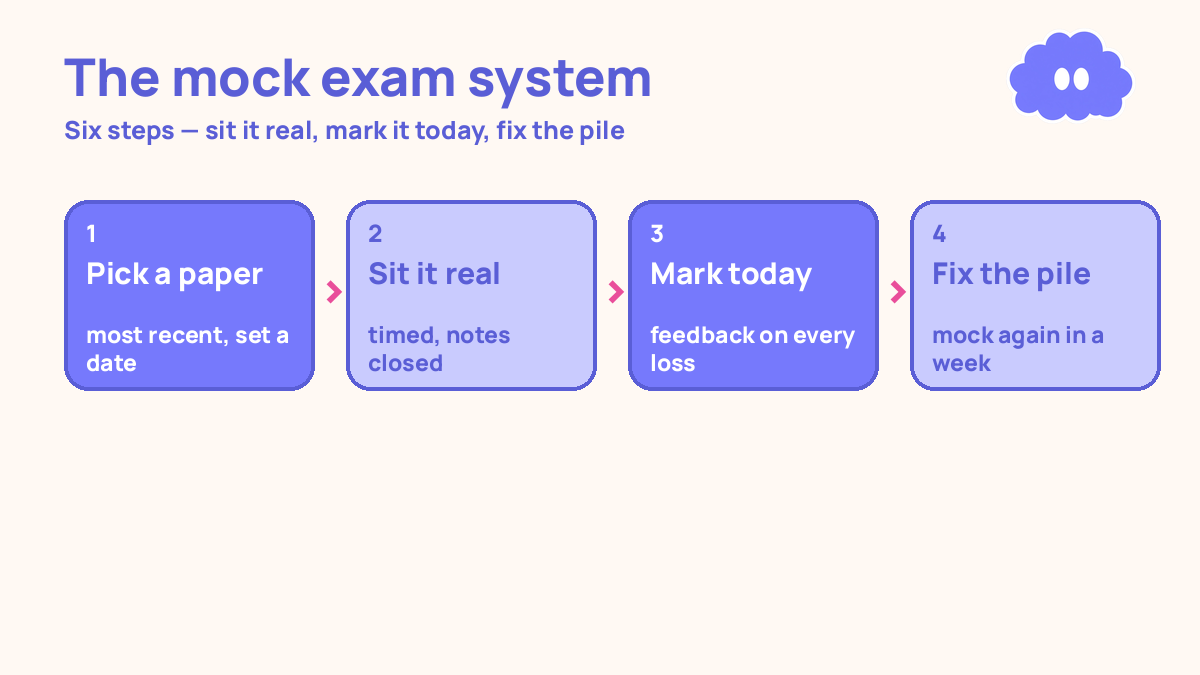
How to use mock exams to prepare: sit a past paper under exam conditions — timed, notes closed, no phone — then mark it with feedback, list every mark lost, and spend the next week fixing the biggest pile. Do another mock a week later to check whether the fixes worked.
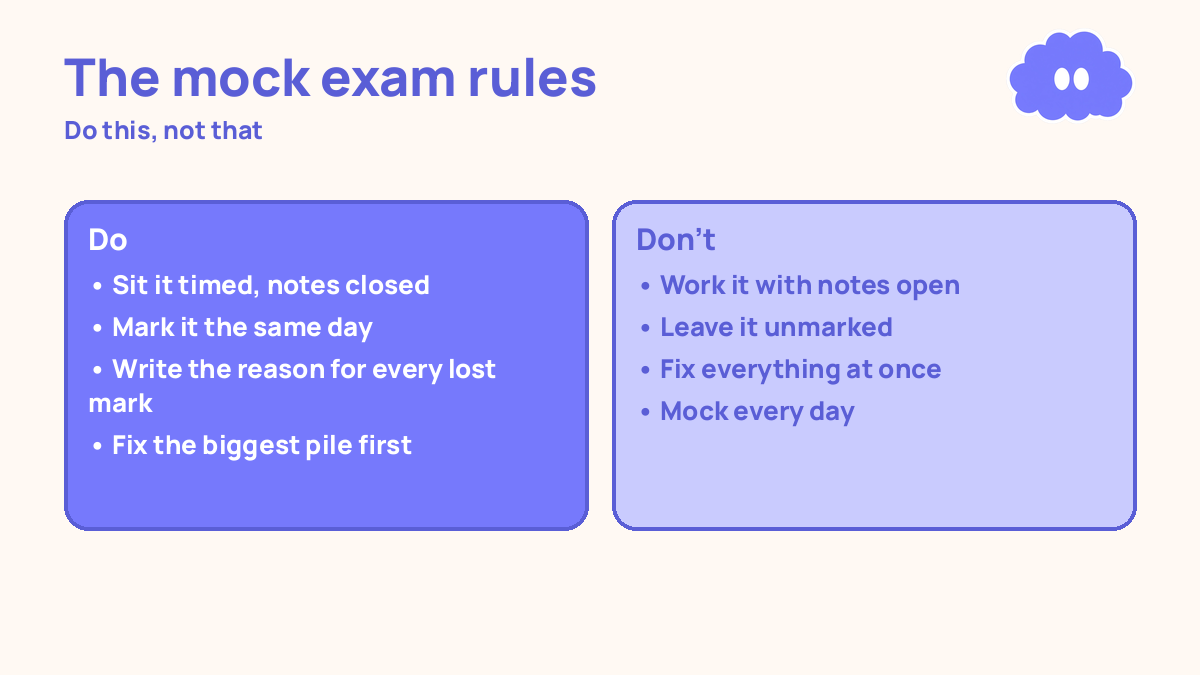
You have two ways to use a past paper. The first is to work through it slowly, with your notes open, looking up the answers you do not know. That feels productive, and it is not a mock exam. It is an open-book exercise, and it tells you nothing about what you will do in the real exam.
The second way is to sit it like the real thing. Same time limit, same format, notes closed, phone in another room, no looking anything up. Then mark it honestly. That is a mock exam, and it is the most honest information you will get before the real exam.
The research backs the method. Across 61 studies, testing yourself beat restudying (g = 0.50), and feedback made the effect larger — g = 0.73 with feedback, 0.39 without (Rowland, 2014). A mock without marking and feedback is only half a mock. The marking is where the learning happens.
This system is the mock in six steps. It sits inside how to revise for exams without cramming, and it uses the past paper system for exams as its raw material. If a topic keeps coming up wrong, test it with a friend in a study group.
The system in short
- Pick a past paper in the real format and set a date for the mock.
- Sit it under real conditions: timed, notes closed, phone in another room.
- Mark it the same day, against the mark scheme, with feedback on every wrong answer.
- List every mark lost and sort the losses into three piles.
- Spend the next week fixing the biggest pile first.
- Do another mock a week later and compare the two scores.
Step 1: Pick a past paper and set a date
Pick the most recent past paper you have not already worked through. The most recent one is the best guide to the current format — how many questions, how long, what types. If you have already worked through it, it is not a mock any more, because you have seen the answers. Pick a different year.
Set a date and write it down. Saturday morning is the usual choice: it matches the time most exams happen, and it leaves the rest of the weekend for marking and fixing. A mock without a date is a mock that never happens.
Step 2: Sit it under real conditions
On the morning, sit down at the time you wrote down and start the timer. The conditions are the whole point: notes closed, textbook closed, phone in another room, no music, no looking anything up. If the real exam is two hours, the mock is two hours. If the real exam bans calculators, the mock bans calculators.
Do not pause the timer. In the real exam you cannot pause the clock because a question is hard, and you cannot pause it here either. If you get stuck, mark the question and move on, exactly as you would in the real exam. If you finish early, use the remaining time to check.
The conditions will feel uncomfortable, and that is the point. A mock that feels easy is a mock that is not testing anything. The discomfort is information: it shows you what happens to your timing, your memory, and your nerve under pressure, while there is still time to fix it. If the mock shows you have never seen a topic, that topic needs learning first, not more mocks.
Step 3: Mark it the same day, with feedback
Mark the mock the same day, while the paper is still fresh. Use the mark scheme, and be strict with yourself. A mark you award yourself generously is a mark that lies to you.
Feedback is the reason for every lost mark: “wrong formula”, “did not read the question”, “ran out of time”, “did not know the topic”. Write the reason next to each lost mark. Across 61 studies, testing with feedback (g = 0.73) beat testing without it (g = 0.39) by a wide margin (Rowland, 2014). The feedback is what turns a score into a plan.
Use recall formats where you can. Short-answer questions beat multiple choice as practice, because recall is a harder test than recognition (Rowland, 2014). The mock should match the real exam’s format, not the easiest format.
Step 4: List every mark lost and sort the losses
Now make the list: every mark you lost, question by question, with the reason next to it. Then sort the losses into three piles: did not know it, knew it but ran out of time, careless mistake.
Count the marks in each pile. The biggest pile is the next week’s job. If pile 1 holds most of the marks, the week is for testing the weak topics. If pile 2 holds most, the week is for timed practice. If pile 3 holds most, the week is for the checking routine.
Step 5: Spend the next week fixing the biggest pile
The week after a mock belongs to the biggest pile. Not to general revision, not to re-reading the notes — to the pile. If pile 1 is biggest, the week is ten questions a day on the weakest topics, notes closed, then check. If pile 2 is biggest, the week is timed questions, with the time blocks written on the paper before you start. If pile 3 is biggest, the week is the checking routine, practised on every question you do.
Do not try to fix all three piles at once. One pile a week is the rule. The other two piles wait for the next mock.
This is also the week to re-test the topics you got wrong. Do not just read the correct answers — test yourself on them again, notes closed, two days after the mock. If you get them right, the fix worked. If you get them wrong again, they go to the top of the next mock’s fix list.
Step 6: Do another mock a week later and compare
A week later, sit another. Same conditions, different paper. Mark it the same day, make the same list, and compare the two.
Compare the piles, not just the scores. If pile 1 shrank from 15 marks lost to 6, the testing worked, even if the total score only went up by a few marks. If pile 2 grew, the timed practice did not work, and you need a different fix. The comparison is the evidence. Without it, you are guessing whether the week helped.
Two or three mocks before the real exam is the right number. One mock is a snapshot. Two mocks show whether the fixes worked. More than three eats the time you need for fixing what the mocks found.
A worked example: how to use mock exams to prepare — chemistry, three weeks to the exam
Your chemistry exam is in three weeks. You have three past papers.
Saturday 7 November, 9:00–11:00 — mock 1: You sit the 2024 paper, timed, notes closed, phone in another room. You mark it the same day: 58%. The list shows 42 marks lost — pile 1 (did not know it) 22 marks, pile 2 (ran out of time) 12 marks, pile 3 (careless) 8 marks. Pile 1 is biggest. The weak topics are electrolysis and mole calculations.
Monday 9 – Friday 13 November — fix week: Ten questions a day on electrolysis and mole calculations, notes closed, then check. Wednesday: re-test the mock questions you got wrong. By Friday you get 8 out of 10 right on both topics, up from 4.
Saturday 14 November, 9:00–11:00 — mock 2: You sit the 2023 paper, same conditions. You mark it the same day: 67%. Pile 1 is down to 10 marks lost. Pile 2 is up to 14 — you are still slow. The next week’s job is timed practice.
Monday 16 – Friday 20 November — fix week 2: Timed questions every day, time blocks written on the paper. You learn that mole calculations take you 12 minutes each, so you do them last in the exam.
Saturday 21 November, 9:00–11:00 — mock 3: You sit the 2022 paper. You mark it the same day: 74%. Pile 2 is down to 6 marks lost. Pile 1 is 8, pile 3 is 6. The exam is in one week. You stop doing mocks and switch to light review.
| Mock | Date | Score | Pile 1 lost | Pile 2 lost | Pile 3 lost | Next week’s job |
|---|---|---|---|---|---|---|
| 1 | Sat 7 Nov | 58% | 22 | 12 | 8 | Test weak topics |
| 2 | Sat 14 Nov | 67% | 10 | 14 | 6 | Timed practice |
| 3 | Sat 21 Nov | 74% | 8 | 6 | 6 | Light review |
When it goes wrong
You work through the paper with notes open and call it a mock. It is not a mock. It is an open-book exercise, and it tells you nothing about the exam. Sit the next one properly: timed, notes closed, phone in another room. The discomfort is the information.
You do the mock but never mark it. A mock without marking is a performance with no feedback, and feedback is where the learning happens. Mark it the same day, with the mark scheme, and write the reason next to every lost mark. If you cannot face marking it, ask a friend or a teacher to mark it for you.
The mock score is bad and you panic. A bad mock score with three weeks left is information. Use it: list the losses, find the biggest pile, and fix that pile for a week. Then do another mock and compare the piles.
You do a mock every day and never fix anything. Mocks are the diagnosis, not the treatment. Two or three mocks before the exam is enough. The week between mocks is the treatment — testing the weak topics, timed practice, the checking routine. If you are doing a mock every day, you are avoiding the fixing.
Weekly review checklist
Copy this list and use it each week:
- Did I sit a mock this week under real conditions — timed, notes closed, phone away?
- Did I mark it the same day, with the reason next to every lost mark?
- Which pile held the most marks, and did I spend the week fixing it?
- What one change will I make next week: more testing, timed practice, or a stricter checking routine?
Downloadable infographic spec: one vertical image, title “How to use mock exams”, with the six steps — pick a past paper, sit it under real conditions, mark it the same day, list the losses, fix the biggest pile, mock again in a week — and the rule “a mock without marking is only half a mock” in Thynq cream, Cloud Purple, Dark Purple and pink, with the cloud mascot. Text taken word-for-word from this article.
What this system is not
It is not a promise of a grade, and it is not a claim that mock scores predict exam scores. A mock is a practice run under exam conditions, and its value is the list of what went wrong, not the number at the top.
Sources
- Rowland, C. A. (2014). Psychological Bulletin, 140(6), 1432-1463. Across 61 studies, testing beat restudy (g = 0.50); with feedback g = 0.73, without g = 0.39; recall formats beat recognition.
- Roediger, H. L. & Karpicke, J. D. (2006). Psychological Science, 17(3), 249-255. Recall beat restudy a week later, though restudiers felt more confident immediately.
- Dunlosky, J., et al. (2013). Psychological Science in the Public Interest, 14(1), 4-58. Only practice testing and distributed practice rated high utility; rereading rated low.
- Bjork, R. A. (1994). In Metcalfe & Shimamura (eds.), Metacognition: Knowing about knowing, MIT Press. A difficulty is only desirable if the learner has the background knowledge to respond to it.
Questions
How many mock exams should I do?
Two or three, spaced a week apart. One mock is a snapshot. Two show whether the fixes worked. More than three eats the time you need for fixing what the mocks found.
Should I do a mock if I have not finished revising?
Yes. A mock is most useful when you have not finished, because it shows which topics to finish first. Do the mock, mark it, and let the wrong answers set next week’s order.
What if I score badly on a mock?
Good — the mock did its job. A bad mock score with three weeks left is information. List what went wrong, fix the biggest pile first, and do another mock in a week to check.
Can I use past papers as mocks?
Yes — they are the best mocks available, because they are the real format. Sit one under timed conditions, notes closed, and mark it against the mark scheme.