The direct answer
How to revise with a study group: everyone arrives having done something alone first, and the group time is spent testing each other from memory, explaining answers out loud, and arguing about the hard bits — not reading notes together. Four people, one topic, 90 minutes, one person keeping time. That is the whole system.
You know the version that does not work. Four of you book a library table, everyone brings their notes, and two hours later you have talked about the exam, the lecturer, and the weekend, and nobody can remember a single thing they revised. The group felt productive because you were together and busy. It was not.
The problem is that most groups spend their time on the easiest activity available: re-reading. In a 2013 review of ten common study techniques, Dunlosky and colleagues rated only two as high utility — practice testing and distributed practice. Re-reading was rated low. A group that re-reads together is doing the weakest method with company.
A good group uses the other people as the test. Students who recalled a passage remembered more a week later than students who restudied it, even though the restudiers felt more confident straight after studying (Roediger & Karpicke, 2006). This system sits inside how to revise for exams without cramming, and pairs with a solo retrieval practice system for students.
The system in short
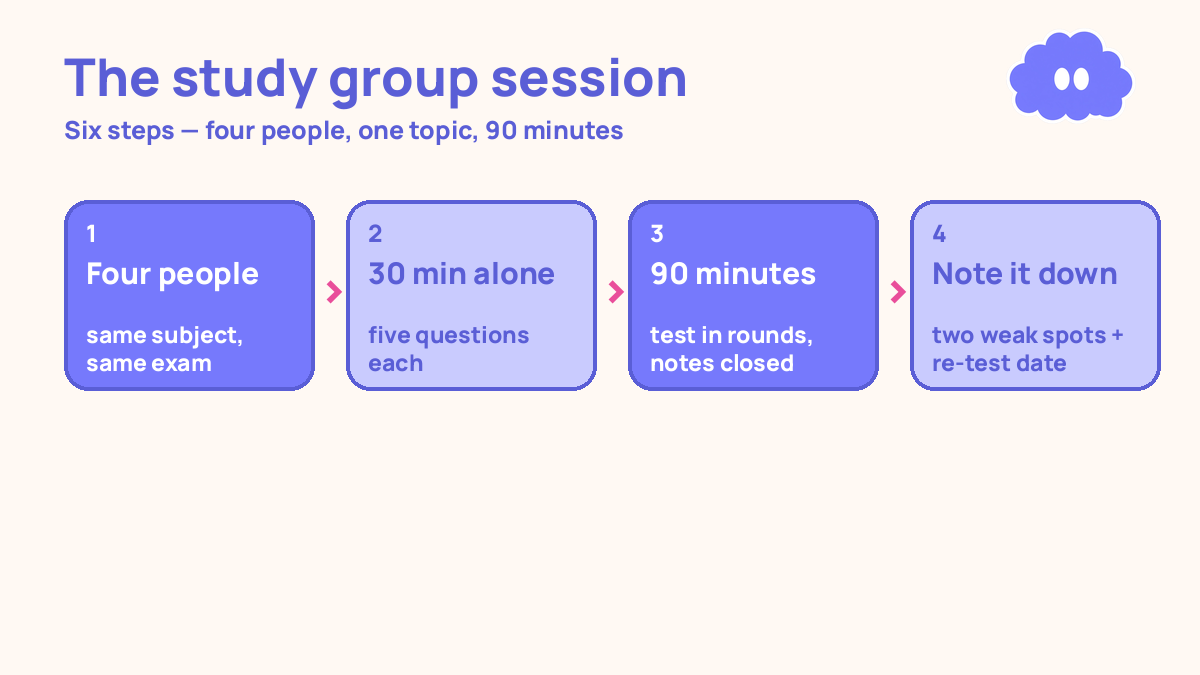
- Cap the group at four people, all studying the same subject for the same exam.
- Each person prepares alone for 30 minutes before the session and writes five questions from memory.
- Meet for 90 minutes on one topic only, with a timed plan and one person keeping time.
- Test each other in rounds with notes closed. One person asks, one answers, one explains why.
- End with ten minutes of writing: each person writes down the two things they still cannot do.
- After the session, each person re-tests those two things alone within two days.
Step 1: Cap the group at four, same subject, same exam
Four is the number. With two people, one of you is always leading and the other is always following, and the session becomes a tutoring session. With three it can work, but one person tends to go quiet. With four, everyone gets a turn, and there are enough different questions to cover a topic properly.
With five or more, the group splits: two people talk, the rest listen.
Same subject and same exam is a hard rule. A group of four people revising four different subjects is four solo sessions at the same table. Pick people who will actually show up and prepare. One person who never prepares turns every session into a lecture, because the other three end up teaching them from scratch. If someone comes unprepared twice, let them go.
Step 2: Everyone prepares alone for 30 minutes first
The session starts before you meet. Each person spends 30 minutes alone on the agreed topic: review the material, close the notes, and write five questions from memory, with the answers on a separate sheet.
Five questions each means twenty questions for a group of four — more than enough for 90 minutes. The questions should be the kind the exam actually asks. “What is osmosis?” is a weak question. “A cell is placed in distilled water — what happens to it and why?” is a good one, because it forces an explanation, not a definition.
If nobody prepares, the group has nothing to test with, so it defaults to reading notes aloud — re-reading with an audience. Agree on the topic at least two days before you meet.
Step 3: Meet for 90 minutes on one topic, with a timer
Ninety minutes is the session length. Shorter and you barely get through one round of questions. Longer and attention falls apart, and the last half hour becomes a chat. Set a timer and stick to it.
The plan for the 90 minutes is fixed:
- 0–10 minutes: Each person reads out their five questions, and the group picks the twelve hardest. The rest go on a shared list.
- 10–70 minutes: Testing rounds. One person asks, one answers with notes closed, one explains why the answer is right or wrong. Rotate every question.
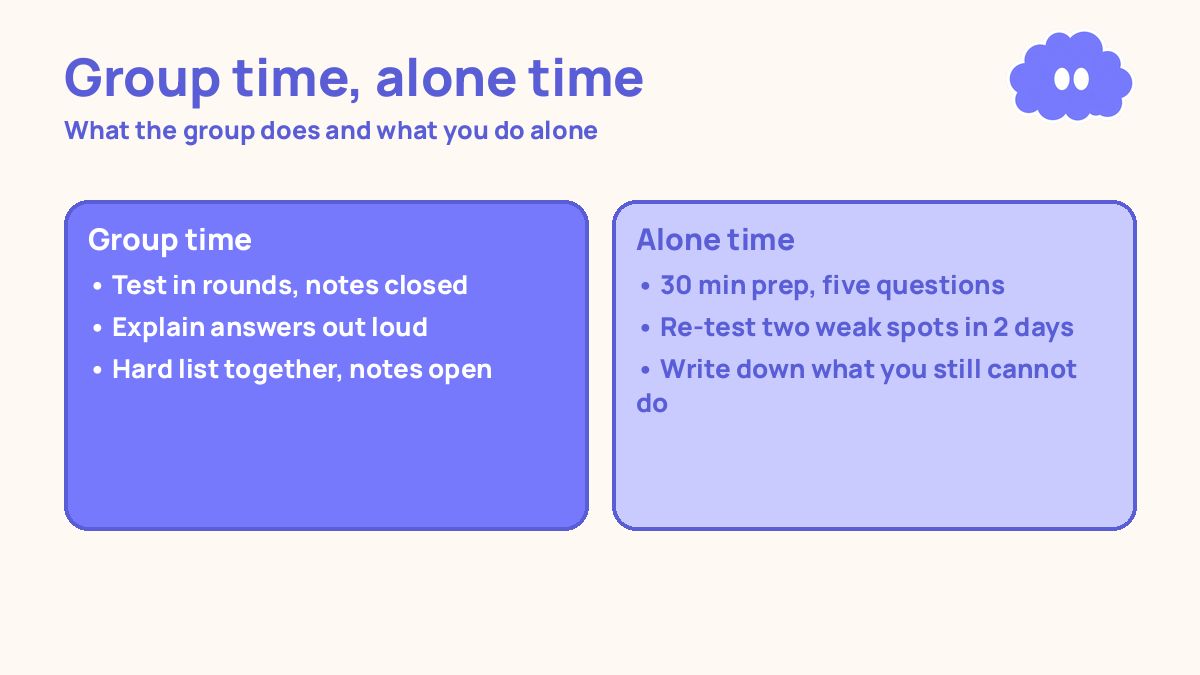
- 70–80 minutes: The hard list. The group takes the three questions nobody could answer and works through them together, notes open, until everyone can explain the answer.
- 80–90 minutes: Write-down. Each person writes the two things they still cannot do, and the date they will re-test them.
One person keeps time and says when to move on. Rotate the timekeeper each session. Without a timekeeper, the first question takes twenty minutes and the last six never get asked.
Step 4: Test each other in rounds, notes closed
One person asks a question from their list. A second person answers, with notes closed, out loud. A third person explains why the answer is right, or corrects it if it is wrong. The asker checks against their answer sheet. Then rotate roles every question.
Notes stay closed during the round. If someone peeks, the test is worthless — you are testing whether they can read, not whether they remember. The hard list at the end is the only part where notes are open, and that is for learning what nobody knew.
The explaining matters as much as the answering. In a small 1989 study of eight physics students, Chi and colleagues found the best solvers gave about 15 explanations per worked example, while the weakest gave fewer than 3 — 82% correct against 46%. A 2018 meta-analysis of 64 reports found prompting self-explanation produced a moderate average benefit (Bisra et al., 2018). When you explain why an answer is right, you find the gaps in your own understanding. If the group gets an answer wrong and nobody can explain why, that question goes on the hard list — mark it, move on, and come back to it with notes open at the end. The group test is good practice, but the real check is a full paper under exam conditions — how to use mock exams to prepare shows how to sit one and use the result.
Step 5: End with a write-down, not a chat
The last ten minutes are the most important part of the session, and the easiest to skip. Each person writes down, on paper, the two things they still cannot do — two questions they got wrong, two topics they could not explain, two problems they could not solve. Not “cell division” — something specific, like “I cannot explain why the cell swells in distilled water” or “I cannot work out the magnification from the image and the scale bar.”
Each person also writes the date they will re-test those two things. Within two days is the rule: short enough that the material is still warm, long enough that re-testing is a real test. The 1–3–7 day review schedule is a practical starting point, not a research rule.
Step 6: Re-test alone within two days
The group session is not the learning. It is the diagnosis. The learning happens in the two days after, when each person goes back to their two weak spots alone and tests themselves again — notes closed, answer out loud or on paper, then check. If you get it right, move it to a list of things to re-check in a week. If you get it wrong again, it goes to the top of the next group session’s hard list. Alone, you choose which questions to ask, and you choose the easy ones.
A worked example: how to revise with a study group on a Tuesday evening
Four students — you, Sara, Dan, and Priya — are revising biology, exam in three weeks. The topic for Tuesday is cell division, chapters 4 and 5.
Monday evening, 30 minutes each, alone: Each of you reads chapters 4 and 5, closes the notes, and writes five questions with answers on a separate sheet — including “What happens to the chromosomes in prophase and why does it matter?” and “Work out the magnification: image 40 mm, actual size 0.04 mm.”
Tuesday 6:00–7:10 — pick and test: The group picks the twelve hardest questions from the twenty. Sara asks, you answer, Dan explains, Priya checks. Rotate every question. You get the magnification question wrong — you divide the wrong way round. Dan explains: magnification is image size divided by actual size, 40 divided by 0.04 is 1,000 times. You write that down.
Thursday, 20 minutes alone: You test your two weak spots from memory — “I cannot explain why the cell swells in distilled water” and “I mix up the magnification formula.” The magnification question is right now. The osmosis explanation is still shaky, so it goes to the top of next Tuesday’s hard list.
| Time | What happens | Who does what |
|---|---|---|
| Monday, 30 min alone | Prepare five questions from memory | Each person, alone |
| Tuesday 6:00–6:10 | Pick the twelve hardest questions | Whole group |
| Tuesday 6:10–7:10 | Testing rounds, notes closed | Rotate asker, answerer, explainer |
| Tuesday 7:10–7:20 | Hard list, notes open | Whole group, explain together |
| Tuesday 7:20–7:30 | Write down two weak spots + re-test date | Each person, on paper |
| Thursday, 20 min alone | Re-test the two weak spots | Each person, alone |
When it goes wrong
One person talks and the other three listen. This usually means the talker is the only one who prepared. Fix it with the rotation rule: each person asks one question and answers one question before anyone gets a second turn. If the same person still dominates, make them the timekeeper.
Nobody prepares, so the session becomes reading notes aloud. Name it at the start of the next session: “Last time nobody had questions, so we read notes for an hour. That is re-reading, the weakest method.” If it happens twice, stop meeting until everyone agrees to the 30-minute preparation.
You argue about one question for fifteen minutes. Mark it and move on. The hard list exists for exactly this. If the group cannot resolve it with notes open, bring it to a teacher or a tutor.
Weekly review checklist
Copy this list and use it each week:
- Did all four of us prepare five questions before each session this week?
- How many questions did we test with notes closed, and how many did we get right on the first try?
- What are the two things I still cannot do, and did I re-test them within two days?
- What one change will I make next week: smaller group, stricter timer, or better questions?
Downloadable infographic spec: one vertical image, title “The study group session”, with the six steps — four people, 30 minutes alone first, 90 minutes one topic, test in rounds notes closed, hard list together, write down two weak spots — and the rule “notes closed during testing, open for the hard list” in Thynq cream, Cloud Purple, Dark Purple and pink, with the cloud mascot. Text taken word-for-word from this article.
What this system is not
It is not a promise of a grade, and it is not a claim that group study beats solo study for everyone. This system is a way to make a group do the two things the research rates highest — testing yourself and spacing your study — with other people as the test.
Sources
- Dunlosky, J., et al. (2013). Psychological Science in the Public Interest, 14(1), 4-58. Only practice testing and distributed practice rated high utility; rereading rated low.
- Roediger, H. L. & Karpicke, J. D. (2006). Psychological Science, 17(3), 249-255. Recall beat restudy a week later, though restudiers felt more confident immediately.
- Chi, M. T. H., et al. (1989). Cognitive Science, 13(2), 145-182. Eight physics students; best solvers gave 15.3 explanations per example versus 2.8.
- Bisra, K., et al. (2018). Educational Psychology Review, 30(3), 703-725. Across 64 reports, prompting self-explanation gave a moderate average benefit (g = 0.55).
- Cepeda, N. J., et al. (2008). Psychological Science, 19(11), 1095-1102. Best gap grows with test delay; no single best gap.
Questions
How many people should be in a study group?
Four. Everyone gets a turn to answer and explain, and one person keeps time. With six or more, half the group goes quiet and the session turns into a chat.
Do we all need to prepare before we meet?
Yes. Each person spends 30 minutes alone first, writing five questions from memory. If nobody prepares, the group spends the session reading notes aloud, the weakest way to revise.
What should we actually do in the session?
Test each other from memory, with notes closed. One person asks, another answers, a third explains why the answer is right. Then rotate. The explaining is where the learning happens, not the listening.
What if one person does all the talking?
Give everyone a turn by rule, not by personality. Go round the table: each person asks one question and answers one question before anyone gets a second turn. If it still does not work, shrink the group.