The direct answer
Interleaving means mixing topics inside one study session instead of finishing one subject before starting the next. You study biology for 25 minutes, then chemistry, then maths — testing yourself on each one as you go. Each switch forces you to recall the topic from scratch and choose the right approach, instead of coasting on the rhythm of the last ten questions. Exams mix topics too, so practising mixed is practising the real thing.
One honest note: interleaving is useful, but it is not the strongest method in the research. In a 2013 review, Dunlosky and colleagues rated ten common study techniques. Only practice testing and distributed practice received a high utility rating. Interleaved practice was rated moderate. So this system uses interleaving on top of testing and spacing, not instead of them.
The system in short
- Pick two or three topics you already partly know. Do not mix topics you have never studied.
- Give each topic one 25-minute block in the session, and test yourself in every block.
- Order the topics so similar ones sit next to each other — that is where the choosing matters most.
- Between blocks, take a five-minute break and close the last topic’s notes completely.
- End the session with a five-minute mixed quiz: one question from each topic, from memory.
- Review each topic again after a gap: next day, in 3 days, in 7 days. That is a practical starting schedule, not a research rule.
Step 1: Pick two or three topics you partly know
Interleaving only works on topics you have already started. If you have never studied a topic, mixing it will only confuse you, because there is nothing to recall yet. Learn each topic a little first — one block of testing on its own — then start mixing.
Two topics is enough to start. Three is the most you should mix in one session. Four or more, and each topic gets too little time.
Pick topics that are easy to confuse, or that need different methods. Biology and chemistry work well together, because both need definitions and processes, but the answers look different. Maths and physics work well, because both need problem-solving, but the methods are different — and choosing the wrong method is the mistake interleaving trains you out of.
Write the two or three topics on a card before the session, in the order you will do them. Without it, you will drift back to one subject and stay there, because staying put always feels easier than switching.
Step 2: One block per topic, testing yourself
Each topic gets one 25-minute block. Close the notes, test yourself from memory, then check: answer questions, write the topic out on a blank page, or work problems without the worked examples. Then close that topic’s notes completely before the next block starts.
The 25-minute length was Francesco Cirillo’s practical choice in the late 1980s, not a number from cognitive science. The Pomodoro technique for students explains the short cycle, and how to study in 50-minute blocks covers the longer one. For interleaving, 25 minutes is usually the right size: long enough to test properly, short enough that the switch stays sharp.
Do not reread between blocks. Rereading was rated low in the 2013 review by Dunlosky and colleagues, and it undoes the point of the switch: if you carry the last topic’s notes into the next block, you never have to recall anything fresh.
Put your phone in another room before the session. A switch between topics is already a moment when your attention is loose, and a phone on the desk will catch it.
Step 3: Put similar topics next to each other
Put the two topics that are easiest to confuse next to each other. That is where interleaving earns its keep: it forces you to notice the difference between them, instead of learning each one in isolation and mixing them up in the exam.
For example, if you confuse two biology systems, study one, then the other, back to back. When you switch, ask one question before you start the second block: how is this different from the one I just did? Write the answer in one line. That line is the learning, and it is what the exam will test.
If the topics are very different — say, history and maths — the order matters less, and the benefit is smaller too. The switch still forces recall, but there is no confusion to clear up.
Write the one-line difference down each time you switch. After a week, you will have a list of differences, and that list is a better revision sheet than a page of notes.
Step 4: End with a five-minute mixed quiz
After the last block, do a five-minute mixed quiz. One question from each topic, written on a card before the session, answered from memory, in any order.
The quiz does two things. First, it tests whether the switching worked: if you can answer a biology question right after a maths block, the recall is real. Second, it shows you which topic is weakest after mixing. A topic that feels fine on its own and falls apart mixed needs more mixed practice, not more blocked practice.
Keep the quiz questions the same for a week, and repeat the quiz each session. When you can answer all of them from memory after switching, change the questions.
The quiz can be one question taken from each of two past papers. The past paper system for exams explains how to use papers as rehearsal.
Step 5: Space the mixed sessions out
Interleaving arranges a session. Spacing arranges the week. You need both. Test a topic, then meet it again after a gap, when you have started to forget it. A 2006 review by Cepeda and colleagues found that spaced practice beat massed practice, and that the best gap is not fixed: it grows with how long you need to remember the material.
A practical starting schedule is: first mixed session, review the next day, then again in three days, then in seven days. That is a starting point to try for a week, not a rule from the research. The spaced repetition system for students explains spacing, and the retrieval practice system for students explains the testing inside each block.
Keep a simple sheet: one line per topic, with boxes for each mixed session. Tick the box only when you tested yourself on the topic in that session.
A worked example: a mixed evening for three subjects
Sara has exams in biology, chemistry, and maths. It is Tuesday, and she has two hours in the evening.
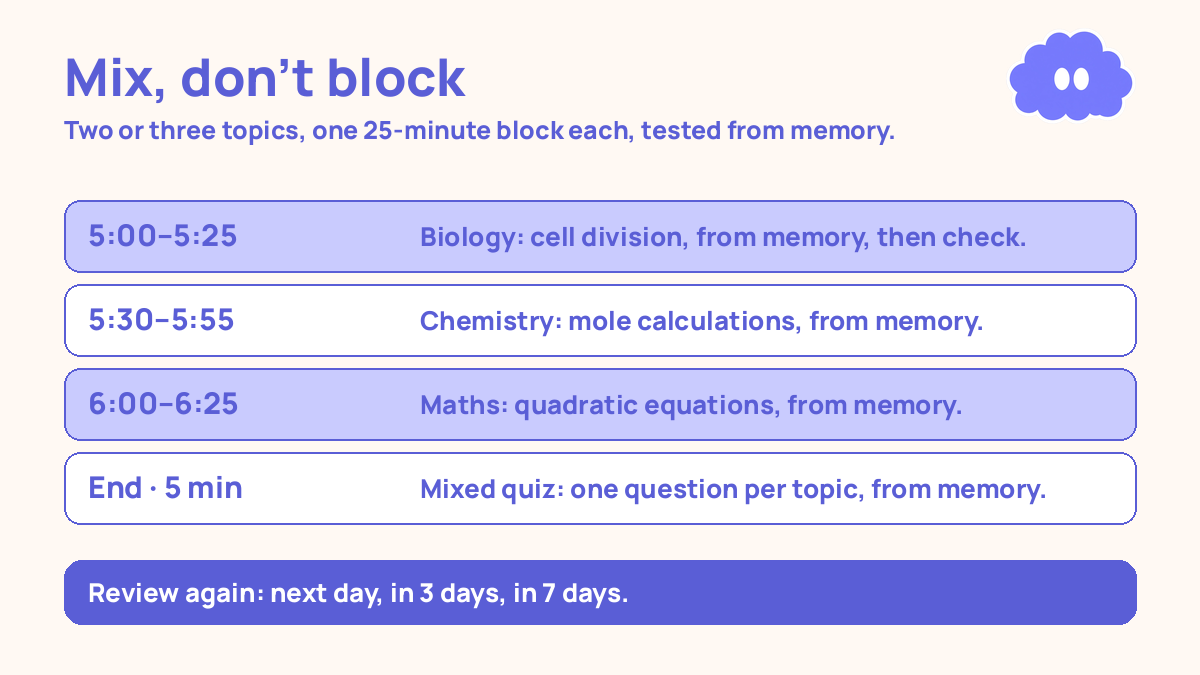
5:00 — Plan the session. Her card reads: biology (cell division), chemistry (mole calculations), maths (quadratic equations). She writes three quiz questions on the back, one per topic. She puts her phone in another room.
5:00–5:25 — Block 1, biology. She closes her notes and writes out cell division from memory, then checks. She misses one stage order.
5:30–5:55 — Block 2, chemistry. She closes the biology notes completely. Ten mole conversions from memory, then checks. Eight right. Before starting, she writes one line: how is this different from biology? “Biology is naming stages in order. Chemistry is calculating with numbers.”
6:00–6:25 — Block 3, maths. She closes the chemistry notes. Five quadratic equations from memory, then checks. Four right. The one she misses is a sign error. She writes the fix in one line.
6:25–6:30 — Mixed quiz. Three questions, one per topic, from memory, in any order. She answers the maths one first, then biology, then chemistry. All three right. She checks them and stops.
6:30 — Done. Three topics tested, three fix lines written, one quiz passed. She did not study any subject for an hour straight, and she can answer a question from any of them cold.
Wednesday: She repeats the session with the same three topics, in a different order: maths first, biology second, chemistry third. The quiz questions are the same. She gets two right and one wrong — the chemistry conversion she got right yesterday. The mix found a weak spot that blocked study would have missed.
Friday: She reviews all three topics in one mixed session, with new quiz questions. The old ones are now easy, so she retires them.
When it goes wrong
The switching feels horrible, and you want to go back to one subject at a time. Switching feels worse than blocking, because every switch makes you start again. That discomfort is the point, and it fades. Give it a week before you judge it. If it still feels awful, mix only two topics instead of three.
You mix topics you have never studied, and the session is a mess. This is the most common failure, and it is not interleaving failing. It is starting too early. Go back to one block per topic on its own until you can answer basic questions on each, then mix them.
You end up doing one topic for the whole session anyway, because switching feels like a chore. The plan card fixes this. Write the topics and the order before you start, set the timer, and switch when it rings, even if the topic feels unfinished. Write down where you stopped, and pick it up next session.
Your mixed quiz scores are worse than your blocked scores, and you think the system is hurting you. Mixed scores are usually lower at first, because the test is harder: you have to recall and choose, not just continue. That is what the exam asks for too. In a 2006 study, Roediger and Karpicke found that students who recalled a passage remembered more a week later than students who restudied it, though the restudiers felt more confident immediately. Judge the system after a week of mixed quizzes, not after one evening.
Weekly review checklist
Copy this list and use it each Sunday:
- How many mixed sessions did I do this week, and which topics did they mix?
- Which topic is weakest after mixing, even if it feels fine on its own?
- Did I test myself in every block, or did I slip back into rereading?
- Did the mixed quiz scores improve across the week?
- What one change will I make next week: fewer topics, a different order, or smaller blocks?
Downloadable infographic spec: one vertical image, title “Mix it up: the interleaving loop”, with the six steps from pick two or three topics to space the mixed sessions out, the three rules — test in every block, close the last topic before switching, end with a mixed quiz — and the one-line difference written at each switch, in Thynq cream, Cloud Purple, Dark Purple and pink, with the cloud mascot. Text taken word-for-word from this article.
What this system is not
It is not a promise of a grade, and it is not a claim that interleaving is the strongest study method. In the 2013 review, it was rated moderate, below practice testing and distributed practice. It is a practical way to arrange your sessions so testing and spacing do more work: mix the topics, switch often, and end with a quiz that proves you can answer any of them cold.
Sources
- Dunlosky, J., et al. (2013). Psychological Science in the Public Interest, 14(1), 4-58. Only practice testing and distributed practice rated high; interleaved practice rated moderate; rereading rated low.
- Cepeda, N. J., et al. (2006). Psychological Bulletin, 132(3), 354-380. Spaced practice beat massed practice; the best gap grows with how long you need to remember.
- Roediger, H. L., & Karpicke, J. D. (2006). Science. Recall beat restudy a week later, though restudiers felt more confident immediately.
- Cirillo, F. — Pomodoro Technique, late 1980s. 25 minutes work, 5 minutes break, longer break after four. The 25-minute length was Cirillo’s practical choice, not science-derived.
The idea behind mixing is the same as the idea behind all revision: test yourself, space it out, and practise the way the exam will ask. That is how to revise for exams without cramming. The testing inside each block is the retrieval practice system for students, and the spacing across the week is the spaced repetition system for students.
Questions
What is interleaving in studying?
Interleaving means mixing topics or subjects inside one study session instead of finishing one block before starting the next. You switch between topics, so each switch forces you to recall and choose the right approach.
Is interleaving better than studying one subject at a time?
It helps for telling similar things apart and for choosing the right method, but it is not a magic fix. In a 2013 review, Dunlosky and colleagues rated interleaved practice as moderate utility, below practice testing and distributed practice.
How do I interleave without getting confused?
Mix two or three topics you already partly know, in short blocks, and test yourself on each one. Do not mix topics you have never studied: learn each one a little first, then mix them.
How long should each interleaved block be?
Twenty-five minutes per topic is a good starting size. Two or three blocks per session, with a short break between them, keeps the switches sharp without tiring you out.