The direct answer
How to revise when you are behind: count the days you actually have, cut the topic list to what the exam will most likely ask, and spend every block testing yourself — not re-reading. Three blocks a day, one topic per block, hardest topics first.
The exam is ten days away and you have barely started. You have notes you have not read, topics you have not covered, and a growing feeling that it is too late. It is not too late. It is too late to do everything — and that is a different problem.
The solution is not to work harder in the way you have been working. It is not sixteen-hour days, not all-nighters, not reading the whole textbook in a week. The solution is to cut. Cut the list to the topics the exam will most likely ask. Cut the re-reading and replace it with testing. Cut the panic and replace it with a plan that fits the days you actually have.
This system is the count, the cut, and the catch-up. It sits inside how to revise for exams without cramming. If you have a full month, use how to revise when you have one month left instead.
The system in short
- Count the days you actually have, and the topics you actually need.
- Cut the list into three: must-know, nice-to-know, skip.
- Work in three 90-minute blocks a day, one topic per block, test first.
- Never do a double day to catch up — one missed day does not break the plan.
- The last three days are for re-testing the must-know list, not new topics.
- Stop at a set time every night and sleep at your normal time.
Step 1: Count the days and the topics
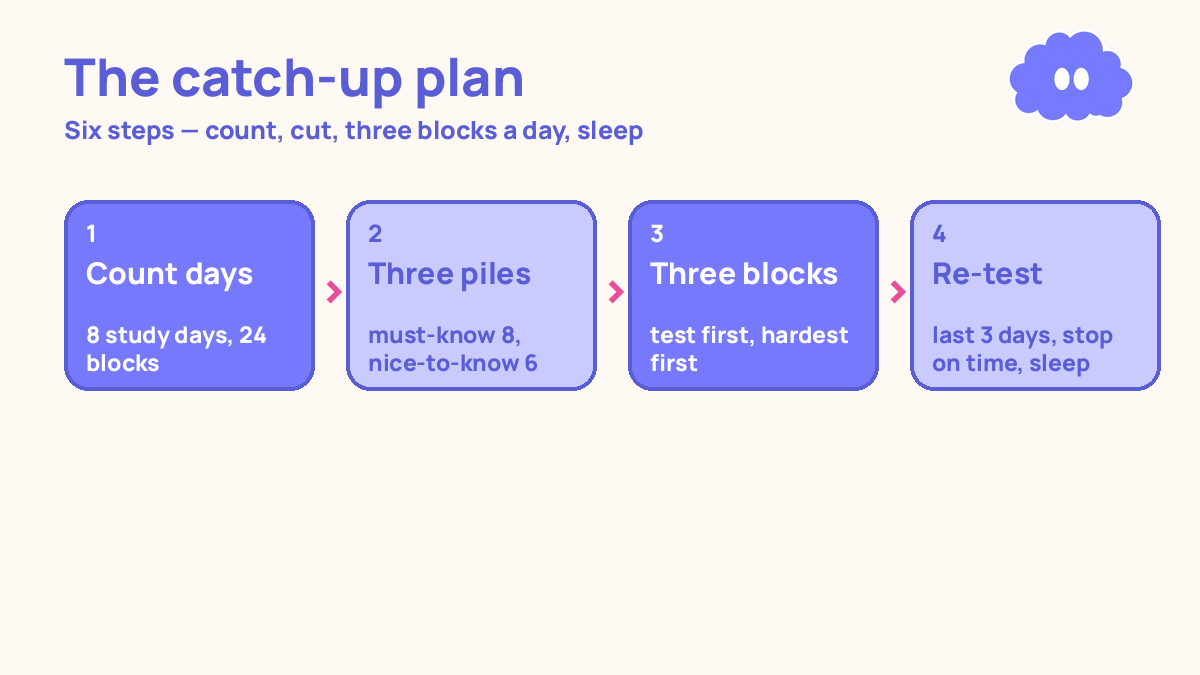
Start with the facts, not the feeling. Write down the exam date and count the days. Then subtract one day for the exam itself, and one day for rest. Ten days to the exam means eight study days. Write that number down: eight days is your budget.
Now list every topic in the syllabus. Next to each one, write how likely it is to come up and how much of the paper it is worth, using past papers, the syllabus weighting, and what your teacher has emphasised. With eight days, you will not cover all of it, and the ranking decides what gets covered.
Count the blocks too. Eight days at three blocks a day is 24 blocks. Each topic needs at least two blocks — one to learn it, one to test it after a gap. That means eight days covers about 12 topics properly. If your list has 20 topics, eight are not going to be covered.
Step 2: Cut the list into three
Sort the list into three piles. This is the hardest step, because it means choosing what not to do. It is not giving up. It is spending your 24 blocks on the topics that will actually be asked, instead of spreading them thinly over everything.
Must-know: The topics most likely to appear and worth the most marks. These get two blocks each — one to learn, one to test.
Nice-to-know: Topics that might appear, worth fewer marks. These get one block each — learn and test in the same block, with the testing first. If you run out of days, these are the first to go.
Skip: Topics least likely to appear and worth the fewest marks. These get no blocks at all. Skipping a topic is not giving up. It is a decision, made with facts, to spend the time where it earns the most marks.
Step 3: Work in three blocks a day, test first
Every study day has the same shape: three 90-minute blocks, one topic per block, with a 30-minute break between them. Block 1 is 9:00–10:30, block 2 is 11:00–12:30, block 3 is 1:00–2:30. Then you stop. Three blocks, done properly, beats five done badly.
Each block has the same shape: 10 minutes to look at the notes, 50 minutes to test yourself from memory, 30 minutes to check your answers. The 50 minutes of testing is the work. In a 2013 review, Dunlosky and colleagues rated practice testing and distributed practice as the only two high-utility techniques; re-reading was rated low. When you are behind, re-reading is the most tempting thing to do and the least useful.
Put the hardest must-know topic in block 1, while you have the most energy. Put the easiest topic, or a re-test, in block 3. Do not switch topics mid-block: switching costs time on every switch, and the cost grows with complexity (Rubinstein et al., 2001).
Step 4: Never do a double day to catch up
You will miss a block. You will miss a day. When it happens, do not try to do two days of work in one day. A double day is how you burn out and miss the day after that too.
One missed day does not reset anything. Do the next block when you can, and let the missed block go — or move it to the next day’s spare block, if there is one.
If you fall behind by more than a day, cut again. Move a nice-to-know topic to the skip pile. The piles are not fixed.
Step 5: The last three days are for re-testing, not new topics
The last three days are for re-testing the must-know list, not for learning new topics. Each day, test the must-know topics from memory, notes closed, and write down what you still get wrong. Those are the topics for the next day’s blocks.
Do not start a new topic in the last three days. A new topic is one you will half-learn, and it will make you doubt the topics you know. If a topic is not covered by the last three days, it is not covered.
The day before the exam, stop at 8pm, pack your bag, and go to bed at your normal time. The full plan for the last week is in the exam week plan for students.
Step 6: Stop at a set time every night and sleep
Pick a stop time and write it down. When the time comes, close the notes. The last hour of cramming adds tiredness, not knowledge.
Sleep is when the day’s learning is consolidated. Diekelmann and Born (2010) reviewed the evidence that sleep improves consolidation of what was learned. A short night after a long study day cuts short the consolidation of the work you did. When you are behind, sleep feels like time you cannot afford. It is time you cannot afford to skip.
Write the morning as an if-then plan the night before: “If the alarm goes at 8:00, then I get up, eat, and start block 1 at 9:00.” An if-then plan names the cue and the action in advance. Across 94 studies, if-then plans raised goal attainment (d = 0.65) over holding the goal alone (Gollwitzer & Sheeran, 2006).
A worked example: how to revise when you are behind — ten days left, biology, 20 topics
Your biology exam is in ten days. The syllabus has 20 topics. You have eight study days and 24 blocks.
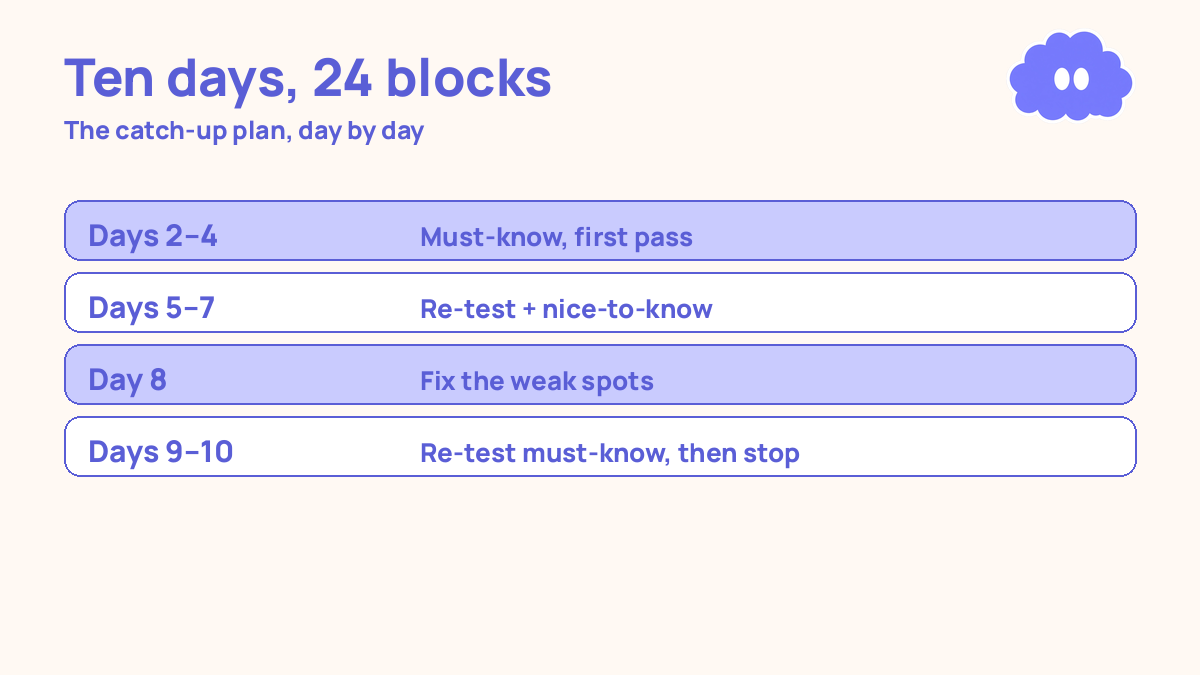
Day 1 — count and cut: You list the 20 topics and rank them. Eight are must-know, six are nice-to-know, six are skip. The eight must-know topics take 16 blocks, the six nice-to-know take 6 — 22 blocks, inside your budget of 24, with 2 spare.
Days 2–4 — must-know, first pass: Three blocks a day, one topic per block. Day 2: cell division, osmosis, genetics. Day 3: ecology, enzymes, photosynthesis. Day 4: respiration, the mole, and a re-test of cell division.
Days 5–7 — re-test and nice-to-know: Day 5: re-test osmosis and genetics, then a nice-to-know topic. Day 6: re-test ecology and enzymes, then a nice-to-know topic. Day 7: re-test photosynthesis and respiration, then a nice-to-know topic. The re-tests show genetics and enzymes are still weak, so they get an extra block on day 8.
Day 8 — fix the weak spots: Re-test genetics and enzymes, then two more nice-to-know topics. The list of things you still get wrong is down to three: the stages of meiosis, the enzyme graph, and one mole calculation.
Days 9–10 — last three days: Day 9: re-test the must-know list from memory, notes closed. You get 7 out of 8 topics right. Day 10, the day before the exam: light review of the three weak spots, pack the bag, stop at 8pm, bed at your normal time. Exam day: you walk in having covered 14 of 20 topics properly, tested twice.
| Topic pile | Topics | Blocks each | Total blocks |
|---|---|---|---|
| Must-know | 8 topics | 2 (learn + test) | 16 |
| Nice-to-know | 6 topics | 1 (learn + test together) | 6 |
| Skip | 6 topics | 0 | 0 |
| Spare | — | — | 2 |
| Total | 20 topics | — | 24 blocks |
When it goes wrong
You refuse to cut anything and try to cover all 20 topics. You will cover none of them properly. The cut is the system. Eight topics covered twice beats twenty topics read once. If you cannot bring yourself to skip a topic, ask a teacher which topics are most likely to appear — then skip the ones at the bottom of their list.
You stay up all night to catch up. An all-nighter trades tomorrow’s revision for tonight’s, and it leaves you tired for the exam itself. Stop at the set time, sleep, and start again in the morning.
You re-read instead of testing, because testing feels too slow. Testing feels slow because it is hard, and it is hard because it is working. Re-reading feels fast because it is easy, and it is easy because it is not working. Every block starts with testing. If a block has no testing in it, the block did not happen.
You fall behind by two days and give up. Do not. Cut again. Move two nice-to-know topics to the skip pile, and keep going with the must-know list. A plan that has been cut twice is still a plan. A plan you abandoned is nothing.
Weekly review checklist
Copy this list and use it each week:
- How many days do I actually have left, and how many blocks does that mean?
- Which pile is each topic in, and why?
- How many must-know topics have had two passes, and which are still on one?
- What one change will I make tomorrow: a cut topic, an earlier stop time, or a harder first block?
Downloadable infographic spec: one vertical image, title “How to revise when you are behind”, with the six steps — count the days, cut the list into three, three blocks a day test first, never double up, last three days re-test only, stop at a set time — and the rule “eight topics covered twice beats twenty topics read once” in Thynq cream, Cloud Purple, Dark Purple and pink, with the cloud mascot. Text taken word-for-word from this article.
What this system is not
It is not a promise of a grade, and it is not a claim that ten days is enough for every syllabus. If you have not started a subject at all, ten days will not finish it — the cut exists so you cover the most likely topics properly instead of all of them badly.
Sources
- Dunlosky, J., et al. (2013). Psychological Science in the Public Interest, 14(1), 4-58. Practice testing and distributed practice rated high utility; rereading rated low.
- Rubinstein, J. S., Meyer, D. E. & Evans, J. E. (2001). Journal of Experimental Psychology: Human Perception and Performance, 27(4), 763-797. Switch costs 614 to 1,096 milliseconds per switch.
- Lally, P., et al. (2010). European Journal of Social Psychology, 40(6), 998-1009. Median 66 days for a new behaviour to feel automatic, range 18-254; one missed day did not reset it.
- Diekelmann, S. & Born, J. (2010). Nature Reviews Neuroscience, 11(2), 114-126. Sleep improves consolidation of what was learned.
- Gollwitzer, P. M. & Sheeran, P. (2006). Advances in Experimental Social Psychology, 38, 69-119. If-then plans raised goal attainment (d = 0.65) across 94 studies.
Questions
Is it too late to start revising?
No, unless the exam is tomorrow morning. With a week left, you can cover the most likely topics and test them twice. With three days left, you can cover the top half of the list once.
Should I stay up all night to catch up?
No. An all-nighter trades tomorrow’s revision for tonight’s, and it leaves you tired for the exam itself. Stop at a set time, sleep, and start again in the morning.
What if I am behind in every subject?
Rank the subjects by exam date and by how much each one is worth, and start with the nearest exam. One subject at a time, one block at a time.
How do I choose what to skip?
Skip the topics least likely to appear and worth the fewest marks. Use past papers and the syllabus weighting to rank them.