The direct answer
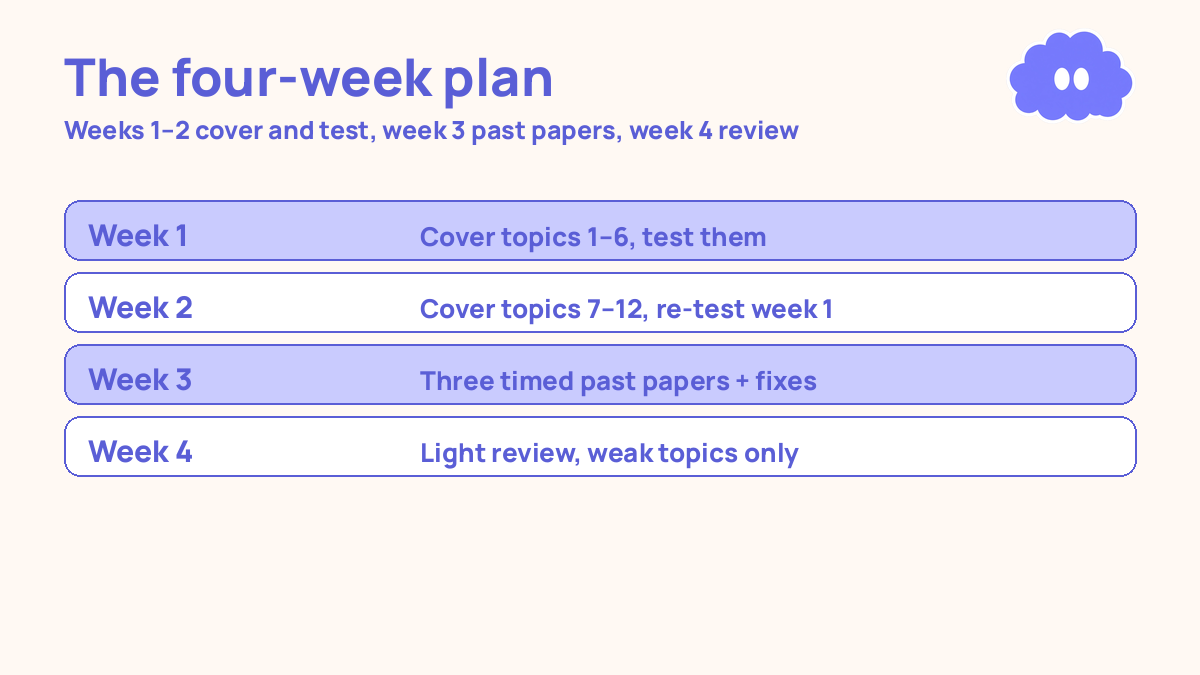
How to revise when you have one month left: stop re-reading and start testing. Split the month into four weeks: weeks 1 and 2 cover the topics and test them, week 3 is past papers under timed conditions, week 4 is the exam week — light review, no new material. Every topic gets three passes, and every day has the same shape. That is the whole system.
The exam is four weeks away. You have notes, a textbook, and a feeling that you should have started earlier. The question is what four weeks can actually hold, and the answer is more than you think — if you spend them testing yourself instead of re-reading.
Four weeks is 28 days. At three focused hours a day, six days a week, that is 72 hours. Seventy-two hours of testing yourself covers a syllabus. The same 72 hours, spent differently, gives a different result. It sits inside how to revise for exams without cramming.
The system in short
- Count the days and list every topic, ranked by how likely it is to come up.
- Split the month into four weeks: weeks 1–2 cover and test, week 3 is past papers, week 4 is exam week.
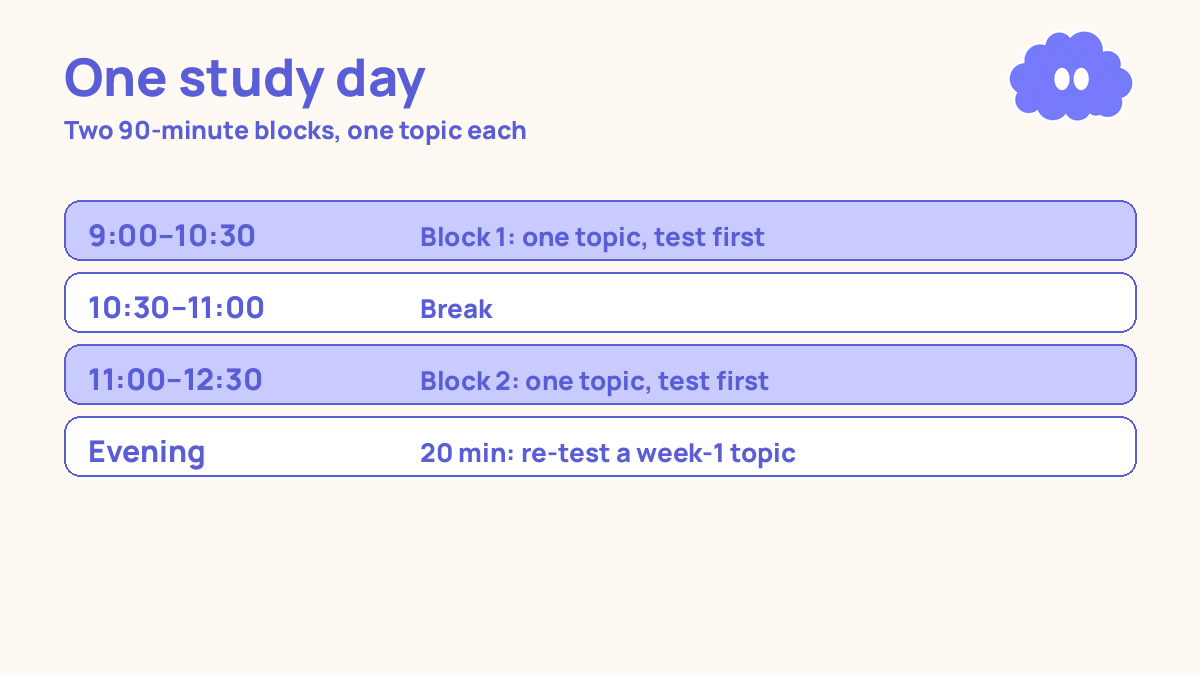
- Each day has the same shape: two 90-minute blocks, one topic per block, test first.
- Every topic gets three passes: learn it, test it after a gap, test it again before the exam.
- The last week is light review only — no new topics, no all-nighters.
Step 1: Count the days and list every topic
Start with the facts. Write down the exam date, count the days, and subtract one full day off per week. Four weeks is 28 days; with four days off, you have 24 study days. At two 90-minute blocks a day, that is 48 blocks. Write that number down: 48 blocks is your budget, and every topic you list has to fit inside it.
Now list every topic in the syllabus — the actual topics, not “biology”. Next to each one, write how likely it is to come up and how much of the paper it is worth, using past papers and the syllabus weighting. Rank the list. The top gets the first blocks; the bottom gets whatever is left, or nothing at all.
This ranking is the hardest part of the month, because it means choosing. A student who tries to cover everything in four weeks covers nothing properly. A student who covers the top 80% of the marks properly, and tests each topic three times, walks in with most of the paper covered and the rest accepted.
To see the count without doing the sums, the exam countdown shows the days left and how many 25-minute focus sessions that is from your study days and minutes. One month is usually fewer sessions than it feels like, which is the point.
Step 2: Split the month into four weeks
The month has four jobs, one per week. Do not mix them up — each week exists for a reason, and doing week 3’s job in week 1 wastes both.
Week 1: Cover and test the first half. One block to learn each topic, one block to test it. Learn means reading the notes and working the examples. Test means closing the notes and answering questions from memory.
Week 2: Cover the second half, re-test week 1. Same shape. End each day with 20 minutes re-testing a week-1 topic. The gap is the point: students who recalled a passage remembered more a week later than students who restudied it, though the restudiers felt more confident immediately (Roediger & Karpicke, 2006).
Week 3: Past papers, timed. No new topics. One full paper every other day, clock running. Between papers, go through what you got wrong and test those topics again.
Week 4: Exam week. Light review only. Re-test the weak topics, look at your one-page summaries, and stop. No new topics, no all-nighters, no past paper the night before. The full plan is in the exam week plan for students. Four weeks is the shape — the day-by-day version, subjects, gaps, and rest days, is how to make a revision timetable that works.
Step 3: Each day has the same shape
Every study day looks the same: two 90-minute blocks, one topic per block, with a 30-minute break between them. Block 1 is 9:00–10:30, break 10:30–11:00, block 2 is 11:00–12:30. A second subject gets one afternoon block, 2:00–3:30.
Each block has the same shape too: 10 minutes to look at the notes, 50 minutes to test yourself from memory, 30 minutes to check your answers and write down what you got wrong. The 50 minutes of testing is the work. If the block turns into 90 minutes of reading, you have slipped back into re-reading, and the day is wasted.
One topic per block, never two. Mixing two topics in one block feels efficient and is not — you end the block having half-learned both. Switching between tasks costs time on every switch, and the cost grows as the tasks get more complex (Rubinstein et al., 2001).
Step 4: Every topic gets three passes
No topic is done after one pass. Every topic on your list gets three passes, spaced out, and the spacing is the system.
Pass 1 — learn it. Week 1 or 2, one block: read the notes, work the examples, write five questions from memory with the answers on a separate sheet.
Pass 2 — test it after a gap. Two to three days later, one block: answer the five questions from memory, notes closed, then check. Write down what you got wrong. This is the pass that does most of the work, because retrieving something after a gap is what makes it stick.
Pass 3 — test it again before the exam. Week 3 or 4, 20 minutes: answer the same five questions again. If you get them all right, the topic is done. If you get two wrong, those two go on the list for the last week.
The gap matters, and it grows with how long you need to remember the material. In a 2008 study of 1,354 people, Cepeda and colleagues found the best gap was about 20–40% of a one-week delay and 5–10% of a one-year delay — an inverted U, where a longer gap first helped and then hurt. For an exam in four weeks, a gap of two to three days between passes is a sensible starting point. The 1–3–7 day review schedule is a practical starting point, not a rule from the research.
Step 5: The last week is light review only
Week 4 is not for learning. It is for keeping what you learned warm and arriving rested. Each day, re-test the weak topics from your pass-2 list and look at your one-page summaries. Pack your bag the night before and go to bed at your normal time.
Do not start a new topic in the last week. A new topic in the last week is a topic you will half-learn, and it will sit in your head next to the topics you know properly, making you doubt both. If a topic is not covered by week 4, it is not covered. Accept it and spend the time on the topics you do know.
Do not do a past paper the night before the exam.
A worked example: how to revise when you have one month left — exam Monday 30 November
Your biology exam is on Monday 30 November. Today is Monday 2 November. You have 28 days, 24 study days, and 48 blocks. The syllabus has 12 topics.
Week 1, Mon 2 – Sat 7 November: Topics 1 to 6, one topic per block, two blocks a day. Each topic gets pass 1 in the morning block, and pass 2 starts on Thursday — re-test topics 1 and 2 after a two-day gap.
Week 2, Mon 9 – Sat 14 November: Topics 7 to 12, same shape. Each day ends with 20 minutes re-testing a week-1 topic. By Saturday you have covered all 12 topics once and re-tested six of them.
Week 3, Mon 16 – Sat 21 November: Past papers. Monday, Wednesday, Friday: one full paper each, timed, 90 minutes. Tuesday, Thursday, Saturday: go through the wrong answers and test those topics again.
Week 4, Mon 23 – Sun 29 November: Light review. Monday to Wednesday: re-test the weak topics from the pass-2 list, 20 minutes each. Thursday: look at your one-page summaries. Friday: pack the bag, check the room, stop studying at 8pm. Saturday: one hour of light review, then stop. Sunday: day off. Monday 30 November: exam.
| Week | Dates | The job | Blocks |
|---|---|---|---|
| 1 | Mon 2 – Sat 7 Nov | Cover topics 1–6, test them | 12 |
| 2 | Mon 9 – Sat 14 Nov | Cover topics 7–12, re-test week 1 | 12 |
| 3 | Mon 16 – Sat 21 Nov | Three timed past papers + fixes | 12 |
| 4 | Mon 23 – Sun 29 Nov | Light review, weak topics only | 12 |
When it goes wrong
You spend week 1 re-reading instead of testing. This is the most common failure, and you will not notice it until week 3, when the past papers show you cannot remember what you “covered”. Fix it on day 1: every block ends with 50 minutes of testing, notes closed. If a block has no testing in it, the block did not happen.
You fall behind in week 2 and try to catch up by skipping the re-tests. Do not. The re-tests are the learning. Skipping them to cover more topics is like skipping the foundations to build more rooms. If you fall behind, cut a low-ranked topic from the list instead. The ranking exists for exactly this.
Week 3 past papers go badly and you panic. A bad paper in week 3 is good news — it is a list of what to fix, with a week left to fix it. Go through every wrong answer, test those topics again, and do the next paper. If the first one is bad, the second one is the test of whether the fixes worked.
You start a new topic in the last week. Stop. A new topic in the last week is a topic you will half-learn, and it will make you doubt the topics you know. Spend the time re-testing the weak topics from your pass-2 list instead. If it is not covered by week 4, it is not covered.
Weekly review checklist
Copy this list and use it each week:
- How many of the 12 blocks did I actually complete this week, and which topics did they cover?
- Which topics have had two passes, and which are still on one?
- What did the past papers (week 3) or the re-tests show I still get wrong?
- What one change will I make next week: more testing per block, a cut topic, or an earlier stop time?
Downloadable infographic spec: one vertical image, title “One month to the exam”, with the four weeks — weeks 1–2 cover and test, week 3 past papers, week 4 light review — and the rule “every topic gets three passes” in Thynq cream, Cloud Purple, Dark Purple and pink, with the cloud mascot. Text taken word-for-word from this article.
What this system is not
It is not a promise of a grade, and it is not a claim that four weeks is enough for every syllabus. If you have not started a subject at all, four weeks will not finish it — the ranking step exists so you cover the most likely topics properly instead of all of them badly.
Sources
- Dunlosky, J., et al. (2013). Psychological Science in the Public Interest, 14(1), 4-58. Only practice testing and distributed practice rated high utility; rereading rated low.
- Roediger, H. L. & Karpicke, J. D. (2006). Psychological Science, 17(3), 249-255. Recall beat restudy a week later, though restudiers felt more confident immediately.
- Cepeda, N. J., et al. (2008). Psychological Science, 19(11), 1095-1102. Best gap grows with test delay; about 20-40% of a one-week delay, 5-10% of a one-year delay.
- Rubinstein, J. S., Meyer, D. E. & Evans, J. E. (2001). Journal of Experimental Psychology: Human Perception and Performance, 27(4), 763-797. Switch costs 614 to 1,096 milliseconds per switch.
Questions
Is one month enough to revise?
It is enough to cover a syllabus once properly and test every topic three times, if you stop re-reading and start testing. It is not enough to learn a subject from zero, so the plan puts the most likely topics first.
How many hours a day should I revise?
Three to four focused hours a day beats eight distracted ones. The plan uses two 90-minute blocks a day, six days a week, with one full day off.
Should I start new topics in the last month?
Only the ones most likely to appear. List every topic, rank it by likelihood and paper weight, and start with the top of the list. A new topic nobody asks about is time taken from one they will ask about.
What if I have more than one exam?
Give each subject its own block in the day and rotate them across the week. One subject per block, never two in the same block.