The direct answer
What to do the morning of an exam is this: work backwards from the start time to set your wake time, run one 10-minute recall warm-up and then stop, check your bag and backup route, arrive 15 to 20 minutes early, and start with a first move you decided before you left home.
Mornings go wrong in small steps: late waking, too long on notes, a late bus, a hard-to-find room. You sit down rushed, with no plan for the first question.
This article runs the morning only, from the alarm to the first answer. Pack the night before, using how to revise the night before an exam, because most of what to do before an exam happens then. If nerves are your main problem, the exam anxiety system is the companion to this article, and this page does not repeat it.
The system in short
- Work backwards from the start time to set the wake time and leave time.
- Wake up, eat normally, and keep the phone shut except for the alarm.
- Do one 10-minute recall warm-up from memory, then stop.
- Check the bag, route, and backup route, then travel without new material.
- Wait quietly, then run the first five minutes for your exam type.
- For an afternoon exam, run a different morning: one session, lunch, rest, warm-up.
Step 1: Set the morning backwards from the start time
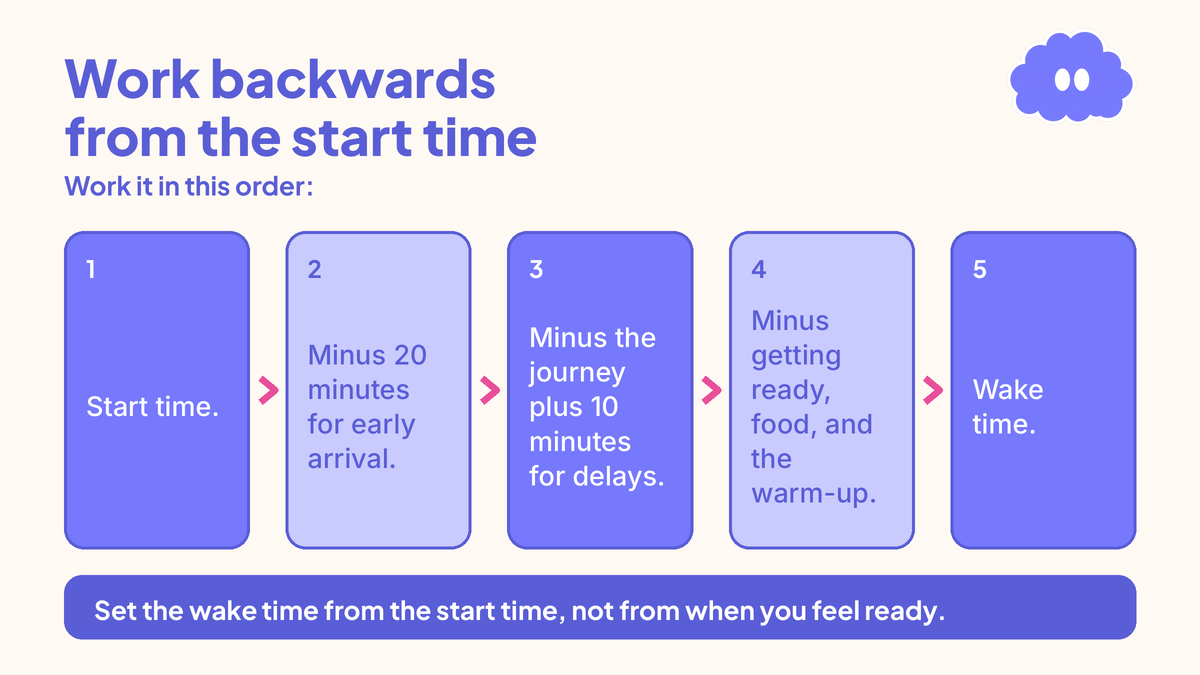
Set the wake time from the start time, not from when you feel ready. Subtract the early-arrival buffer, the journey plus a delay buffer, and the time to get ready, eat, and warm up.
Work it in this order:
- Start time.
- Minus 20 minutes for early arrival.
- Minus the journey plus 10 minutes for delays.
- Minus getting ready, food, and the warm-up.
- Wake time.
Write the four times, the route, and the backup route on one card the night before, and keep it by your bed. That card is your exam morning routine for tomorrow.
Set two alarms, 10 minutes apart. Put the phone or clock where you must sit up to silence it, then leave the phone shut.
In a shared house or dorm, agree the bathroom order the night before. Shower the night before if the queue is long, and keep your bag, clothes, and keys by the door. Ask housemates for quiet until you leave.
If you work shifts, adjust the same calculation, not the system. After a night shift, sleep first and keep the morning short, with nothing beyond the 10-minute warm-up. Before a shift, pack the shift bag the night before as well.
Step 2: Wake up, eat what you normally eat, and keep the phone shut
When the alarm rings, sit up and start getting ready at once. Wash, dress in the clothes you laid out, and use the bathroom before you leave.
Eat what you normally eat, in the normal amount. Do not try a new food, a larger meal, or a skipped breakfast on exam day. If nerves take your appetite, eat something small and familiar, such as a banana, a slice of toast, or a glass of milk, and take a snack for after the exam.
Keep caffeine exactly as normal: the same drink, the same amount, at the same time. Drink water as normal. Use the phone for the alarm only, then put it face down or in your bag, and do not open group chats, predictions, or last-minute notes.
If you must check travel, check delays once, note the result, and shut the phone again. At the venue, follow the phone rules on your entry slip, not the rule from a past exam.
Step 3: Do one short recall warm-up, then stop
Should you study the morning of an exam? Only in this warm-up, and only from memory. The warm-up wakes up what you already know.
Test yourself, do not re-read. In a 2013 review, Dunlosky and colleagues rated practice testing and distributed practice as the only two high-utility techniques; re-reading was rated low.
Set a timer for 10 minutes and work in three parts:
- Minutes 1 to 3: write the must-knows from memory, with notes closed.
- Minutes 4 to 7: check against your one-page summary and circle the misses.
- Minutes 8 to 10: test only the circled items once more, then close the notes.
The list comes from work you did before today: formulas, definitions, confused pairs, and mistakes from your fix list. Keep it to one page and no more than 15 items. New topics, full papers, and the hardest practice question never belong in the warm-up.
When the timer rings, stop, even if the list feels unfinished. The stop point is fixed: notes closed when you leave home, and none opened in the building. Do not run your normal morning study routine on exam day, because exam morning is a capped warm-up and logistics, not two rounds on the hardest task.
Step 4: Check the bag, the route, and the backup route
Check the bag against your entry slip and the exam rules, not from memory. Pens, spare pens, pencils, calculator with fresh batteries, student ID or entry slip, water bottle if allowed, and layers for a cold room all go in the night before, so the morning check is a count, not a pack. If a rule is unclear, check the entry slip before you leave, and do not guess.
Use this step as a morning of exam checklist: bag counted, route checked, backup route ready, leave time written down. Check the main route once before you leave, then shut the phone. The backup route is a second way to the venue, or an earlier service, with its own leave time on the card.
Write the Plan B trigger in advance. For example: if the bus is 7 minutes late, walk to the second stop; if the train is cancelled, take the backup bus; if both fail, call a taxi or ask for a lift, and contact the school or centre at once in the way shown on the entry slip.
Aim to arrive 15 to 20 minutes early, not an hour early. Travel as neutral time: no cramming videos, no group-chat debates, and no new notes. Silent recall is fine, and silence is fine too.
Step 5: Wait quietly, then run the first five minutes for your exam type
Outside the room, step away from quizzing clusters and find a quiet spot. Use the bathroom, lay out your materials, put the phone away as the rules require, take slow breaths, and wait.
If friends start quizzing, use one fixed line and move away: “I am keeping it quiet until we go in. Good luck.” Do not answer, debate, or open notes to settle an argument.
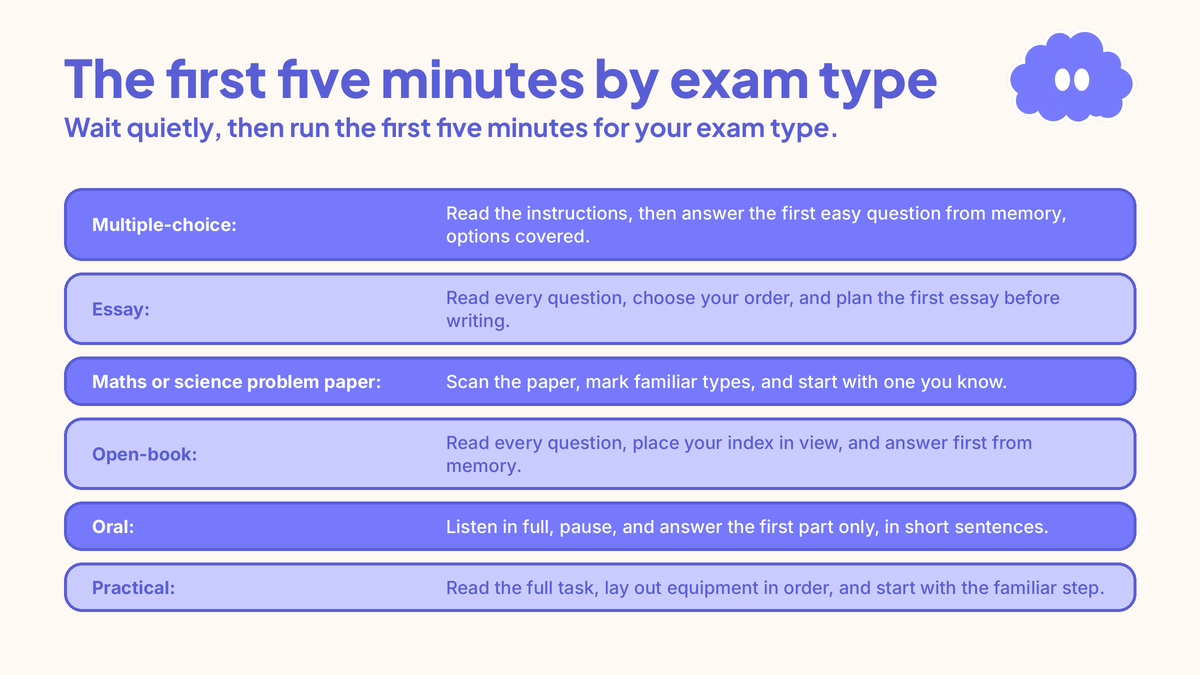
In the room, read the paper first, start with a question you can answer, and keep to your time for each part. The opening move differs by exam type:
| Exam type | First five minutes |
|---|---|
| Multiple-choice | Read the instructions, then answer the first easy question from memory, options covered. |
| Essay | Read every question, choose your order, and plan the first essay before writing. |
| Maths or science problem paper | Scan the paper, mark familiar types, and start with one you know. |
| Open-book | Read every question, place your index in view, and answer first from memory. |
| Oral | Listen in full, pause, and answer the first part only, in short sentences. |
| Practical | Read the full task, lay out equipment in order, and start with the familiar step. |
The multiple-choice exam system covers options and flagging, and the essay exam system covers timed planning. For notes in the room, follow the open-book exam system, and for hands-on papers, follow the practical exam system.
Step 6: Run a different morning for an afternoon exam
An afternoon exam needs a different morning, not a longer revision session. Keep your normal wake time and breakfast, and keep the morning light: shower, walk, ordinary tasks. Do not sleep in by two or three hours to fill the morning.
Run one capped recall session in the mid-morning, for 20 to 30 minutes: test from memory, check, test the misses once, then stop. Use the same one-page list, and do not open new topics. When it ends, close the notes.
Eat lunch at a fixed time, finished at least an hour before you leave. Eat familiar food, in a normal amount, and keep caffeine as normal.
After lunch, rest: a short walk, a lie-down, or quiet sitting, with no notes. Do not run a second session, and do not revise for tomorrow’s exam all morning.
Run the 10-minute warm-up about an hour before you leave, using the protocol in Step 3. Travel and waiting follow Steps 4 and 5 exactly.
A worked example: what to do the morning of an exam, at 9am and at 2pm
Two mornings, worked backwards.
Morning exam: 9:00am psychology paper.
Your situation: 9:00am multiple-choice paper, 60 questions in 90 minutes, 35-minute bus journey, one bathroom, shared house.
- 6:50am: up, wash, dress. Shower done the night before; bathroom slot agreed.
- 7:15am to 7:35am: normal toast and tea. Phone face down.
- 7:35am to 7:45am: warm-up, 12 terms and 4 confused pairs, from memory.
- 7:45am to 7:55am: bag counted, bus checked once, backup bus noted.
- 7:55am: leave. Main bus 7:58am; backup 8:12am from High Street if 7 minutes late.
- 8:40am: arrive, 20 minutes early. Quiet spot, bathroom, materials ready.
- 9:00am: read the instructions, answer the first easy question from memory.
Afternoon exam: 2:00pm history paper.
Your situation: 2:00pm essay paper, 3 questions in 2 hours, 20-minute walk, no shift today.
- 7:30am: up at the normal time. Breakfast, shower, short walk, no notes.
- 10:00am to 10:25am: recall session, 25 minutes, same one-page list, then stop.
- 11:30am to 12:00pm: lunch, familiar sandwich and water. No new food.
- 12:10pm to 12:20pm: warm-up, 10 minutes, same protocol as Step 3.
- 12:20pm to 1:00pm: rest, quiet sitting and a short walk. No notes.
- 1:00pm to 1:10pm: bag counted, walking route and backup bus noted.
- 1:10pm: leave. Walk 20 minutes plus 10 minutes buffer, arrive 1:40pm.
- 2:00pm: read every question, choose order, plan the first essay.
Same rules, different clocks.
When it goes wrong
You oversleep. Get ready fast, take the essentials only, and leave at once, skipping the warm-up. Follow the late-arrival instructions on your entry slip.
Transport fails or you are running late. Switch to the backup route at the trigger time. If both routes fail, take a taxi or ask for a lift, and contact the school or centre at once.
You forget an item. Borrow a spare, and ask an invigilator what is allowed. Do not go back if it risks lateness, unless the item is needed to sit the exam.
You feel you have forgotten everything. Start with one small question you can answer, then move to the next familiar question. Do not re-read notes outside the room, and do not quiz friends.
Friends quiz you outside the room. Use the fixed line, step away, and find the quiet spot. Do not answer, debate, or open notes to check a claim.
You arrive far too early. Do not join the largest group, and do not reopen notes. Find a quiet spot, wait with materials ready, and take a short walk if the wait exceeds 30 minutes.
Housemates, family, or a shift disrupt the morning. Leave earlier and warm up near the venue. If a shift overruns, tell the supervisor, take the fastest backup route, and skip the warm-up.
Weekly review checklist
After each exam, answer these in writing.
- Did the wake time work, or did the morning take longer than planned?
- Did the warm-up stop on time, with notes closed when I left?
- Did the bag, route, and backup checks catch everything?
- Did waiting and the first five minutes follow the plan?
- What one change will I make for the next exam morning?
Downloadable infographic spec: one vertical image, title “What to do the morning of an exam”, with the six steps from “The system in short” and the five review questions above, in Thynq cream, Cloud Purple, Dark Purple and pink, with the cloud mascot. Text taken word-for-word from this article.
What this system is not
It is not a promise of a grade, and it is not a rescue for a term of missed work. A good morning cannot replace weeks of revision, and no system can guarantee a result.
It is not medical advice, and it does not diagnose or treat anxiety. If exam stress affects your health or sleep for weeks, talk to a doctor, a counsellor, or your university’s support service.
It is not a substitute for the exam body’s rules on lateness, allowed items, phones, and calculators. Check your entry slip and centre instructions for every exam, because rules vary. It is not a list of exam day tips to pick from.
Sources
- Dunlosky, J., Rawson, K. A., Marsh, E. J., Nathan, M. J., & Willingham, D. T. (2013). Improving students’ learning with effective learning techniques. Psychological Science in the Public Interest, 14(1), 4-58. The review that rated practice testing and distributed practice as the only two high-utility techniques out of ten.
For the full system behind this morning, start with how to revise for exams without cramming.
Questions
Should you study the morning of an exam?
Study only in one short, capped warm-up, and do not learn anything new. Test yourself from memory on a short list from your own summary for 10 minutes, then close the notes and stop. If the warm-up starts to worry you, stop early and follow the rest of the morning plan instead.
What should I do the morning of an afternoon exam?
Keep a normal wake time, run one capped recall session in the mid-morning, eat a familiar lunch, and rest before you leave. Do not fill the whole morning with revision for today or tomorrow, or you will arrive tired. Run the same 10-minute warm-up about an hour before you leave, then travel and wait as you would for a morning exam.
What if you wake up late on exam morning?
Get ready fast, take the essentials only, and leave at once. Do not try to fit in the warm-up, and do not go back for anything that is not needed to sit the exam. Follow the late-arrival instructions on your entry slip or timetable, and contact the school or centre in the way it asks you to.
What should you revise on the morning of the exam?
Revise only a short list you made before today: formulas, definitions, confused pairs, and mistakes you have made before. Test yourself on each item from memory, check what you missed, and test the misses once more. Stop after 10 minutes, and do not open a new topic, a full paper, or the hardest question you can find.