The direct answer
The exam anxiety system for students is not one trick on the morning. It is a plan that covers three moments: the week before, the morning, and the first five minutes in the exam room. Prepare so there are fewer unknowns, write down exactly what the morning looks like, and walk in with a first move already decided. That is the whole system.
Your stomach is tight the night before the exam. You have revised, but you keep thinking about the one topic you skipped and what happens if you blank. You open your notes again at 11pm, not because it helps, but because doing nothing feels worse.
That feeling is normal, and it is not a sign that you are unprepared. Most students feel it. The problem is not the nerves. The problem is that nerves plus no plan turns into last-minute cramming, a bad night, and a panicked first ten minutes in the room. A plan does not remove the nerves. It gives you something to do while you feel them, so the nerves do not get to choose what happens next.
This system is practical coping only: preparation, the morning, and the exam room. It is not medical advice, and it does not diagnose or treat anything. If exam stress is affecting your health or your sleep for weeks, talk to a doctor, a counsellor, or your university’s support service.
It sits inside how to revise for exams without cramming.
The system in short
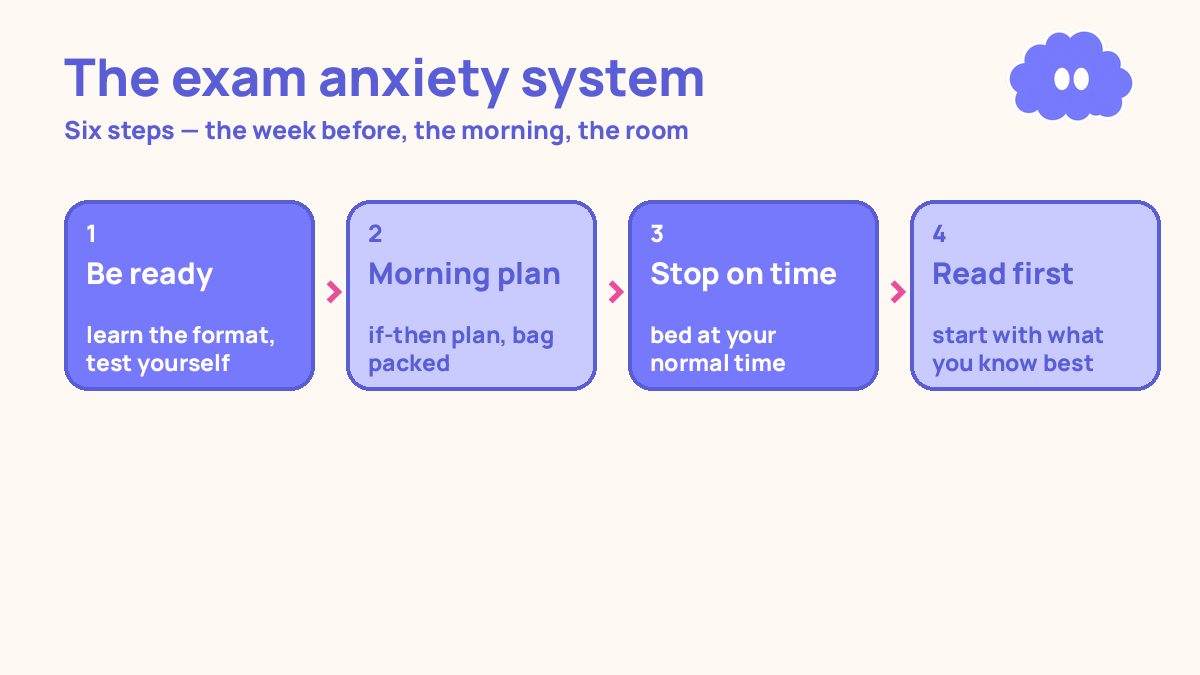
- Prepare so there are fewer unknowns: test yourself, and learn the paper format before exam week.
- Write an if-then plan for exam morning: what time you get up, what you eat, when you leave, what is in your bag.
- The night before, stop studying at a set time and go to bed at your normal time.
- On the morning, follow the plan exactly. No new material, no last-minute cramming.
- In the room, spend the first five minutes reading the paper and choosing your order before you write anything.
- When you get stuck, mark the question, move on, and come back to it later.
Step 1: Prepare so there are fewer unknowns
Most exam nerves come from unknowns. You do not know which topics will come up, you do not know the format, you do not know whether you actually remember what you revised. Each unknown adds a worry. The week before the exam is for removing as many of them as you can.
First, find out the format. How many questions, how long, what types? If past papers exist, work through one under timed conditions. Knowing the shape of the paper is the cheapest way to reduce the fear of it.
Second, test yourself instead of re-reading. In a 2013 review, Dunlosky and colleagues rated practice testing and distributed practice as the only two high-utility techniques; re-reading was rated low. Testing yourself tells you the truth about what you know.
Step 2: Write the if-then plan for exam morning
Decide the morning in advance, in writing, the day before the exam: what time you get up, what you eat, what time you leave, what is in your bag, which route you take, what time you arrive.
An if-then plan names the cue and the action in advance, so starting does not need a fresh decision. Across 94 studies, if-then plans raised goal attainment by a medium-to-large amount (d = 0.65) over holding the goal alone (Gollwitzer & Sheeran, 2006).
The point of the plan is not efficiency. It is that on the morning, when your nerves are loudest, you do not have to decide anything. You follow the list. Every decision you make in advance is one fewer decision the nerves get to interfere with.
Step 3: The night before, stop at a set time
Pick a stop time and write it down: 8pm, 9pm, whatever fits your day. When the time comes, close the notes. The last hour of cramming adds tiredness, not knowledge.
Sleep is when the day’s learning is consolidated. Diekelmann and Born (2010) reviewed the evidence that sleep improves consolidation of what was learned, with patterns of brain activity from learning re-activated during slow-wave sleep. That does not mean one good night fixes a week of no study. It means a short night after a long study day cuts short the consolidation of the work you did.
Go to bed at your normal time — not two hours early, not two hours late. Normal time, normal routine. The full night-before plan is in how to revise the night before an exam. The full 90-minute wind-down — review from memory, tomorrow’s plan, then nothing exam-related — is in the evening wind-down for better sleep before exams.
Step 4: On the morning, follow the plan exactly
Get up, eat, and leave at the planned times. Do not add anything new. The morning is for arriving calm, fed, and on time.
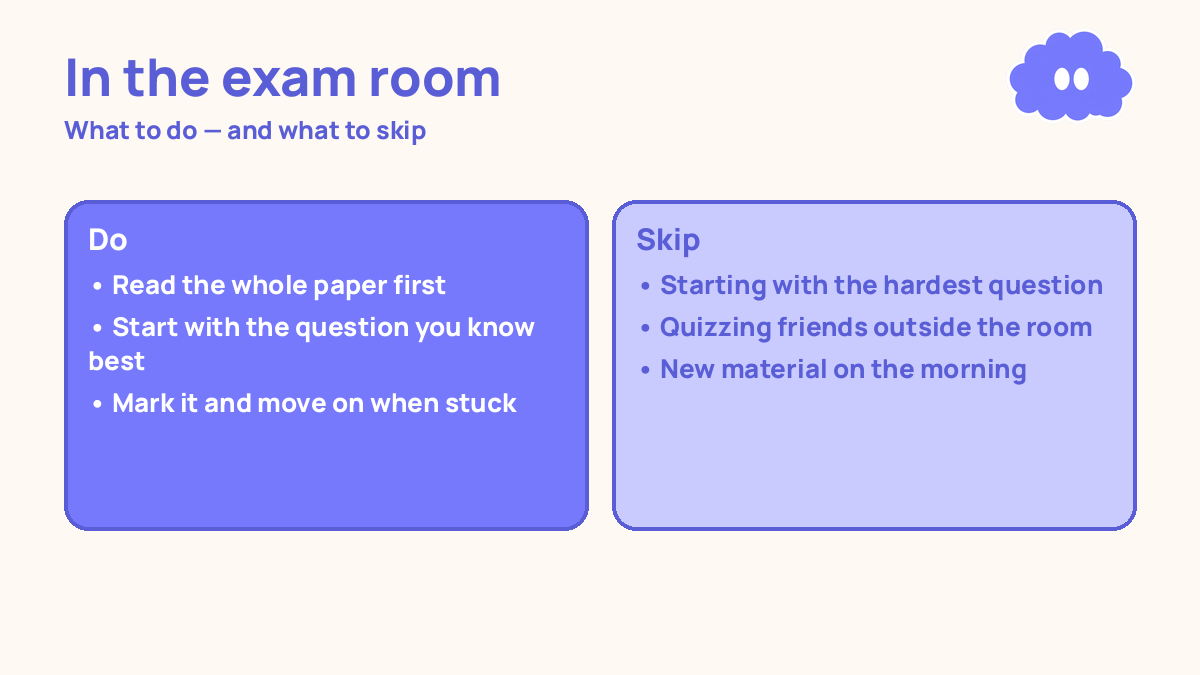
Do not study new material on the morning. A quick look at your one-page summary is fine. A new chapter is not. If you open something new and do not understand it, you have just added a worry with no time to fix it.
Do not quiz your friends outside the exam room. The student who asks “did you revise chapter 9?” five minutes before the exam is handing you a worry. Walk away and look at your own summary. Arrive fifteen to twenty minutes early.
Step 5: The first five minutes in the room
When the paper is in front of you, do not start writing immediately. Spend the first five minutes reading the whole paper. This is the most important five minutes of the exam, and most students skip it.
Read every question and mark the ones you can answer confidently. Then choose your order: start with a question you can answer well. Not the first question — the easiest question for you. A good first answer earns marks, and it proves to you that you can do this.
Divide the time before you start. If the exam is two hours with four questions, that is 30 minutes per question, minus five minutes for reading and five for checking at the end. Write the time blocks on the paper and follow them. When a block ends, move on, even if the answer is not perfect. A finished paper with rough answers beats a half-finished paper with two perfect answers.
Step 6: When you get stuck, mark it and move on
You will get stuck. Mark the question, move on to the next one, and come back to it later.
Marking it matters. A question you skip without marking is a question you forget. Move on to a question you can answer — starting it gets you moving again, and the answer to the stuck one often comes back once you are working on something else.
When you come back to it, write down what you do know about the topic, even if it is only two lines. If it still does not come, leave it and move on. One blank question is not a failed exam. At the end, use the last five minutes to check: every question answered, name and number on the paper, no missed page. Then stop and leave the room.
A worked example: the exam anxiety system for students on exam day, 9am start
Your biology exam starts at 9:00 on Wednesday. Here is the day, using the system above.
Tuesday evening: You stop studying at 8:00pm. Your bag is packed: pens, pencils, calculator, water, student card, watch. Your morning plan is written on a card: up 7:00, shower, toast and eggs, leave 8:15, arrive 8:45. You check the room number and go to bed at 10:30, your normal time.
Wednesday 7:00 — up: Alarm goes, you get up, shower, eat toast and eggs. No notes. You look at your one-page summary for ten minutes while you eat — key facts only, nothing new.
Wednesday 8:15 — leave: You leave at the time in the plan and arrive at 8:45, fifteen minutes early. Friends are quizzing each other outside the room. You walk past them, find a quiet bench, and wait.
Wednesday 9:00–9:05 — read the paper: You read all four questions. Q3 is the one you know best. Q2 is the one you are least sure about. You write the time blocks on the paper: Q3 9:05–9:30, Q1 9:30–9:55, Q4 9:55–10:20, Q2 10:20–10:45, check 10:45–10:50.
Wednesday 10:45–10:50 — check: Every question has an answer. Your name and number are on the paper. You stop. You leave.
| Time | What happens | The rule |
|---|---|---|
| Tuesday 8:00pm | Stop studying, pack the bag | Stop time is written down |
| Tuesday 10:30pm | Bed at normal time | No early bed, no late cramming |
| Wednesday 7:00 | Up, shower, breakfast | Follow the plan, no new material |
| Wednesday 8:15 | Leave | Arrive 8:45, 15 minutes early |
| Wednesday 9:00–9:05 | Read the whole paper | Start with the question you know best |
| Wednesday 9:05–10:45 | Answer in time blocks | Move on when a block ends |
| Wednesday 10:45–10:50 | Check, then stop | Check name, number, every question answered |
When it goes wrong
You cram until 1am the night before. You wake up tired, and the tiredness feels like panic. Fix it next time with a written stop time. If you cannot stop, set an alarm for the stop time and put your notes in another room when it rings.
You quiz friends outside the room and hear a topic you skipped. Your stomach drops. Walk away. One topic you skipped is not the whole exam, and hearing about it five minutes before the start does not give you time to learn it. Look at your own summary instead.
You blank on the first question you try. This is the moment the system is for. Do not sit and stare at it. Mark it, move to a question you can answer, and come back later. The blank is usually temporary — the answer comes back once you are writing about something else.
You run out of time and leave a question blank. Next time, write the time blocks on the paper before you start, and move on when a block ends. A rough answer in every question earns more than a perfect answer in half of them.
Weekly review checklist
Copy this list and use it each week:
- Did I test myself on this week’s topics, or only re-read them?
- Do I know the format of the next exam — how many questions, how long, what types?
- Is my exam-morning plan written down: wake time, food, leave time, bag packed?
- What one change will I make next week: a written stop time, time blocks, or no quizzing outside the room?
Downloadable infographic spec: one vertical image, title “The exam anxiety system”, with the six steps — remove unknowns, write the morning plan, stop at a set time, follow the plan, read the paper first, mark and move on — and the rule “start with the question you know best” in Thynq cream, Cloud Purple, Dark Purple and pink, with the cloud mascot. Text taken word-for-word from this article.
What this system is not
It is not a promise of a grade, and it is not medical advice. It does not diagnose anxiety or treat it. It is a practical plan for the normal nerves most students feel around exams. If exam stress is affecting your health or your sleep for weeks, talk to a doctor, a counsellor, or your university’s support service.
Sources
- Dunlosky, J., et al. (2013). Psychological Science in the Public Interest, 14(1), 4-58. Only practice testing and distributed practice rated high utility; rereading rated low.
- Gollwitzer, P. M. & Sheeran, P. (2006). Advances in Experimental Social Psychology, 38, 69-119. Across 94 studies, if-then plans raised goal attainment (d = 0.65).
- Diekelmann, S. & Born, J. (2010). Nature Reviews Neuroscience, 11(2), 114-126. Sleep improves consolidation of what was learned.
Questions
Is it normal to feel nervous before an exam?
Yes. Most students feel nervous before an exam, and nerves do not mean you are unprepared. This system does not try to remove the nerves. It gives you a plan for what to do while you feel them.
What should I do the night before an exam?
Stop studying at a set time, pack your bag, and go to bed at your normal time. Sleep is when the day’s learning is consolidated. The full night-before plan is in how to revise the night before an exam.
What if I blank on a question in the exam?
Mark it, move on, and come back to it later. One blank question is not a failed exam. The answer often comes back once you are working on something else.
What if I run out of time in the exam?
Divide the paper into blocks before you start, and move on when a block ends, even if the answer is not perfect. A finished paper with rough answers beats a half-finished one.