The direct answer
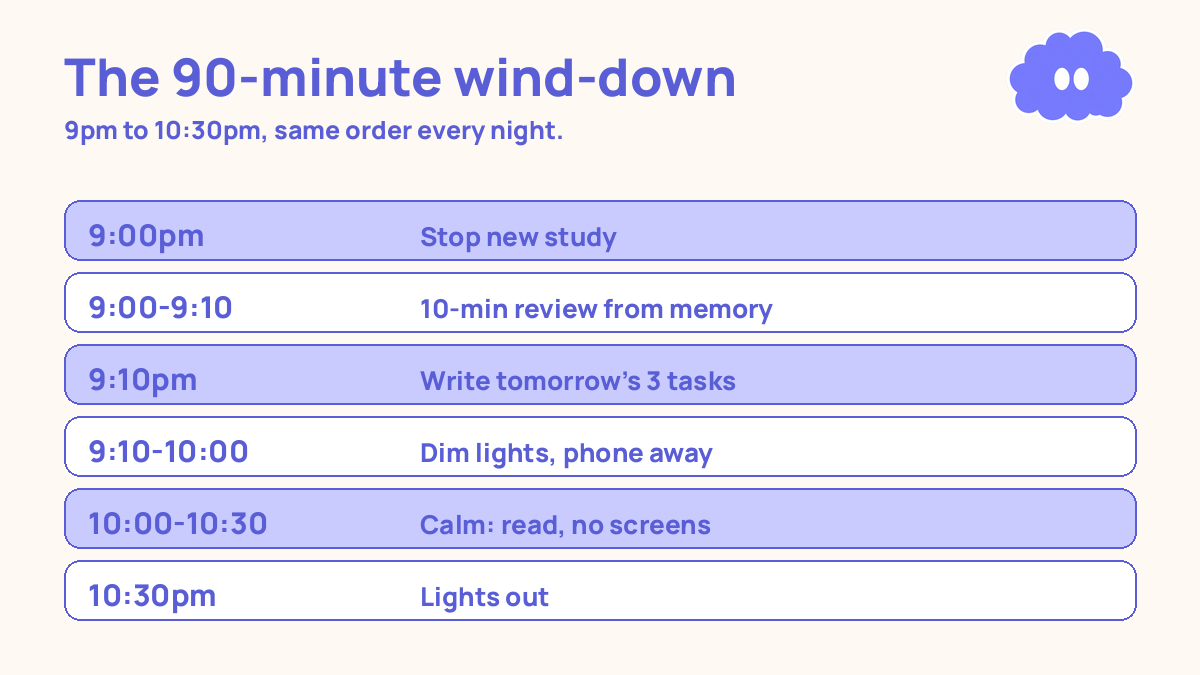
An evening wind down for better sleep before exams works like this: stop new study by 9pm, do a 10-minute review from memory at your desk, dim the lights, put the phone away, and be in bed by 10:30pm. That is the whole routine. It works because sleep is when the day’s learning is consolidated, and a short night after a long study day means the work was done but the consolidation was cut short.
You need the same 90 minutes, in the same order, every night in the week before the exam. Your brain learns that 9pm means the day is closing, and closing the day is what lets you fall asleep.
Why the night before the exam feels impossible
You have studied all day. You are tired, but when you get into bed your brain starts going through everything you have not finished. You check your phone once, then again. An hour passes. You fall asleep late, wake up groggy, and walk into the exam feeling like you never studied at all.
The problem is not the exam. The problem is that you tried to switch from full-speed studying to sleep in five minutes, and the switch does not work. Your brain needs a runway. Ninety minutes of winding down is the runway: study stops, light drops, the phone goes away, and your body gets the signal that the day is over.
The system in short
- 9:00pm — Stop new study. No new topics, no new chapters, no new problems.
- 9:00–9:10pm — A 10-minute review from memory at your desk: write down what you remember from today, then check.
- 9:10pm — Write tomorrow’s first three tasks on paper. Close the books.
- 9:10–10:00pm — Dim the lights, phone on charge outside the bedroom, shower, change, something calm.
- 10:00–10:30pm — Read something light or sit quietly. No screens, no exam talk.
- 10:30pm — Lights out. Same time every night in exam week.
Evening wind down for better sleep before exams: the 90-minute plan
The plan is 90 minutes, from 9pm to 10:30pm, in the same order every night. The order matters more than any single step, because the order is the signal. When your brain has felt the same sequence five nights in a row, step one starts to trigger step six. That is the whole trick, and it is why you do the routine even on nights when you feel fine.
If 9pm is too early to stop because your classes run late, shift the whole plan later by 30 minutes: stop at 9:30pm, bed at 11pm. Keep the 90 minutes and the order.
Step 1: Stop new study at 9pm
At 9pm, new study stops. No new chapter, no new topic, no new problem set. You are allowed to finish the sentence you are on. You are not allowed to start a new one.
This is the hardest step, because 9pm is exactly when the panic arrives: there is still so much to cover. But new material learned at 10:30pm, when you are tired, is material you will not remember. It is better to stop at 9pm and sleep on what you already studied than to add one more half-learned topic.
Step 2: A 10-minute review from memory
Sit at your desk, not in bed. Close your notes. For 10 minutes, write down what you remember from today: the three main points, the five formulas, the ten terms. Then open your notes and check. Mark what you got right and what you missed. The missed ones go on tomorrow’s list.
This is not extra study. It is the last thing you do, and it is short on purpose. Testing yourself is one of only two techniques Dunlosky and colleagues (2013) rated high utility in their review of ten common study techniques — the other was distributed practice, spacing study out. Re-reading was rated low. So the review is a test, not a re-read: close the notes first, write from memory, then check. The reason a short review before bed works is that sleep consolidates overnight — how sleep helps you remember what you studied explains what happens while you sleep.
Step 3: Write tomorrow’s plan, then close the books
Take a piece of paper and write tomorrow’s first three tasks. Not a long list — three tasks, one line each. Then close the books, clear the desk, and put the paper where you will see it in the morning.
An if-then plan helps here. In a meta-analysis of 94 studies, Gollwitzer and Sheeran (2006) found that deciding the cue and the action in advance raised goal attainment by a medium-to-large amount (d = 0.65) over holding the goal alone. Write it that way: “If I sit down at 9am, then I will start with the five formulas I missed tonight.”
Step 4: Dim the lights and lose the phone
From 9:10pm, the lights go down. Use one lamp instead of the ceiling light. Put the phone on charge outside the bedroom — not on the bedside table, not face down next to you, outside the room. If you use it as an alarm, put it across the room where you cannot reach it without getting up, or buy a cheap alarm clock.
Shower, change into sleep clothes, brush your teeth. Do the boring, physical things that tell your body the day is ending. Do them in the same order every night.
Step 5: Thirty minutes of nothing exam-related
From 10pm to 10:30pm, do something calm that has nothing to do with the exam. Read a novel, listen to music, sit by the window, stretch. No screens, no exam talk, no “just one more look” at your notes.
If your mind keeps going back to the exam, that is normal. Do not fight it — notice it, and go back to the book. The point of this half hour is not to empty your mind. It is to give it something other than the exam to hold.
At 10:30pm, lights out. Same time every night in exam week.
A worked example: the night before a biology exam
Your exam is tomorrow at 9am.
9:00pm — Stop: Close the textbook mid-chapter. No new material. 9:00–9:10pm — Review: At your desk, write from memory: the three stages of cell division, the five terms from today’s chapter, the two diagrams you practised. Check against your notes. You missed one term. It goes on tomorrow’s list. 9:10pm — Plan: Write tomorrow’s first three tasks: “1. Re-read the one missed term. 2. Breakfast by 7:30. 3. Leave at 8:15.” Close the books. Clear the desk. 9:10–10:00pm — Wind down: Shower, change, teeth. Phone on charge in the kitchen. One lamp on. 10:00–10:30pm — Calm: Read a novel for 30 minutes. No screens. 10:30pm — Lights out: You fall asleep by 11pm. You wake at 7am, eat breakfast, and leave at 8:15 with the plan you wrote last night.
Seven and a half hours of sleep, a plan already written, and nothing left to decide in the morning.
| Time | Wind-down night | Usual night |
|---|---|---|
| 9:00pm | Stop new study | Still studying |
| 9:10pm | Plan written, books closed | Still studying |
| 10:00pm | Phone away, reading | Phone in bed |
| 10:30pm | Lights out | Still scrolling |
| 7:00am | Wake, plan ready | Wake groggy, panic |
What changes after a week of wind-downs
One night of winding down helps a little. A week of it changes the evenings. By the fourth night, 9pm starts to feel like the natural end of the day.
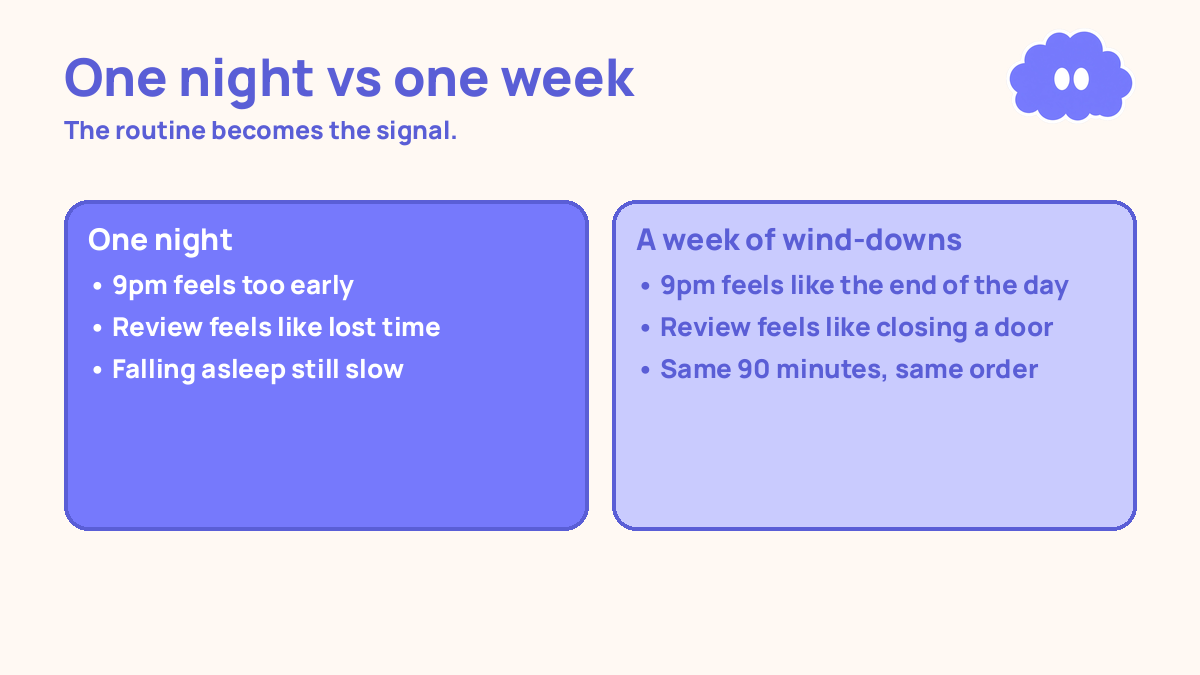
Routines take longer than people think to feel automatic. In a study of 96 people building one new daily behaviour, Lally and colleagues (2010) found the median time was 66 days, with a range of 18 to 254 days, and missing a single day did not measurably hurt. Do not expect the wind-down to feel natural after two nights.
If your evenings are usually spent studying because you are tired after work or classes, pair this with the evening study routine for tired students. That system covers the study part of the evening; this one covers the last 90 minutes, when study stops and sleep starts.
When it goes wrong
You stop at 9pm and then keep studying “just for ten more minutes”. Ten minutes becomes an hour. The fix is a hard edge: set an alarm for 9pm, and when it rings, close the book mid-sentence. A book closed mid-sentence is easier to reopen tomorrow than a book you studied until midnight.
You do the review in bed. Then the bed becomes a study desk, and your brain treats it that way. Do the review at your desk, every night, even when the desk is cold and the bed is warm. The bed is for sleep.
You put the phone away and then go and get it. This usually means the phone is too close. Charge it outside the bedroom, not across the room. If you need it as an alarm, put it in a drawer in another room and buy a cheap alarm clock. The barrier has to be bigger than the urge.
You lie awake worrying about the exam. Write the worries down before bed — the three things you will do first tomorrow. If you are still awake after 20 minutes, get up and read something boring in dim light until you feel sleepy. Do not lie in bed rehearsing the exam. And remember what Diekelmann and Born (2010) do not prove: no single night of sleep fixes a week of no study. The wind-down is a routine for exam week, not a rescue for one night.
Weekly review checklist
Copy this list and use it each week:
- How many nights this week did I stop new study by 9pm?
- How many nights was I in bed by 10:30pm?
- Which step broke most often — the 9pm stop, the phone, or the 10-minute review?
- What one change will I make next week: an earlier stop, the phone outside the bedroom, or the review at my desk?
Downloadable infographic spec: one vertical image, title “The 90-minute wind-down”, with the six steps — stop new study at 9pm, 10-minute review from memory, write tomorrow’s three tasks, dim the lights and lose the phone, 30 minutes of nothing exam-related, lights out at 10:30pm — in Thynq cream, Cloud Purple, Dark Purple and pink, with the cloud mascot. Text taken word-for-word from this article.
What this system is not
It is not a promise that one good night of sleep will fix your exam, and it is not a claim that 10:30pm is the scientifically correct bedtime for every student. It is a practical 90-minute routine: stop, review, plan, dim, calm, sleep. If your day runs later, shift the whole plan by 30 minutes and keep the order.
Sources
- Diekelmann, S. & Born, J. (2010). The memory function of sleep. Nature Reviews Neuroscience, 11(2), 114-126. Sleep improves consolidation of facts, procedural and emotional memories; slow-wave sleep re-activates learning patterns, and memories move from hippocampus to cortex. It does not prove any number of hours guarantees remembering.
- Dunlosky, J., et al. (2013). Improving students’ learning with effective learning techniques. Psychological Science in the Public Interest, 14(1), 4-58. Only practice testing and distributed practice received a high utility rating; rereading was rated low.
- Gollwitzer, P. M. & Sheeran, P. (2006). Implementation intentions and goal achievement: a meta-analysis of effects and processes. Advances in Experimental Social Psychology, 38, 69-119. If-then plans raised goal attainment by a medium-to-large amount (d = 0.65) across 94 studies.
- Lally, P., et al. (2010). How are habits formed: modelling habit formation in the real world. European Journal of Social Psychology, 40(6), 998-1009. Median time for a new daily behaviour to feel automatic was 66 days, range 18-254; one missed day did not measurably hurt.
For the study part of the evening, read the evening study routine for tired students, and for the phone part, the phone focus system for distracted students.
Questions
What time should I stop studying before an exam?
Stop new study by 9pm and be in bed by 10:30pm. The last 90 minutes are for winding down, not for new material. Sleep is when the day’s learning is consolidated.
Should I revise in bed?
No. Keep the bed for sleep. Do your 10-minute memory review at your desk, then leave the desk. If you revise in bed, your brain starts treating the bed as a study desk.
What if I cannot fall asleep because I am thinking about the exam?
Write down the three things you will do first tomorrow. A written plan lets your brain stop rehearsing it. If you are still awake after 20 minutes, get up, sit somewhere dim, and read something boring until you feel sleepy.
Does one good night of sleep fix a week of bad sleep?
No. Sleep supports memory consolidation, but no single night fixes a week of no study or no sleep. The wind-down works best as a daily routine in the week before the exam, not as a one-night rescue.