
The direct answer
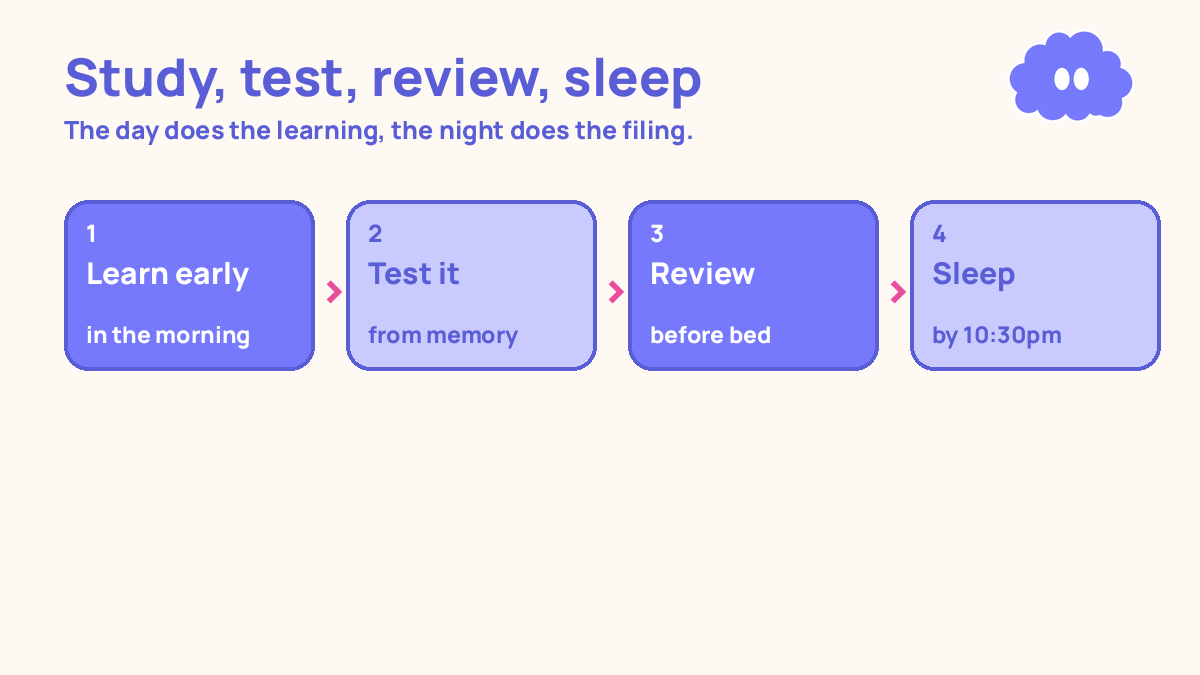
How sleep helps you remember what you studied is simple: sleep is when the day’s learning is consolidated, so the study you do in the day is filed away overnight, and a short night after a long study day means the work was done but the consolidation was cut short. That is the whole idea. Study in the day, test yourself before bed, and protect a full night of sleep.
You do not need to study more. You need the study you already do to survive the night: the day does the learning, the evening does a short review, and the night does the filing.
You studied it yesterday. Today it is gone.
You spent three hours on a topic yesterday. You read the chapter, underlined the key lines, and felt like you understood it. Today you open your notes and it feels like you never saw them.
That is not a memory failure. It is a method failure plus a sleep failure, and they feed each other. Re-reading feels like learning, but it mostly produces fluency — the feeling that you know it, because you just saw it. Dunlosky and colleagues (2013) reviewed ten common study techniques and rated re-reading low utility. Only two techniques received a high utility rating: practice testing and distributed practice, spacing study out. And the second failure is the night: if you studied until 1am and woke at 7am, the consolidation was cut short.
Diekelmann and Born (2010) found that sleep improves the consolidation of what was learned. What their review does not prove is that any number of hours guarantees remembering, or that one night of sleep fixes a week of no study. So this article gives you a practical routine, not a promised number of hours.
The system in short
- Study the hard material earlier in the day, not at midnight. Mornings and afternoons are for learning; evenings are for review.
- Test yourself during the day. Close the notes and answer questions from memory, then check.
- Before bed, do a 10-minute review from memory at your desk. Write what you remember, then check.
- Protect the night: in bed by 10:30pm, phone outside the bedroom, no new material after 9pm.
- The next morning, spend 10 minutes recalling yesterday’s material before you start anything new.
Step 1: Learn it earlier in the day
The material you learn at 11pm, when you are tired, is half-learned. The material you learn at 11am, when you are fresh, has a full day of waking hours behind it before sleep does the filing. So put the hard topic in the morning or the early afternoon, and put the easy work — organising notes, light reading — in the evening.
This is a scheduling decision, not a willpower decision. Look at tomorrow and ask: what is the hardest thing I need to learn? Put it in the first study block of the day.
If your day is full of classes, use the gaps: one 50-minute block between classes for the hard topic, and the evening for the review. Hard first, review last, sleep in between.
Step 2: Test yourself while you study
Reading a chapter twice is not learning it twice. It is seeing it twice, and seeing is not remembering. Roediger and Karpicke (2006) found that students who recalled a passage remembered more a week later than students who restudied it, even though the restudiers felt more confident immediately after studying. Feeling fluent right after re-reading is not the same as remembering a week later.
So inside every study block, test yourself. Read a section, close the book, and write down what it said. Work the problem without looking at the worked example. Answer the questions from memory, then check your answers. The check matters: in a meta-analysis of 61 studies, Rowland (2014) found testing beat restudy (g = 0.50), and with feedback the effect was larger (g = 0.73) than without it (g = 0.39). Testing without checking is guessing. Testing with checking is learning.
If you get something wrong, that is the system working. A wrong answer tells you what to review tonight and retest tomorrow morning.
Step 3: The 10-minute review before bed
At 9pm, stop new study. Sit at your desk — not in bed — and spend 10 minutes writing from memory what you studied today. The three main points, the five formulas, the ten terms. Then open your notes and check. Mark what you got right and what you missed.
This review is one more retrieval practice, and it is the last thing your brain meets before sleep, so it is the freshest material when consolidation starts.
Ten minutes is enough. If you cannot write anything from memory, tomorrow starts with that topic, not with a new one. Do not turn the 10-minute review into an extra hour of study. An extra hour at 10pm costs you sleep, and sleep is the part that does the filing.
For the full evening routine around this review — the 90 minutes from 9pm to bedtime — read the evening wind-down for better sleep before exams.
Step 4: Protect the night
In bed by 10:30pm, phone on charge outside the bedroom, no screens in the last 30 minutes, no new material after 9pm. These are the edges of the system. A night that starts at 1am after three hours of scrolling is a night where consolidation barely started.
This is the step students resist most, because it feels like giving up study time. It is protecting the study time you already spent. Six hours of study and a full night of sleep beats eight hours followed by four, because the eight hours were learned tired and filed badly.
If the exam is tomorrow, the rule still holds. Stop at 9pm, review for 10 minutes, sleep. An all-nighter does not save an unprepared student, and it punishes a prepared one.
Step 5: The morning recall check
The next morning, before you start anything new, spend 10 minutes recalling yesterday’s material. Close your notes, write down what you remember, then check.
This is the honest test of the whole system. If you can recall it in the morning, the day-and-night cycle worked: you learned it, you reviewed it, you slept on it. If you cannot, you know exactly what to re-study today, and you know it before you have wasted an hour re-reading everything.
The morning check also sets the spacing. Cepeda and colleagues (2006) found that spaced practice beat massed practice, and that the best gap grows with how long you need to remember the material. A day is a good first gap, then review again in 3 days, then in 7 days — a practical starting schedule, not a rule from the research. The spaced repetition system for students builds this into a full routine.
A worked example: how sleep helps you remember what you studied
You are learning the five stages of a process for a test on Friday. Here is the same topic, learned two ways.
Tuesday night, the sleep way: You study the five stages at 11am, testing yourself after each one: close the book, write the stage from memory, check. At 9pm you do the 10-minute review at your desk and get four out of five right. You are in bed by 10:30pm. Wednesday morning you recall four stages before checking, and the one you missed is the first thing you re-study. By Thursday you have reviewed it twice more, and on Friday you write all five from memory.
| Cram night | Sleep night | |
|---|---|---|
| Learned | 10pm, tired | 11am, fresh |
| Method | Read twice | Tested after each stage |
| Bedtime | 1:00am | 10:30pm |
| Next morning | 2 of 5 recalled | 4 of 5 recalled |
| Friday | Re-reading again | Writing all 5 from memory |
What sleep does, and what it does not do
Sleep is not a shortcut. It does not learn the material for you, and it does not fix a week of no study. What it does is consolidate what you actually learned — and consolidation only works on material that was learned properly in the first place. That is why the order matters: test yourself in the day, review before bed, then sleep.
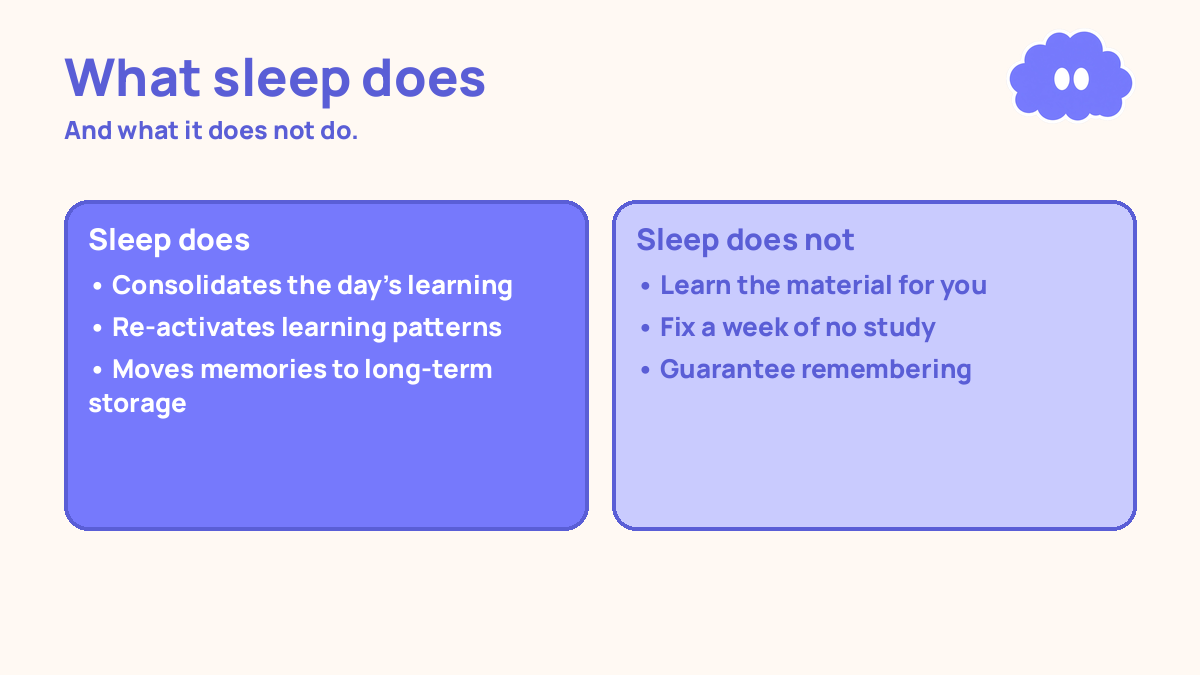
What sleep does is give the day’s learning its best chance.
When it goes wrong
You test yourself and get almost everything wrong. That is the system working, not failing. A wrong answer tells you what to review tonight and retest tomorrow.
You do the evening review in bed. Then the bed becomes a study desk. Do the review at your desk, every night. The bed is for sleep, and the review is the last study you do.
You stay up late “just to finish this chapter”. The chapter will still be there tomorrow, and you will learn it better fresh. Stop at 9pm, review for 10 minutes, sleep. The all-nighter is the most expensive way to study: it costs you the night and the next morning.
You sleep well but still forget. Check the method first. If the day’s study was re-reading, the problem is not the sleep — Dunlosky and colleagues (2013) rated re-reading low utility. Switch the day’s study to testing yourself, keep the sleep, and check again in the morning.
Weekly review checklist
Copy this list and use it each week:
- How many nights this week was I in bed by 10:30pm?
- How many mornings did I do the 10-minute recall check before starting new work?
- Which topics survived the night, and which ones did I keep forgetting by morning?
- What one change will I make next week: an earlier stop, testing instead of re-reading, or the phone outside the bedroom?
Downloadable infographic spec: one vertical image, title “Study, test, review, sleep”, with the five steps — learn it earlier in the day, test yourself while you study, 10-minute review before bed, protect the night, morning recall check — and the rule “sleep files what testing learned”, in Thynq cream, Cloud Purple, Dark Purple and pink, with the cloud mascot. Text taken word-for-word from this article.
What this system is not
It is not a promise that sleeping more will raise your grades, and it is not a claim that any number of hours guarantees remembering — Diekelmann and Born (2010) do not prove that. It is a practical routine: learn it fresh, test yourself, review for 10 minutes, sleep, and check in the morning. If your timetable forces late nights, move the hard study earlier and protect whatever sleep you can get. The routine works with the sleep you have.
Sources
- Diekelmann, S. & Born, J. (2010). The memory function of sleep. Nature Reviews Neuroscience, 11(2), 114-126. Sleep improves consolidation of facts, procedural and emotional memories; slow-wave sleep re-activates learning patterns, and memories move from hippocampus to cortex. It does not prove any number of hours guarantees remembering.
- Dunlosky, J., et al. (2013). Improving students’ learning with effective learning techniques. Psychological Science in the Public Interest, 14(1), 4-58. Only practice testing and distributed practice received a high utility rating; rereading was rated low.
- Roediger, H. L. & Karpicke, J. D. (2006). Test-enhanced learning. Psychological Science, 17(3), 249-255. Students who recalled a passage remembered more a week later than students who restudied it, though restudiers felt more confident immediately.
- Rowland, C. A. (2014). The effect of testing versus restudy on retention: a meta-analytic review of the testing effect. Psychological Bulletin, 140(6), 1432-1463. Testing beat restudy (g = 0.50), 81% of comparisons; with feedback g = 0.73 vs 0.39 without.
- Cepeda, N. J., et al. (2006). Distributed practice in verbal recall tasks. Psychological Bulletin, 132(3), 354-380. Spaced practice beat massed practice; the best gap grows with the retention interval.
For the evening routine around the review, read the evening wind-down for better sleep before exams, for the spacing schedule, the spaced repetition system for students, and for the phone, the phone focus system for distracted students.
Questions
Does sleeping after studying really help you remember it?
Yes, in the sense that sleep supports consolidation. Diekelmann and Born (2010) found sleep improves the consolidation of facts, procedural and emotional memories. It does not prove any number of hours guarantees remembering.
Is it better to study late or sleep and study in the morning?
Sleep, then study in the morning. Material learned late at night, when you are tired, is half-learned, and the short night cuts the consolidation of the rest. A fresh morning hour beats a tired midnight hour.
What should I do right before bed?
A 10-minute review from memory at your desk: close your notes, write down what you remember from today, then check. Then stop. Do not start new material in the last hour before bed.
I studied for hours and still forgot everything. Did sleep fail me?
Probably not sleep. If the study was re-reading, the problem was the method: Dunlosky and colleagues (2013) rated re-reading low utility and practice testing high. Test yourself during the day, review before bed, then sleep.