The direct answer
A practical exam system for students works like this: list every skill the exam can test, practise each one start to finish with no notes and no stopping, explain each step out loud while your hands do it, then practise the skills mixed up under timed conditions. If you can do it, explain it, and choose it, you are ready.
Why a practical exam system for students starts with your hands
You have read the method three times. You can recite the steps in order. Then you walk into the lab, pick up the equipment, and your hands do not know what to do. You check the method sheet, lose your place, and the examiner watches you read instead of work.
That is the practical-exam gap. Reading a method is not the same as doing it. A written exam tests what you can recall; a practical exam tests what you can do, in order, under observation, without stopping. The only practice that prepares you for that is doing it — start to finish, no notes, hands on the equipment.
The research backs the doing. In Rohrer and Taylor’s 2007 study, maths students who practised problems mixed up scored 63% on a test a week later, against 20% for students who practised them blocked by type — even though the blocked group did far better during practice itself. Mixed practice felt worse and worked better, because it forced students to choose the right procedure for each problem.
The system in short
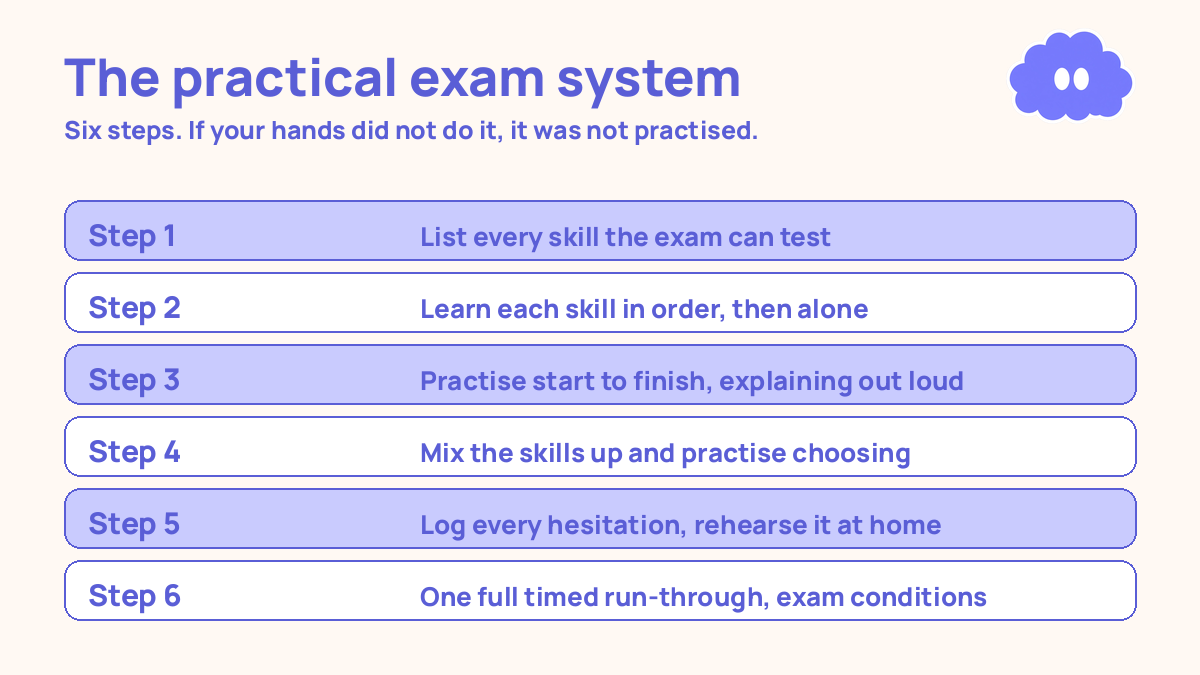
- List every skill the exam can test, from the syllabus and past papers. One line each.
- Learn each skill in order: watch, copy, then do it alone with no notes.
- Practise each skill start to finish, no stopping, explaining each step out loud as you do it.
- Mix the skills up: do them in random order, so you practise choosing, not just repeating.
- Log every hesitation and every slip. Rehearse the logged steps at home, out loud, with your hands.
- Do a full timed run-through of the whole practical, exam conditions, the week before.
Step 1: List every skill the exam can test
Open the syllabus and the past papers. Write down every skill the exam can ask you to do, one line each. “Set up the microscope and focus on the slide.” “Titrate to the endpoint and record the volume.” “Dissect and label the specimen.”
Be specific. “Do the experiment” is not a skill — it is a whole practical. Break it into the physical steps: set up, measure, record, clean up. If you cannot name the steps, you have not understood the practical well enough to practise it.
Count the list. Most practical exams test between five and ten skills. If your list has twenty, you have listed sub-steps — group them. If it has three, you have missed some. Check the past papers again: the skills that appear every year are the ones that will appear this year.
Step 2: Learn each skill in order, then alone
For each skill, learn it in three passes. First, watch it done — a teacher, a video, a classmate — and notice the order of the steps. Second, copy it with the method open, following each step as you do it. Third, do it alone, with no notes, from memory.
The third pass is the one that matters. Doing it with the method open feels like practice, but it is copying. If you cannot do the skill from memory, you have not learned it yet. Go back to pass two, then try pass three again tomorrow.
Step 3: Practise start to finish, explaining out loud
Now do the whole skill without stopping, and explain each step out loud as your hands do it. “I am focusing the microscope by moving the coarse adjustment slowly, watching the slide come into view.” Say it while you do it.
Talking while doing has two jobs. First, it forces you to explain why each step works, not just what the step is — self-explanation, rated moderate utility by Dunlosky in 2013, and a 2018 meta-analysis found prompting it gave a moderate average benefit. Second, it shows you the gaps immediately: if you cannot explain a step while doing it, you do not understand it, and the examiner will see that too.
Do not stop mid-skill to check a step. If you forget one, mark it, finish the skill as best you can, and go back to the method afterwards. Stopping breaks the flow the exam will demand. In the exam, a forgotten step is a gap you note and work around, not a reason to freeze.
Step 4: Mix the skills up and practise choosing
Once you can do each skill alone, stop doing them in order. Shuffle the list and do them in random order. This is the step that feels worst and does the most work.
Blocked practice — doing the same skill five times in a row — feels fluent, because you are repeating the last thing you did. Mixed practice forces you to choose the right procedure for each step, and choosing is what the exam tests. Rohrer and Taylor’s students who mixed their practice scored 63% a week later against 20% for the blocked group, even though the blocked group scored 89% during practice against 60% for the mixed group.
Step 5: Log every hesitation and rehearse it at home
After each practice session, write down every place you hesitated, every step you got wrong, and every time you had to stop and think. One line each: “Forgot to zero the balance before weighing.” “Focused with the fine adjustment first.”
These lines are your real revision list. Rehearse them at home, out loud, with your hands — mime the movements if you do not have the equipment. Say the step, do the movement, say why. Ten minutes on three logged steps beats an hour of re-reading the method.
If the same step appears in the log three sessions in a row, it is not a slip — it is a gap. Go back to step 2 for that skill: watch it, copy it, do it alone. Do not just practise the mistake faster.
Step 6: A full timed run-through, exam conditions
In the week before the exam, do the whole practical start to finish under exam conditions: the full time, no notes, no stopping, explaining out loud. If the exam gives two hours, take two hours. If it gives forty minutes, take forty.
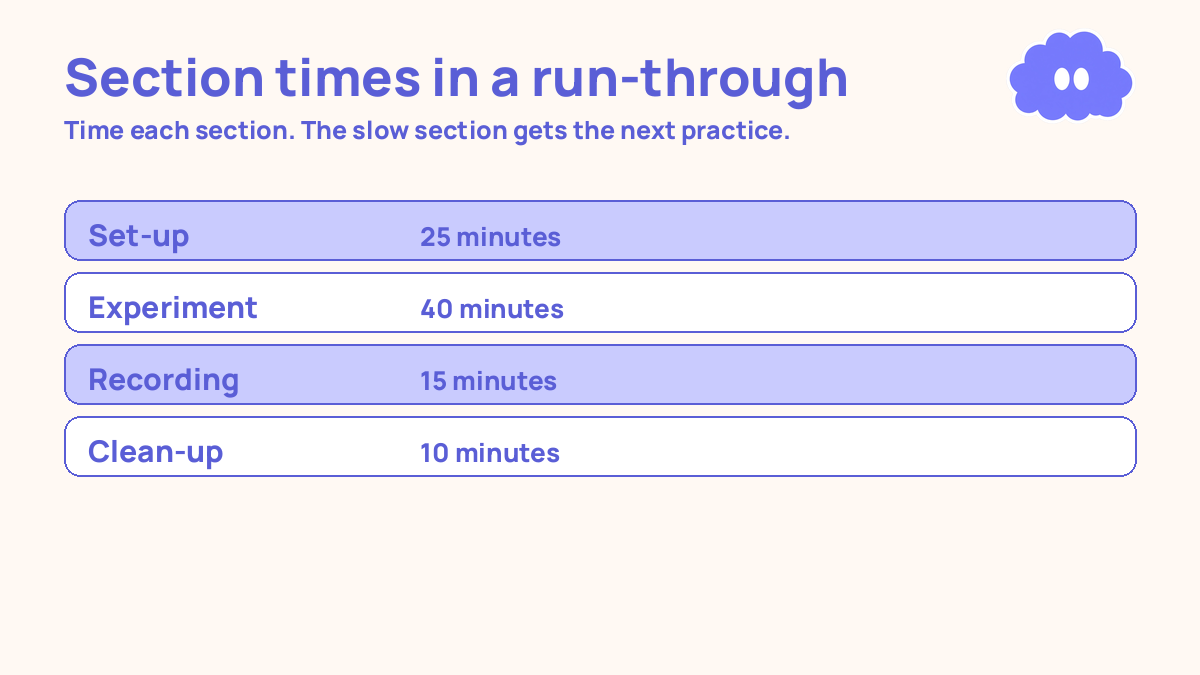
Time each section as you go. If the set-up takes half your time, the set-up is the problem, not the experiment. Write the section times down when you finish: set-up 25 minutes, experiment 40 minutes, recording 15 minutes, clean-up 10 minutes.
A worked example: a Saturday lab session, two weeks before the exam
You have a biology practical in two weeks. Five skills on the list. One Saturday lab session, three hours.
9:00–9:20 — Set up and check the list. Five skills, all learned at home this week. Equipment laid out. Timer set for the full practical time: two hours.
9:20–10:20 — Full run-through, in order. All five skills, start to finish, explaining out loud. Two hesitations: forgot to zero the balance, focused with the fine adjustment first. Both logged.
10:20–10:35 — Break. Water, walk, no phone. The break is part of the session.
10:35–11:20 — Mixed practice. The five skills in random order, drawn from a shuffled list. Slower than the first run, and that is the point — you are choosing now, not repeating. One more hesitation logged: recorded the volume before reading the meniscus at eye level.
11:20–11:40 — Rehearse the log. Three logged steps, out loud, with your hands, at the bench. Each one three times, slowly, with the explanation said every time.
11:40–12:00 — Timed section check. Set-up only, timed: 18 minutes, down from 25 in the first run. The practical is ready. Next Saturday: one more full run-through, mixed order, under time.
That is three hours, and it produced something reading the method never does: your hands know the steps, and the log tells you exactly which ones still need work.
When it goes wrong
You practise by reading the method, not doing it. Then you are preparing for a written exam. The rule is simple: if your hands did not do it, it was not practised. Read the method once to learn the steps, then close it and do them.
You do the same skill five times in a row and it feels easy. That is blocked practice, and the fluency is a lie. Shuffle the skills. If it feels harder, it is working — Rohrer and Taylor’s mixed group felt worse during practice and scored three times higher a week later.
You run out of time because the set-up takes too long. Then the set-up is the skill to practise, not the experiment. Time each section in your run-through. The slow section gets the next practice session, alone, until it is fast enough.
Weekly review checklist
Copy this list and use it each week:
- Which skills can I now do start to finish, from memory, with no notes?
- What is in my hesitation log, and which step has appeared three times?
- Did I practise the skills mixed up this week, or only in order?
- What one change will I make next week: more mixed practice, rehearse the log, or a timed run-through?
Downloadable infographic spec: one vertical image, title “The practical exam system in six steps”, with the six steps — list every skill, learn each one alone, practise start to finish out loud, mix the skills up, log every hesitation, one timed run-through — and the rule, if your hands did not do it, it was not practised, in Thynq cream, Cloud Purple, Dark Purple and pink, with the cloud mascot. Text taken word-for-word from this article.
What this system is not
It is not a promise of a grade, and it is not a claim that doing beats knowing. You need both: the knowledge of what each step is for, and the hands that can do it. If you do not understand a step, no amount of repetition will fix it — the explanation out loud will show you the gap, and the fix is ten minutes with your notes, not ten more repetitions.
Sources
- Rohrer, D. & Taylor, K. (2007). The shuffling of mathematics problems improves learning. Instructional Science, 35(6), 481–498. Interleaved practice scored 63% vs 20% blocked a week later, though blocked did better during practice (89% vs 60%).
- Dunlosky, J., et al. (2013). Improving students’ learning with effective learning techniques. Psychological Science in the Public Interest, 14(1), 4–58. Only practice testing and distributed practice rated high utility; self-explanation and interleaved practice moderate; rereading low.
- Bisra, K., et al. (2018). Inducing self-explanation: a meta-analysis. Educational Psychology Review, 30(3), 703–725. Prompting self-explanation gave a moderate average benefit (g = 0.55).
- Bjork, R. A. (1994). Memory and metamemory considerations in the training of human beings. In Metcalfe & Shimamura (eds.), Metacognition: Knowing about knowing, MIT Press. Performance now is not learning later; a difficulty is only desirable if the learner has the background knowledge to respond to it.
For the full exam system this sits inside, start with how to revise for exams without cramming. If your exam is spoken rather than hands-on, the oral exam system for students covers that, and for timed written practice, the past paper system for exams is the companion piece.
Questions
How is a practical exam different from a written one?
Your hands are being marked, not just your head. Knowing the steps is not enough — you have to do them, in order, under observation, without stopping to look things up. Practice has to be physical, not just reading the method.
What if I only get one practice session in the lab?
Use it for a full timed run-through, not for re-reading the method. Walk in knowing the steps from memory, do the whole practical start to finish, and write down every place you hesitated. Then rehearse those places at home, out loud, with your hands.
Should I practise the skills in order or mixed up?
Both, in that order. Learn each skill in order first, then practise them mixed up. In the exam you will have to choose the right procedure for each step, and mixed practice is what trains the choosing.
What do I do if something goes wrong mid-practical?
Stop, say what happened out loud, and start that step again from the beginning. Do not try to rescue a broken step halfway through — it wastes more time than restarting it. Examiners mark the recovery, not just the mistake.