The direct answer
An oral exam system for students works like this: write down ten questions the examiner is likely to ask, answer each one out loud in full sentences with no notes, record yourself, and play it back. Then practise the follow-up — answer “why?” three times in a row for every answer. If your answer survives three rounds of “why?”, it is ready.
Why an oral exam system for students starts with your voice
You know the material. You can write a good answer. But the examiner asks the question, you open your mouth, and the first sentence comes out wrong. You stop, correct yourself, lose the thread, and the examiner moves on to an easier question — which feels like a rescue and is actually a lower mark.
That is how oral exams go wrong. The knowledge is there, but it has never been spoken. Reading notes and writing essays do not train the thing the exam tests: producing a clear answer, out loud, in the moment, while someone listens.
The system in short
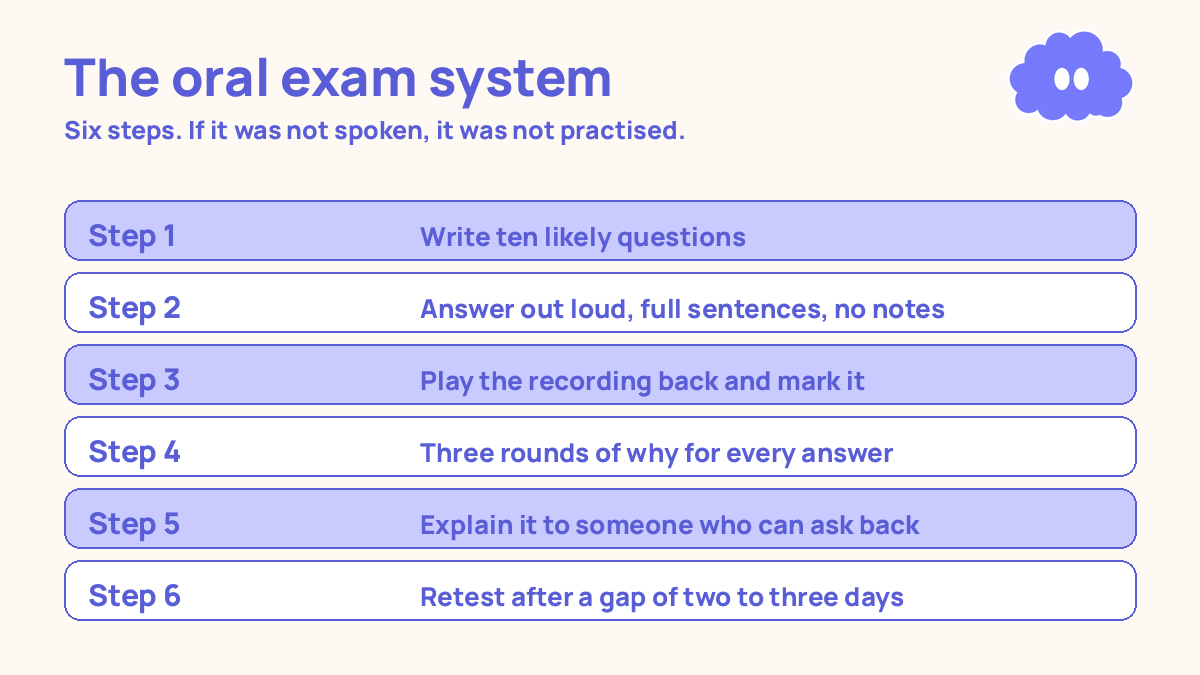
- Write ten questions the examiner is likely to ask, from past papers and your syllabus.
- Answer each one out loud, in full sentences, with no notes. Phone recording on.
- Play the recording back. Mark the pauses, the filler words, and the places the explanation runs out.
- For each answer, ask yourself “why?” three times and answer each round out loud.
- Explain the same topic to a friend, a classmate, or an empty chair — someone who can ask a follow-up.
- Retest the ten questions after a gap of two to three days, out loud again.
Step 1: Write ten likely questions
Start with the questions, not the material. Look at past papers, your syllabus, and the topics your teacher kept returning to. Write ten questions the examiner is likely to ask, in the examiner’s words — not your version of them.
Ten is a practical number: enough to cover the syllabus, few enough to practise in one evening. If your exam covers five topics, write two questions per topic. Mix the types: a definition question (“What is…?”), an explanation question (“Why does…?”), and a comparison question (“How is X different from Y?”). Examiners ask all three, and each one needs a different shape of answer.
Write the questions on cards or a single sheet. You will use the same ten questions all week — the point is not to collect more questions, it is to get better at answering these ten.
Step 2: Answer out loud, in full sentences, no notes
Pick up the first card. Read the question out loud. Then answer it out loud, in full sentences, with no notes in front of you. Start the phone recording before you begin.
Full sentences matter. “Photosynthesis, chloroplasts, light energy” is not an answer — it is a list of words. An oral exam needs sentences: “Photosynthesis is the process by which plants convert light energy into chemical energy, and it takes place in the chloroplasts.” If you cannot say it in a sentence, you do not know it well enough to say it to an examiner.
Step 3: Play the recording back and mark it
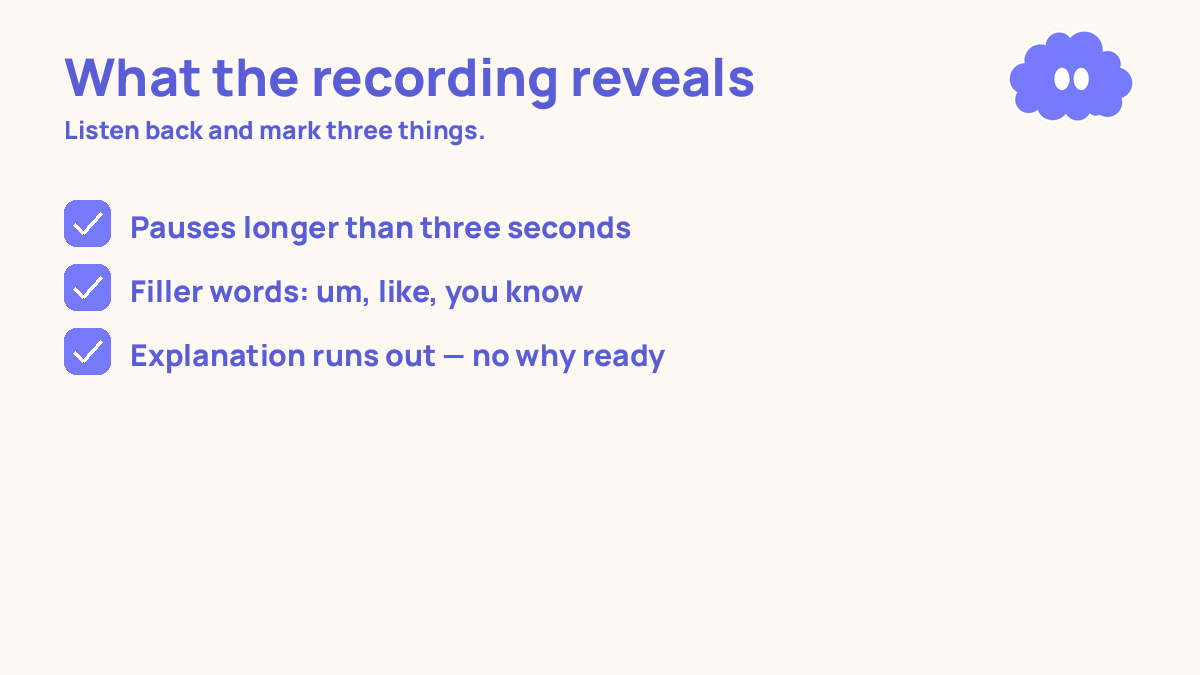
Now listen to yourself. This is the uncomfortable part, and it is the part that does the most work. Mark three things as you listen: pauses longer than three seconds, filler words, and places where the explanation runs out. A long pause means the next step was not ready. Ten filler words in one answer means you were thinking out loud instead of answering.
But do listen to the whole thing. Skipping the playback is the same as skipping the marking in a written practice essay.
Step 4: The three rounds of “why?”
For each of your ten answers, ask yourself “why?” three times, and answer each round out loud.
First round: “Why does photosynthesis take place in the chloroplasts?” Answer: because that is where the chlorophyll is. Second round: “Why does it need chlorophyll?” Answer: because chlorophyll absorbs light energy. Third round: “Why does absorbing light energy matter?” Answer: because the energy drives the chemical reactions that build sugars. Three rounds is a practical depth — most examiners stop at two. If it breaks at round one, you know the fact but not the reason behind it, and that is the gap.
This is self-explanation in its spoken form. Dunlosky rated self-explanation moderate utility in 2013, and a 2018 meta-analysis found prompting it gave a moderate average benefit (g = 0.55).
Step 5: Explain it to someone who can ask a follow-up
A recording cannot ask you a follow-up question. A person can. So once a week, explain one topic to a friend, a classmate, or a family member — anyone who will listen for five minutes and ask one question at the end.
It does not matter if they know the subject. In fact, it is better if they do not. A person who knows nothing will ask “what does that mean?”, and that is the question that exposes a memorised answer. If you cannot explain it to someone who knows nothing, you are repeating words, not understanding them.
If nobody is available, use an empty chair and a timer. Say the topic out loud for five minutes, then ask yourself the follow-up question the examiner would ask. It is less good than a real person, but far better than silent reading. Before you explain it to anyone, it helps to know where you actually stand — how to check your own understanding when studying alone is the solo version of that test.
Step 6: Retest after a gap, out loud again
Two to three days later, take the same ten cards and answer them out loud again, with the recording on. Same rules: full sentences, no notes, keep going when stuck.
Compare the two recordings. The pauses should be shorter. The “why?” rounds should go further before they break. If a question is still breaking at the same place, that is not a practice problem — it is a knowledge gap, and it needs ten minutes with your notes before the next round.
A two-to-three-day gap is a practical starting schedule, not a rule from the research.
A worked example: a Wednesday evening, one week before the exam
You have a biology oral exam in one week. Ten questions, one evening.
6:00–6:15 — Write the ten questions. Two per topic, five topics. Definition, explanation, and comparison mixed in. Cards on the table, phone recording ready.
6:15–6:45 — Answer them all out loud. Full sentences, no notes. Question 4 breaks after the first sentence — you write “pause, step 2” on the card and keep going.
6:45–7:00 — Play back two recordings. You listen to questions 4 and 7, the two weakest. Question 4 has a four-second pause after step 2. Question 7 runs out of explanation after the fact — no “why?” ready.
7:00–7:20 — Three rounds of “why?” For questions 4 and 7 only. Question 4 survives two rounds and breaks on the third — the gap is the reason behind step 3. Question 7 breaks on round one. Both gaps go in the log.
7:20–7:30 — Fix the gaps. Ten minutes with your notes on the two gaps only — not the whole chapter. Then one spoken answer for each, recorded.
Saturday 6:00–6:30 — Retest. All ten questions again, out loud. Question 4 now survives three rounds. Question 7 survives two. The exam is Wednesday, and you have two more retest evenings before it.
That is one evening of real practice, and it produced something silent revision never does: you have heard yourself answer, and you know exactly where the answers break.
When it goes wrong
You practise by writing the answers down. Then you are preparing for a written exam, not an oral one. The rule is simple: if it was not spoken, it was not practised. Write the questions, write the marks, write the gaps — but the answers themselves must be spoken, every time.
You freeze on the first question and stop the session. Freezing is the thing to practise, not a reason to stop. Say the first step you know — “The first thing that happens is…” — and keep going. If the whole answer is gone, mark the card, move to the next question, and come back to it at the end. One frozen question is a gap. Ten frozen questions is a sign you need to learn the material first.
Your recordings sound fine to you. Then you are listening for fluency, not for content. Listen again with one question in mind: could a stranger follow this answer? If the sentences are full but the explanation never says why, the answer is smooth and empty. The “why?” rounds in step 4 are the fix for exactly this.
You keep answering the same ten questions and they get easy. That is the point — and the signal to write ten new ones. Easy answers mean the practice is no longer testing you. In Bjork’s terms, performance now is not learning later: if practice feels fluent, it may only be performance. New questions or a real person asking them will make it hard again, and hard in the right way is what lasts.
Weekly review checklist
Copy this list and use it each week:
- How many questions did I answer out loud this week, and how many did I record?
- Which question still breaks at the same place after two retests?
- Did I do the three rounds of “why?” for every answer, or only the easy ones?
- What one change will I make next week: new questions, a real listener, or more time on the gaps?
Downloadable infographic spec: one vertical image, title “The oral exam system in six steps”, with the six steps — write ten questions, answer out loud, play it back, three rounds of “why?”, explain it to someone, retest after a gap — and the rule, if it was not spoken it was not practised, in Thynq cream, Cloud Purple, Dark Purple and pink, with the cloud mascot. Text taken word-for-word from this article.
What this system is not
It is not a promise of a grade, and it is not a claim that speaking is a substitute for knowing the material. If the knowledge is not there, no amount of fluent speaking will produce it — the recording will simply show you the gap faster.
Sources
- Chi, M. T. H., et al. (1989). Self-explanations: how students study and use examples in learning to solve problems. Cognitive Science, 13(2), 145–182. Eight physics students; the best solvers gave 15.3 explanations per example vs 2.8 for the weakest, scoring 82% vs 46%. A small observational study — a pattern, not a proof.
- Bisra, K., et al. (2018). Inducing self-explanation: a meta-analysis. Educational Psychology Review, 30(3), 703–725. Prompting self-explanation gave a moderate average benefit (g = 0.55) across 64 reports.
- Dunlosky, J., et al. (2013). Improving students’ learning with effective learning techniques. Psychological Science in the Public Interest, 14(1), 4–58. Only practice testing and distributed practice rated high utility; self-explanation moderate; rereading low.
- Cepeda, N. J., et al. (2006). Distributed practice in verbal recall tasks. Psychological Bulletin, 132(3), 354–380. Spaced practice beat massed practice.
- Roediger, H. L. & Karpicke, J. D. (2006). Test-enhanced learning. Psychological Science, 17(3), 249–255. Retrieval beat restudy a week later, though restudiers felt more confident immediately.
- Bjork, R. A. (1994). Memory and metamemory considerations in the training of human beings. In Metcalfe & Shimamura (eds.), Metacognition: Knowing about knowing, MIT Press. Performance now is not learning later; a difficulty is only desirable if the learner has the background knowledge to respond to it.
For the full exam system this sits inside, start with how to revise for exams without cramming. If you also have written exams, the essay exam system for students covers them.
Questions
How is an oral exam different from a written one?
You cannot hide behind a half-finished sentence. The examiner hears the pause, and they follow up. So the practice must be spoken, not written: answer out loud, in full sentences, and keep going when you are unsure instead of stopping.
What if I freeze and cannot say anything?
Say what you do know, even if it is only the first step. ‘The first thing that happens is…’ buys you time and usually unlocks the rest. A frozen silence tells the examiner nothing; a partial answer shows them where you are.
Should I memorise my answers word for word?
No. Memorised answers sound rehearsed and break on the first follow-up question. Memorise the structure instead: the one-sentence answer, the three points, and the order they go in. Then say it differently every time you practise.
How do I practise an oral exam alone?
Record yourself on your phone. Ask the question out loud, answer it, then play it back. You will hear the pauses, the filler words, and the places where the explanation runs out. That recording is your examiner — it does not flatter you.