The direct answer
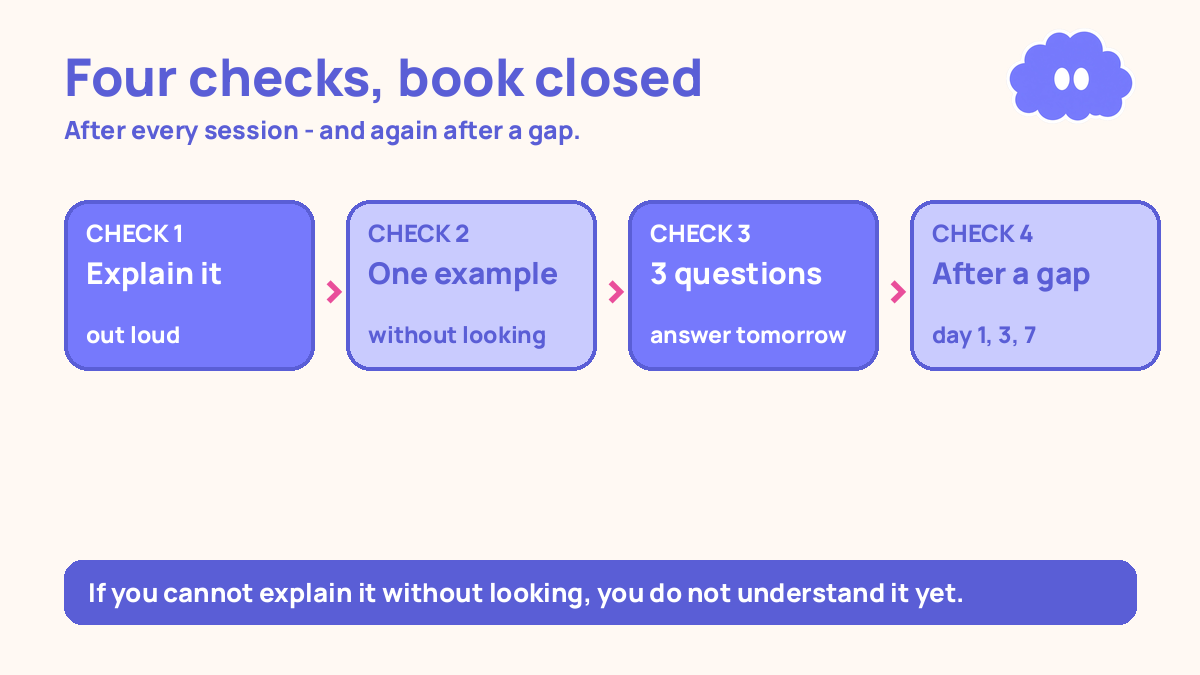
After every study session, close your notes and run one check: explain the main idea in your own words, do one example without looking, or answer three questions from memory. Then run the same check again after a gap — the next day, in three days, in seven days. That is the whole system. A check right after studying tells you what went in. A check after a gap tells you what stayed. If you cannot explain it or use it without looking, you do not understand it yet, however familiar it felt while you were reading.
You need a pen, a blank page, and the habit of closing the book before you decide what you know.
The trap: familiarity feels like understanding
The biggest trap in studying alone is that reading feels like knowing. You read a page, it makes sense, and you turn the page. You read the next page, it makes sense too. By the end of the chapter you feel like you know it. Then someone asks you to explain it, and nothing comes out. What happened is simple: you recognised the ideas while you were looking at them. You never tested whether you could produce them without looking.
Recognising and understanding are different jobs. Recognising is seeing a word and knowing you have seen it before. Understanding is being able to say what it means, use it in an example, or spot where it does not apply.
In a 2013 review of ten common study techniques, Dunlosky and colleagues gave a high utility rating to only two: practice testing and distributed practice. Re-reading and highlighting were rated low. That is the research version of the same point: the techniques that feel easiest — reading it again, underlining it — are the weakest. The technique that feels hardest — closing the book and trying to recall — is the one that works.
There is a second finding that matters here. Roediger and Karpicke showed in 2006 that students who recalled a passage remembered more a week later than students who restudied it, even though the restudiers felt more confident immediately after studying. Feeling confident right after reading is not evidence that you will remember it. It is evidence that the words are still in front of you.
So this article is about building your own evidence. Four checks, each one simple, each one done with the book closed. This article sits inside the self-study system for online learners, where these checks are one part of the weekly routine. The fuller version of the testing idea is in the retrieval practice system for students.
The system in short
- Study one topic at a time, in a session of 25 to 50 minutes.
- Close your notes. Explain the main idea out loud, in your own words.
- Do one example, problem, or question without looking.
- Write down where the explanation or the example broke. That is your gap.
- Learn only the gap, then run the check again.
- Test yourself on the same topic the next day, in three days, and in seven days.
- In the weekly review, list the topics that passed three checks and the ones that still fail.
Check 1: Explain it in your own words
This is the first and simplest check. Close your notes, look at the topic heading only, and explain the idea out loud, as if you were telling a friend who knows nothing about it. Two or three sentences is enough. Use your own words, not the textbook’s. If you catch yourself repeating the textbook’s exact phrases, stop — you are reciting, not explaining.
A good explanation has a shape: what the idea is, why it matters, and one example. “A loop repeats a block of code until a condition changes. It matters because it saves you writing the same lines twenty times. For example, a loop that prints the numbers one to ten.”
If the explanation breaks halfway, do not keep talking through the gap. Stop. The break is the most useful thing that happened in the session, because it shows you exactly where your understanding ends. Write the break down in one line: “Could not explain when the loop stops.” That line is your next job.
Explaining out loud works better than explaining in your head. In your head, it is easy to skip the hard part and feel like you covered it. Out loud, the skip is obvious — you hear the silence.
Check 2: Do one example without looking
Some ideas cannot be explained in words alone. A calculation, a piece of code, a diagram, a translation — these have to be done, not described. So the second check is to do one example with the book closed.
Pick the smallest real example you can: one problem, one short piece of code, one diagram from memory. Do it on paper. Then open the book and compare. A right answer means the idea is in your head. A wrong answer means you found a gap, and the gap has a shape now: the step where your working went wrong.
Do not do ten examples. One is enough for a check. If it goes wrong, fix the gap and do one more. If it goes right, move on.
If there is no obvious example, make one up: invent a situation where the idea applies and work through it.
Check 3: Write three questions, answer them tomorrow
This check catches the ideas that pass today and fail tomorrow. After a study session, write three questions about the topic on a card or in your notebook. Make them real questions, not “What is X?” questions. “When would you use a loop instead of writing the lines out?” is a real question. “What is a loop?” is a definition, and definitions are easy to recite without understanding.
Put the card aside. The next day, answer the three questions without looking. The ones you answer are holding. The ones you miss are the gaps, and they go into the next review. This is also how you build your own practice questions when a course gives you none: you write them the day you study, and you answer them the day after.
Keep the cards. A stack of question cards, with the failed ones marked, is a record of what you actually know. It is also the raw material for the flashcard system that works if you want to turn the questions into a regular routine.
Check 4: The delayed check
The first three checks happen on the day you study. The fourth happens after a gap, and it is the one that tells the truth. A topic that passes on the day and fails a week later was never really learned. It was still warm from the reading.
The schedule is a practical starting point: test yourself on the topic the next day, then in three days, then in seven days. That is a starting schedule to try, not a rule from the research. Cepeda and colleagues, in a 2006 review, found that spaced practice beat massed practice, and that the best gap is not fixed — it grows with how long you need to remember the material. So if a topic still feels fresh after three days, stretch the gap. If it has faded, shorten it.
A delayed check takes five minutes. Take the topic heading, try to explain it and do one example, then look at your notes. The topics that pass three delayed checks are done. The ones that fail go back into the study plan for another round. Keep the record in your notes — the notes system that you can actually review — and let the delayed checks keep it honest.
A worked example: an evening of biology
A student studies cell division for an hour in the evening. She reads one section, about 20 minutes, then closes the book. Check 1: she explains the main idea out loud in two sentences. It works. Check 2: she draws the stages from memory on paper. Two stages are right, one is in the wrong order. She writes the gap in one line — “stages 3 and 4 mixed up” — looks up only that part, and redraws it. This time it is right.
Before bed, she writes three questions about the section. The next day, before class, she answers them without looking. Two pass, one fails. The failed one goes into the three-day check. Three days later she explains the section again from memory, and the stages come out in the right order. Seven days later she does it once more, and it holds.
When it goes wrong
Every check passes, so you stop checking. If every check passes, the checks are too easy. Make them harder: explain without the heading, do a harder example, or write questions that ask “when” and “why” instead of “what.” A check that always passes tells you nothing.
Every check fails, so you stop checking. If every check fails, the material is too hard for where you are, or the session was too long. Go back one topic, study a smaller piece, and check that. A check that always fails is not a measurement. It is a sign to slow down.
You check with the book open. This is the most common failure, and it is quiet: you glance at the notes “just to start,” and the whole check becomes reading. The rule is simple — book closed before the check starts. If you cannot start without looking, that is the result. Write it down and learn the gap.
You remember the words but cannot use the idea. You can recite the definition but not do the example, or you can do the example but not explain why it works. That is half an understanding. Fix it with the check you are avoiding: if words are easy, do the example. If the example is easy, explain it. The weak half is the one that needs the work.
Weekly review checklist
Copy this list and use it each week:
- Which topics did I check this week, and which checks did I run on each one?
- Which explanations broke, and where exactly did each one break?
- Which topics passed three delayed checks, and which ones still fail?
- Which gaps did I fix this week, and which are still open?
- What one change will I make next week: harder questions, shorter sessions, or a fixed check time?
Downloadable infographic spec: one vertical image, title “How to check your own understanding when studying alone”, with the four checks — explain it in your own words, do one example without looking, write three questions and answer them tomorrow, test yourself after a gap — and the rule “if you cannot explain it or use it without looking, you do not understand it yet”, in Cream Paper, Cloud Purple, Dark Purple and pink, with the Cloud mascot. Text taken word-for-word from this article.
What this system is not
It is not a promise of a grade, and it is not a claim that four checks are the scientifically correct number. They are a practical set: enough to catch the gaps, few enough to run every day. The system is the explanation, the example, the questions, and the delayed check — and the honest record of which ones passed.
Sources
- Dunlosky, J., et al. (2013). Improving students’ learning with effective learning techniques. Psychological Science in the Public Interest, 14(1), 4-58. Only practice testing and distributed practice received a high utility rating; rereading was rated low.
- Roediger, H. L., & Karpicke, J. D. (2006). Test-enhanced learning. Science, 311, 249-250. Recalling a passage beat restudying it a week later, though restudiers felt more confident immediately.
- Cepeda, N. J., et al. (2006). Distributed practice in verbal recall tasks. Psychological Bulletin, 132(3), 354-380. Spaced practice beat massed practice; the best gap grows with how long you need to remember. The “next day, in 3 days, in 7 days” schedule is a practical starting point, not a rule from this paper.
For the fuller testing system, read the retrieval practice system for students. For the notes these checks live in, read the notes system that you can actually review.
Questions
How is understanding different from recognising something?
Recognising means it looks familiar when you see it. Understanding means you can explain it or use it without looking. If you can only nod along while reading, you recognise it. Close the book and try to say it yourself.
How often should I check my understanding?
After every study session, with one short check, and again after a gap — the next day, then in three days, then in seven days. A check right after studying tells you what went in. A check after a gap tells you what stayed.
What do I do when my explanation breaks halfway?
Stop and write down the exact place it broke. That is the gap. Learn only that part — one idea, one example — then try the explanation again from the start. Do not reread the whole chapter.
Can I test myself without practice questions?
Yes. Explain the idea out loud in your own words, do one example without looking, or write three questions about the topic and answer them the next day. A question you write yourself still tests you.