The direct answer
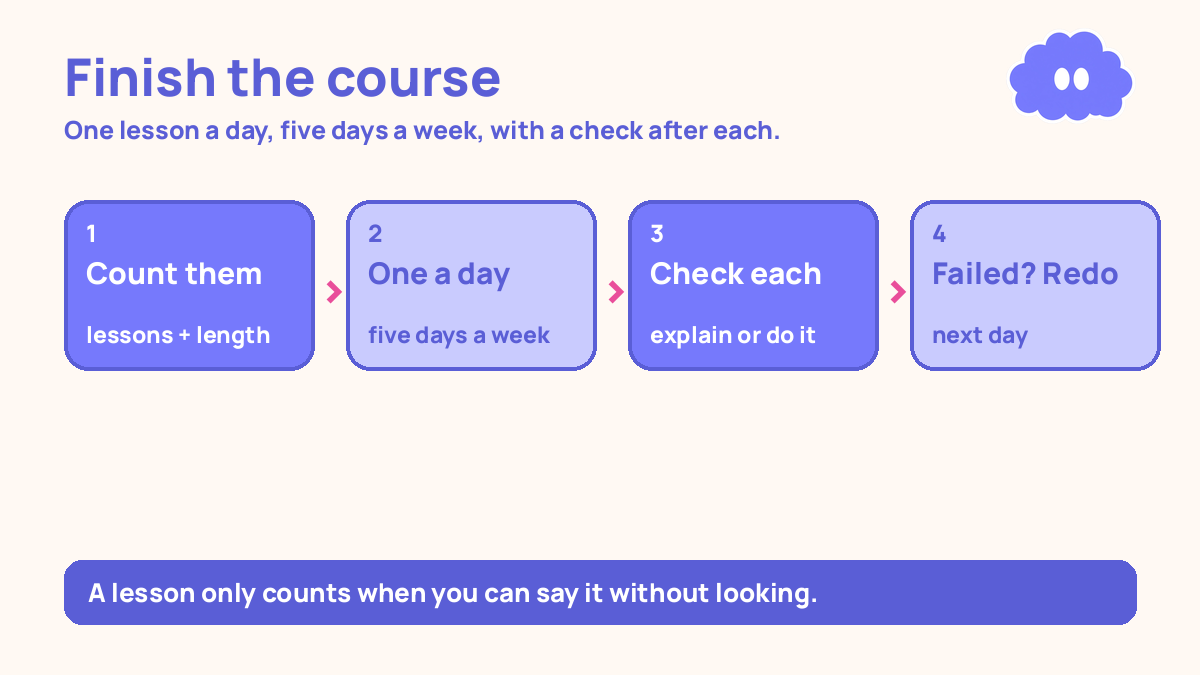
Pick one course, count its lessons, and do one lesson a day, five days a week, with a short check after each lesson and a review at the end of the week. That is the whole system. You finish a course by making the daily piece small enough to repeat, and by checking that each piece actually landed before you move on.
You need a finish date, a weekly number of lessons, and a rule: a lesson only counts when you can say what it taught you without looking at the screen.
Why online courses do not get finished
A course has no teacher watching, no class on Tuesday, and no one who notices when you stop.
Then there is size. A course page says “42 lessons” and your brain hears “42 evenings of work.” So you either do not start, or you start with a burst — six lessons on Saturday — and then do not touch it for two weeks. It costs one lesson a day. The burst is what made it feel expensive.
The third problem is that watching feels like learning. You watch a lesson, it makes sense while the teacher is talking, and you move on. A week later you remember almost nothing. In a 2013 review of ten common study techniques, Dunlosky and colleagues gave a high utility rating to only two: practice testing and distributed practice. Re-reading and highlighting were rated low. Watching a video all the way through is the video version of re-reading.
This article sits inside a bigger system for learning without a teacher. For the full picture — your week, your notes, your reviews as one routine — start with the self-study system for online learners. This article is the finishing part: how to take one course from the first lesson to the last.
The system in short
- Pick one course and write down how many lessons it has and how long each one is.
- Work out your finish date: lessons divided by the lessons you will do each week.
- Do one lesson a day, five days a week, at the same time of day.
- After each lesson, close it and test yourself: explain the main idea in your own words, or do the practice task without looking.
- If the check fails, redo the lesson the next day instead of moving on.
- At the end of each week, review the week’s lessons from memory and plan next week’s lessons.
- When the course is done, do one final check of the whole course before you call it finished.
Step 1: Pick one course and count it
You cannot finish three courses at once. Pick one — the one you need most, not the one that looks most interesting.
Count the lessons and write down the average lesson length. A course with 40 lessons of 15 minutes each is 10 hours of watching. Divide it: two lessons a day, five days a week, done in four weeks.
If the course has no clear lesson list, split it yourself. A two-hour video becomes four 30-minute lessons, each with its own start and stop point. You need a list you can tick off.
Do not buy, start, or browse for another course while this one is running. The search for a better course is the most common way to avoid finishing the one you have.
Step 2: Set a weekly number, not a daily promise
A daily promise breaks the first time life gets in the way. A weekly number bends instead. Decide how many lessons you will do each week, and give yourself two days off. Five a week is a good starting number: one a day, Monday to Friday.
Work out the finish date from the weekly number. Forty lessons at five a week is eight weeks.
If five a week feels too easy after two weeks, raise it to six or seven. If it keeps failing, drop it to three and keep the streak alive. The right number is the one you actually do, week after week.
Step 3: One lesson, same time, same place
Do your lesson at the same time every day if you can. Attach it to a slot that already exists: after breakfast, after class, after dinner.
Before you press play, write down what the lesson is supposed to teach you, in one line: “Lesson 12: how to write a loop that runs ten times.”
Watch the lesson once, all the way through, without pausing every minute to take notes. Pausing to copy everything turns a 15-minute lesson into 45 minutes of copying, and copying is not learning.
Keep your phone in another room while you watch. If your phone keeps breaking your sessions, the phone focus system for distracted students gives you the same rule in more detail.
Step 4: The check after every lesson
This is the step that turns watching into learning. When the lesson ends, close the video. Take a blank piece of paper and do one of these:
- Explain it. Write two or three sentences explaining the main idea in your own words, as if telling a friend. If you cannot, you did not learn it yet.
- Do it. If the lesson taught a skill — a calculation, a piece of code, a diagram — do one example without looking.
- Answer it. If the course has questions or exercises, do them now, from memory, before you look at the answers.
The check takes five to ten minutes, and it is the only part that tells you the truth. Watching tells you the lesson made sense. The check tells you whether it stayed.
If the check goes well, tick the lesson off and stop. If it fails, write down exactly what failed, in one line: “Could not explain what a loop does without looking.” That line is tomorrow’s starting point.
This is practice testing, one of the two techniques Dunlosky and colleagues rated highly in 2013. The other was distributed practice — spacing study out instead of cramming it.
Step 5: What to do with a failed check
A failed check is the system working. It found the gap before it became a wall ten lessons later. Redo the lesson the next day, before the new lesson, then test yourself again. Most failed checks pass on the second try, because your brain has had a night to work on the idea and you now know exactly what to look for.
If the check fails twice, the lesson may assume something you do not know yet, or it may explain badly. Go back one lesson, or look up the one blocking idea — just that idea, not a whole new course.
Step 6: The weekly review
At the end of each week, spend 20 minutes reviewing the week’s lessons from memory. For each lesson, say the main idea out loud or write it in one line, without looking. The ones you get wrong go on next week’s redo list.
This is distributed practice: the same material, met again after a gap. Cepeda and colleagues, in a 2006 review, found that spaced practice beat massed practice, and that the best gap is not fixed — it grows with how long you need to remember. A practical starting schedule is to review a lesson the next day, then in three days, then in seven days. That is a starting point to try, not a rule from the research. The weekly study review system gives you a fuller version of this review.
A worked example: a six-week course
A student takes a 30-lesson programming course, each lesson about 20 minutes, alongside classes. She counts 30 lessons: at five a week, that is six weeks. She picks a slot, 7pm after dinner, Monday to Friday.
Monday, lesson 1: target first — “What a variable is.” She watches it, phone in another room, then writes two sentences explaining variables in her own words. It works. Lesson 1 is ticked off. Tuesday, lesson 2: the check is three lines of code without looking. It works on the second try. Wednesday, lesson 3: the check fails, so she writes down what failed in one line and stops. Thursday: she redoes lesson 3 first, it passes, then she does lesson 4. Friday, lesson 5, then the weekly review from memory — four of five pass, and variables go on next week’s redo list. The weekend is rest. By week six she finishes on the date she wrote down in week one.
When it goes wrong
You do six lessons in one day, then nothing for two weeks. The burst blurs the lessons together and makes the next day feel too hard to start. Go back to one lesson a day, no matter how far behind you feel. A moved finish date is better than a dead course.
The checks keep failing. Slow down: watch once, check, and redo a failed lesson the next day instead of pushing on. If checks keep failing, go back to the earliest shaky lesson and rebuild from there. If the course itself is badly taught, pick a different course.
You miss a whole week. Do not try to do two weeks of lessons in the week after. Do one lesson on the first day back, review the last week you did, and rebuild the plan from where you are.
You finish the course but cannot use any of it. The checks were skipped or done with the video open. Before you call any course done, pick five tasks from across it and do them without looking. If you can do three, you learned the core. If you can do none, redo the lessons that failed.
Weekly review checklist
Copy this list and use it each week:
- How many lessons did I do this week, and how many did I plan to do?
- Which checks failed, and what exactly failed in each one?
- Which lessons do I need to redo next week?
- Can I say the main idea of each lesson in one line, from memory?
- What is my finish date now, and does next week’s plan still reach it?
- What one change will I make next week?
Downloadable infographic spec: one vertical image, title “How to finish an online course”, with the seven steps — count the lessons, set the weekly number, one lesson a day, check after every lesson, redo failed checks next day, weekly review, final check before calling it done — and the rule “a lesson only counts when you can say what it taught you without looking”, in Cream Paper, Cloud Purple, Dark Purple and pink, with the Cloud mascot. Text taken word-for-word from this article.
What this system is not
It is not a promise that you will pass an exam or get a job from the course. It is a way to do steady work and check whether it actually happened. It is not a claim that one lesson a day is the scientifically correct pace for every student. It is a practical starting point, and it is not a system for collecting courses. Finish one, use what it taught you, then pick the next one.
Sources
- Dunlosky, J., et al. (2013). Improving students’ learning with effective learning techniques. Psychological Science in the Public Interest, 14(1), 4-58. Only practice testing and distributed practice received a high utility rating.
- Cepeda, N. J., et al. (2006). Distributed practice in verbal recall tasks. Psychological Bulletin, 132(3), 354-380. Spaced practice beat massed practice; the best gap grows with how long you need to remember. The “next day, in 3 days, in 7 days” schedule is a practical starting point, not a rule from this paper.
- Roediger, H. L., & Karpicke, J. D. (2006). Test-enhanced learning. Science, 311, 249-250. Students who recalled a passage remembered more a week later than students who restudied it, though restudiers felt more confident immediately.
For the full system this fits into, read the self-study system for online learners. For the lessons themselves, the companion article is how to study video lectures properly, which covers what to do while the video is playing.
Questions
How long should one online course session be?
One lesson plus one check, usually 25 to 50 minutes. A session that long is easy to repeat tomorrow, and repeating is what finishes a course. Longer sessions feel productive once and then do not happen again.
What should I do when I fall behind the course schedule?
Do not try to catch up in one day. Go back to the last lesson you actually finished, do one lesson today, and rebuild the weekly plan from there. A plan you can keep beats a plan that looks fast on paper.
Should I take notes on every lesson?
No. Take notes only on the parts you will need to use or test yourself on later. For most lessons, a short summary written from memory after the lesson is worth more than pages copied during it.
How do I know if I am actually learning from the course?
Test yourself before you move on. Close the lesson and explain the main idea in your own words, or do the practice task without looking. If you cannot, that lesson is not finished yet, even if you watched it.