The direct answer
A self-study system for online learners is: the same start time every day, one weekly plan on one page, one lesson followed by practice and a self-test before the next lesson, and a Sunday review where you shrink or grow the plan based on what actually happened. No teacher is coming to check, so the system has to do the checking.
Online learning fails in a specific way. Watching feels like learning. You finish a video, you feel like you understand it, and a week later you cannot use any of it. That is not laziness. It is the same trap as re-reading: familiarity feels like memory, and video makes familiarity very easy.
The system in short
- Pick a start time and a place. Same time, same place, every study day.
- On Sunday, write one weekly plan on one page: which lessons, which practice, which test.
- For each lesson: watch or read once, practise it, then test yourself without looking.
- End each session by writing what you finished and what is next.
- On Sunday, review: what got finished, what did not, and what one change you will make.
Step 1: Same time, same place
Online study has no bell, no classroom, and no one waiting for you. That freedom is the problem. Without a fixed start, “later” becomes “tomorrow”, and tomorrow becomes next week.
Pick a time you can keep on a tired day, not your best day. One hour, same time, five days a week, is a system. Three hours “when I feel like it” is not.
Place matters too. Same chair, same desk, same setup. When you sit down there, your brain learns that this is study time, not scrolling time. If you study in bed, bed becomes a study place, and sleep gets worse. Keep them separate if you can.
Step 2: One weekly plan on one page
On Sunday, write the week’s plan on one page. Not in an app with ten tabs. One page, paper or a single note.
For each day, write three things: the lesson, the practice, and the test.
- Monday: Lesson 4, exercises 1-5, 10 questions from memory.
- Tuesday: Lesson 5, exercises 1-5, recall Lesson 4 without notes.
- Wednesday: Review Lessons 4 and 5, redo the exercises you got wrong.
If the plan does not fit on one page, it is too big. Shrink it. A plan you can see in one glance is a plan you can actually follow.
This is the same rule as building any system: start from your life, not from the course’s suggested pace. The course does not know about your job, your house, or your tired evenings. Your weekly plan should. For the full version of that rule, see how to build a study system that fits your life.
Step 3: Watch once, practise, test — in that order
For each lesson, follow the same loop, every time:
- Watch or read once. Take short notes, but do not try to copy the lesson.
- Practise it immediately. Do the exercises, write the code, solve the problems, or explain the idea in your own words. Practice is where learning happens.
- Test yourself without looking. Close the lesson. Write what you remember, answer your own questions, or redo one exercise from scratch. Then check and correct.
Do not watch the next lesson until you have practised this one. Watching five lessons in a row feels productive and leaves you with five half-understood lessons. One lesson, practised and tested, beats five watched.
If the course has no exercises, make your own test: write 5 questions about the lesson, answer them without looking, then check. That is practice testing, one of the two techniques rated highest in Dunlosky and colleagues’ 2013 review of study techniques, and it works without any special tool.
If the course comes with a long reading list, the reading schedule calculator splits it into pages a day across your study days and finishes before your deadline.
Step 4: End with what is next
At the end of each session, write two lines: what you finished, and what is next. That note is tomorrow’s start. Without it, tomorrow begins with ten lost minutes deciding where you were, and ten lost minutes is often where the phone wins.
If your phone breaks your sessions, fix that before you buy a course or a planner. The phone focus system for distracted students is the same system, applied to the phone: phone in another room, timer on, one task at a time.
A worked example week
Course: an online programming course, 12 lessons left. Time: 6-7pm, same desk, Monday to Friday.
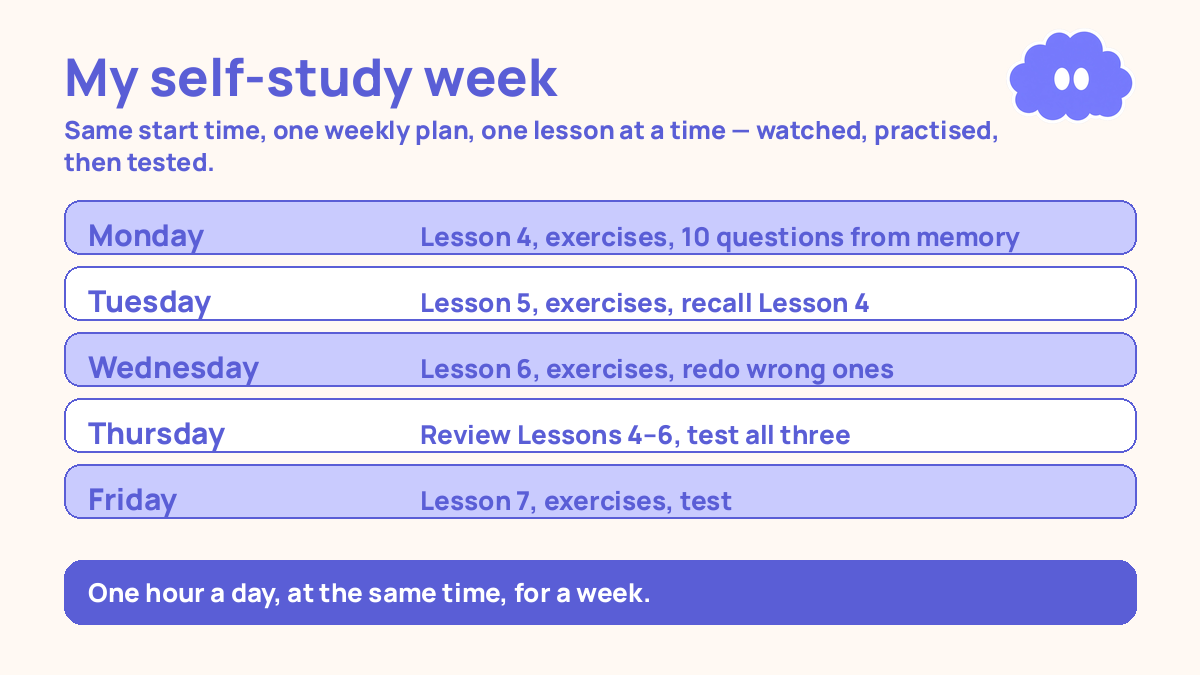
- Monday: Lesson 4, exercises, 10 questions from memory. Finished: Lesson 4. Next: Lesson 5.
- Tuesday: Lesson 5, exercises, recall Lesson 4 without notes. Finished: Lesson 5. Next: Lesson 6.
- Wednesday: Lesson 6, exercises, redo Tuesday’s wrong exercises. Finished: Lesson 6. Next: review.
- Thursday: Review Lessons 4-6, test yourself on all three, fix gaps.
- Friday: Lesson 7, exercises, test. Finished: Lesson 7. Next: Lesson 8.
- Sunday, 15 minutes: review. Finished 4 lessons this week, not 5. Next week: 4 lessons planned, not 5.
Notice what did not happen: no marathon Saturday, no restarting from Lesson 1, no watching ahead to “get ahead”. Steady, checked progress, week after week, is how online courses actually get finished.
When it goes wrong
You fall behind. Do not restart. Pick up from the last lesson you actually finished and tested, not the last lesson you watched. Watched is not finished.
You watch videos but cannot do the exercises. That means the lesson was not understood, not that you are bad at the subject. Re-watch only the part you could not do, practise that part, test it again. Re-watching the whole lesson is re-reading with sound.
You keep missing the start time. Change the start time, not the whole system. A time that fails three days in a row is information. Try a different time for a week and compare.
You feel alone and unmotivated. That is normal for self-study, and it is not a sign to quit. A study group, even one other person doing the same course, or a weekly check-in with a friend, can replace the teacher’s check. If you cannot find a group, the Sunday review is your check: write what happened, honestly, and change one thing.
Weekly review checklist
Copy this list and use it every Sunday:
- What lessons did I finish and test this week?
- What did I watch but not practise? (Those are not finished.)
- What broke the system: time, phone, tiredness, or a lesson that was too hard?
- What one change will I make next week?
Downloadable infographic spec: one vertical image, title “My self-study week”, with the five steps from “The system in short” and the Sunday review questions, in Thynq cream, Cloud Purple, Dark Purple and pink, with the Cloud mascot. Text taken word-for-word from this article.
What this system is not
It is not a promise that you will finish the course, and it is not a claim that one hour a day works for every course. Some courses need more time, some need a teacher, and some are simply not the right course. What this system does is tell you, honestly, each week, whether the work happened and whether you understood it. That information is worth more than another watched video.
Sources
- Dunlosky, J., et al. (2013). Improving students’ learning with effective learning techniques. Psychological Science in the Public Interest, 14(1), 4-58. Practice testing and distributed practice were the only two techniques rated high utility.
Questions
How do I stay motivated with no teacher?
Do not rely on motivation. Rely on a start time, a weekly plan, and a check at the end of each session. Motivation follows finished work more often than it comes before it.
Should I watch all the videos first, then practise?
No. Watch one lesson, then practise it, then test yourself on it, before moving on. Watching a whole course first feels like progress and leaves almost nothing you can use.
What if I fall behind on an online course?
Do not restart from the beginning. Pick up from the last lesson you actually finished, do one lesson a day, and let the weekly review shrink the plan to what you can keep.
How much should I study each day online?
Start with one hour a day, at the same time, for a week. Grow it only after a full week kept. A kept hour beats a planned three hours that never happens.