The direct answer
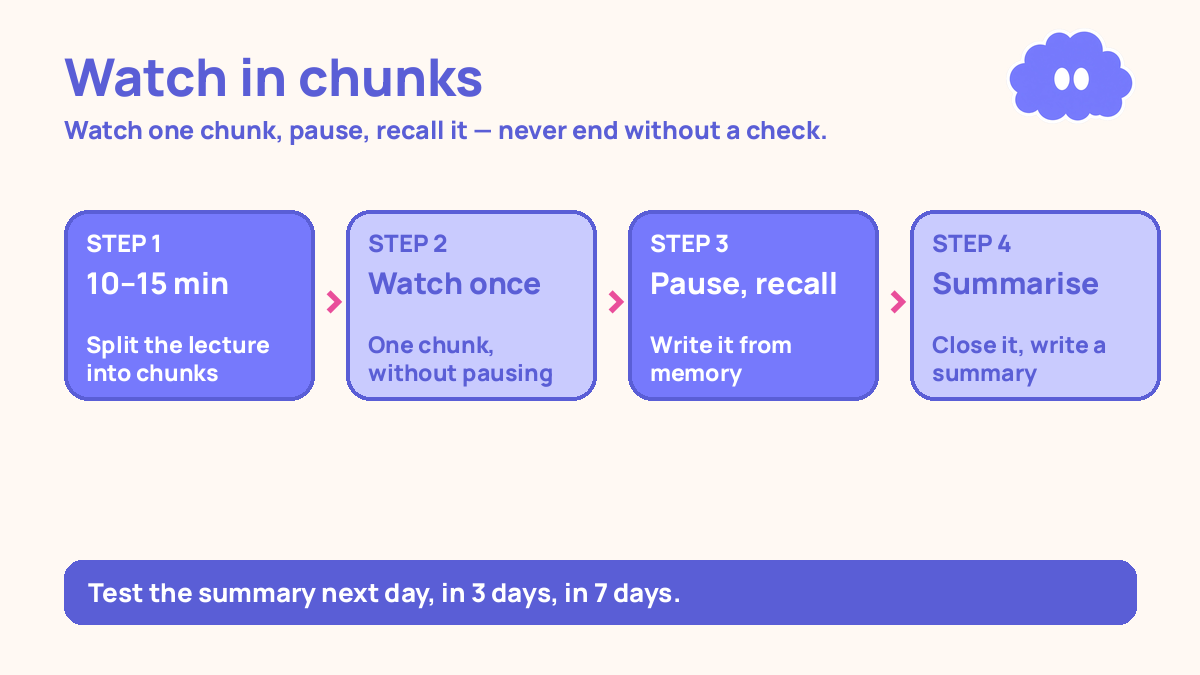
Split the lecture into chunks of 10 to 15 minutes. Before each chunk, write down what it should teach you. Watch it once without pausing, then pause and write what it taught you from memory. When the lecture is done, close it and summarise the whole thing in your own words. That is the whole system: watch in pieces, recall after each piece, and never let a lecture end without a check.
You do not need a special app or a new way of taking notes. You need a pause plan, a pen, and the habit of closing the video before you decide what you learned.
Why video lectures feel like learning
A video lecture is the easiest kind of studying to fake. The teacher talks, the slides move, and everything makes sense while it plays. Your brain confuses following along with knowing it. Then the exam, the assignment, or the next lecture arrives, and the knowledge is gone — because following along was never the same as learning.
Three habits make it worse. First, watching at double speed. It feels efficient, but speed does not add understanding; it removes the pauses your brain uses to catch up. Second, pausing every minute to copy the slide. You end the lecture with pages of notes and no memory of what any of it means. Third, rewatching. When a lecture does not stick, the instinct is to watch it again from the start. The second watch feels easier — because you have seen it before, not because you know it.
This article is part of a bigger system for learning without a teacher. For the full routine — your week, your notes, your reviews — read the self-study system for online learners. The finishing side of that system, turning a whole course into finished lessons, is in how to finish an online course. This article is about the lecture itself: what to do while it plays, and what to do the moment it stops.
The system in short
- Before you press play, write the lecture’s topic and what it should teach you, in one line.
- Split the lecture into chunks of 10 to 15 minutes and mark the split points.
- Watch one chunk without pausing. Phone in another room.
- Pause. Write what the chunk taught you, from memory, in two or three lines.
- Repeat for each chunk. Do not move on until the chunk’s recall is done.
- When the lecture ends, close it and write a short summary of the whole lecture from memory.
- Test yourself on the summary the next day, and again in three days, then in seven.
Step 1: Before you press play
Never start a lecture cold. Look at the title and the first slide, or the course outline, and write one line on paper: “This lecture: how loops work, and when to use one instead of repeating code.” If the lecture has no clear topic, write your best guess. A wrong guess you can correct is better than no target at all.
Get your materials ready before you start: paper, a pen, and the course page open. Put your phone in another room. A lecture on a screen with a phone on the desk is a lecture competing with every message you have ever received.
Check the length. A 60-minute lecture is four chunks of 15 minutes. A 20-minute lecture is two chunks of 10. Write the chunk breaks down — for example, pause at 15:00, 30:00, and 45:00. Deciding the breaks before you start means you never have to decide while you watch, and deciding while you watch is how pausing becomes random.
Step 2: Watch one chunk without pausing
Press play and watch the whole chunk without touching the controls. Do not pause to write. Do not rewind when you miss a sentence. If something is unclear, write one word on your paper — just the topic, like “nested loops” — and keep watching. You will come back to it in the recall.
If the teacher talks too fast, slow the video down instead of pausing. If the teacher talks too slowly on a part you already know, speed that part up. Use the speed control for the easy parts and the hard parts, not for the whole lecture. A whole lecture at double speed is a whole lecture half heard.
Step 3: Pause and recall the chunk
When the chunk ends, pause. Close the video tab if it helps. Take your paper and write two or three lines about what the chunk taught you, from memory, in your own words. Do not look at the slides. Do not look at the transcript. The recall is the learning; the writing is just how you catch it.
If you can write the chunk’s main idea and one example, move on. If you cannot, you have found a gap while it is still small. Rewatch that chunk once, then recall again. Most gaps close on the second watch, because now you know what you are listening for.
Write the recall in short lines, not sentences copied from the teacher. “A loop repeats a block of code until a condition changes” is a recall. “Loops are a fundamental programming construct used for iteration” is a copied sentence, and it tells you nothing about whether you understood it.
Step 4: Notes that help you review
Your chunk recalls are your notes. Add to them only what you will need later: a formula, a definition in the teacher’s exact words if the exact words matter, or a worked example you want to copy. Everything else stays as recall.
If you want a fuller note system for the course, the notes system that you can actually review shows how to turn short notes into a review routine. The rule is the same there as here: notes you never look at again are not notes, they are clutter.
One exception: if the teacher works through an example step by step — a calculation, a diagram, a piece of code — follow along on paper as they do it. Doing the example with them is not copying. It is practice, and practice is one of the two techniques Dunlosky and colleagues rated highly. But once the example is done, close your copy and redo it from memory before you move on.
Step 5: The summary and the spaced checks
When the lecture ends, close it. Do not rewatch the ending. Write a short summary of the whole lecture from memory: the topic, the three or four main ideas, and one example for each. Five to ten lines is enough. If the lecture was an hour long and your summary is two lines, you watched it, but you did not study it.
This summary is what you review later. The schedule is simple and practical: test yourself on it the next day, then in three days, then in seven days. That is a starting schedule to try, not a rule from the research. Cepeda and colleagues, in a 2006 review, found that spaced practice beat massed practice, and that the best gap is not fixed — it grows with how long you need to remember the material. So if the material still feels fresh after three days, stretch the gap. If it has faded, shorten it.
Each review takes five minutes. Read your one-line topic, then try to say the main ideas before you look at the summary. The ideas you miss go back into the next review. The ones you get right three times in a row are done — until the exam, when you review them once more.
A worked example: a 45-minute lecture
A student has a 45-minute lecture on sorting algorithms, alongside classes. She splits it into three chunks of 15 minutes and writes the target: “How sorting works, and when to use each method.”
Chunk one, 0 to 15 minutes: she watches without pausing, phone in another room. She pauses and writes two lines from memory: what sorting means and one example. It works. Chunk two, 15 to 30 minutes: she watches, pauses, and writes the recall — but the second method will not come. She rewinds to the start of chunk two, watches once more, and this time the recall works. Chunk three, 30 to 45 minutes: she watches, pauses, recalls. Then she closes the video and writes the whole-lecture summary: three methods, one line each, one example each.
The next day she tests herself on the summary before class: two methods come easily, one is shaky, so it goes into the three-day review. By the seven-day review she can say all three without looking.
When it goes wrong
You watch the whole lecture without a single pause. It felt easy, and you remember nothing an hour later. Next time, set the chunk breaks before you start and pause at the first one no matter what. The first pause is the hardest; after it, the routine carries you.
You pause every minute to copy the slides. Your notes are long and your understanding is thin. Switch to the chunk rule: no writing during a chunk, recall after it. If you are afraid of missing something, remember that the slides will still be there when you check your recall.
You rewatch the whole lecture and it still does not stick. Stop rewatching. Find the one idea that blocks you — write it in one line — and learn just that idea from another explanation: the course text, a worked example, a classmate. Then rewatch only the chunk that used it. A full rewatch hides the gap instead of fixing it.
You take great notes and never look at them again. Notes are not the goal. The summary review is the goal. Put the summary on one page, keep it where you study, and test yourself on it the next day. A page you review three times beats a notebook you never open.
Weekly review checklist
Copy this list and use it each week:
- How many lectures did I study with chunks and recalls this week?
- Which chunk recalls failed, and what idea was missing in each one?
- Which summaries did I review on schedule — next day, three days, seven days?
- Which lecture ideas can I still explain in one line, from memory?
- What one change will I make next week: shorter chunks, stricter pauses, or a fixed review time?
Downloadable infographic spec: one vertical image, title “How to study video lectures properly”, with the seven steps — write the target, split into 10 to 15 minute chunks, watch one chunk without pausing, pause and recall from memory, repeat, summarise the whole lecture, test yourself next day, in 3 days, in 7 days — and the rule “never let a lecture end without a check”, in Cream Paper, Cloud Purple, Dark Purple and pink, with the Cloud mascot. Text taken word-for-word from this article.
What this system is not
It is not a promise of a grade, and it is not a claim that 15-minute chunks are the scientifically correct length for every lecture. They are a practical starting point: short enough to hold your attention, long enough to hold one idea. The system is the recall, the summary, and the three spaced checks.
Sources
- Dunlosky, J., et al. (2013). Improving students’ learning with effective learning techniques. Psychological Science in the Public Interest, 14(1), 4-58. Only practice testing and distributed practice received a high utility rating; rereading was rated low.
- Cepeda, N. J., et al. (2006). Distributed practice in verbal recall tasks. Psychological Bulletin, 132(3), 354-380. Spaced practice beat massed practice; the best gap grows with how long you need to remember. The “next day, in 3 days, in 7 days” schedule is a practical starting point, not a rule from this paper.
- Roediger, H. L., & Karpicke, J. D. (2006). Test-enhanced learning. Science, 311, 249-250. Recalling a passage beat restudying it a week later, though restudiers felt more confident immediately.
For the full self-study routine, read the self-study system for online learners. For turning finished lectures into a finished course, read how to finish an online course.
Questions
Should I watch a lecture at normal speed or faster?
Start at normal speed. Faster speeds save time only if you still understand, and most students find they miss the parts that matter. If a section is easy, speed it up; if it is new, slow it down.
How much should I pause a video lecture?
Pause at planned points, not every minute. Split the lecture into chunks of 10 to 15 minutes, watch one chunk, then pause to write what it taught you from memory. Constant pausing turns watching into copying.
Should I take notes while the lecture is playing?
Take short notes only: one line per idea, in your own words. Long notes copied word for word are just the lecture written down again. The real note is the summary you write after the lecture, from memory.
What if I watch a lecture twice and still do not understand it?
Do not watch it a third time the same way. Find the one idea that blocks you, learn just that idea from another explanation, then rewatch only the part that used it. A full rewatch hides the gap instead of fixing it.