The direct answer
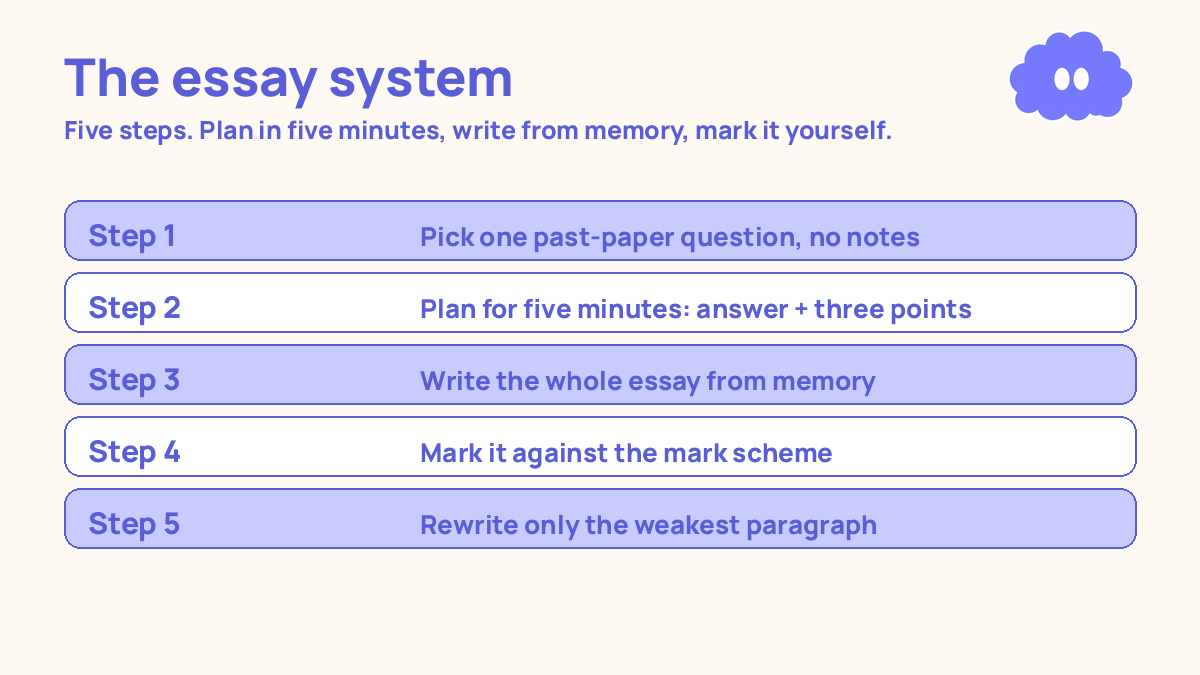
An essay exam system for students works like this: spend five minutes planning — one sentence for your answer, three points that support it — then write the whole essay from memory under timed conditions, then mark it yourself against the mark scheme. The practice that matters is writing essays, not reading about them.
Why an essay exam system for students starts with a blank page
You read the question and your mind goes blank. Not because you know nothing — you revised for hours — but because the answer is sitting in your notes and you cannot pull it out in sentences. So you write something vague, hope the examiner finds the point in it, and move on.
That is the normal way essay exams go wrong. Reading notes feels like learning, but an essay exam does not ask you to recognise material. It asks you to produce it: an argument, in order, under time pressure. The only practice that prepares you for that is producing it — writing essays from memory, then checking them.
This is also what the research points to. In a 2011 study, Karpicke and Blunt found students who practised free recall scored 0.67 on a test a week later, against 0.45 for students who built concept maps — and the recall group did best on inference questions, the ones that need understanding. Writing an essay from memory is recall practice in its hardest form.
The system in short
- Pick one past-paper question. No notes open, no phone, timer set to the real exam time.
- Plan for five minutes: your answer in one sentence, three points that support it, one piece of evidence per point.
- Write the whole essay from memory. Do not stop to check a fact — mark the gap and keep writing.
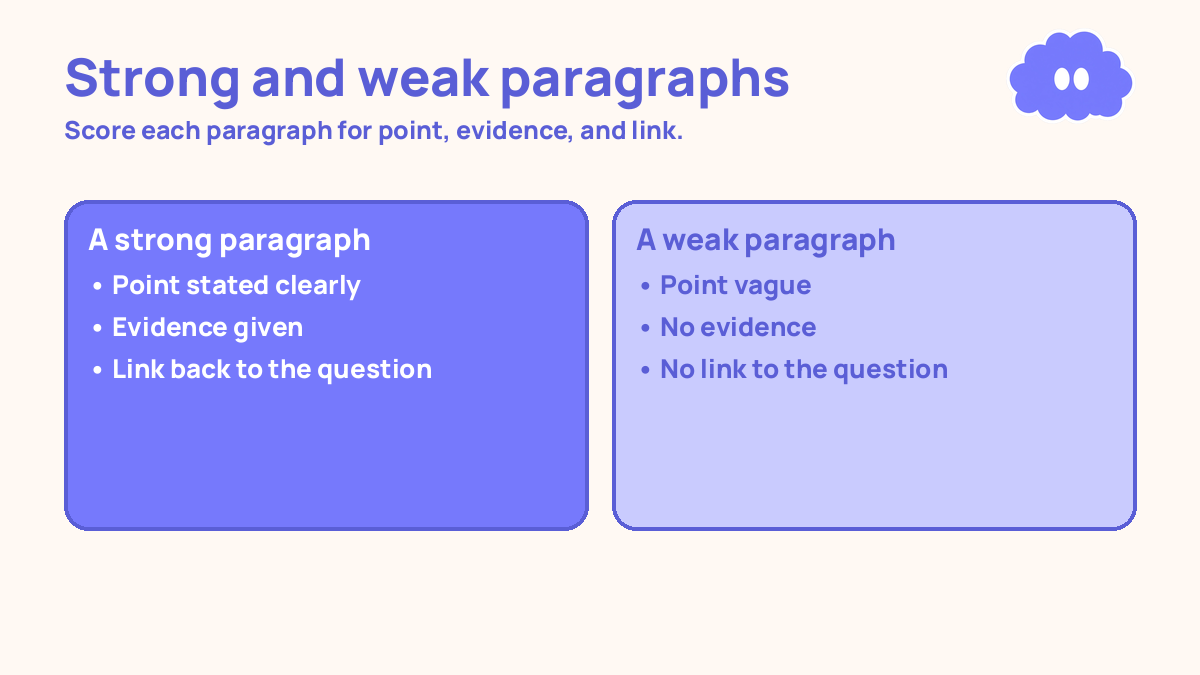
- Mark it yourself against the mark scheme. Score each paragraph for point, evidence, and link to the question.
- Rewrite only the weakest paragraph, from memory, the next day. Then file the question for a retest after a gap.
Step 1: Pick the question and close everything
One question, one sitting, exam conditions: no notes, no textbook, no phone, and a timer set to the real exam time — 45 minutes for a 45-minute essay.
The closed-book part is the whole point. An essay written with notes open is a copying exercise. In Roediger and Karpicke’s 2006 study, students who recalled a passage remembered more a week later than students who restudied it, even though the restudiers felt more confident right after studying. Feeling fluent after re-reading is not the same as remembering a week later.
Pick questions from past papers, not from your own head. Your own questions are too easy — you ask about what you already know. Past-paper questions ask about what the examiner cares about.
Step 2: Five minutes of planning, on paper
Spend the first five minutes on a plan, written on paper, in this shape:
- Answer in one sentence: “The main cause of the war was X, not Y.”
- Point 1, with one piece of evidence.
- Point 2, with one piece of evidence.
- Point 3, with one piece of evidence.
Three points is a practical number for a 45-minute essay: one per paragraph, plus an introduction and a conclusion.
The one-sentence answer is the most important line on the page. It is what your introduction will say and what your conclusion will repeat. If you cannot write it in one sentence, you do not yet know what you think. Go back to your notes for five minutes, find the answer, and then start the timer again.
For coursework essays, where you have more than five minutes, the essay outline planner builds the same plan as a printable page: thesis, one section per argument, the counterargument and the conclusion, with a word guide for each. When the draft is written, the essay word counter shows it against the target.
Step 3: Write the whole essay from memory
Now write. Introduction first: your one-sentence answer, in your own words. Then one paragraph per point — make the point, give the evidence, explain why it supports the point, and link it back to the question.
The explanation sentence is where most marks are won or lost. Students write the point and the evidence and stop, assuming the examiner will join them up. The examiner will not. Write the join yourself: “This shows X, because…” Explaining why each step works, in your own words, is self-explanation — rated moderate utility by Dunlosky in 2013, and a 2018 meta-analysis found prompting it gave a moderate average benefit.
If you hit a fact you cannot remember, do not stop and look it up. Write “[check]” in the margin and keep going. Stopping breaks the essay and breaks the timing. The gap goes on tomorrow’s list. An essay with two “[check]” marks and a finished conclusion is far better practice than a perfect first paragraph and nothing else.
Step 4: Mark it against the mark scheme
When the timer ends, stop writing — even mid-sentence. Then open the mark scheme and mark your own essay honestly.
Most mark schemes reward three things: the point, the evidence, and the link back to the question. Score each paragraph out of three, one mark per element. A paragraph with a point and evidence but no link scores two out of three. Write the score in the margin.
| Paragraph | Point | Evidence | Link to question | Score |
|---|---|---|---|---|
| Introduction | Answer stated | — | Yes | 2/3 |
| Point 1 | Clear | One example | Weak | 2/3 |
| Point 2 | Clear | Two examples | Yes | 3/3 |
| Point 3 | Vague | None | No | 0/3 |
| Conclusion | Answer repeated | — | Yes | 2/3 |
This table is from the worked example below, and it shows what self-marking is for: it tells you that point 3 is the problem, not the whole essay.
Be honest in the scoring. If the evidence is not really there, it is not there. Marking yourself generously is the same as not marking at all.
Step 5: Rewrite only the weakest paragraph, tomorrow
Do not rewrite the whole essay. Take the weakest paragraph — the one with the lowest score — and rewrite it from memory the next day. That is the whole revision for that essay.
Why the next day, not the same day? Because a gap is what makes it a test instead of a copy. Spaced practice was one of only two techniques rated high utility in Dunlosky’s review, and Cepeda’s 2006 synthesis found spaced practice beat massed practice. A one-day gap is a practical starting schedule, not a research rule.
When you rewrite, keep the same shape: point, evidence, explanation, link.
File the question away after the rewrite. Retest it — full essay, from memory — after a gap of three to seven days. If the weakest paragraph is now solid, the essay is done. Move on to the next question.
A worked example: a Tuesday evening, two weeks before the exam
You have a history exam in two weeks. One essay question per evening, 45 minutes each.
6:00–6:05 — Plan. The question: “Why did the war start in 1914?” Your one-sentence answer: “The war started because the alliance system turned a local crisis into a general war.” Three points: the alliance system, the arms race, the July crisis. One piece of evidence per point.
6:05–6:45 — Write. Introduction, three paragraphs, conclusion. You cannot remember the exact date of one treaty, so you write “[check]” and keep going. Timer ends mid-sentence in the conclusion — you stop.
6:45–7:00 — Mark and log. Against the mark scheme: introduction 2/3, point 1 2/3, point 2 3/3, point 3 0/3, conclusion 2/3. Total 9/15. Point 3 is the problem — the July crisis paragraph has no evidence and no link. Log the gap: “July crisis — need two facts: the ultimatum date and the Russian mobilisation.” That is tomorrow’s ten minutes.
Wednesday 6:00–6:15 — Rewrite. Point 3 only, from memory, with the two facts now learned. It scores 3/3. The essay is filed for a full retest on Sunday.
One evening, one essay, one paragraph fixed. Four evenings like this and you have four essays you can actually write, not four chapters you have re-read. If the subject itself is the problem and you keep putting the essay off, how to revise a subject you hate is the system for getting started on the one you dislike.
When it goes wrong
You plan for twenty minutes and write for twenty-five. Set a separate five-minute timer for planning. When it rings, start writing, even if the plan feels thin. A thin plan with a finished essay beats a perfect plan with two paragraphs.
You cannot write the one-sentence answer. Then you do not know the argument yet, and no amount of writing will produce one. Stop the timer. Spend ten minutes with your notes finding the answer, write it in one sentence, and start again.
Your self-marking is always generous. You give yourself 3/3 for paragraphs that have no evidence. Fix it with a rule: no evidence named, no mark for evidence. If you cannot point to the exact sentence that is the evidence, it is not there.
You rewrite the whole essay instead of one paragraph. That feels thorough and wastes an evening. The weakest paragraph is the only one that needs rewriting. If two paragraphs tie for weakest, pick the one that carries more marks and do the other one tomorrow.
Weekly review checklist
Copy this list and use it each week:
- How many timed essays did I write this week, and how many did I self-mark?
- Which paragraph element is weakest across my essays: point, evidence, or link?
- Did I rewrite every weakest paragraph the next day, from memory?
- What one change will I make next week: shorter plans, more evidence per point, or stricter marking?
Downloadable infographic spec: one vertical image, title “The essay system in five steps”, with the five steps — pick one question, plan for five minutes, write from memory, mark against the scheme, rewrite the weakest paragraph — and the paragraph shape, point, evidence, explanation, link, in Thynq cream, Cloud Purple, Dark Purple and pink, with the cloud mascot. Text taken word-for-word from this article.
What this system is not
It is not a promise of a grade, and it is not a claim that writing essays is the only way to revise. It is the way to practise for an exam that asks you to write essays. It is also not a shortcut around knowing the material — if you cannot produce the evidence from memory, the essay will show it, and the fix is ten minutes with your notes.
Sources
- Karpicke, J. D. & Blunt, J. R. (2011). Retrieval practice produces more learning than elaborative studying with concept mapping. Science, 331(6018), 772–775. Retrieval scored 0.67 vs 0.45 for concept mapping a week later, on verbatim and inference questions.
- Roediger, H. L. & Karpicke, J. D. (2006). Test-enhanced learning. Psychological Science, 17(3), 249–255. Students who recalled a passage remembered more a week later than students who restudied it, though restudiers felt more confident immediately.
- Dunlosky, J., et al. (2013). Improving students’ learning with effective learning techniques. Psychological Science in the Public Interest, 14(1), 4–58. Only practice testing and distributed practice rated high utility; self-explanation moderate; rereading low.
- Bisra, K., et al. (2018). Inducing self-explanation: a meta-analysis. Educational Psychology Review, 30(3), 703–725. Prompting self-explanation gave a moderate average benefit (g = 0.55).
- Cepeda, N. J., et al. (2006). Distributed practice in verbal recall tasks. Psychological Bulletin, 132(3), 354–380. Spaced practice beat massed practice.
For the full exam system this sits inside, start with how to revise for exams without cramming. If the question type trips you up, the multiple-choice exam system for students covers the other common format.
Questions
How long should I spend planning an essay in the exam?
Five minutes for a 45-minute essay. Write your answer in one sentence, then three points that support it, then start writing. A five-minute plan saves far more time than it costs, because you stop mid-essay to work out what to say next.
Should I memorise whole essays before the exam?
No. Memorised essays break when the question is even slightly different. Memorise the building blocks instead: your one-sentence answers, three points per topic, and two pieces of evidence per point. Then assemble them for the question in front of you.
How do I practise essay writing without a teacher marking it?
Mark it yourself against the real mark scheme. Past papers usually come with one. Score each paragraph for the point, the evidence, and the link back to the question. Then rewrite only the weakest paragraph. One rewritten paragraph teaches more than three new essays.
What if I run out of time mid-essay?
Stop writing the paragraph you are on and write a two-line conclusion that answers the question directly. An unfinished essay with a conclusion scores better than a finished body with no ending, because the conclusion is where the answer lives.