The direct answer
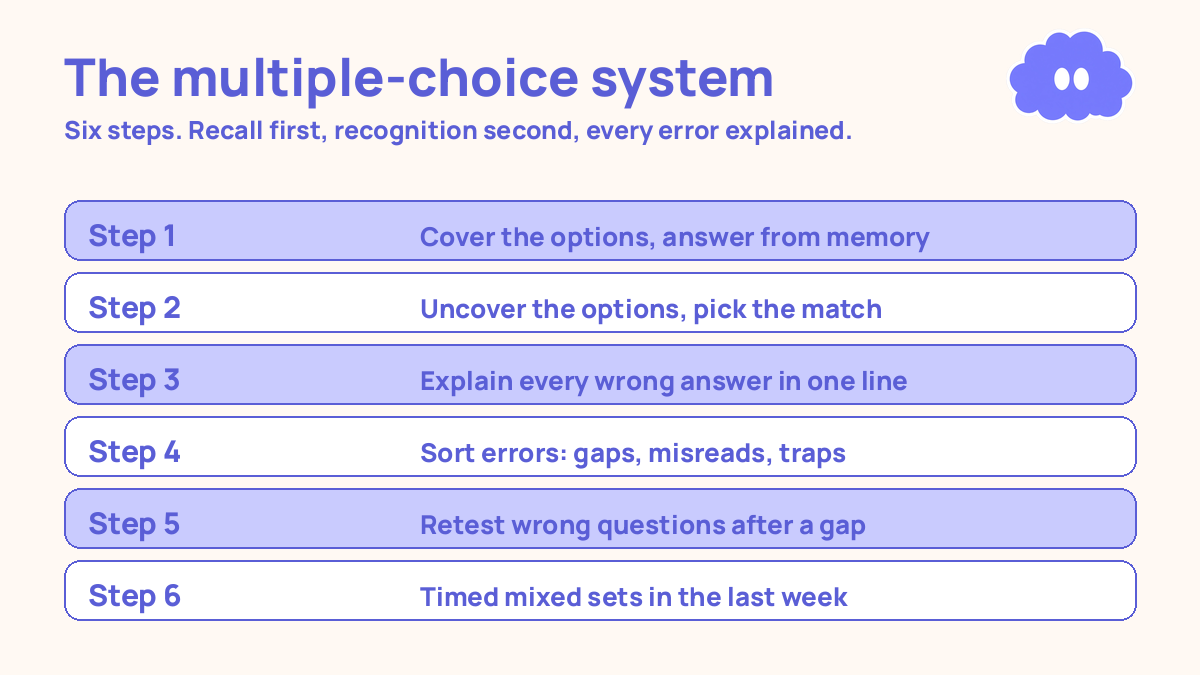
A multiple choice exam system for students works like this: cover the options, answer the question from memory in your own words, then uncover the options and pick the one that matches. For every question you get wrong, write one line saying why the wrong option is wrong. That is the whole system — recall first, recognition second, and every error explained.
A multiple choice exam system for students starts with the wrong answers
You know the material. You read the question, and two options both look right. You pick one, and it is the other. Then you check your notes and the answer was in there all along. The problem is not that you did not study. The problem is that multiple-choice questions test recognition, and recognition feels like knowing when it is only familiarity.
That is why practising by reading options and picking the best one is a weak way to revise. Rowland’s 2014 meta-analysis found testing yourself beat restudying across 61 studies, and recall formats — short answer, writing it out — beat recognition formats like multiple choice as practice.
The system in short
- Cover the four options with your hand or a piece of paper. Read only the question stem.
- Answer the question from memory, in your own words, out loud or on paper. One sentence is enough.
- Uncover the options. Pick the one that matches your answer. If none matches, pick the closest and mark the question.
- For every wrong answer, write one line: why the option you picked is wrong, in your own words.
- Sort each error into one of three types: knowledge gap, misread question, or trap option. Fix the type, not just the question.
- Retest every wrong question after a gap of one to three days, with the options covered again.
Step 1: Cover the options and answer from memory
This is the step that makes the whole system work. Before you look at a single option, cover them and ask yourself what the answer is.
Read the question stem carefully — the part above the options — and say the answer in your own words. Not “I know this one.” Say it: “The answer is the mitochondria, because it produces energy.” If you cannot say anything, write “don’t know” and move on. That is useful information, not a failure. It tells you exactly what to go back and learn.
This feels slower than just picking an option. It is slower. But it turns every practice question into a recall test, which is the stronger kind of practice.
Step 2: Treat each option as a true-or-false claim
Once you have your own answer, uncover the options. Now read each one as a separate claim and test it against the question, word by word. Examiners build wrong options that are almost right — one word changed, a date, a unit, an “always” where the truth is “usually”. Underline the word in the question that decides it, then check each option against that word.
If your recalled answer matches one option, pick it and move on. Do not re-read the other three looking for reasons to doubt yourself.
If no option matches your answer, pick the closest, mark the question with a star, and keep going. You will come back to the starred ones in step 4.
Step 3: Write why the wrong option is wrong
This is the step most students skip, and it is the step that does the learning. When you get a question wrong, do not just look at the right answer and move on. Write one line, in your own words, saying why the option you picked is wrong. For example: “Picked B because I thought the answer was 1945, but the treaty was 1919.” Explaining an error in your own words is self-explanation, rated moderate utility by Dunlosky (2013), and a 2018 meta-analysis found prompting it gave a moderate average benefit.
Do the same for questions you got right but were unsure about. If you guessed, it was not a right answer, it was a lucky one. Write the line anyway: “Guessed C, did not know why A was wrong.”
Step 4: Sort your errors by type, then fix the type
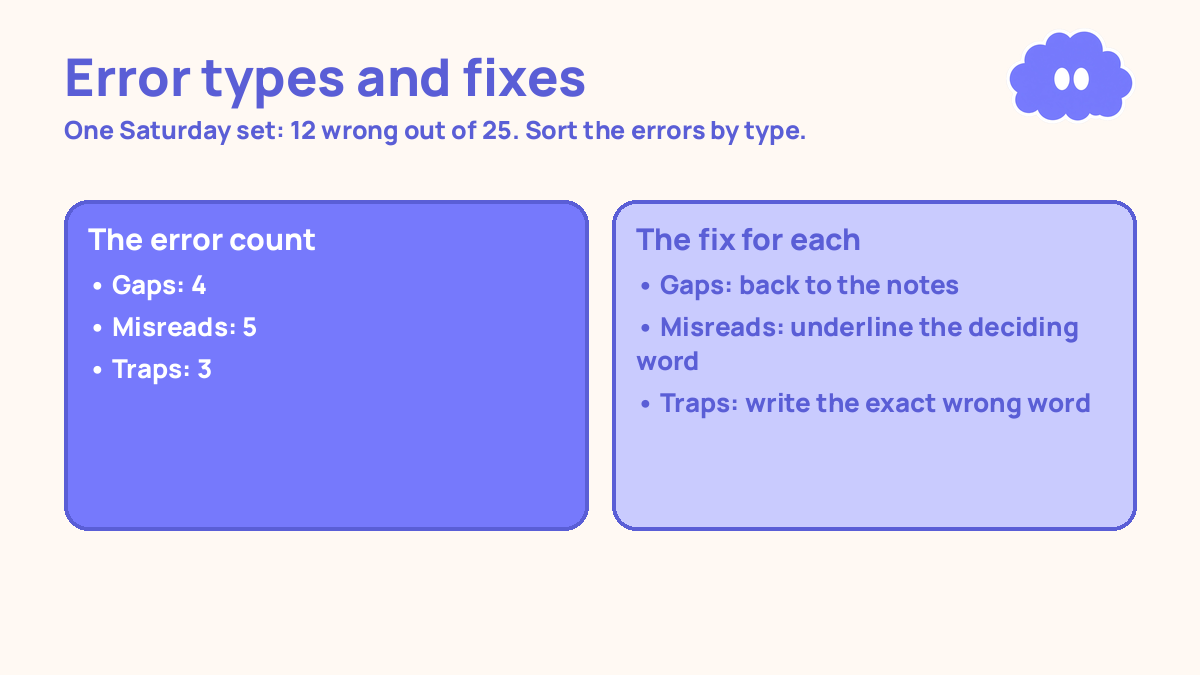
At the end of each set, go through your wrong answers and sort them into three types: a knowledge gap (you did not know the fact), a misread question (you knew it but answered a different question), or a trap option (you picked the almost-right option with one wrong word). The fix follows the type: gaps go back to the notes, misreads get the deciding word underlined next time, traps get the exact wrong word written down.
Count your types at the end of each set and write the three numbers at the top of your error log. Next week, compare. If misreads are not falling, the fix is a slower first read of every question, not more revision.
Step 5: Retest the wrong questions after a gap
Do not retest wrong questions the same day. You will remember the right answer from ten minutes ago, and that tells you nothing. Wait at least a day, then go back to the same questions with the options covered again. A one-to-three-day gap is a practical starting schedule, not a research rule
To make the retest easy to repeat, put the questions you got wrong into the free quiz maker. It shuffles the questions every time, marks multiple choice and true or false for you, and shows the wrong ones with the right answer at the end.
Step 6: Do timed mixed sets in the last week
In the final week, stop doing topic-by-topic sets. Do mixed sets of 20 to 30 questions under timed conditions, with the same time limit per question as the exam.
Mixed practice forces you to choose the right idea for each question instead of repeating the last topic you studied. The exam will not group questions by topic, so your practice should not either.
Time yourself properly. If the exam gives you one minute per question, give yourself one minute per question. When the time is up, stop — even mid-question. Running out of time in practice is cheap. Running out of time in the exam is not. Multiple choice is only one format — for written answers, the essay exam system for students covers planning an answer under time and writing it from memory.
A worked example: a Saturday morning, three weeks before the exam
You have a biology exam in three weeks. It is Saturday, and you have the morning free.
9:00–9:50 — The set. Pick 25 past-paper questions on cell biology. Cover the options for each question, answer from memory in one sentence, then uncover and pick. Star any question where no option matches your answer. Do not check answers yet. Phone in another room.
9:50–10:10 — Mark and explain. Check the answers. For each wrong answer, write one line saying why your option was wrong. For each lucky guess, write the line too.
10:10–10:25 — Sort the errors. Twelve wrong out of 25: gaps 4, misreads 5, traps 3. Misreads are the biggest group, so for the next set you will underline the deciding word in every question before answering.
10:25–10:40 — Fix the gaps. Four knowledge gaps. Go back to your notes on those four topics only — not the whole chapter.
10:40–11:00 — Break. Walk, water, no phone. The break is part of the system.
11:00–11:30 — Second set, different topic. Twenty questions on genetics, same method, underlining the deciding word first. Misreads drop from 5 to 2.
11:30–11:40 — Log it. Total today: 45 questions, 17 wrong, 4 gaps carried to tomorrow’s retest list. Tomorrow you retest the 17, with options covered, before you start anything new.
When it goes wrong
You read the options first because covering them feels slow. It does feel slow, and that is the point. Reading the options first turns the question into a recognition test, and recognition is the weaker practice. Put a sticky note over the options until you have written your one-sentence answer. After a week the habit holds on its own.
You get the question right but cannot explain why the other options are wrong. Then you did not really know it — you recognised it. Write the one-line explanation anyway, and if you cannot, put the topic on tomorrow’s retest list. On exam day there will be no answer key to check against, so “it looked right” is not a safe basis for a mark.
Your error log is all knowledge gaps and nothing else. Either you started this system too late, or you are sorting wrong. A question you got wrong because you picked the almost-right option is a trap, not a gap. If it really is all gaps, stop doing question sets and go back to learning the topics first.
You keep making the same misread errors. “NOT” questions, “main cause” questions, questions with a double negative. These are not knowledge problems. Fix them with a rule: underline the deciding word in the question before you read any option, every single time, for one full week.
Weekly review checklist
Copy this list and use it each week:
- How many questions did I answer this week, and how many did I get wrong?
- What are my error counts — gaps, misreads, traps — and which type is biggest?
- Did I retest every wrong question after a gap, with the options covered?
- What one change will I make next week: underline the deciding word, smaller sets, or more time on gap topics?
Downloadable infographic spec: one vertical image, title “The multiple-choice system in six steps”, with the six steps — cover the options, answer from memory, pick the match, explain every wrong answer, sort the errors, retest after a gap — and the three error types, gaps, misreads and traps, in Thynq cream, Cloud Purple, Dark Purple and pink, with the cloud mascot. Text taken word-for-word from this article.
What this system is not
It is not a promise of a grade, and it is not a claim that multiple-choice questions are a good way to learn on their own. They are not — recall practice is stronger, and this system turns a recognition test into a recall test. It is also not a shortcut around knowing the material. If knowledge gaps are most of your errors, no exam technique will fix that. The system tells you that in numbers, instead of letting you keep practising the wrong thing.
Sources
- Rowland, C. A. (2014). The effect of testing versus restudy on retention: a meta-analytic review of the testing effect. Psychological Bulletin, 140(6), 1432–1463. Testing beat restudy (g = 0.50); recall formats beat recognition formats as practice; feedback raised the effect (g = 0.73 with, 0.39 without).
- Dunlosky, J., et al. (2013). Improving students’ learning with effective learning techniques. Psychological Science in the Public Interest, 14(1), 4–58. Only practice testing and distributed practice rated high utility; self-explanation and interleaved practice moderate; rereading low.
- Cepeda, N. J., et al. (2006). Distributed practice in verbal recall tasks. Psychological Bulletin, 132(3), 354–380. Spaced practice beat massed practice; the best gap grows with how long the material must be remembered.
- Bisra, K., et al. (2018). Inducing self-explanation: a meta-analysis. Educational Psychology Review, 30(3), 703–725. Prompting self-explanation gave a moderate average benefit (g = 0.55).
- Karpicke, J. D. & Blunt, J. R. (2011). Retrieval practice produces more learning than elaborative studying with concept mapping. Science, 331(6018), 772–775. Retrieval beat concept mapping a week later (0.67 vs 0.45); students who felt most confident did worst.
For the full exam system this sits inside, start with how to revise for exams without cramming, and for timed practice sets use the past paper system for exams.
Questions
Should I practise with multiple-choice questions at all?
Yes, but not as your main practice. Short-answer recall from memory is the stronger practice: in a 2014 meta-analysis, recall formats beat recognition formats as practice. Use multiple-choice questions to check yourself and learn the examiner’s traps, after you have already tested yourself by recall.
What do I do when two options both look right?
Treat each option as a separate true-or-false claim and test it against the question word by word. The wrong one usually breaks on one word — a date, a unit, an ‘always’ or ‘only’. Write down the word that kills it. If you cannot find the difference, that is a knowledge gap, and it goes in your error log.
How many practice questions should I do per session?
Twenty to thirty in one timed set is enough. More than that and you stop reading properly and start pattern-matching. Every wrong answer needs a one-line reason why it is wrong, written before you move on.
Is it better to guess or leave a blank on a multiple-choice exam?
Follow the exam’s marking rule. If there is no penalty for a wrong answer, always guess — eliminate what you can first, then pick from what is left. If wrong answers lose marks, guess only when you have eliminated at least two options. Check the rule before exam day.