The direct answer
An open book exam system for students works like this: before exam day, build a one-page index of your notes so you can find any topic in under thirty seconds. In the exam, write each answer from memory first, then open the book only to check an exact fact. The book is a reference, not a plan.
Why an open book exam system for students starts before exam day
The exam is open-book, so you relax. You read your notes once, lightly, and tell yourself the book will be there on the day. Then exam day comes, you open the first question, and you realise you do not know where anything is. You spend ten minutes searching for one definition, find it, and discover you do not understand it well enough to use it. The clock runs out with half the paper untouched.
That is the open-book trap. The book removes the need to memorise facts, but it does not remove the need to know the material. You still need to know what the answer is, which topic it comes from, and where it lives in your notes. The students who do well in open-book exams are the ones who revised hardest — they just revised differently. Retrieval practice beat restudying in Rowland’s 2014 meta-analysis, and in Karpicke and Blunt’s 2011 study retrieval beat concept mapping a week later. An open-book exam still rewards the student who can produce the answer, not the one who can find it.
The system in short
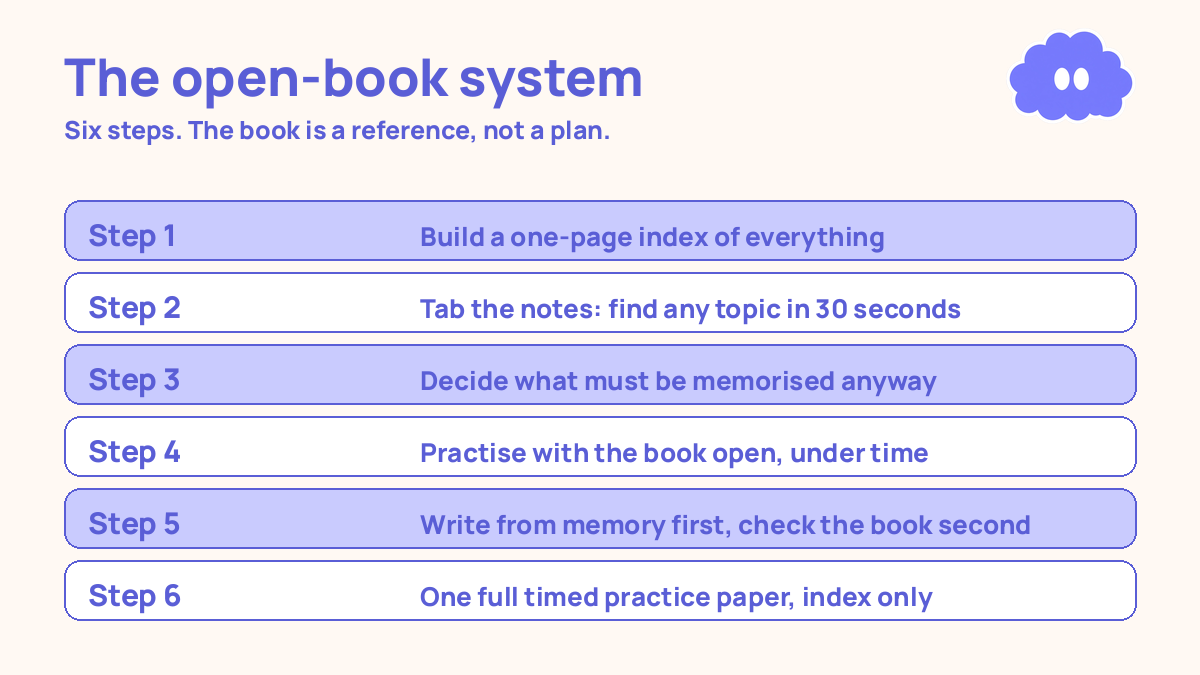
- Build a one-page index: every topic, the page it is on, one line saying what it covers.
- Tab your notes and textbook so every index entry takes under thirty seconds to reach.
- Decide what must be memorised anyway: definitions, structures, formulas — the things you use in every answer.
- Practise answering past-paper questions with the book open, under timed conditions.
- In every practice answer, write from memory first, then open the book only for an exact fact.
- Do one full timed practice paper, book open, with the index only — no searching the whole textbook.
Step 1: Build a one-page index of everything
Take one sheet of paper. List every topic in the syllabus, in the order the course taught them. Next to each one, write the page number where your notes on it start, and one line saying what the topic covers.
“Cell division — notes p.12 — mitosis stages, why cells divide.” That is an index entry. It is not a summary. It is a map. The whole index fits on one page, and that is the point: if it takes two pages, it is too detailed to use under pressure.
Build the index by hand, not by copying a contents page. Writing it forces you to decide what each topic actually is, and that decision is revision. When you finish, test it: pick a topic at random, find it using only the index, and time yourself. More than thirty seconds means the entry is wrong — the page number is off, or the one-line description does not match the page.
Step 2: Tab the notes so thirty seconds is real
Tabs are what make the index fast. Put a sticky tab on every page the index points to, and write the topic name on the tab in your own handwriting.
Now test the whole system the way you will use it: pick three topics, find each one with the index and the tabs, and time the whole thing. Three topics in under ninety seconds is the standard. If you miss it, the problem is usually the index — a topic listed under the wrong name, or a page number that points to the middle of the topic instead of the start.
Step 3: Decide what must be memorised anyway
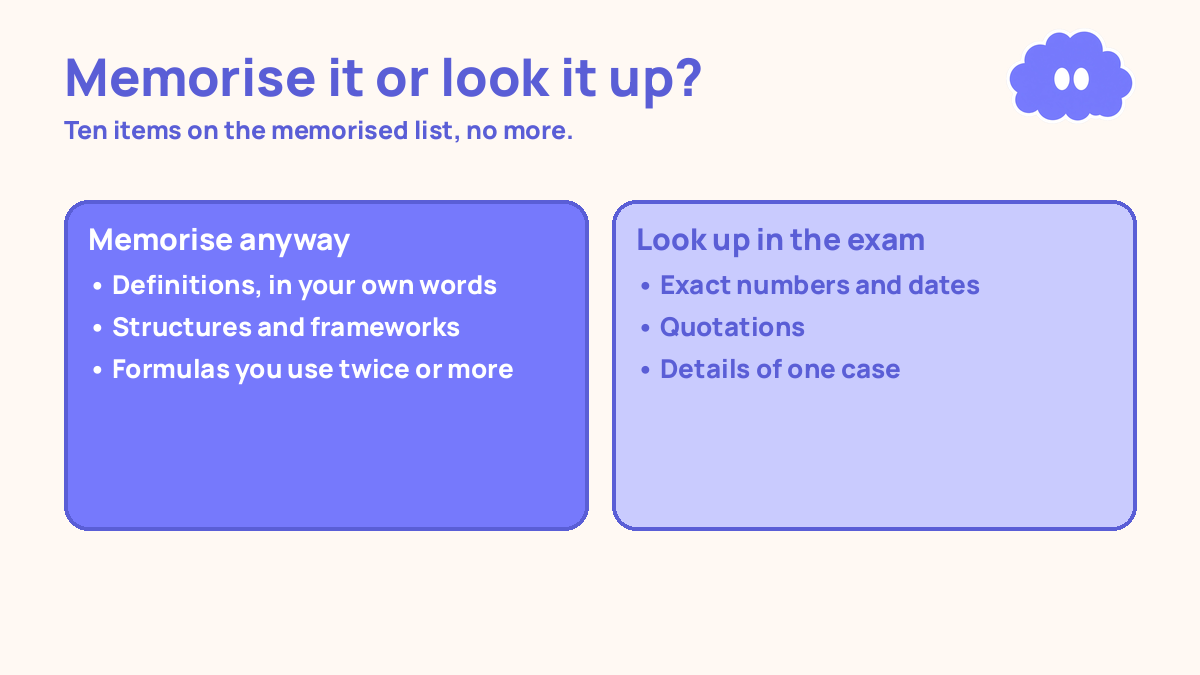
Not everything can be looked up. Three kinds of things must be in your head before you walk in:
- Definitions, in your own words. You will use them in every answer, and looking one up costs a minute you do not have.
- Structures: the order of an argument, the steps of a process, the shape of a framework. You cannot look up a structure mid-answer — by the time you find it, the sentence has fallen apart.
- Formulas and core frameworks you use in every question. If you use it more than twice, memorise it.
Everything else can be looked up: exact numbers, dates, quotations, and the details of one specific case. Write the memorised list on the back of your index — no more than ten items. If the list is longer than ten, you have listed facts instead of structures.
Step 4: Practise with the book open, under time
Take a past-paper question. Set the timer to the real exam time. Book open, index on top. Write the answer.
This is where most students discover the truth about their index: it works in theory and fails in practice. You look up a definition and it takes two minutes. You open the textbook to the wrong section.
Step 5: Write from memory first, check the book second
This is the rule that makes the whole system work. For every practice answer, and in the real exam, write the answer from memory first. Get the structure down, the points in order, the argument written. Then open the book — once, briefly — to check the exact facts: the date, the number, the quotation.
If you open the book before you have an answer, you will copy instead of think. The sentences will be the textbook’s sentences, not yours, and the examiner will mark them as such. Worse, you will spend the exam reading, not writing, and the paper will be half empty when the time runs out.
The order matters because of how memory works. In Roediger and Karpicke’s 2006 study, students who recalled a passage remembered more a week later than students who restudied it, even though the restudiers felt more confident immediately. Writing from memory first is retrieval practice. Reading the book first is restudy.
Step 6: One full timed practice paper, index only
In the last week before the exam, do one full past paper under real conditions: the full time, the book open, the index on top. No searching the whole textbook — if the index cannot find it in thirty seconds, you do not have it, and you move on.
This is the rehearsal that tells you whether the system holds together. Time how long the look-ups take and count them. If you looked something up more than three times, it belongs on the memorised list. If a topic took more than thirty seconds to find, the index entry is wrong.
A worked example: a Thursday evening, ten days before the exam
You have an open-book psychology exam in ten days. One evening to build the system.
6:00–6:40 — Build the index. Twelve topics, one page. Each entry: topic, page number, one line. “Classical conditioning — notes p.4 — Pavlov, stimulus, response.” Test it: three random topics, all found in under thirty seconds.
6:40–7:00 — Tab the notes. A sticky tab on every indexed page, topic name on the tab. Three-topic test again: 80 seconds total. Good enough.
7:00–7:15 — The memorised list. Ten items on the back of the index: five definitions, three structures, two frameworks. Test yourself from memory — seven out of ten. Three go on tomorrow’s list.
7:15–7:45 — First timed question. “Explain classical conditioning, with an example.” Book open, timer 30 minutes. You write from memory first, then look up two facts: Pavlov’s year and the exact term for the learned response. Two look-ups, four minutes total.
7:45–8:00 — Review. The answer is solid, but one look-up took three minutes — the index pointed to the middle of the topic, not the start. Fix the page number. Tomorrow: retest the three memorised items and do one more timed question.
That is two hours, and the system is now built. The remaining nine days are practice, not preparation.
When it goes wrong
You treat open-book as no revision. You read the notes once and trust the book. Then the exam comes and you spend it searching. The fix is the index: if you cannot build it, you have not revised enough to sit the exam yet. Build the index first, and the gaps in it will show you what to learn.
Your index is a second set of notes. Two pages, full sentences, detail everywhere. An index that takes a minute to read is not an index. Cut it to one page: topic, page, one line. If a line is longer than ten words, shorten it.
You look things up ten times per answer. The book is doing the thinking. The fix is step 3: the memorised list is too short, or you have not learned it. Add the three most-looked-up items to the list, learn them, and do the next practice question with a rule — three look-ups maximum.
You run out of time because every look-up takes minutes. The index is wrong, not the exam. Time your look-ups in practice. Any topic that takes more than thirty seconds needs a better index entry, a better tab, or a page number that points to the start of the topic instead of the middle.
Weekly review checklist
Copy this list and use it each week:
- Can I find every topic in my notes in under thirty seconds using only the index?
- How many times did I open the book in my last practice answer, and for what?
- Can I produce my ten memorised items from memory, with no book open?
- What one change will I make next week: fix the index, learn the memorised list, or fewer look-ups?
Downloadable infographic spec: one vertical image, title “The open-book system in six steps”, with the six steps — build the index, tab the notes, memorise the structures, practise with the book open, write from memory first, one timed practice paper — and the rule, the book is a reference, not a plan, in Thynq cream, Cloud Purple, Dark Purple and pink, with the cloud mascot. Text taken word-for-word from this article.
What this system is not
It is not a promise of a grade, and it is not a claim that open-book exams are easy. They are not — they test whether you understand the material well enough to use it, which is harder than memorising it. This system does not let you skip revision. It changes what revision is for: knowing where everything is and what it means.
Sources
- Rowland, C. A. (2014). The effect of testing versus restudy on retention: a meta-analytic review of the testing effect. Psychological Bulletin, 140(6), 1432–1463. Testing beat restudy (g = 0.50) across 61 studies; feedback raised the effect (g = 0.73 with, 0.39 without).
- Karpicke, J. D. & Blunt, J. R. (2011). Retrieval practice produces more learning than elaborative studying with concept mapping. Science, 331(6018), 772–775. Retrieval scored 0.67 vs 0.45 for concept mapping a week later.
- Roediger, H. L. & Karpicke, J. D. (2006). Test-enhanced learning. Psychological Science, 17(3), 249–255. Retrieval beat restudy a week later, though restudiers felt more confident immediately.
- Dunlosky, J., et al. (2013). Improving students’ learning with effective learning techniques. Psychological Science in the Public Interest, 14(1), 4–58. Only practice testing and distributed practice rated high utility; rereading rated low.
For the full exam system this sits inside, start with how to revise for exams without cramming. If your exam is multiple choice instead, the multiple-choice exam system for students covers that format, and if your notes need sorting before you can index them, the notes system that you can actually review is the place to start.
Questions
Do I still need to revise for an open-book exam?
Yes — more cleverly, not less. You do not need to memorise every fact, but you need to know where every fact is and what it means. Students who walk in without revising spend the exam searching the book and run out of time.
What should I memorise anyway?
The structure of each topic, the key definitions in your own words, and the formulas or frameworks you will use in every answer. Look up exact numbers, dates, and quotations — but never look up what your answer is.
How do I organise my notes for an open-book exam?
Build a one-page index: every topic, the page it is on, and one line saying what it covers. Tab the pages. If you cannot find a topic in under thirty seconds during practice, the index is not good enough yet.
Should I write my answer first and check the book after?
Yes. Write the answer from memory first, then open the book only to check an exact fact — a date, a number, a quotation. If you open the book before you have an answer, you will copy instead of think.