
The direct answer
Learning how to take notes from a textbook means working in a fixed order: preview the chapter, read one section at a time, close the book and recall what you read, check what you missed, turn the gaps into questions, and write the notes in a format that fits the chapter.
Most textbook notes fail in the same way. You read with a pen in your hand, underline half the chapter, and copy the lines into a notebook. The notes look complete. Two weeks later you open them and cannot say what the chapter argued, because copying never asked you to think. The system below fixes that by putting recall before writing. Notes taken this way are short, testable, and easy to review.
The system works for any textbook chapter with headings and a clear structure.
The system in short
- Preview the chapter in 10 minutes: headings, diagrams, questions, and a format choice.
- Read one section at a time, with one question in hand, and no pen.
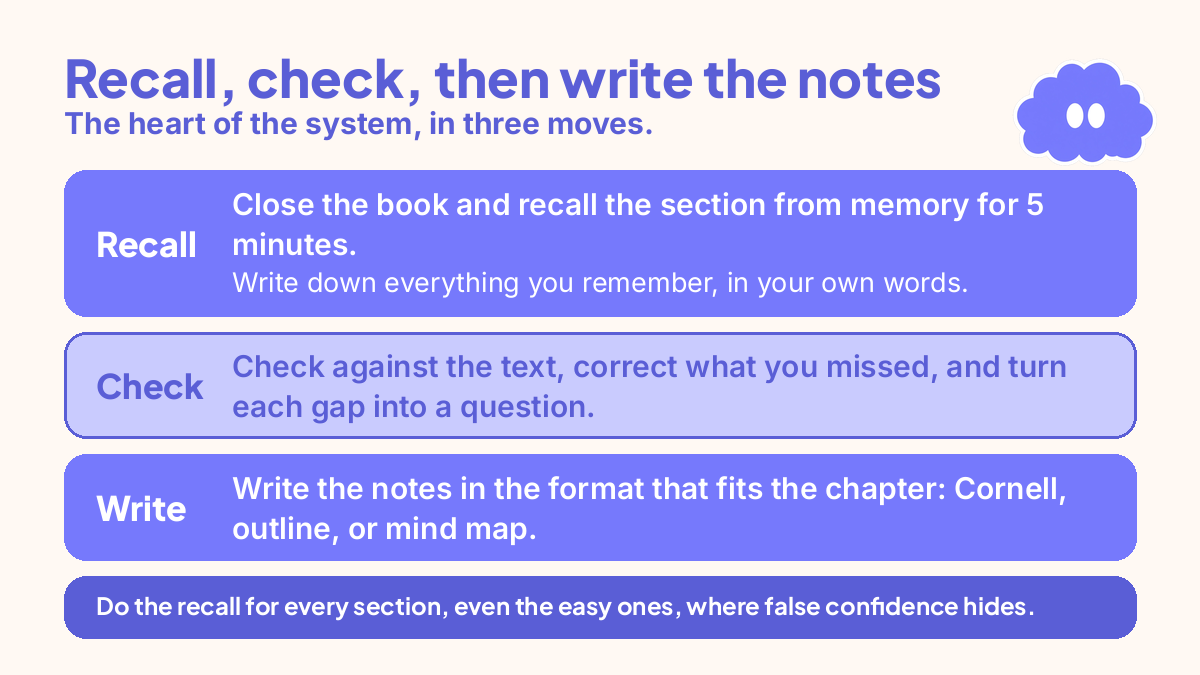
- Close the book and recall the section from memory for 5 minutes.
- Check against the text, correct what you missed, and turn each gap into a question.
- Write the notes in the format that fits the chapter: Cornell, outline, or mind map.
- Review the notes from memory: next day, in three days, and in seven days.
Step 1: Preview the chapter in 10 minutes
Set a timer for 10 minutes. Do not read the chapter yet. Preview it first, the way you would survey a route before walking it.
Read the chapter title, every heading, and the summary box if there is one. Look at every diagram, table, and worked example, and read their captions. Read the end-of-chapter questions and the key terms list.
Then answer three questions in writing, in one line each: what is this chapter trying to teach me, what do I already know about it, and what will probably be hard? If you cannot answer the first question, read the introduction paragraph and try again.
Now choose the note format, before you read a word of the body text: Cornell notes for a chapter that builds one argument step by step, an outline for a chapter that lists types, stages, or causes, and a mind map for a chapter that connects many ideas to one centre. Write the format at the top of your page.
This preview step follows the same survey habit as the SQ3R reading system for students: SQ3R is the reading method, and this article is the notes system that sits on top of it.
Step 2: Read one section at a time, with a question in hand
Read one section, not the whole chapter: usually 3 to 6 pages, between two headings. Turn each heading into a question before you read it. “Cell respiration” becomes “How does a cell release energy from glucose?”
Read with no pen in your hand. Do not underline, highlight, or write anything while you read: notes taken during reading are usually copies of the text, and copying is not thinking. Your only job is to answer the question you set.
Read at a steady pace and do not re-read a sentence three times to memorise it. If a paragraph confuses you, mark the page number on a scrap of paper and keep going. The recall step will show you whether the confusion matters.
When you reach the end of the section, stop. Do not read on into the next section to “keep the flow going”: reading on feels productive and hides the fact that you kept nothing. One section, one question, then recall.
A 30-page chapter usually has five or six sections. At 8 to 10 minutes each, the reading takes 50 minutes.
Step 3: Close the book and recall the section from memory
Close the book and put it face down. Set a timer for 5 minutes and write down everything you remember from the section, in your own words, on scrap paper. Write what you can, in any order.
Start with the question you set in Step 2. Write the answer as if you were explaining it to a classmate who missed the lesson, then add the details: the stages, the numbers, the examples, the terms. If you remember a diagram, sketch it from memory.
A blank first minute is normal. Write the heading, then one fact, then another. If the page is still blank after 3 minutes, write down the one thing you do remember.
This step is the heart of the system, and it is the step most students skip. Dunlosky and colleagues found in 2013 that only practice testing and distributed practice received a high utility rating. Roediger and Karpicke showed in 2006 that students who recalled a passage remembered more a week later than students who restudied it. The retrieval practice system for students explains the same rule in full.
Do the recall for every section, even the easy ones, where false confidence hides.
Step 4: Check against the text, and turn gaps into questions
Open the book and check your recall against the section, in a different colour. Tick what you got right, correct what you got wrong, and circle what you missed. The missed items are the study list for this chapter.
Turn every gap into a question at the top of your notes page. “What are the three stages of cell respiration?” is a question you can test yourself with. “Cell respiration stages” is a label, not a question.
Do not copy the missing facts straight into your notes as sentences from the book. Write them as answers to your questions, in your own words, in one or two lines each. If you cannot put a fact in your own words, you do not understand it yet: re-read that paragraph once, then try again.
Check quickly: five minutes per section is enough.
By the end of this step you have, for each section, a short recall page and a list of questions.
Step 5: Write the notes in the format that fits the chapter
Now write the final notes, using the format you chose in the preview. One chapter, one format, one page or one spread. If the notes need more than two pages, split the chapter and run the system again tomorrow.
Cornell notes fit a chapter that builds one argument step by step, such as a history chapter that traces causes to an event. Put the recall questions in the left cue column, the answers in the right column, and a three-line summary at the bottom. The Cornell notes system for students sets out the page layout in five steps.
An outline fits a chapter that lists types, stages, or causes, such as a biology chapter on the stages of cell division. Use numbered headings, short phrases, and indenting to show what belongs under what. Keep each point to one line.
A mind map fits a chapter that connects many ideas to one centre, such as a psychology chapter on memory. Put the chapter topic in the middle, draw one branch per major idea, and add short labels, not sentences. The mind-mapping system for students covers the layout rules.
Whichever format you choose, keep the notes short: questions in your own words, answers in one or two lines, one diagram redrawn from memory if the chapter has one that matters. Do not paste in printed handouts: a note you did not write is a note you will not review.
Step 6: Review the notes from memory, on a schedule
Review each set of notes three times: the next day, three days later, and a week later. Each review takes 10 minutes per chapter and starts from memory, with the notes covered.
Cover the answers and read the questions. Answer each one aloud or on scrap paper, then uncover and check. Mark the ones you missed and re-read only those sections. The spaced repetition system for students sets out the spacing behind this schedule: Cepeda and colleagues showed in 2006 that spaced practice beat massed practice.
Put the three review dates at the top of the notes page when you write it. If a review date falls on a day you cannot study, move it one day earlier, never later.
File the notes where you can find them: one folder per subject, one file per chapter, named by chapter title and date. The notes system that you can actually review covers the filing habit.
After the third review, move the notes into your exam revision pile, carrying forward the questions that still fail.
A worked example: one biology chapter, from preview to third review
Your situation: second-year college student, biology textbook, Chapter 7 on cell division, 30 pages, six sections. The test is in two weeks. You have Tuesday evening free, 6:00-8:00pm, and 10 minutes each morning.
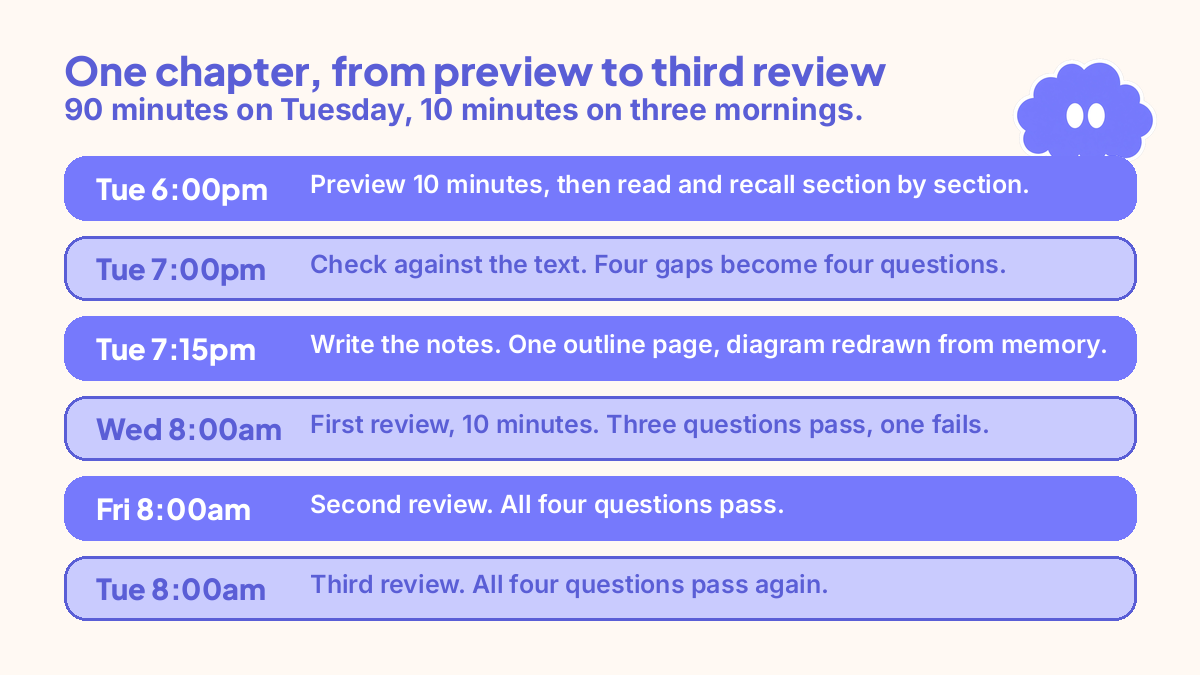
- Tuesday 6:00-6:10pm: preview. Headings, three diagrams, end-of-chapter questions. The chapter lists stages, so you choose an outline. Three preview questions written down.
- Tuesday 6:10-7:00pm: read and recall, section by section. Five sections at 8 to 10 minutes each. After each section, close the book and recall for 5 minutes on scrap paper. Section 3, on meiosis, is the weakest.
- Tuesday 7:00-7:15pm: check. Compare each recall page against the text in a different colour. Four gaps become four questions at the top of the notes page.
- Tuesday 7:15-7:30pm: write the notes. One outline page: six headings, one line per point, the cell division diagram redrawn from memory. Review dates at the top: Wednesday, Friday, next Tuesday.
- Wednesday 8:00-8:10am: first review. Notes covered, four questions answered aloud. Three pass, one fails: the order of the meiosis stages.
- Friday 8:00-8:10am: second review. All four questions pass. The diagram is redrawn correctly from memory.
- Next Tuesday 8:00-8:10am: third review. All four questions pass again. The notes move into the exam revision pile, with one flagged question to carry into revision.
That is 90 minutes on Tuesday evening and 10 minutes on each of three mornings, for one chapter. Two chapters a week is a pace you can keep for a whole term.
When it goes wrong
The chapter is too dense to recall anything. Split it. Run the preview and Steps 2 to 4 on the first half only, then stop. Do the second half tomorrow. If the text is dense because the vocabulary is new, write the five key terms on a card first and learn those before you read.
The chapter is too boring to read. Boring usually means you have no question to answer, so the reading has no job. Go back to Step 1 and turn each heading into a real question. If that fails, set a timer for 25 minutes and read one section only, then recall it. Boredom survives open-ended reading. It rarely survives a 5-minute recall test.
Your recall page is blank every time. Shrink the section. Read two pages, close the book, recall those two pages. Then read the next two. A blank page means the chunk was too big, not that you cannot remember.
Your notes are as long as the chapter. You are copying, not noting. Stop and check: does every line answer one of your questions? If a line does not answer a question, cut it. A one-page outline for a 30-page chapter is the target.
You skip the reviews. Put the review dates on the notes page and in your calendar the day you write the notes. If a review is missed, do it the next morning. Three missed reviews mean the notes were never learned, and the chapter needs a fresh recall pass. For gaps that keep failing, turn them into flashcards: the flashcard system that works covers how to write cards that test one fact each.
Weekly review checklist
Use this checklist at the end of each week, in writing, in 15 minutes.
- Which chapters did I take notes from this week, and are the notes filed?
- Did every set of notes get its first review?
- Which questions are still failing after two reviews?
- Did any chapter need splitting, and did I split it?
- Are my notes getting shorter?
- Which chapter type did I meet this week, and did I pick the right format?
Downloadable infographic spec: one vertical image, title “Notes from a textbook”, with the six steps from “The system in short” and the six review questions above, in Thynq cream, Cloud Purple, Dark Purple and pink, with the Cloud mascot. Text taken word-for-word from this article.
What this system is not
This system is not a speed-reading method, and it does not promise grades. It is slower than reading straight through, on purpose: the recall step after every section costs time, and that time is the learning.
It is not a system for every kind of reading. A research paper needs a different approach: one page per paper, claim and evidence, not a chapter outline. See the guide to taking notes from research papers for that job.
It is also not a substitute for understanding. If you cannot put a fact in your own words, the notes will not fix that. Re-read the paragraph, ask your teacher, or check the previous chapter.
Sources
- Dunlosky, J., et al. (2013). Improving students’ learning with effective learning techniques. Psychological Science in the Public Interest, 14(1), 4-58. Only practice testing and distributed practice received a high utility rating; rereading was rated low.
- Roediger, H. L., & Karpicke, J. D. (2006). Test-enhanced learning. Psychological Science, 17(3), 249-255. Retrieval practice beat restudying after a delay.
- Cepeda, N. J., et al. (2006). Distributed practice in verbal recall tasks: a review and quantitative synthesis. Psychological Bulletin, 132(3), 354-380. Spaced practice beat massed practice.
For the full system behind this method, start with the Thynq study system pillar.
Questions
Should I take notes while I read a textbook chapter?
No. Notes taken during reading are usually copies of the text, and copying is not thinking. Read one section, close the book, and write down what you remember. Then check the text and fix what you missed.
How long should notes from one chapter take?
Allow about 90 minutes for a 30-page chapter: 10 minutes to preview, 50 minutes to read and recall section by section, 15 minutes to write the notes, and 15 minutes to check them. A dense chapter takes longer. Do not rush the recall step to save time, because that step is the learning.
Which note format should I use for a textbook chapter?
Match the format to the chapter type. Use Cornell notes for a chapter that builds one argument step by step, an outline for a chapter that lists types, stages, or causes, and a mind map for a chapter that connects many ideas to one centre. Pick it during the preview, before you start reading.
How often should I review textbook notes?
Review each set of notes three times: the next day, three days later, and a week later. Each review takes 10 minutes per chapter and starts from memory, with the notes covered. If you cannot recall a section, re-read that section only.