
The direct answer
Take notes from research papers with one page per paper: the claim in your own words, how the authors showed it, the evidence that matters, one exact quote with its page number, and where the paper fits in your thesis. Write the page the day you read the paper, file it where you can find it, and review it from memory a week later.
You know the other version. You read a paper, highlighted half of it, and closed the PDF feeling like you understood it. A month later you open it again and the highlights mean nothing. You cannot remember what the paper claimed, why it mattered, or where it fits.
Highlighting feels like learning. It is not. In a 2013 review, Dunlosky and colleagues rated ten common study techniques, and only practice testing and distributed practice received a high utility rating. Highlighting and rereading were rated low. Notes work when they make you do something harder: put the claim in your own words, and test yourself on it later.
The system in short
- Read the paper once, properly, before you write anything.
- Write one page: claim, method, evidence, one quote, where it fits.
- Put the claim in your own words. If you cannot, you do not understand it yet.
- File the page the same day, under the author’s name and year.
- Review the page from memory: next day, in three days, in seven days.
- Use the page when you write. If a note never reaches your thesis, it was the wrong note.
Step 1: Read the paper before you write the note
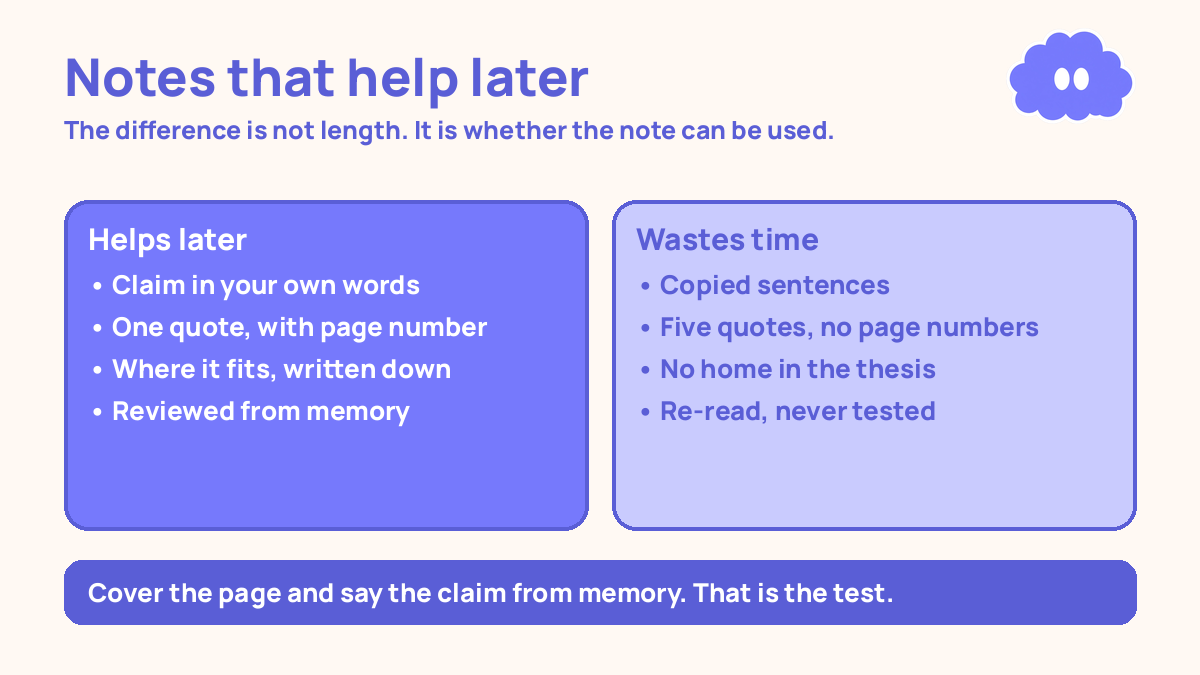
Do not take notes while you read the paper for the first time. Read it first, then write. Notes taken during a first read are usually copied sentences, because you do not yet know what matters. A note written after the read is a decision: this is the claim, this is the evidence, the rest can go.
Read in this order: abstract, then the discussion or conclusion, then the method, then the results. The abstract tells you the claim. The discussion tells you what the authors think it means. The method tells you how they showed it. If you read the results first, you drown in numbers before you know what they are for.
If you are still learning how to read papers at all, start with the research paper reading system. This article is about what to write down once you have read.
Step 2: Write the one-page note
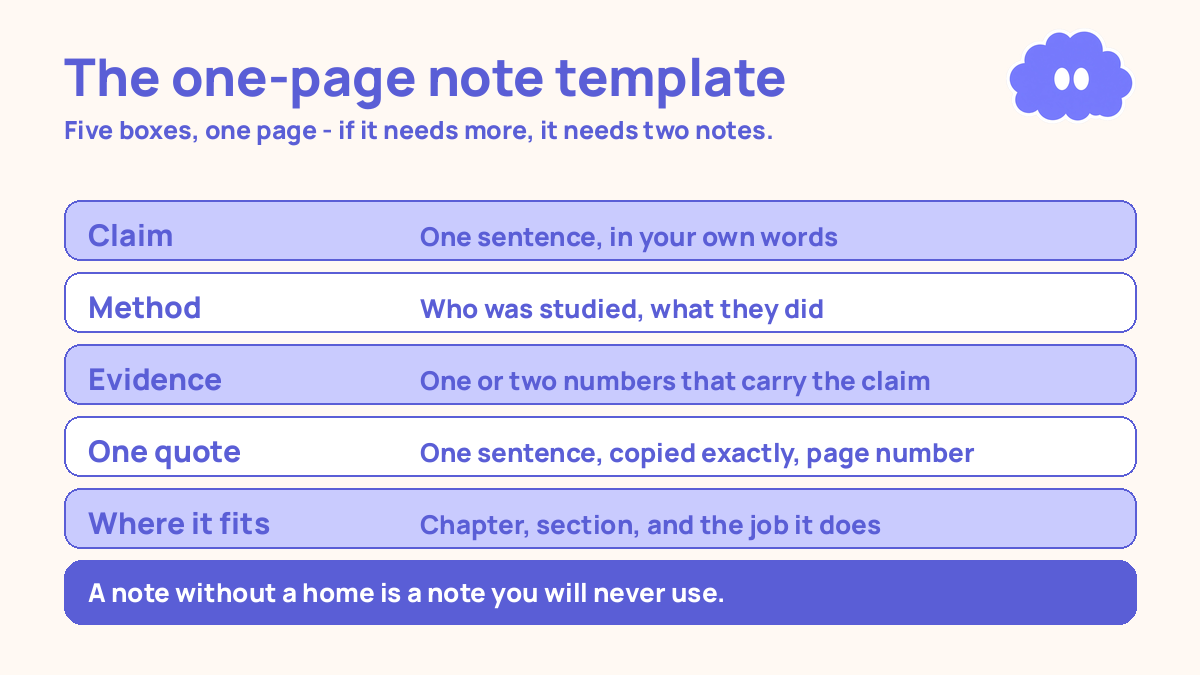
Use the same template for every paper. Five boxes, one page.
Claim. One sentence, in your own words. What did the authors find? Not what the paper is about — what it claims. “Testing beat restudy a week later, even though restudiers felt more confident” is a claim. “This paper is about testing” is not.
Method. Two lines. Who was studied, and what did they do? “200 students studied science texts, then re-read, mapped, or recalled from memory.” Enough to judge the claim.
Evidence. The numbers or findings that carry the claim. One or two, not ten. “Retrieval group scored 0.67, concept-mapping group 0.45, a week later.”
One quote. A single sentence you might actually cite, copied exactly, with its page number. One quote, not five.
Where it fits. One line: which chapter, which section, and what job it does there. “Literature review, spacing section — supports the claim that spacing beats massing.” A note without a home is a note you will never use.
Step 3: Put the claim in your own words, or do not move on
This is the step most students skip, and it is the step that does the learning. Copying a sentence from the abstract takes ten seconds and teaches you nothing. Writing the claim in your own words forces you to check whether you actually understood it.
If you cannot write the claim in your own words, stop. Re-read the abstract and the discussion. Look up the one term you do not understand. Ask yourself: what would I tell a friend this paper found? If the answer is still the abstract’s words, you are not ready to write the note yet.
Explaining an idea in your own words is a moderate-utility technique (Dunlosky et al., 2013), and a 2018 meta-analysis of self-explanation (Bisra et al.) found a moderate average benefit (g = 0.55). The original self-explanation study (Chi et al., 1989) was small — eight students — so say so honestly. A claim you can explain is a claim you own, and a claim you copied is a claim you will forget.
Step 4: File the note the same day
A note you cannot find is a note you never took. File the page the day you write it, in one place, under the author’s name and year. If your notes live in a reference manager, attach the page to the paper’s entry. If they live in a folder, name the file Author-Year-Note and keep it beside the PDF. If they live on paper, file the page in one box, in the same order.
Do not keep notes in three places. One place, one order, every time. And do not keep a separate pile of “notes to file later”. Filing takes two minutes. Finding a lost note takes an evening.
Your notes and your references are one system, not two. The reference list says a paper exists. The note says what it claims. Keep them together, and your literature review writes itself in pieces.
Step 5: Review the note from memory, three times
A note you never review is a note you wrote for the bin. Review each note three times: the day after you write it, three days later, and seven days later. That 1–3–7 schedule is a practical starting point, not a research rule. Each review takes five minutes per paper.
Review means testing yourself, not re-reading. Cover the page, and say the claim from memory. Then say how the authors showed it. Then uncover the page and check. If you got it right, move on. If you got it wrong, fix the note — the claim was probably copied, not understood — and review it again tomorrow.
This is where retrieval practice does its work. In a 2006 study, Roediger & Karpicke found that students who recalled a passage remembered more a week later than students who restudied it, even though the restudiers felt more confident right after studying. Feeling fluent after re-reading is not the same as remembering a week later.
And do not turn your notes into a concept map and call it revision. In a 2011 study, Karpicke & Blunt found that retrieval practice beat concept mapping by about half as much again a week later (means 0.67 vs 0.45), on both verbatim and inference questions. Maps organise material. Retrieval learns it.
A worked example: one paper, one page, one week
You read a paper on Monday morning: Karpicke & Blunt (2011), on retrieval practice and concept mapping.
Monday, 10:00–11:00: You read the paper — abstract, discussion, method, results. Then you write the one-page note. Claim: “Retrieval beat concept mapping a week later, on both recall and understanding questions.” Method: “200 students studied science texts, then re-read, mapped, or recalled.” Evidence: “Retrieval 0.67, mapping 0.45.” Quote: one sentence from the discussion, with its page number. Where it fits: “Literature review, retrieval section — supports testing over mapping.”
Tuesday, 9:00–9:05: You cover the page and say the claim from memory. You get it right, but you forget the numbers. You uncover the page, check, and move on.
Thursday, 9:00–9:05: You test yourself again. This time you remember the claim and the numbers.
Next Monday, 9:00–9:05: Third review. You remember the claim, the method, and the numbers without looking. The paper is now yours. When you write the literature review, you will open this note, not the paper.
When it goes wrong
Your notes are ten pages per paper. You are copying, not noting. Go back to the template: five boxes, one page. If a paper needs more than a page, it needs two notes — one for each claim — not one long one. Long notes are never reviewed, and unreviewed notes are wasted work.
You cannot find a note you know you wrote. It is in the wrong place, or under the wrong name. Search by author and year first. Then pick one home for all notes and move everything there, in one session.
You review by re-reading, and the test still fails. Re-reading feels fluent, and fluency feels like learning. It is not. Cover the page and say the claim from memory. If you cannot, the note needs fixing, not another re-read. The test is the only honest check, and it is supposed to feel hard.
You have fifty notes and none of them are in your thesis. The “where it fits” line was blank, or wrong. Go through the notes once, write the chapter and section for each one, and sort them by chapter. The notes that have no home are the ones to cut — or the sign that a chapter needs rethinking.
Weekly review checklist
Copy this list and use it each week:
- Did I write a one-page note for every paper I read this week?
- Does each note have a claim in my own words, a method, evidence, one quote, and a home?
- Did I file every note the same day, under author and year?
- Did I review last week’s notes from memory, on the 1–3–7 schedule?
- Which notes did I fail to recall, and did I fix them?
- Did any note reach my thesis draft this week?
- What one change will I make next week: shorter notes, faster filing, or stricter testing?
Downloadable infographic spec: one vertical image, title “One paper, one page”, with the five boxes — claim, method, evidence, one quote, where it fits — and the three review days — next day, in 3 days, in 7 days — in Thynq cream, Cloud Purple, Dark Purple and pink, with the cloud mascot. Text taken word-for-word from this article.
What this system is not
It is not a promise that one page per paper will make you remember everything, and it is not a claim that notes replace reading. It is a practical routine for turning papers you read into material you can use. If your supervisor wants a different note format, use that one. If your field has a standard way of recording evidence, follow it. The system survives either change, because the system is one page, one claim in your own words, and a test from memory — not a template.
Sources
- Dunlosky, J., et al. (2013). Improving students’ learning with effective learning techniques. Psychological Science in the Public Interest, 14(1), 4–58. Only practice testing and distributed practice received a high utility rating; rereading and highlighting were rated low.
- Roediger, H. L. & Karpicke, J. D. (2006). Retrieval practice. Science. Students who recalled a passage remembered more a week later than students who restudied it, even though restudiers felt more confident immediately after studying.
- Karpicke, J. D. & Blunt, J. R. (2011). Retrieval practice produces more learning than elaborative studying with concept mapping. Science, 331(6018), 772–775. Retrieval beat concept mapping by about half as much again a week later (means 0.67 vs 0.45).
- Chi, M. T. H., et al. (1989). Self-explanations: how students study and use examples. Cognitive Science, 13(2), 145–182. A small observational study of 8 students; the best problem solvers generated far more explanations.
- Bisra, K., et al. (2018). Inducing self-explanation: a meta-analysis. Educational Psychology Review, 30(3), 703–725. Prompting self-explanation produced a moderate average benefit (g = 0.55).
For the wider system this routine sits inside, see the thesis writing system that keeps moving, for how to read a paper before you note it, see the research paper reading system, and for the general notes system this builds on, see the notes system you can actually review.
Questions
How long should notes on one paper be?
One page. If your notes are longer than the paper’s abstract and discussion put together, you are copying, not noting. One page forces you to decide what matters.
Should I take notes by hand or on a computer?
Use whichever you will actually search later. Typed notes are searchable, which matters when you have fifty papers. Handwritten notes work if you file them in order and review them the same week.
What if I do not understand a paper well enough to note it?
Write down exactly where you got lost: the method, a term, a table. Then read that part again, or ask your supervisor. A note that says what confused you is more useful than a neat summary of a paper you did not follow.
When should I review my paper notes?
The day after you write them, then three days later, then a week later. That is a practical starting schedule, not a research rule. Each review takes five minutes per paper and tests whether you still remember the claim.